Join us in person on the U of M campus or tune in online to the CTS winter research seminars. The seminars will highlight a sampling of the latest transportation research at the U of M.
Each seminar will be held in Room 50B at the Humphrey School of Public Affairs. Or, if you can’t make it in person, you can watch the seminars live online or view recordings posted after the events. For details about the live broadcasts, see the individual seminar web pages.
There’s no cost to attend, and each seminar qualifies for one Professional Development Hour.
Representatives of the test tracks are meeting next week in Minneapolis at the 19th Annual TERRA Pavement Conference. They said the partnership will develop a national hot mix asphalt cracking performance test and expand the scope of existing pavement preservation research at the NCAT facility in Auburn, Alabama, to include northern test sections in Minnesota.
MnROAD plans to build test sections at its facility and also off-site on a low- and high-volume road, which may include concrete test sections if funding allows. These Minnesota test sections will supplement 25 test sections built by NCAT on an existing low-volume haul route in 2010 and an off-site high-volume test road planned for this summer in Alabama to assess the life-extending benefits of different pavement preservation methods. Both agencies have also been developing performance tests to predict the cracking potential of asphalt mixes, and they will now work together on that research as well.
“We will collect and analyze the data in similar ways, and I think we’ll have a greater appeal nationally, as we cover a range of climate conditions,” said MnROAD Operations Engineer Ben Worel.
Participation in the pavement preservation study is $120,000 per year for the initial research cycle, which will drop to $40,000 after three years; the cracking study will run three years at $210,000 per year. Alabama will be the lead state for this effort.
State departments of transportation are asked for commitment letters this month if they are interested in joining either study, even if they do not have SP&R (State Planning and Research) dollars available at the time. Participating agencies will get to design the scope of the research and be kept advised of the ongoing findings, so they can benefit early from the project. Initial planning meetings will be done through a series of webinars in March and April of this year with participating agencies.
At a January 8 webinar, speakers said the research will help states determine how long pavement preservation treatments will last.
“Many DOTs have really well-designed and well-thought-out decision trees, where they can take pavement management data and end up with a rational selection of pavement alternatives. But the issue of extending pavement life is the really big unknown, because references provide a broad range of expected performance,” NCAT Test Track Manager Buzz Powell said.
Another benefit is that states can learn how pavement treatments hold up in both hot and cold climates.
“It’s 14 degrees right now in Mississippi. It rains about every three days, freezes and then thaws,” said Mississippi Chief Engineer Mark McConnell. “So we need to know how pavement preservation is going to work in the north as well.”
For additional information, contact Ben Worel (ben.worel@state.mn.us) at MnROAD or Buzz Powell (buzz@auburn.edu) at NCAT.
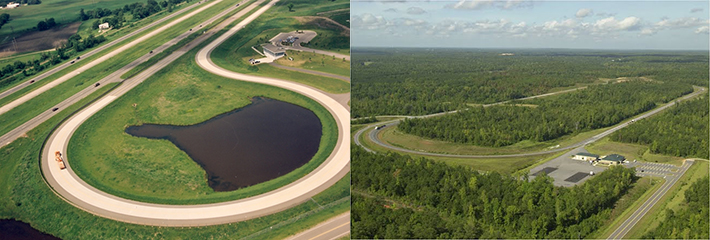
Aerial views of the pavement test tracks at MnROAD (left) and NCAT (right).
You betcha, says a new study by University of Minnesota researcher Carol Becker, who compiled 65 examples of innovative multimodal rural and small urban transportation projects from around the United States.
The study, funded by the Minnesota Department of Transportation, looks at alternatives for promoting and strengthening multimodal transportation in rural and small urban areas. Becker developed these six case studies to showcase different modes and strategies:
Retrofitting Sidewalks
The city of Olympia, Washington, was mostly built during the automobile era. As a result, most of the city developed without sidewalks. In 2004, Olympia passed a voter referendum that linked enhanced parks with adding sidewalks throughout the city. The referendum was supported by parents who wanted safe routes to school for their children and by environmentalists who wanted alternatives to driving. But the key to voter approval was linking recreation at parks with recreation walking to and from the parks. The Parks and Pathways program is now retrofitting miles of sidewalks into neighborhoods.
A sidewalk that was built using utility tax funds on San Francisco Avenue in Olympia, Washington.
Intercity Bus Service
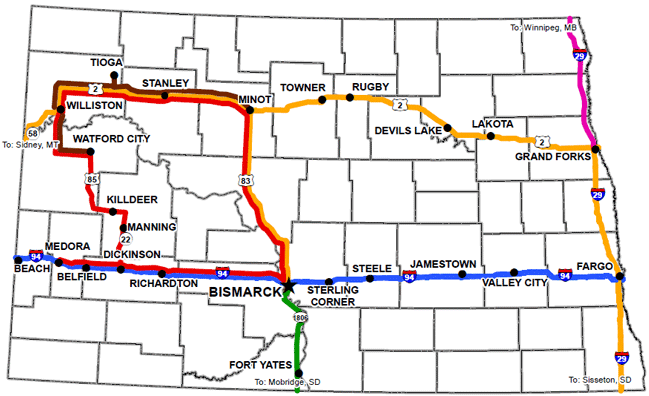
North Dakota has the third-lowest population density in the United States. Despite this, it has a network of buses that connect small towns to larger regional centers. Such alternatives to driving allow residents — particularly elderly and disabled persons — to stay in their communities rather than move to large cities to access needed services.
Senior Transportation
A nonprofit in Mesa, Arizona, implemented a program to reimburse eligible seniors for car trips provided by other individuals. The program was moved to the regional transit provider for expansion. It did not scale up well, however, and was recently replaced with the East Valley RideChoice Program, which provides seniors and disabled adults with discounted cards for taxi service. RideChoice participants can receive up to $100 of taxi service per month for either $25 or $30, depending on their city of residence.
Photo courtesy of RideChoice
Integrating Highways into Small Town Fabric
One challenge to making smaller communities more walkable and pedestrian-friendly is that most small towns are built around highways. In fact, unless a bypass has been built, the main street of a small town is also typically a highway. This creates a conflict between groups who want to move vehicles efficiently and groups who want pedestrian-friendly downtowns.
Oregon took two steps to help mediate this:
Added a functional classification to the Oregon Highway Manual for the portion of roadway that runs through small towns. This functional classification has very different design standards that can accommodate walking, biking, commercial activity along the roadway, parking along the roadway and many other small-town needs.
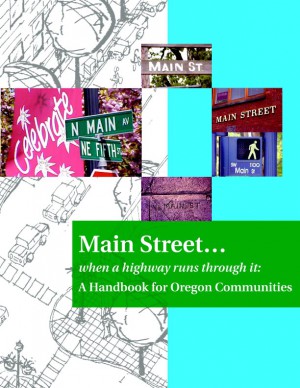
“Main Street: When A Highway Runs Through It” was written to help local governments understand their options for creating a multimodal environment and better advocate for their interests with the Oregon Department of Transportation. The document explains ODOT funding processes and shows examples of design options. Local governments can then adopt these elements and standards into their local plans, which ODOT must work with when doing highway improvements.
Complete Streets
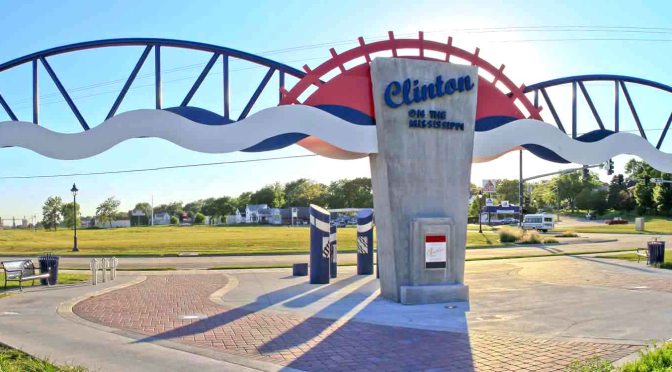
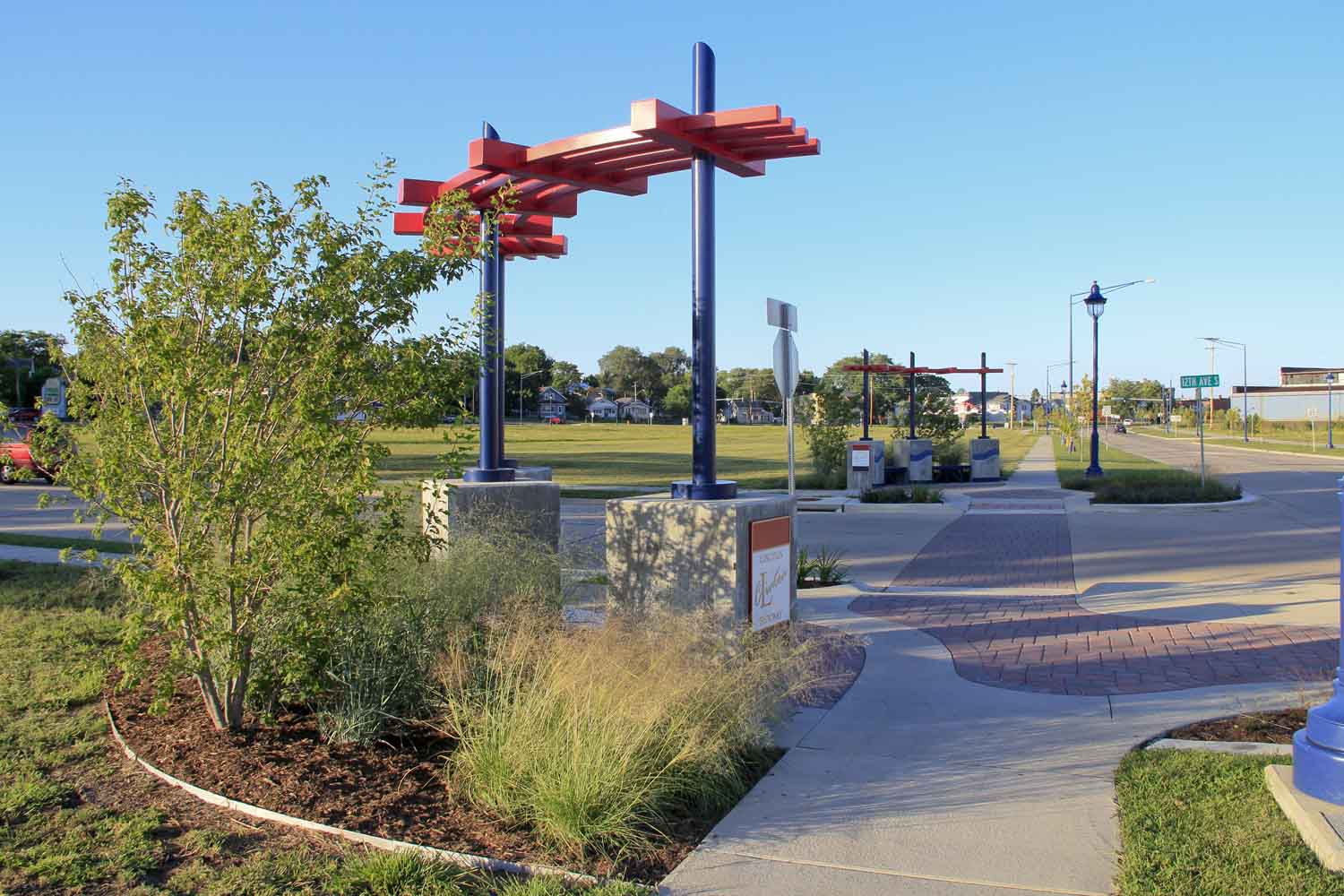
Clinton, Iowa, is a city with a population of 27,000 on the Mississippi River in eastern Iowa. In 1995, the rail yard closed, which provided an opportunity to redevelop land. The city created a comprehensive long-range plan that included remediating soil contamination, purchasing land for redevelopment, realigning two streets and increasing transportation choices with a “complete streets” design. The reclaimed land will support a multi-use path, sidewalks and connections to cross streets.
Approximately $50 million has been secured for the project. A $2.7 million Transportation Investment Generating Economic Recovery (TIGER) grant was also received from the U.S. Department of Transportation in 2012 to pay for a multi-use trail with a direct connection to the Mississippi River Trail, decorative lighting and plantings. In the future, land will be sold for higher density, walkable development.
A look at part of Clinton, Iowa’s redeveloped old railroad area, now called Liberty Square.
Impact Fees for Funding Infrastructure
As resistance increases to broad-based taxes, there has been a shift toward funding transportation with fees linked to specific projects. Examples include:
Concurrency laws, which require capacity in governmental systems (either planned or existing) before development can occur. If capacity does not exist, development cannot occur. In the state of Washington, a number of cities use concurrency to set transportation fees paid by new development. Bellingham, Washington, uses this kind of system to raise funds for transportation projects.
Development impact fees. Contra Costa County, California, has a capital plan for transportation improvements and sets a fee that is paid by new development to fund that infrastructure. Fees vary from under $1,000 to over $15,000 depending on where new development is occurring. The county expects to raise more than $845 million in transportation dollars from 2014 to 2030 using such a mechanism.
Allowing local units of government to create special districts to fund transportation projects.
Related Resources
Rural and Small Urban Multi-Modal Alternatives for Minnesota – Final Report
The nation’s two largest pavement testing centers are planning to partner in order to better leverage research performed at their cold and hot-weather facilities.
MnROAD, located in Albertville, Minnesota, and its southern U.S. equivalent, the National Center for Asphalt Technology in Auburn, Alabama, are full-scale test tracks that evaluate different types of pavement material under real-life conditions using semi-trailer truck and live interstate traffic.
Each facility has a history of evaluating the performance of pavement preservation treatments, including chip sealing, micro-surfacing, crack sealing and thin overlays. To address needs in both northern and southern climates, similar test sections would be developed at each facility to address national issues.
“By working together we can maximize the potential for each track,” said MnROAD Operations Engineer Ben Worel. “A closer relationship between NCAT and MnROAD is a logical progression in developing and evaluating new sustainable technologies, pavement systems and construction methods that lead to safer, quieter, lower-cost and longer-lasting roads.”
A test track at the National Center for Asphalt Technology in Alabama, MnROAD’s hot-weather equivalent.
The partnership idea was introduced to federal officials earlier this month at a national pavement performance conference in Minneapolis. Final details must still be worked out.
One of the workshops at the event discussed the proposed partnership between MnROAD and NCAT. Further talks are expected at the end of October.
“NCAT is thrilled about the opportunity for a partnership with MnROAD to address pavement research needs at a national level,” said NCAT Director Randy West. “Bringing NCAT and MnROAD results together will expand the climate base, loading distribution and other important pavement factors.”
Conference participants also reviewed the latest preservation techniques being developed for high volume roads. MnROAD’s chip sealing study, which demonstrated that highways with an average daily traffic (ADT) of 58,000 can be successfully chip sealed, was especially attention-grabbing for agencies who don’t chip seal on roads with more than 2,000 ADT.
A national panel of speakers included Michael Trentacoste, director of the federal Turner-Fairbank Highway Research Center (pictured in top photo), who discussed Federal Highway Administration’s support of pavement preservation research and implementation.
With about 160 people in attendance over four days, MnDOT Materials Engineer Jerry Geib said the conference was successful in sharing the benefits of pavement preservation techniques with other state DOTs and federal highway officials who want adopt new practices to help alleviate budget constraints.
Thanks to a flexible new contracting method, the cost and time of delivering small highway projects in Minnesota should go down.
The Minnesota Department of Transportation is now able to put road construction contractors on standby for certain types of projects, rather than bid each project individually, due to the adoption of Indefinite Delivery/Indefinite Quantity (IDIQ) contracts.
“IDIQ contracts give MnDOT more flexibility and the ability to get to the field quicker for work that we need repeated routinely, such as culvert repairs, overlays and seal coats,” said Kevin Kosobud, project development engineer with MnDOT’s Office of Construction and Innovative Contracting.
IDIQs also provide flexibility when needs are uncertain. Contracts are often used for multiple small projects that are similar in scope, but difficult to quantify in cost and timing.
For instance, the state of Florida awards IDIQs for hurricane debris removal, activating and paying contractors only when a hurricane necessitates the service.
Although IDIQs showed great promise, MnDOT had to develop a framework to implement them.
The federal government has used IDIQ contracts since the 1980s, but only a small number of state DOTS have used them to procure construction services. No standard procedures existed for their use by state DOTs, and federal procedures are not always applicable at the state level.
MnDOT hired Iowa State University researchers to examine IDIQ usage across the country and develop implementation procedures for Minnesota. (Read a summary of their research here.)
Researchers examined contracting practices at 14 different transportation agencies to recommend guidelines for Minnesota to follow, which allowed MnDOT to begin awarding IDIQ contracts in April 2013.
Case study analyses show clear benefits where IDIQ has been used: acceleration of the project delivery period, reduced construction costs and flexible delivery scheduling.
“IDIQs can help DOTs get better prices for routine services via an economy of scale, for instance, by awarding a contract for a larger number of culvert repairs rather than awarding a single contract for each repair,” explained Doug Gransberg, professor of construction engineering at the Iowa State University Institute of Transportation.
Agencies can award IDIQ contracts individually or collectively.
With a single-award contract, a single contractor is awarded task orders based on the pricing furnished in the initial bid package; multiple-award contracts determine a pool of qualified contractors who may subsequently bid on task orders.
*Editor’s note: This article was adapted from the September-October 2014 issue of our Accelerator newsletter. Read it online or sign up for your free subscription.
Related Resources
Leveraging the Advantages of Indefinite Delivery/Indefinite Quantity Contracts – Technical Summary (1 MB, 2 pages); Final Report (expected Fall 2014)
There’s nothing like colored concrete to make a crosswalk, sidewalk or breezeway look snazzy.
But the extra touch that many cities are putting into their downtown streetscapes may not be so pretty in just a few short years.
Early cracking has prompted the city of Vadnais Heights to tear up its colored concrete, and the city of Centerville — which installed colored concrete only six years ago — plans to follow suit, said MnDOT’s Senior Road Research Engineer Tom Burnham.
Both cities participated in a recent study, sponsored by the Local Road Research Board and conducted by MnDOT, to determine what is causing the early deterioration.
Across Minnesota, many of the estimated 45 colored concrete projects have experienced early deterioration, particularly microcracking near contraction joints. While this type of distress also occurs with regular concrete, it appears to be accelerated in the colored concrete projects, within five years in some instances.
Although the newly released study identifies likely causes for the failing colored concrete, further research is needed to evaluate proposed solutions.
Findings
Researchers determined that the colored concrete mixtures have likely been too porous for Minnesota winters, allowing deicing chemicals to leach in and wreak havoc. Although not quite as problematic for sidewalks and medians — which aren’t salted as heavily — it is especially bad for colored crosswalks.
A denser concrete mixture (one formed with less water) is recommended; however, constructing the concrete panels this way will require extra steps.
“There are chemicals that can be added to the mixture to artificially lower that water-to-concrete ratio,” Burnham said. “This will allow a denser mixture to be more easily placed.”
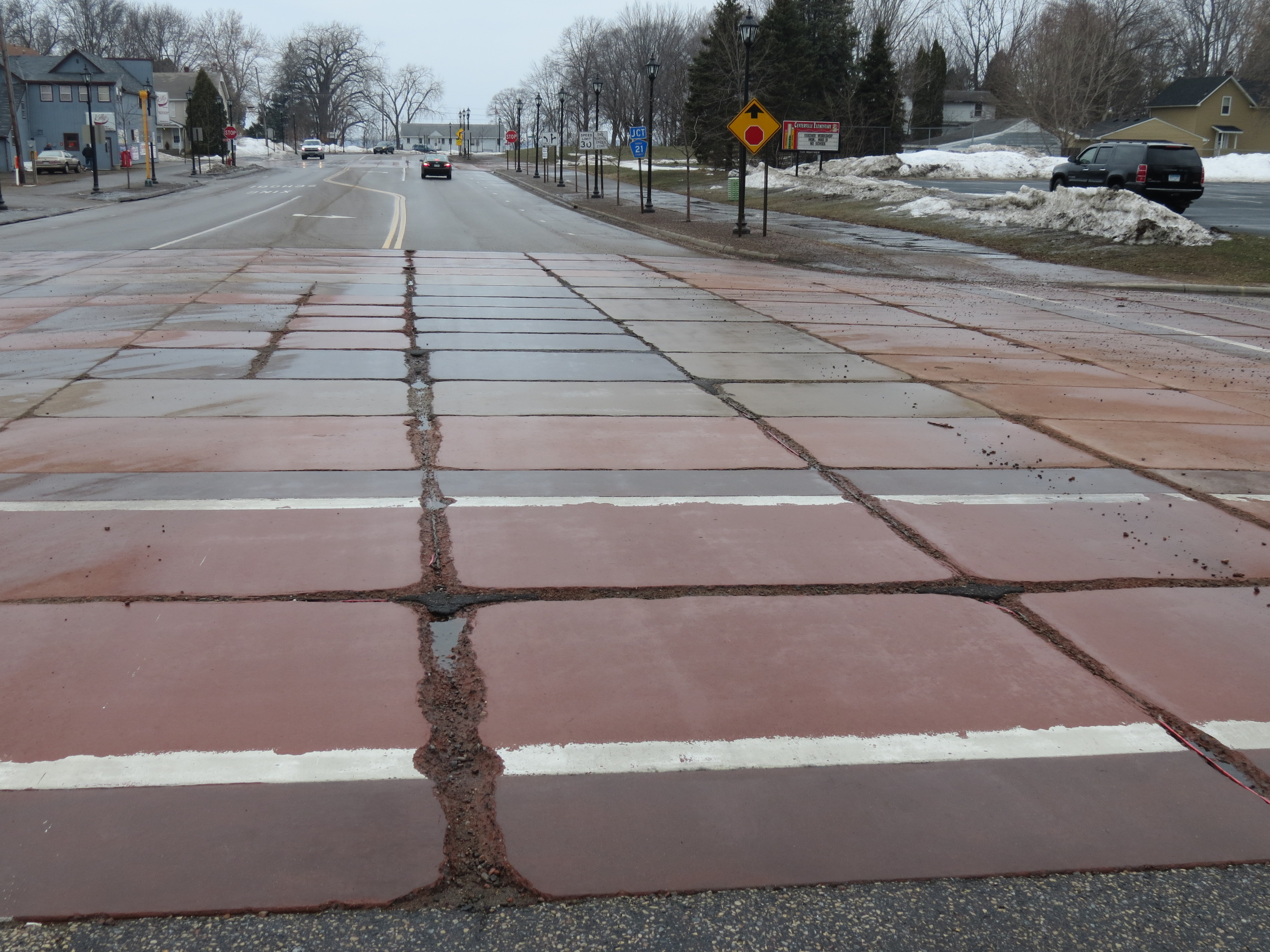
The city of Centerville plans to tear up its colored concrete. This photo shows early joint deterioration.
Color in vogue
Although there was a spate of colored concrete construction in Ramsey County in the late 1990s, it has only come into fashion in the rest of the state within the last five to six years, according to Burnham.
“You go to almost any community and they’re installing it — on their sidewalk and medians and also crosswalks,” said Burnham, who coordinated the research study.
Because of the added expense, cities may be very disappointed in the results.
The city of Stillwater, which installed a colored concrete panel crosswalk on its main street just two years ago (see top photo), is already experiencing cracking and deterioration in several panels.
Possible remedies
Although reducing the porosity of the colored concrete mixture should help, it won’t solve everything.
Another issue is the curing. The typical white curing product can’t be applied like it is with standard concrete, so curing the colored panels is more challenging, Burnham explained.
There are possible remedies, however, to assist with the curing, such as wet burlap or curing blankets.
Adding complexity to the issue are the new deicing chemicals on the market, which are also impacting regular road materials.
Several test samples showed evidence of chemical attack of the cement paste and fine aggregates, as well as an alkali-silica reaction, which can cause cracking or spalling and isn’t normally seen in regular concrete.
“Is there anything unique with the coloring that would accelerate the observed chemical reactions? We didn’t feel we had enough samples and knowledge at this point to conclusively say,” Burnham said.
Different construction techniques could go a long way toward increasing the livelihood of colored concrete; however, it could take several years of observation to determine if other methods work.
MnROAD is considering adding colored concrete panels to its facility for testing.
Until more questions are answered, MnDOT researchers are recommending repair techniques and alternative streetscaping ideas to cities, such concrete stains, pavers or colored high friction surface treatments.
In addition to sharing the findings with cities and counties, Burnham wants to educate contractors.
“We hope this research is a wake-up call for the colored concrete industry too because we don’t want the industry to die in Minnesota,” he said. “If it can work, we want cities and counties to be able to use it.”
*Editor’s Note: This story was updated 09/04/2014 to specify that this research project was funded entirely by the Local Road Research Board, and that MnDOT conducted the research.
Related Resources
Investigation and Assessment of Colored Concrete Pavement — Final Report (PDF, 20 MB, 368 pages); Technical Summary (forthcoming)
MnDOT, in partnership with the Federal Highway Administration, is test-deploying a high-tech system to help combat drowsy driving and keep truck drivers in compliance with federal hours-of-service regulations.
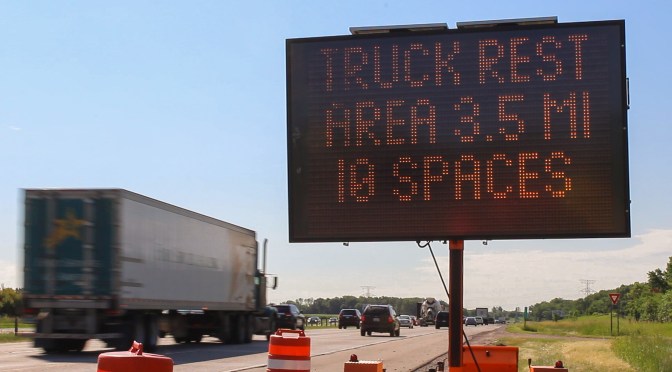
Developed by researchers at the University of Minnesota, the prototype system lets drivers know when parking spaces are available at rest stops ahead. It has been deployed at several locations along the heavily traveled I-94 corridor between Minneapolis and St. Cloud.
ST. PAUL, Minn. – New technology along the I-94 corridor west and northwest of the Twin Cities is helping truckers find safe places to park. Three Minnesota Department of Transportation rest areas are now equipped with automated truck stop management systems that tell truck drivers when parking spaces are available.
The technology will improve safety, lead to better trip and operations management by drivers and carriers and help MnDOT and private truck stop owners manage their facilities more effectively, according to John Tompkins, MnDOT project manager.
“So far, the results have been positive. We’ve had 95 percent accuracy in determining the availability of spaces,” he said.
Federal hours of service rules require truck drivers to stop and rest after 11 hours of driving. Tompkins said if drivers continue to drive beyond 11 hours, they could become fatigued and be forced to park in unsafe locations such as freeway ramps. They could also face legal penalties.
The problem of truck driver fatigue recently took the national spotlight when an allegedly drowsy driver slammed his semitrailer into a limousine carrying actor-comedian Tracy Morgan and six others. One passenger died in the crash.
The parking availability project is led by MnDOT Freight Project Manager John Tompkins and University of Minnesota professor Nikolaos Papanikolopoulos. MnDOT Research Services & Library produced the video above, which demonstrates the system in action. You can learn more about the project on the Center for Transportation Studies website.
Have you ever dreamed that all of your tinkering, fussing, and fiddling in the shop and on the road could help improve every road in Minnesota? Do you need funding to improve your sign maintenance and installation process? Or maybe you’ve come up with an idea for a new tool for controlling roadside vegetation or a design for a more effective work-zone safety product. Whatever it is, the Local Operational Research Assistance (OPERA) Program wants to hear about it.
Funding for 2015 OPERA projects is now available, and it’s easy to submit a proposal. Simply fill out the brief proposal application (50 KB DOC) and submit it via e-mail to Mindy Carlson at Minnesota LTAP. There isn’t a deadline to submit your proposal, but FY15 funds are limited and they often go quickly.
The maximum funding per project is $10,000, and local agencies are welcome to submit more than one proposal.
Project Guidelines
Your proposed research project should focus on the timely development of relevant ideas or methods that improve transportation or maintenance operations. Our goal is to collect and disseminate homegrown, innovative solutions to the everyday challenges our transportation workforce faces on the job. Counties, cities, and townships, this is your opportunity to encourage your maintenance staff to become actively involved in researching and testing their ideas.
To see what other local agencies have done with OPERA funding, check out our fact sheets and annual reports, or watch these videos highlighting previous OPERA projects:
For the past 10 years, Minnesota and 37 other states have pooled their resources to test the effectiveness of roadway safety improvement strategies. The project, appropriately titled “Evaluation of Low-Cost Safety Improvements,” evaluates key strategies laid out in a national guidebook aimed at reducing the number of annual highway deaths.
Participating states say the project, which has now been extended a total of eight times beyond its original scope, has been a resounding success. MnDOT Safety Engineer Brad Estochen said the pooled-fund study has provided state DOTs much-needed evidence to gain support for implementing new safety improvements.
“Some states want to do a certain strategy, but don’t have the institutional support,” Estochen said. “Through the collaboration of the Peer Exchange, they have national results they can point to.”
We asked Estochen, MnDOT’s technical liaison for the pooled fund, to name his top strategies to come out of the study.
Traffic calming measures
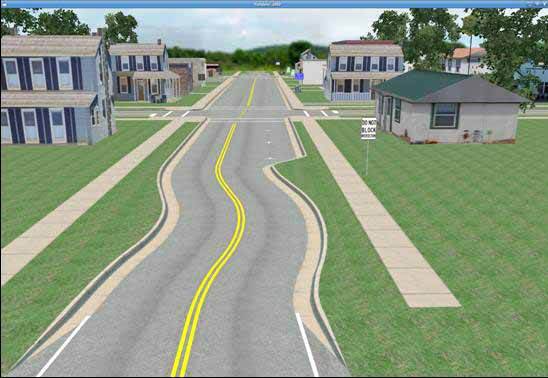
One phase of the study used simulated driving scenes to examine methods of traffic calming (i.e., getting drivers to slow down) in rural towns. The research found that drivers were most impacted by chicanes — extra curves in the road — and the presence of parked cars on the street. An alternative strategy, curb extensions (also called “bulb-outs”), was found to offer only a small potential safety benefit or no benefit at all.
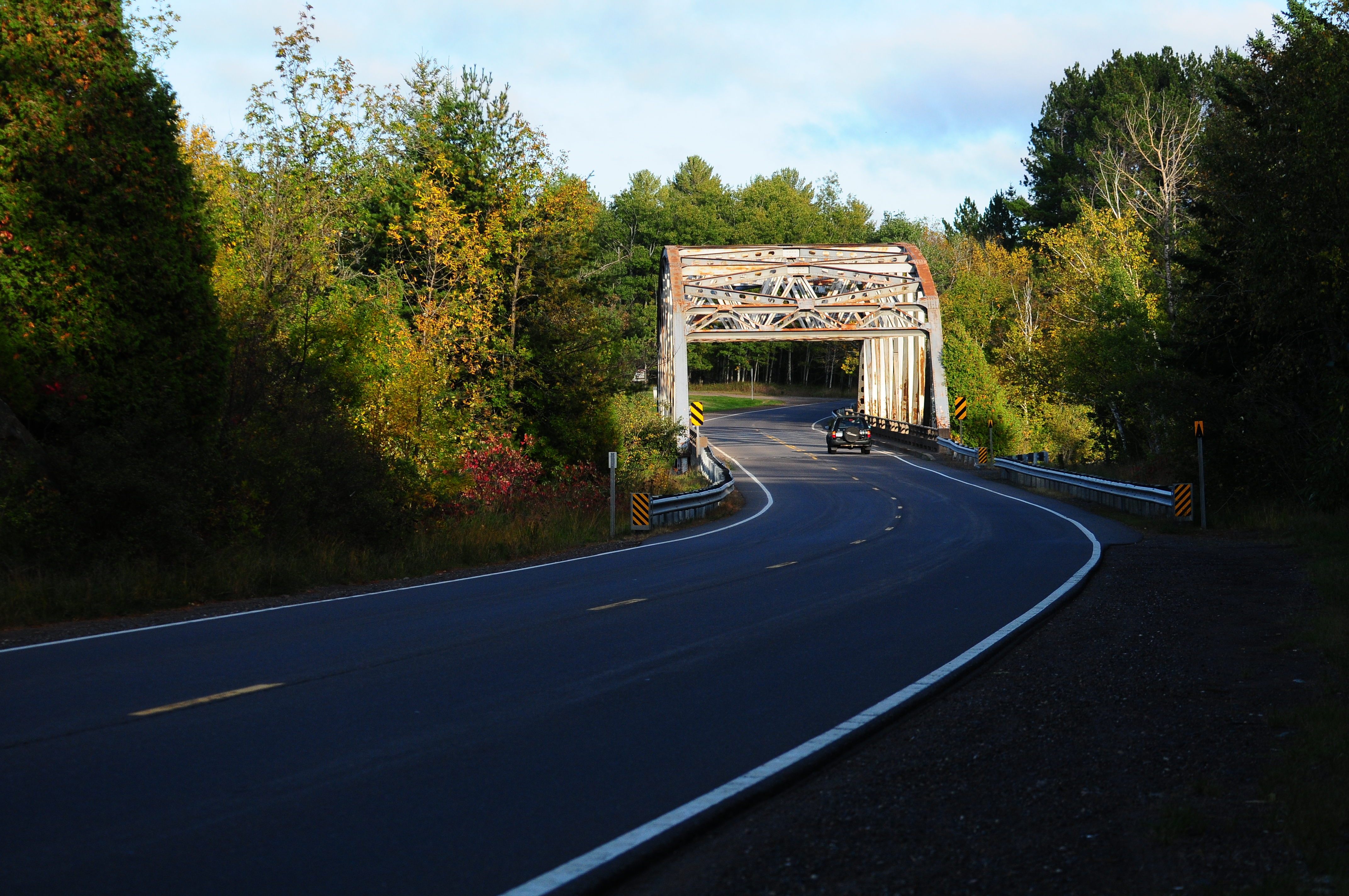
Researchers also looked at ways of improving nighttime driver visibility on rural roads. Edge lines and post-mounted delineators were selected as the best alternatives for improving curve visibility at night, with curve detection improving 12 percent to 70 percent due to enhanced edge lines. The results are significant, since horizontal curve sections of two-lane rural roads are a major source of roadway fatalities.
One way to make drivers aware that they’re approaching a stop sign is to add a flashing beacon to the intersection. Researchers installed various configurations of flashing beacons at more than 100 sites in North and South Carolina and examined the crash data before and after installation.
Courtesy of K-Kystems
Results indicate that standard flashing beacons, as well as some “actuated” beacons (i.e. those that only turn on when traffic is approaching the intersection), are not only effective at reducing crashes, but also economically justifiable based on cost-benefit calculations.This research helped pave the way for more widespread adoption of Minnesota’s Rural Intersection Conflict Warning Systems (RICWS).
Edgeline rumble strips on curves were shown to significantly improve safety in the third phase of the study, which tested a variety of techniques.
Whereas rumble strips are traditionally ground into centerline or on the shoulder, Kentucky and Florida experimented with placing rumble strips right along the white edgeline of curved sections of road. This method was shown to reduce overall crashes by 29 percent.
(Watch the FHWA website for updates on this phase of the study.)
Red light enforcement devices
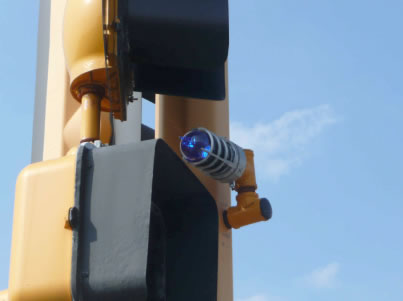
In Florida, crashes due to people running the red light fell by 33 percent thanks to a small light that turns on when the signal turns red. This little light bulb, which is placed on top of a signal, allows for a police officer to sit at the other end of the intersection rather than pursue a car right through the intersection. Not only is it safer, but motorists are also more likely to obey the signal if they know police might be watching on the other side.
Researchers are also still collecting data on the other techniques studied in phase three, including surface friction treatments on curves and ramps and larger curve warning signs (called chevrons). Watch the FHWA website for updates.
Wider roads in rural areas
Could simply shifting the edge lines of a rural road reduce the number of accidental drive-offs?
Yes, according to this study, which evaluated the effectiveness of various lane-shoulder width configurations on rural, two-lane undivided roads using data from Pennsylvania and Washington.
In general, results were consistent with previous research, showing crash reductions for wider paved widths, lanes and shoulders. For specific lane-shoulder combinations, the study found a general safety benefit associated with wider lanes and narrower shoulders for a fixed pavement width; however, there are exceptions. The report has a chart that shows the optimal lane-shoulder combinations for different sizes of roads.
In theory, there should be no additional cost for these strategies, as an edgeline can be re-striped as part of an existing resurfacing project.
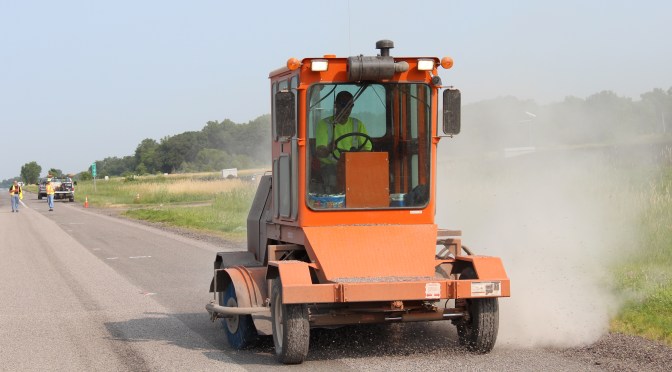
Chip-sealing — spraying an asphalt emulsion over existing pavement and then covering it with fine aggregate — is a cost-effective alternative to resurfacing asphalt pavements. Traditionally, however, it has only been used on rural and low-volume urban roadways.
During a recent visit to MnROAD, we filmed a road crew chip-sealing a test section on I-94 and spoke with MnDOT Research Project Supervisor Tom Wood, who explained why chip sealing can also be an effective treatment for high-volume roadways.
*Note: This story was updated on 08/12/2014 to clarify that the chip sealing shown in the video involves spraying an “asphalt emulsion” rather than “hot liquid asphalt,” as stated in an earlier version of this post.