Category Archives: research

General research posts.

CTS Webinar: EV Infrastructure and Fuel Policy—Understanding the Transportation and Economic Impacts

Thursday, April 23, 2026, 2:00–3:30 pm, Virtual

About the Webinar

Transportation policy and energy markets are evolving rapidly as states explore strategies to reduce emissions and support new fuel technologies. This webinar will examine two current policy areas shaping transportation systems: electric vehicle infrastructure development and low-carbon fuel standards.

Beth Kallestad from MnDOT’s Office of Sustainability and Public Health will provide an overview of Minnesota’s Electric Vehicle Infrastructure Program. Her presentation will discuss how the Infrastructure Investment and Jobs Act and NEVI funding have shaped the development of EV infrastructure in Minnesota, the program’s current status, and what to expect in the next phase of implementation.

Monica Haynes and Neil Wilmot from the University of Minnesota Duluth will highlight a 2025 study that examined the relationship between low-carbon fuel standard (LCFS) programs and gasoline prices. They will explore how LCFS programs in other states have affected retail fuel costs and discuss the challenges of predicting the economic impacts of a potential LCFS program in Minnesota.

Through these presentations, webinar attendees will gain insights into how emerging transportation energy policies influence infrastructure planning and economic outcomes.

Speakers

Beth Kallestad is the sustainable transportation planning director with MnDOT’s Office of Sustainability and Public Health. She has a wide range of experience in the environmental field, including in the private, government, academic, and nonprofit sectors.  This experience has given her a strong background in the management and implementation of a variety of sustainability planning efforts, public and stakeholder engagement, effective communications, trust building, and collaboration. Beth joined MnDOT in June 2022 and has focused her work on the development and implementation of the EV infrastructure program with federal NEVI funding and supporting MnDOT’s internal fleet transition. 

Monica Haynes has served as the director of the Bureau of Business and Economic Research at the University of Minnesota Duluth since 2014, supervising a small team of student researchers and a writer/editor. During her time in this role, the department has completed more than 90 funded research projects on a wide range of topics related to current events, proposed development opportunities, and economic trends. She also serves as adjunct faculty in the Labovitz School of Business and Economics (LSBE), as chair of LSBE’s outreach committee, and on the Duluth Workforce Development Board. 

Neil A. Wilmot is an associate professor and head of the Department of Economics and Health Care Management, Labovitz School of Business and Economics, at the University of Minnesota Duluth. He is also an associate of the Institute on the Environment at the University of Minnesota. Wilmot’s research interests include energy economics and energy commodities, encompassing a wide range of topics including oil and gas markets, renewable energy integration, and energy pricing mechanisms. He has published numerous articles in leading energy economics journals, including Energy EconomicsResource and Energy Economics, and The Energy Journal.

Registration

This webinar is free, but registration is required. Once you have registered, you will receive an email confirmation with a Zoom link. The link should not be shared with others; it is unique to you.

Related Reading

Transitioning to EV Fleets: Best Practices and a Decision Tool | MnDOT Digital Library

CTS Webinar: Species from Feces—A New Tool to Identify Bats in Culverts and on Bridges

Wednesday, April 22, 2026, 12:00–1:30 pm, Virtual

About the Webinar

Bats frequently use bridges and culverts as roosting habitat, creating challenges for transportation agencies working to balance infrastructure needs with environmental compliance. Traditional visual surveys can be limited, especially when bats are hidden within structures or present only intermittently. 

This webinar will highlight ongoing research exploring the use of DNA analysis from bat feces (guano) as a noninvasive method to identify bat species occupying culverts and bridges. Speaker Ron Moen will discuss how this approach works, share early findings from field applications, and explore how the results could support more efficient environmental review, project planning, and species protection efforts for transportation agencies.

It is being held in conjunction with a CTS Environment and Energy in Transportation Council meeting.

Speaker

Ron Moen is an associate professor in the Department of Biology at the University of Minnesota Duluth and a senior research associate with the Natural Resources Research Institute’s Center for Water and the Environment. His research focuses on mammalian ecology, including habitat use, movement patterns, and predator–prey interactions, often using GPS radiotelemetry. His current work includes studies on moose, Canada lynx, American marten, wood turtles, bats, and other wildlife, as well as projects related to climate change impacts and carnivore monitoring in the Upper Midwest.

Registration

This webinar is free, but registration is required. Once you have registered, you will receive an email confirmation with a Zoom link. The link should not be shared with others; it is unique to you.

Follow the Research

Species From Feces: A New Tool to Identify Bats in Culverts and on Bridges

Call for Presentations: 2026 CTS Transportation Research Conference

The Center for Transportation Studies at the University of Minnesota has called for speakers. If you have recently completed or participated in an innovative transportation-related research, implementation, or engagement activity, consider sharing your work in a presentation at the 2026 CTS Transportation Research Conference!

Continue reading Call for Presentations: 2026 CTS Transportation Research Conference

TRB Webinar: Improving Mobility in Rural and Tribal Communities

February 25, 2025, 10-11 AM CST

TRB is offering a free webinar tomorrow on rural mobility, which has been a focus of a number of MnDOT studies in the last few years. For a review of research on rural mobility in Minnesota, see the following lists of completed and active projects. To register for the webinar, follow the link above.

Continue reading TRB Webinar: Improving Mobility in Rural and Tribal Communities

New Project: Engineering Post-Construction Soil Composition to Support Resilient Stormwater Management

Post-construction soils can produce much higher stormwater runoff rates than pre-construction or typical vegetated soils. Poor soil conditions can hinder the establishment of vegetation and carry large volumes of runoff, sediment, and nutrient loads to local waters. Organic soil amendments (composts) may support post-construction vegetative growth by boosting soil structure, nutrient availability, and water holding capacity.

This research aims to define targeted pre-construction soil health baselines, determine optimized design and field implementation inputs that return soils to baseline health indices using organic amendments, and identify how these inputs can benefit transportation requirements and resilient stormwater treatment.

The results may facilitate the quantification of benefits provided through soil health restoration and the development of implementable guidance for roadside soil health restoration techniques.

“This research project will help us understand how implementing soil health practices can improve the performance of roadside vegetation establishment resulting in MnDOT being able to close out construction contracts and stormwater permits sooner,” said Warren Tuel, Natural Resources Program Coordinator with MnDOT’s Office of Environmental Stewardship. “There are also significant potential stormwater benefits of soil health practices including increased infiltration, improved treatment of pollutants present in highway stormwater runoff. The improved management of stormwater will result in improved water quality of runoff from MnDOT highway systems resulting in greater protection of the many water resources here in Minnesota.”

The objectives are:

  1. Evaluate resilience to water availability through organic amendment (e.g., compost) addition through greenhouse stormwater experiments
  2. Optimize amendment loadings based on resilience
  3. Develop a “recipe” for improving the health of poor soils based on soil health measurements, by amending the soil with compost or other organics

Project Details

  • Start Date: 05/16/2025
  • Estimated Completion Date: 06/30/2027
  • Funding: MnDOT
  • Principal Investigator: Bora Cetin
  • Co-Principal Investigators: Angela Farina
  • Technical Liaison: Warren Tuel

Details of the research study work plan and timeline are subject to change.

To receive email updates about this project, visit MnDOT’s Office of Research & Innovation to subscribe.

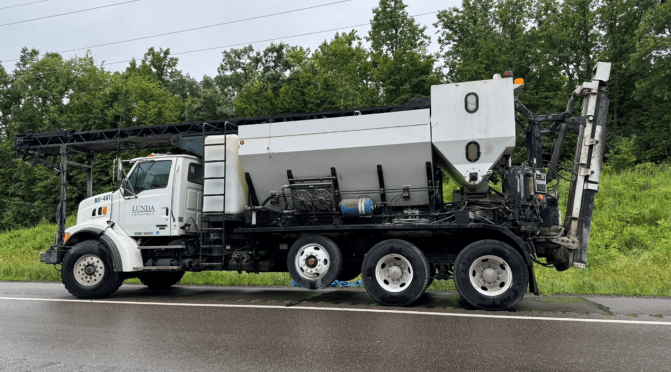
Comparing Salt Brine and Granular Salt for Safety and Performance

While studies have shown that salt brine can be less expensive and better for the environment than granular salt, public perception maintains that salt brine is less efficient and less safe for travelers.

In this Clear Roads project, researchers developed metrics for comparing the two different forms of salt and conducted a variety of tests to measure their performance in the field.

Now, agencies have data and infographics they can use to support their decision to use salt brine in place of granular salt.

Download the final report and two-page briefCR 22-04 – Evaluation of Direct Liquid Application of Salt Brine vs Granular Salt as Measured through Various Performance and Safety Metrics, December 2025.

Reprinted from Clear Roads news, January 21, 2026.

Pedestrian Safety Impacts of Dedicated Right-Turn Lanes

While research has found that right-turn-only, or dedicated right-turn lanes, at intersections reduce traffic delays and vehicle crashes, their impact on pedestrian safety has been unclear. To better understand these impacts for future intersection design and countermeasure considerations, this project investigated driver response to pedestrians in or near crosswalks at dedicated right-turn lanes. 

Continue reading Pedestrian Safety Impacts of Dedicated Right-Turn Lanes

Household-based travel measures may help agencies cut emissions

Reprinted from Catalyst, December 15, 2025

Across the country, transportation agencies, including the Minnesota Department of Transportation (MnDOT), are working to meet ambitious targets for reducing vehicle miles traveled (VMT) and climate emissions. To succeed, they need to understand what actually encourages households to drive less. 

A recent University of Minnesota (UMN) research study aimed to answer this question. Led by Eric Lind, director of the UMN’s Accessibility Observatory, the study examined how accessibility—the opportunities reachable by different travel modes such as driving, public transit, or biking—influences a household’s VMT. 

“We wanted to go beyond the typical approach of using roadway volume counts and instead examine households, because that is where VMT comes from,” Lind says. “This helps us better understand the influence of transportation and land-use systems on the travel decisions people make in their daily lives.”

Lind and his research team used Twin Cities travel behavior survey records to match households with access to opportunities on three different levels: local access (biking to jobs within 20 minutes), transit access (walking or rolling to transit to reach jobs within 10 to 40 minutes), and regional access (driving to jobs within 20 to 60 minutes). The models also accounted for important demographic factors including household income, vehicle availability, and number of workers.

The findings point to a challenging road ahead for transportation agencies working to reduce VMT and greenhouse gas emissions. The good news is that higher local and transit access does lead to lower expected VMT. However, the impact is modest: doubling local or transit access to jobs results in a VMT decrease of about 3 percent. 

Conversely, higher regional auto access is the most influential factor and positively predicts higher VMT. According to the model, a modest 10 percent increase in regional auto access to jobs resulted in a VMT increase of roughly 4 percent.

“The challenge is that MnDOT is required to balance increasing roadway capacity with strategies that reduce VMT to the same extent,” Lind explains. “Increasing what is easily reachable by bike or transit does lead people to drive less, but these are nudges compared with the main effects of roadway expansions that have a much larger, counteracting effect on VMT.”

To meet VMT goals, the research team recommends a two-pronged approach. First, agencies must continue to invest in and increase local and transit and nonmotorized access. Second, they must critically assess any planning that increases regional auto access, as its VMT-boosting impact requires non-auto mitigation to balance it out. 

These findings will provide MnDOT and other transportation agencies with a clearer understanding of the levers available to them, offering the estimates needed to calculate the true VMT impact of future infrastructure changes.

This study was sponsored by the Applied Research in Transportation (ART) Program, which addresses time-sensitive research questions in a 6- to 12-month timeframe. CTS and MnDOT contributed initial funding to launch this pilot program in 2024, with the Metropolitan Council joining in 2025. To reinforce the applied nature of the program, ART projects must directly address a current process, document, or policy need with an initial focus on sustainability in transportation and climate change impacts.

Related topics

For an overview of travel behavior in the U.S. generally, see Ten years of measurement reveals evolution of destination access across America.

To see how the transportation system is performing in Minnesota, see MnDOT performance measures.

CTS Webinar: Reaching Opportunities Through Transportation—New Results from the National Accessibility Evaluation

Wednesday, January 7, 2026
noon–1:00 p.m. CST, VIRTUAL

About the Event

Accessibility is the ease of reaching valued destinations. It can be measured for various transportation modes (auto, transit, bicycling, walking), to different types of destinations (home, work, school, shopping), at different times of day. Accessibility measures can be used to answer questions such as: How many jobs can I reach within a 30-minute transit trip from my home in Evanston, Illinois?

Continue reading CTS Webinar: Reaching Opportunities Through Transportation—New Results from the National Accessibility Evaluation

The winding road to an electric fleet

Reprinted from CTS News, November 24, 2025

Even for cities, counties, and organizations with zero-carbon emissions goals, most fleet managers are skeptical about going fully electric. Calculating the return on investment for a single vehicle is straightforward—but for a fleet, it’s complex. 

Continue reading The winding road to an electric fleet