

Connected Automated Vehicles (CAV) are part of tomorrow’s transportation future happening today. The evolution of vehicle technology is shifting how drivers interact with the infrastructure around them. Local agencies are beginning to respond and anticipate these changes, while CAV manufacturers request to test their vehicles on local roadways further pushing the urgency on local agencies.
Continue reading New Project: Autonomous Vehicles – What Should Local Agencies Expect?Category Archives: Traffic and Safety

New Project: Impact of Speed Limit Changes on Urban Streets
Speeding is one of the top 5 factors in crashes in Minnesota. Prioritizing the most effective methods to encourage safe speeds is critical to maximizing effort and funding to reach zero deaths on our roadways.
In 2019, legislation passed to allow Minnesota cities to establish speed limits for city streets under the city’s jurisdiction without conducting an engineering or traffic investigation.
Continue reading New Project: Impact of Speed Limit Changes on Urban Streets
New Project: Driver Comprehension of Flashing Yellow Arrows
Flashing yellow arrow indicators have been deployed at many signalized intersections in recent years to control left-turn movements and improve traffic flow.
When illuminated, the flashing yellow arrow allows waiting motorists to make a left-hand turn after yielding to oncoming traffic.
The Federal Highway Administration considers flashing yellow arrows to be a significant safety improvement over traditional yield-on-green indicators, which are believed to be less intuitive. However, motorist complaints and some high-profile crashes indicate that there is still some level of driver confusion.
Continue reading New Project: Driver Comprehension of Flashing Yellow Arrows

Impacts of the COVID-19 Pandemic on Minnesota’s Traffic and Transit Networks
The five CTS councils are holding this special webinar to discuss how the COVID-19 pandemic is affecting traffic and transit networks in Minnesota. The webinar will feature representatives from Minnesota transportation agencies sharing what they’re seeing in the Twin Cities metro and statewide, presentations from University of Minnesota researchers, and time for an audience Q&A.
Continue reading Impacts of the COVID-19 Pandemic on Minnesota’s Traffic and Transit Networks
Get Lots of Sleep—But Not Behind The Wheel
This article was originally published in Catalyst, May 2020.
Many of us would never drive after drinking, but we’re not as hesitant about getting behind the wheel after being awake for too long or not getting enough sleep. It turns out that can be just as dangerous as driving while impaired by alcohol or drugs.
Continue reading Get Lots of Sleep—But Not Behind The Wheel
Improving Traffic Volume Estimates By Monitoring Health of Loop DetecTORS
A newly developed system helps traffic engineers quickly spot failing loop detectors, which are used to monitor traffic volumes on Minnesota highways. The software program, developed by the University of Minnesota-Duluth for the Minnesota Department of Transportation, evaluates loop detector data and reports current loop detector health in an easy-to-read graphic format, making it easy to identify loop detectors in need of repair and which loop detectors should be used for the most accurate traffic counts.
Continue reading Improving Traffic Volume Estimates By Monitoring Health of Loop DetecTORS
Transverse Rumble Strips: Another Tool for Rural Road Safety?
Rural intersections account for 30% of crashes in rural areas and 6% of all fatal crashes, representing a significant but poorly understood safety problem.
Transverse rumble strips are one low-cost measure that some states have deployed to reduce rural intersection crashes.
Continue reading Transverse Rumble Strips: Another Tool for Rural Road Safety?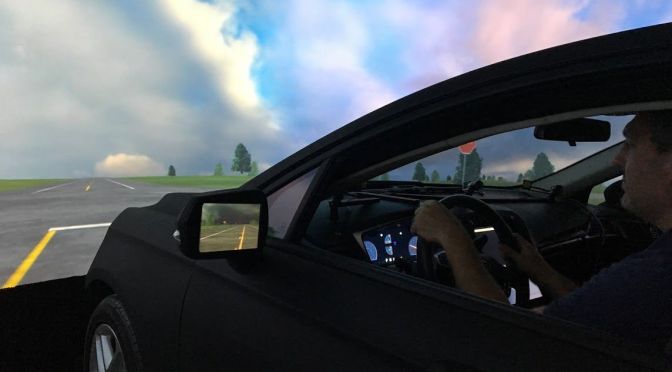
Optimal Sight Distances at Rural Intersections
A new study sponsored by the Minnesota Local Road Research Board has identified 1,000 feet as an optimal sight distance for allowing drivers to make better crossing decisions at rural intersections. Researchers used a state-of the-art driving simulator to examine drivers’ ability to judge traffic speed and gaps between cars at unsignalized intersections with varying sight distances.
Continue reading Optimal Sight Distances at Rural Intersections
Design Standards for Unobstructed Sight Lines at Left-Turn Lanes
Positive offset left-turn lanes are one solution to improving left-turning motorists’ visibility of opposing through and right-turning traffic.
MnDOT is revising its Road Design Manual and seeks to incorporate more information, policies and design guidance regarding positive offset left-turn lanes.
Researchers from the University of Wisconsin’s Traffic Operations and Safety Laboratory reviewed safety performance data from research that examined left-turn offsets. They also consulted 23 state DOT road design guides to understand the extent of available guidance.
Continue reading Design Standards for Unobstructed Sight Lines at Left-Turn Lanes
