All posts by Christine Anderson

Taking the guesswork out of measuring winter operations

Being able to accurately and reliably estimate traffic conditions during snow events is critical to transportation agencies. Typically, state DOTs use measurements such as “time to bare pavement”—based on the visual inspection of plow drivers—to gauge the progress of snow operations. These estimates are limited, however, by the subjectivity and inconsistency of human-based measurements.

Now, new research sponsored by the MnDOT and led by University of Minnesota Duluth civil engineering professor Eil Kwon aims to take the guesswork out of assessing traffic conditions during winter weather events.

“Dr. Kwon’s research on a new approach to snow and ice performance reporting is exciting,” says Steve Lund, state maintenance engineer and director of the Office of Maintenance at MnDOT. “For quite a few years, MnDOT snowfighters have been reporting their performance through a visual review of the roadway conditions. Our snowfighters have a tough job—automating the performance reporting will remove that task from their duties. Also, looking at traffic returning to a ‘normal’ condition is truly the ultimate goal or outcome measure, and where we want to go.”

In the first phase of this project, researchers developed a prototype process that uses data on traffic speed, flow, and density collected by loop detectors in the Twin Cities metro area to estimate the point at which traffic patterns return to normal—an indicator that the roadway surface has “recovered.” In the newly published second phase, researchers further analyzed the traffic flow patterns during snow events under normal and snow conditions and refined the earlier prototype into a traffic-data-based measurement process for snow operations.

“We found that by comparing the variation patterns in traffic flow during a snow event with those during normal weather conditions, we could successfully identify the recovery status of the traffic flow at a given location,” Kwon says.

Based on their findings, the researchers developed a new process to identify the Normal Condition Regain Time (NCRT)—as an alternative to the traditional “time to bare pavement” measurement used to gauge the progress of maintenance operations during a winter weather event.

One advantage of the new process is that it can reflect how road surface conditions affect traffic flow differently during day and night periods. “Nighttime traffic flow patterns are substantially different from those during daytime periods,” Kwon says. “We identified normal traffic patterns separately for daytime and nighttime conditions to account for these differences in estimating the recovery status.”

Future research plans include the development of an operational version of the NCRT estimation system that can be used on a daily basis to analyze and improve snow operations, and the creation of an online version that can be used for coordinating snow operations in real time.

“There is a lot of potential to use these findings to make snow operations even more effective and efficient,” Kwon says. “For example, the analysis of the relationship between the NCRT measures and operational strategies such as plowing start time and methods could help further refine MnDOT’s winter maintenance strategies.”

For more information, download the technical summary (PDF) or the project’s final report.

Internship program helps students build skills, make connections

While some interns spend their days making copies and coffee runs, Caitlin Johnson spent her summer internship working on a research project exploring ways to improve safety in work zones.

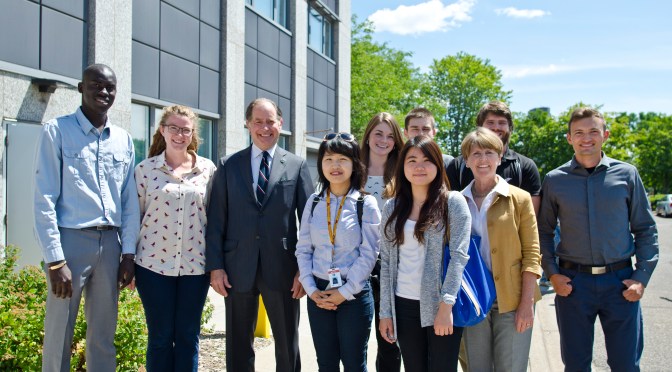
Johnson, a fifth-year civil engineering student, is one of eight undergrads from the University of Minnesota who participated in this year’s Summer Transportation Internship Program.

Interns worked at MnDOT for 10 weeks and gained valuable transportation-related experience in areas ranging from designing roadways to measuring pavement movement. The program, offered jointly by CTS and MnDOT, is now in its fourth year.

This year’s participants included the following students, working in these MnDOT offices:

  • Caitlin Johnson, Office of Traffic, Safety and Technology
  • Mamadou Mbengue, Office of Environmental Stewardship
  • Ellie Lee, Office of Design
  • Luke Horsager, Bridge & Hydraulics Office
  • Sheue Torng Lee, Materials & Pavement Office
  • Trenton Pray, Materials & Concrete Office
  • Colleen Tamara Maluda, Environmental & Vegetation Office
  • Lucas Karri, Bridge Office

Johnson says her internship at MnDOT gave her the opportunity to study a topic that hasn’t been explored in-depth in the past and present those findings to industry professionals, including staff from the Federal Highway Administration. Luke Horsager, a civil engineering senior, spent his internship with the Bridge & Hydraulics Office equipping MnDOT boats with new GPS and Bluetooth software used for river mapping and monitoring bridge scour. He says he enjoyed gaining hands-on experience with the technology.

Heidi Gray, a MnDOT Metro District designer who supervised intern Ellie Lee in the Office of Design, says the internship program is valuable not only for the students, but also for the supervisors and MnDOT as a whole. While the interns gained important hands-on work experience and made valuable professional connections, MnDOT supervisors were introduced to talented young professionals.

“It’s really good to get young people in here and teach them what MnDOT is all about,” Gray says. “I personally have enjoyed the opportunity to teach and pass along what I know. It’s a good refresher.”

Application materials for the 2016 Summer Transportation Internship Program will be available on the CTS website in early November.

For more information, read the full article in the September issue of Catalyst or visit the internship program web page.

Roadway deaths and what Minnesota is doing about it

Joint article produced with MnDOT Research Services

Minnesota developed the Strategic Highway Safety Plan a decade ago, as the nation set a goal of reducing roadway deaths to less than one person per 100 million vehicle miles traveled. Last year, the nation still hadn’t reached this milestone (1.1 deaths occurred per 100 million miles), but Minnesota had lowered its fatality rate to 0.63 deaths (down from 1.48 deaths from 20 years ago).

“When I look at what Minnesota has done over the last 15 years compared to other states, we’re one of the few states that has a pretty consistent downward trend [in fatal crashes],” said Brad Estochen, MnDOT state traffic engineer, who gave an update on the highway safety plan during a recent presentation at the Roadway Safety Institute. “I think we’re doing some unique things here that have given us these results.”

These steps, Estochen says, have included passing a primary offense seatbelt law (seatbelt usage is now above 90 percent), investing in strategic safety infrastructure like high-tension cable median barriers and focused enforcement of DWI, speed and seatbelt laws.

Developing a plan

To best understand the risk factors for fatal and serious injury crashes, the state combined real-life crash data with input from professionals in engineering, law enforcement, emergency medical services, as well as everyday road users. The results showed that most crashes in the state involve multiple factors—such as road conditions, driver impairment and driver age.

Estochen said this approach of analyzing data and gaining stakeholder perspectives provided new insights into the dynamic causes of fatal and serious injury crashes.

In conjunction with the Departments of Health and Public Safety, MnDOT created a highway safety plan aimed at both professional stakeholders and the community that identified critical strategies for reducing serious traffic incidents. It has been updated in 2007 and 2014, most recently.

MnDOT also created a complimentary document for every county and MnDOT district (respectively called the county safety plan and district safety plan) to help local agencies identify locations and potential projects for reducing fatalities.

“We were the first state to take the SHSP concept to the local level. It was identified as a noteworthy practice by FHWA and other states are now starting to engage locals in developing specific plans for their use and implementation,” Estochen said.

The highway safety plan is an integral part of Toward Zero Deaths, the state’s cornerstone traffic safety program that has a goal of reducing fatalities to less than 300 per year by 2020.

Overall, Estochen said one of the best ways to reduce crashes in the state is to promote a culture of traffic safety — something he hopes the highway safety plan contributes to.

“Creating a traffic safety culture has nothing to do with building bigger and better roads,” he said. “It really has to do with making us as a state, as a community and as individuals responsible for our actions.”

MnPASS extension on I-35E shaped by U of M study

Based in part on a planning study conducted by U of M researchers at the Humphrey School of Public Affairs, MnDOT is extending MnPASS Express Lanes on Interstate 35E in the northeast Twin Cities. The extension will build on the project currently adding MnPASS lanes from Cayuga Street to Little Canada Road.

The study, funded by MnDOT and the Federal Highway Administration (FHWA), examined the feasibility of extending these MnPASS lanes from Little Canada Road north to County Road 96. During peak periods, MnPASS lanes provide a congestion-free option to transit vehicles, carpools, and motorcycles at no cost—and to single-occupant vehicles for a fee.

Led by Director Lee Munnich and Associate Director Frank Douma of the Humphrey School’s State and Local Policy Program, the U of M research team worked with Parsons Brinckerhoff to develop and evaluate several concepts for the MnPASS extension. The goal was to provide an option that reduced congestion for all users, including drivers in the general-purpose traffic lanes and transit users. The team also included Mary Vogel from the U’s Center for Changing Landscapes.

The primary challenge was how to handle MnPASS traffic through the recently reconstructed I-694/I-35E interchange. After going over several design options, the team recommended what it termed a “hybrid” option, which creates a continuous southbound MnPASS lane and a discontinuous northbound MnPASS lane through the interchange.

Researchers also engaged community stakeholders and corridor users to gather feedback about the proposed alternatives and worked to illustrate options that could facilitate greater transit, carpool, and vanpool use in communities along this section of I-35E.

Additional recommendations developed by the team—in partnership with representatives from MnDOT, the FHWA, and the Metropolitan Council—included continuing to educate community motorists about the MnPASS program as well as expanding transit options by creating more park-and-ride sites, encouraging mixed land uses, and building better walking and biking connections.

Based on these recommendations, MnDOT is moving forward with the hybrid option for the project, says Brad Larsen, director of the MnPASS Policy and Planning Program. MnPASS lanes will be added to southbound I-35E between County Road 96 and Little Canada Road; through the I-35E/I-694 commons area, the existing inside lane will be designated as a MnPASS lane during peak periods. There will be no MnPASS lane northbound through the commons area, but a lane will be added north of the interchange from County Road E to County Road J.

Construction on the extension project is expected to begin in March 2016, with the lanes slated to open in late 2016.

More information:

(Featured photo courtesy of David Gonzalez, MnDOT.)

Bike, pedestrian counting efforts engage local agencies statewide

Across Minnesota, local agencies need better information about where and how many people are biking and walking to make decisions about infrastructure investments, understand safety risks, and even plan active living initiatives.

To help provide agencies with bicycle and pedestrian traffic data, U of M researchers have been working with MnDOT on the Minnesota Bicycle and Pedestrian Counting Initiative since 2010. The initiative is a collaborative, statewide effort to support bike and pedestrian traffic monitoring by local, regional, and state organizations.

Recently, the project team completed an implementation study—the second of three MnDOT-funded projects related to the initiative—specifically designed to engage local agencies. The goal was to demonstrate the feasibility of using both permanent and portable sensors to collect bicycle and pedestrian traffic data in several Minnesota cities, suburbs, and small towns.

“If we want to institutionalize counting and monitoring across the state, local agencies need to know it’s not something that’s only important for large cities like Minneapolis,” says principal investigator Greg Lindsey, professor at the Humphrey School of Public Affairs and current MnDOT scholar-in-residence. “We have to be on the ground in these places, illustrating that it’s relevant to the decisions they’re making.”

To that end, the team installed commercially available sensors—including inductive loops, passive infrared, pneumatic tubes, and radio beams—to collect traffic counts in several Minnesota cities. Overall findings indicate that all of the sensors produced reasonably accurate measurements—and that participating agencies found value in the collected data.

Findings and case studies from the study have already been incorporated into the draft Bicycle and Pedestrian Data Collection Manual, a new MnDOT guidance document being used in statewide training workshops. Also as a result of the study, MnDOT plans to include commitments to bike and pedestrian traffic monitoring in its forthcoming statewide bicycle and pedestrian plans. In addition, MnDOT is investing in a network of permanent traffic monitoring sites around the state as well as in portable equipment that will be available to local agencies.

Read the full article in the September issue of Catalyst.

Census report looks at U.S. commuting patterns; U of M report analyzes Twin Cities’ patterns

A recent report issued by the U.S. Census Bureau looks at commuting patterns by U.S. workers in 2013 using data from the American Community Survey. It highlights differences in rates of automobile commuting by key population characteristics such as age, race, ethnicity, and the types of communities in which workers live.

One finding of note: young people in big cities were much less likely to drive to work in 2013 than they were several years earlier. For instance, urban workers aged 25 to 29 showed about a 4-percentage-point decline in automobile commuting between 2006 and 2013.

You can also find an extensive analysis of commuting behavior that was produced locally. In a recent multifaceted study sponsored by the Metropolitan Council and MnDOT, U of M researchers analyzed travel behavior over time in the Twin Cities.

The extensive five-part study report is based on the rich set of data produced by the Met Council’s Travel Behavior Inventory household travel survey. David Levinson, RP Braun/CTS Chair in the U’s Department of Civil, Environmental, and Geo- Engineering, was the study’s principal investigator.

The five components of the report examine:

  • Changes in travel duration, time use, and accessibility
  • Changes in walking and biking
  • The effect of transit quality of service on people’s activity choices and time allocation
  • Changes in travel behavior by age cohort
  • Telecommuting and its relationship with travel and residential choices

For more information:

Engaging the next generation of the transportation workforce

In July, CTS introduced the next generation of the workforce to transportation topics and careers during a two-week summer program. Thirty students entering seventh through ninth grade attended the CTS-hosted National Summer Transportation Institute, where they got hands-on experience with topics ranging from distracted driving to aeronautics to traffic management.

As part of the program, attendees toured campus, visited the U of M’s transportation-related labs, and learned tips on researching, studying, public speaking, and writing. In addition, participants learned about many aspects of transportation, including human factors, roadway safety, bridge design, surveying, and traffic simulation.

This slideshow requires JavaScript.

The camp also included outings to several MnDOT facilities, UPS, Metro Transit, the Minneapolis–St. Paul International Airport, the Minnesota Transportation Museum, and boat tours of the St. Croix River Crossing construction site and St. Paul Port Authority.

Highlights for attendees included riding the light rail and going behind the scenes in a Metro Transit control room, watching airplanes take off and exploring maintenance equipment at the airport, getting up close to bridge construction on the St. Croix River Crossing boat tour, and using a driving simulator to learn about distracted driving at UPS.

“I really enjoyed using the driving simulators,” said one of the ninth-grade program participants. “It was a hands-on experience that truly taught me the dangers of texting while driving and how much harder it really is.”

In post-program evaluations, parents reported that their children had learned valuable information about transportation topics, careers, and related education opportunities.

“This was one of the best camps we have ever experienced,” one parent said. “There was always a plan for college, and this program increased enthusiasm, preparedness, and maturity.”

“[The program] opened up my daughter’s horizon for future career choices and major focus areas after high school,” another parent said.

The program was sponsored by CTS with funding from the Federal Highway Administration administered by the Minnesota Department of Transportation (MnDOT).

To learn more, read the full article in the August issue of Catalyst.

Salt-tolerant sod and seed mixes bring greener roadsides to Minnesota

For Minnesota’s roadside grasses, life isn’t easy. To survive, grass must be able to withstand extreme stresses including drought, heat, disease, soil compaction, poor quality soils, and high levels of road salt. Ideally, it could survive all that while still looking lush and green.

“Many roadsides, especially in metropolitan areas, need to look good,” says Eric Watkins, associate professor in the Department of Horticultural Science. “In addition to aesthetics, quality roadside vegetation is needed to prevent erosion and maintain water quality from roadside runoff.”

In 2010, MnDOT noticed a number of its new sod and seed plantings were failing and asked U of M experts to take a look at its specification. “We saw the problem immediately,” Watkins says. “The specification was for a mix with a lot of Kentucky bluegrass, which needs a great deal of care and watering. There was clearly an opportunity for improvement.”

During the next several years, Watkins’ team, led by former graduate student Josh Friell, worked to identify the best seed and sod for use along Minnesota’s roadsides in research sponsored by the Minnesota Local Road Research Board and MnDOT. Findings are now available in a final report.

The study was completed in several stages. First, many different types of cool-season grasses were planted in the fall and assessed the following spring to determine their ability to establish and survive on roadsides in Minnesota. Next, researchers looked at the salt tolerance of those grasses.

Eric Watkins (third from left) leads a greenhouse tour of grass mixtures.

“In cold-weather climates like Minnesota’s, salt tolerance is required because of the application of deicing salts in the winter,” Watkins explains. “To determine if a grass species could stand up to this stress, we applied different levels of salt solution to the different grass species in a greenhouse. We identified several types of fescue grass as the most salt tolerant.”

Based on the results of the first two stages, researchers developed and tested 50 different grass mixtures along Minnesota’s roadsides and evaluated the survival and performance of those plantings for two years. In addition, each mixture was planted under a movable rain-out shelter to determine drought tolerance. This phase of the study resulted in the identification of a mix of three types of fescue for planting on roadsides in Minnesota.

Finally, researchers needed to find out if the new grass mixture would work as sod (sod growers need to be able to harvest it properly from their sod fields). “Most sod currently grown in Minnesota is Kentucky bluegrass, which isn’t the best for winter survival when salt stress is a problem,” says Watkins. “We grew 51 different grass mixtures as sod for 22 months and found that contrary to popular belief, fine fescue mixtures produced sod of acceptable strength for harvest.”

MnDOT has applied the research to standard specifications for construction activities for salt-tolerant sod products, salt/shade/drought-tolerant turf seed mixtures, and a third-party certification program for ensuring performance standards are met based on past and current research results, says Dwayne Stenlund, MnDOT erosion control engineering specialist. Researchers are also working with the state’s sod growers to produce sod grown from the new seed blends.

Moving forward, the researchers plan to continue their work to improve Minnesota’s roadside grass plantings. “The reality is that the success of sod or seed plantings depends on a number of factors, including time of year, amount of water, soil preparation, temperature, and sod harvest depth,” Watkins says. “In our next project, beginning this spring, we will identify the most important factors for the success of roadside plantings and sod cultivation, and then help MnDOT update the specifications for managing new installations.”

Minnesota Bicycle and Pedestrian Counting Initiative highlighted in FHWA case study

Work on bike and pedestrian counting by University of Minnesota researchers and MnDOT has been highlighted as part of the FHWA’s Livable Communities Case Study Series.

The case study features the Minnesota Bicycle and Pedestrian Counting Initiative, led by the U of M’s Greg Lindsey and MnDOT’s Lisa Austin and Jasna Hadzic. Under the initiative, the team has developed general guidance and consistent methods for counting bikes and pedestrians. Team members have also worked with other state and local agencies to implement counting strategies across Minnesota.

The case study showcases the initiative as an example of how agencies can leverage partnerships to implement a successful counting program for nonmotorized traffic. These traffic counts can help agencies identify safety concerns, understand and communicate benefits of active transportation, prioritize investments, and analyze trends. According to the FHWA, the results can help inform decisions that make biking and walking viable transportation options in livable communities.

Read the case study on the FHWA Livability website.

Travel behavior study shows drivers are spending less time traveling

Something unprecedented has happened to Americans’ travel patterns. Even before the recent recession, total distance traveled per person had started to decline, and the rate of total vehicle travel had begun to steadily decrease as well.

In a new five-part series of research reports sponsored by MnDOT and the Metropolitan Council, University of Minnesota researchers are delving into a set of rich data encompassing more than four decades of travel behavior surveys to enable the region’s transportation planners to better understand how its residents make decisions about whether, when, where, and why to travel.

In the first study, researchers examined how changes in the accessibility of destinations—such as jobs, shopping, and leisure activities—have changed travel behavior in the past 20 years.

“We started with a detailed analysis of travel surveys conducted by the Metropolitan Council in 1990, 2000, and 2010,” says David Levinson, the study’s principal investigator and RP Braun/CTS Chair in the Department of Civil, Environmental, and Geo- Engineering. “We found that people are spending slightly less time in motion and more time at home. We also found that accessibility is a significant factor in determining not only travel behavior but overall time budgeting in general. In short, each person has to decide how they will use the time allotted to them each day, and many of those decisions are directly related to the transportation and land-use systems in place.”

A deeper look into the data sheds additional light on the relationship between accessibility and travel behavior. For example, trip durations for workers have gone up for all activities between 1990 and 2010. More noticeably, distances for trips have increased markedly: workers take jobs farther from their homes and shop farther from their homes. Travel speeds also increased for the average worker, due to more travel on faster suburban roadways that carry a larger share of all travel. In contrast, for non-workers, trip durations and overall travel time have gone down.

“Interestingly, although time, distance, and speed per trip has generally risen for workers, the number of those trips is declining,” Levinson says. “As a result, overall, fewer miles are being traveled and less time is being allocated to travel.”

Total time spent shopping also decreased for workers and for males, likely caused in part by an increase in online commerce. “The Internet has provided electronic accessibility, much as the transportation network has in the material world,” Levinson explains. “It helps to facilitate commerce, communication, education, and leisure. This may lead to a decreased need for people to travel, and account for more time spent at home.”

Jonathan Ehrlich, planning analyst with the Metropolitan Council, says the research “helps us get more value from our travel surveys and will aid in understanding how travel is changing, and what the risks are in the assumptions and models we use for planning and forecasting.”

The findings will prove useful not just for Twin Cities transportation planners but for planners and engineers worldwide. “Our models can be easily adapted to data from other cities or for other activities besides work,” Levinson says. “This creates an approach that can be used to gauge the impact of a transportation project from an accessibility standpoint and determine how that project will translate into time allocation.”

Other parts of the study will look at changes in telecommuting behavior over time, the effect of transit quality of service on people’s activity choices and time allocation, changes in travel behavior by age cohort, and analysis of bicycling and walking in light of land-use and transportation system changes.

Crossroads will feature coverage of these projects as they are completed.