

According to recent survey results, new highway signs promoting rest area amenities are influencing motorists’ decisions to use them.
Continue reading New signs give highway drivers more reasons to stop at rest areasCategory Archives: Traffic and Safety

Collaboration with Minnesota Zoo aims to conserve wildlife
Turtles and other wildlife are at risk along Minnesota roadways.
MnDOT is collaborating with the Minnesota Zoo on a new research project installing small animal exclusion fencing. The fencing is intended to redirect turtles (and other small animals) to culverts and bridges where they can cross the road safely.
Continue reading Collaboration with Minnesota Zoo aims to conserve wildlife
Smartphone App Alerts Drivers Exceeding Speed Limits on Curves
Researchers have developed a proof-of-concept curve speed warning system for use with mobile phones, a technology they hope car manufacturers might adopt for in-vehicle systems. The proof-of-concept system uses data from local road agencies on curve locations, speed limits and signage with geofencing to trigger cloud-based data alerts to road users driving faster than recommended speeds for curves.
Continue reading Smartphone App Alerts Drivers Exceeding Speed Limits on Curves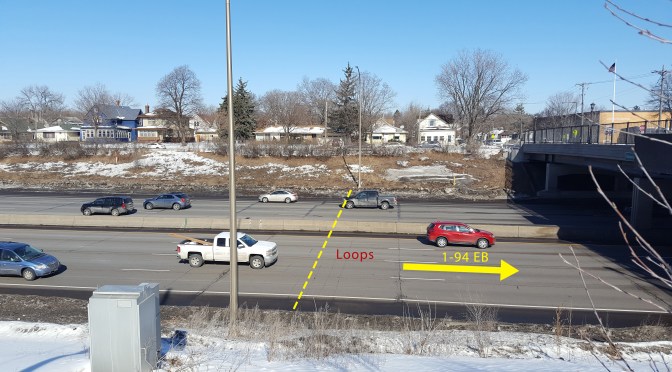
Leveraging Existing Inductive Loops to Classify Highway Vehicles
Researchers evaluated the use of existing inductive loop installations in Minnesota for vehicle classification. Results showed that inductive loops may be effective at identifying and classifying individual vehicles as they pass, but the system will require further refining for Minnesota use.
Continue reading Leveraging Existing Inductive Loops to Classify Highway Vehicles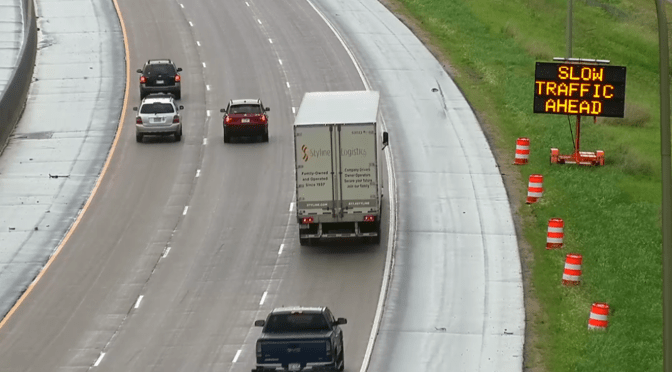
Speed Notification System Warns Drivers Approaching Urban Work Zones
Using an innovative method to calculate vehicle trajectories and gather large amounts of driver data, researchers tested and evaluated the new Smart Work Zone Speed Notification system and determined that its messages successfully influenced drivers to reduce their speed.
Continue reading Speed Notification System Warns Drivers Approaching Urban Work Zones
Evaluating the Use of Central Traffic Signal Control Systems
MnDOT sought to determine the full range of intersection control information (ICI) currently used in the state and how it could best be made accessible for state transportation system needs. Researchers created the Regional Database of Unified Intersection Control Information, a machine-readable, cloud-based unified ICI system. They determined steps MnDOT could take toward more effective use of its central traffic signal control system, such as mitigating traffic disruption around construction zones and participating more fully in emerging technologies such as vehicle information systems and vehicle automation.
Continue reading Evaluating the Use of Central Traffic Signal Control Systems
Preparing Roads for Connected and Autonomous Vehicles
Proprietary technologies, industry competition and federal regulatory concerns are slowing the advent of defined standards for connected and autonomous vehicles (CAVs). Researchers investigated the state of CAV implementation to help local agencies begin preparing for the infrastructure needs of these vehicles. CAV-friendly options are considered for eight infrastructure categories. Since truck platooning is the likely first application of this technology, and optical cameras appear imminent as an early iteration of sensing technology, researchers suggest that wider pavement striping and well-maintained, uniform and visible signage may effectively serve the needs of CAVs in the near future while enhancing infrastructure for today’s drivers.
Continue reading Preparing Roads for Connected and Autonomous Vehicles
New project: Effectiveness of Teenage Driver Support System
The Minnesota Local Road Research Board (LRRB) has funded a follow-up study to determine whether a monitoring system it field tested for new drivers, called the Teen Driver Support System (TDSS), affected teenagers’ long-term driver behavior.
Continue reading New project: Effectiveness of Teenage Driver Support System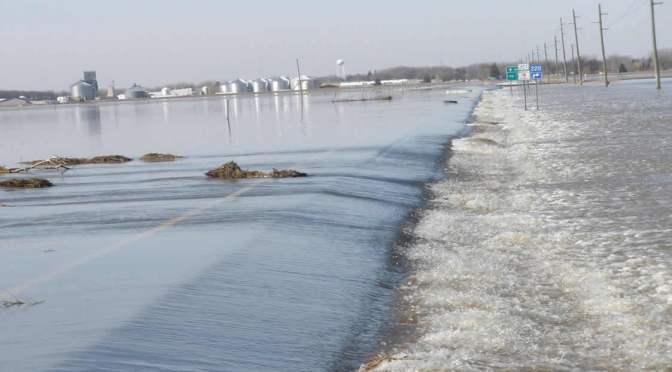
New Project: Extreme Flood Risks to Minnesota Bridges and Culverts
Extreme flooding is a threat to Minnesota’s transportation infrastructure and the safety and economic vitality of its communities. A spate of recent flooding events around the state has demonstrated this and heightened the level of concern. Furthermore, climate change — a factor not traditionally accounted for in the design of the state’s infrastructure — is projected to enhance precipitation and the threat of flooding in coming decades.
Given this, MnDOT is undertaking an effort to better predict the threat flooding poses to its bridges, large culverts and pipes, which may be increasingly called upon to convey higher, more frequent flood flows than they were designed for.
The state transportation research program recently launched a two-year extreme flood vulnerability analysis study, which will develop a methodology for characterizing the vulnerability of the state’s bridges, large culverts, and pipes to flooding.
The effort builds upon the previously completed Flash Flood Vulnerability and Adaptation Assessment Pilot Project (2014), which scored bridges, large culverts, and pipes in MnDOT Districts 1 and 6 for flood vulnerability, allowing detailed assessments of adaptation options for each of their facilities to be prioritized.
This new study, which will be conducted by WSP, aims to develop and test ways to enhance the vulnerability scoring techniques used in the previous study and ensure their applicability throughout the state. Researchers will not actually undertake the statewide assessment, but specify an approach that could be used for it. They will also explore how the outputs of the analysis can be incorporated into MnDOT’s asset management systems. The results of this work will be a clear path forward for MnDOT to use for prioritizing adaptation actions — a key step towards enhancing agency resilience and maintaining good fiscal stewardship.
Project scope
The primary intent of this study is to develop a methodology for characterizing the flood vulnerability of bridges, large culverts, and pipes statewide. As part of the development process, the methodology will be tested on a limited, but diverse, set of assets across the state. Following a successful proof of concept, recommendations will be made on how the outputs (i.e., the vulnerability scores) can be incorporated into the state’s asset management systems.
By determining which facilities are most vulnerable to flooding through the techniques developed on this project, MnDOT can prioritize where adaptation measures will make the biggest impact, ultimately decreasing asset life-cycle and road user costs. Without the development of assessment techniques, adaptation measures run the risk of being implemented in a more reactive and/or ad-hoc fashion, with less regard to where the biggest “bang for the buck” can be realized.
This project will produce several technical memorandums, and is expected to be completed in early 2021.

Affordable GPS-Based System Warns Drivers About Lane Departures, Approaching Curves
Researchers have developed an affordable camera-free curve and lane departure warning system that relies on consumer-level GPS, rather than sophisticated, expensive digital maps.
The technology uses cumulative driving trajectory data from GPS points detected every 100 milliseconds to predict driving path trajectories and compare these to mapped curves and lanes. With further development, the system can be used as an inexpensive smartphone app or retail device to warn drivers of lane drift and approaching curves.
“The goal of the project is to reduce lane departure crashes. We viewed this as a seed project and demonstrated that the system can be successful,” said Victor Lund, Traffic Engineer, St. Louis County.
What Was Our Goal?
The Minnesota Local Road Research Board sought research to develop a camera-free curve and lane departure warning system that uses consumer-level GPS capability without reliance on sophisticated, expensive digital maps.
What Was the Need?
Lane departures and run-off-road crashes cause more fatalities and serious injuries in Minnesota than any other accident type.
Many current warning technologies rely on cameras that identify lane position based on pavement markings. In inclement weather, stripes and pavement markings can be difficult or impossible to identify; markings also wear off over time, reducing visibility even in clear conditions. Camera-based lane departure warning systems are also expensive and generally restricted to newer luxury vehicles, making them inaccessible to the general driving public.
Though in-vehicle technology for the public usually falls outside the research interests of the Minnesota Department of Transportation and the Minnesota Local Road Research Board, the agencies have been funding development of lane departure warning technologies to improve driver safety. GPS technologies offer an intriguing path to consumer-level lane departure warning systems.
High-level GPS can be accurate to the centimeter level, but access is restricted and use is expensive. These systems also rely on accurate, lane-level roadway mapping, an elusive data set with high access costs.
What Did We Do?
Researchers began with a literature search of the uses of standard GPS receivers in lane departure and navigation. The research team then developed an algorithm for travel direction that uses standard GPS in a straight road lane departure system to determine driving trajectories at accuracy levels suited to safe driving needs.
Investigators adapted a publicly available digital mapping platform to the same algorithm to identify navigational points along curves and develop the curve lane departure warning system. The team enhanced standard safe distance methods to consider driver reaction time in determining when approach warnings should be issued.
Researchers then brought the two developmental stages of the system together with a warning system that identifies vehicle speed, curvature characteristics and safe speed limits, and calculates distance for driver response times to issue an audible warning to drivers on lane drift and a text warning of when and how much to reduce speed as the vehicle approaches a curve.

For project testing and demonstration, investigators programmed the algorithm into a device with a built-in GPS receiver, connected it to a laptop for messaging and conducted driving tests on Rice Lake Road and on Interstate 35 near Duluth.
“From a technical point of view, this approach works. We developed a warning system with standard GPS that everyone has in a phone or vehicle. This is a lifesaving technology in a sense,” said Imran Hayee, Professor, University of Minnesota Duluth Department of Electrical Engineering.
What Did We Learn?
Finding no research on development of consumer-grade GPS for lane departure purposes, the research team adapted previous work on the relative accuracy of GPS readings from a MnDOT study on wearable GPS for work zone safety.
Researchers adapted a consumer-level GPS device to acquire data at 10-hertz frequency, which yields a GPS position point of 2.7 meters if a vehicle is driven at 60 mph.
The system calculates lane trajectory from cumulative readings and detects turns or drift. The curve warning system plots trajectories and compares these with open-source digital maps with road-level (rather than lane-level) accuracy to anticipate curves.

In road testing, the system issued audio warnings for every one of the approximately 200 lane changes, including curves. For curve warnings, the system scanned for curves at least half a mile ahead and calculated the vehicle’s speed and the distance to a curve to issue a timely text warning of the curve ahead and an advisory speed limit. Additional messages were issued when the vehicle was on the curve and when the curve had ended.
False alarms—warnings issued when the vehicle was not departing its lane—occurred in 10 percent of the tests, usually on sharp curves. Further adjustment of the algorithm and additional testing reduced false alarms significantly as the system accumulated data over multiple uses of the same roadway.
What’s Next?
Investigators filed a patent for the technology and will continue to develop the system. Further refinement of reference road direction information will improve accuracy and safety; the research team has developed a new project to employ vehicle-to-vehicle dedicated short-range communication technology to expand road direction reference data. The system will then need to be adapted for a consumer-level device or a smartphone app for use in any vehicle.
This post pertains to the LRRB-produced Report 2018-34, “Development and Demonstration of a Cost-Effective In-Vehicle Lane Departure and Advanced Curve Speed Warning System,” published December 2018.
 Crossroads