Category Archives: Maintenance Operations

Knowing While Mowing: GPS Keeps Maintenance Workers Out Of the Weeds

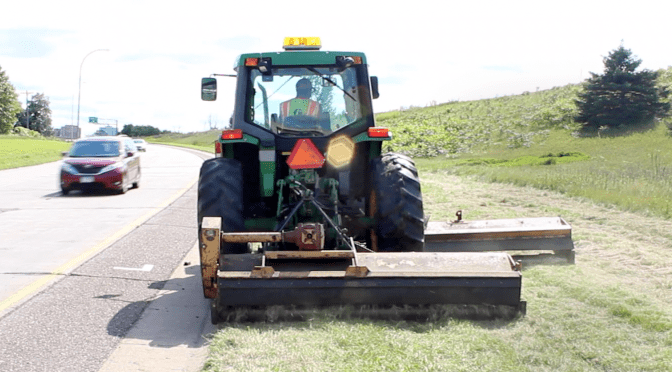
As temperatures fall and days get shorter, MnDOT Metro District maintenance workers are wrapping up a season of mowing grass along roadsides and in medians that they hope will prove a little more efficient than in the past.

Thanks to a research project that installed GPS devices in tractor cabs, operators have a better sense of exactly which areas they need to mow and which areas should be left alone. Five Metro District tractors were tested in 2015. This year, more than 40 tractors were fitted with the automated vehicle location (AVL) technology, which includes a GPS antenna, an on-board central processing unit (CPU) and an in-cab screen with a user interface.

Trisha Stefanski, Metro District asset management engineer, expects one of the biggest benefits of the project to be a reduction in herbicide use. Maintenance crews use herbicide to control the spread of noxious weeds that sometimes get spread during mowing operations. Mapping exactly where noxious weeds are, and providing that information to operators on a real-time, in-cab screen and user interface helps them mow around those areas.

“We’re really hoping it will reduce the amount of herbicide that we’re putting on our roadways by 50 percent,” Stefanski said. “We’re not certain that will be the number, but that’s what we’re hoping for. We think just not mowing those areas will not spread as many noxious weeds and so we don’t have to apply as much herbicide.”

Metro District operators, such as Jesse Lopez, give the AVL technology rave reviews.

“Basically you can see what you shouldn’t mow and what you should mow. So, it makes it easy for me. It’s just like playing a game,” Lopez said. “This actually helps me to optimize what my job is. I know exactly where I’m at and where I’m going. I think everyone should use it – absolutely everybody who is in a mowing situation or a plowing situation.”

In addition, the AVL technology helps maintenance supervisors keep tabs on exactly where their operators are in real time. It also helps supervisors complete reports by automatically providing the geographic areas where mowing has been completed.

Stefanski says the project has gone really well, and she hopes collecting more data over another mowing season will show real savings on herbicide use. In the meantime, she is thinking of other ways AVL technology could be applied to maintenance operations.

“What I really like about the project is that we are taking something used in a lot snow plows and a lot of other technologies – cars, other things, maybe UPS uses them – and we’re putting it into maintenance operations,” Stefanski said. “Having it for mowing, we can also use it for smooth pavements. We can also use it for other things in mowing operations.”

Driver-assist system helps keep plows on the road

Darryl Oeltjenbruns, snowplow driver in District 7, operates the only driver assist system, or DAS, equipped snowplow in the state. The system helps snowplow operators see road alignments and features such as turn lanes, guardrails and road markings. (Photo by Chase Fester)

By Sue Roe, MnDOT Communications

Southwest Minnesota has the highest average wind speeds in the state—bad news for MnDOT snowplow operators who often drive in low visibility to clear roads.

“We have more days when the wind blows than when it doesn’t,” said Chase Fester, MnDOT District 7 transportation operations supervisor. “We struggle with the wind.”

That’s why District 7 is piloting a snowplow driver-assist system (DAS) developed by University of Minnesota researchers to combat the blowing snow and fog that often cause zero visibility. The DAS helps snowplow operators see the road alignment and features, such as turn lanes, guardrails, and road markings. Even in less extreme winter weather, snowplow operators gain assurance of their lane location using the system.

The driver assist system displays a white box on the screen when an obstacle, or in this case a mailbox, is located. If the object appears in the lane, such as a car stuck in a snow drift, the box turns red and gets bigger as the snowplow gets closer to the object. (Photo courtesy of MnDOT District 7)

The DAS was developed and refined over the past 20 years under multiple research projects funded by MnDOT and the USDOT’s University Transportation Center program. Professor Max Donath, director of the University of Minnesota’s Roadway Safety Institute, led the work. In addition to plows, the DAS technology has also been applied in other specialty vehicles such as patrol cars and ambulances. Numerous vehicles using the system have been deployed in both Minnesota and Alaska.

The DAS uses GPS technology and a front-mounted radar to provide an image of the road and any obstacles in front of the operator. The image is displayed on a monitor inside the cab of the plow. The system also vibrates the operator’s seat as a warning if the plow veers too close to the roadway’s centerline or fog line.

“If the driver gets within one foot of the fog line on the right side, the right side of the seat vibrates. If the driver gets too close to the centerline on the left side, the left side vibrates,” said Fester.

The vibrations continue until the driver moves back into the center of the lane. The driver can also turn off the warning feature to clear snow from the shoulder.

The DAS is currently installed in one truck in District 7. The $75,000 cost makes it difficult to install in every truck in the district or the state, although having at least one system in every district may be possible, Fester said.

Fester said the system proved its worth one day in February when blizzard conditions caused zero visibility and forced many road closures in southwest Minnesota. He was called out at 2 a.m. Feb. 8 to assist a stranded state trooper and several motorists on a 12-mile stretch of Hwy 60 between Windom and Heron Lake. Fester drove a pickup behind the DAS-equipped snowplow, driven by Darryl Oeltjenbruns, to reach them.

As the DAS identified stranded vehicles on the way to Heron Lake, Fester and Oeltjenbruns checked to make sure they weren’t occupied with people. Once they made it to Heron Lake, they stopped at the community center, where the state trooper and the stranded motorists he brought in were located.

On the way back to Windom, Fester and the state patrolman continued to check on stranded vehicles as the DAS-equipped snowplow led the way. If the vehicles weren’t in the ditch, motorists drove behind the two MnDOT vehicles. If their vehicles were in the ditch, motorists rode in a Suburban that was also being escorted to Windom. After returning to Windom, the motorists were dropped off at motels or truck stops.

“When we first went out, there were about six stranded vehicles. Coming back from Heron Lake, there were about 15,” Fester said. “At one time, we had 12 vehicles in line as we drove back to Windom, driving about 10 to 15 miles per hour.”

Later that morning the DAS system was used again to locate other motorists.

“We continued to use it until about 10 a.m. or 11 a.m. that day,” Fester said. “The system worked great and kept everyone safe. It was an interesting morning.”

(Reprinted and adapted with permission from an article by Sue Roe in MnDOT’s Feb. 17, 2016 Newsline.)

Willow shrubs could be next great Minnesota snow fence

The benefits of living snow fences and other snow control tools to keep roadways clear of blowing and drifting snow have been known for decades, and MnDOT has been using a variety of these techniques for years to catch  snow before it gets to a road.

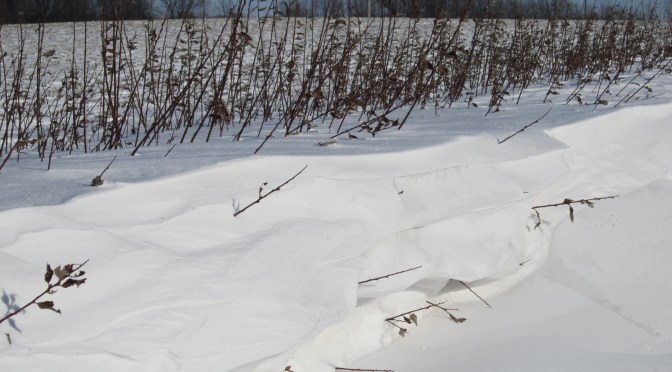
Living snow fences often consist of trees, grasses and even corn stalks left standing in a farmer’s field.  Now willow shrubs are being added to the list as a fast-growing, inexpensive snow control measure.

What’s new

WillowSeptember
Fish Creek willow shrubs (left) grow alongside corn in September 2015.

Researchers recently completed a study that investigated whether willow shrubs could make good living snow fences. While typical snow-fence plants, such as dogwood or cranberry shrubs, can take five to 20 years to establish themselves, shrub willows were effective at trapping snow after just two growing seasons, according to the study.

In spring 2013, researchers installed three varieties of shrub willow side-by-side in two-row and four-row configurations along about a quarter of a mile of Highway 14 in Waseca, where snow drifts are an issue. In April 2014, they cut the shrubs down to the ground  to encourage branching and bush density. Though the trimmed willows had little impact on drifting snow the first winter, each willow-shrub plot was collecting two to three metric tons of snow by the second winter, according to the research report. Researchers believe that after three or four growing seasons the willow shrubs could catch the entire mean annual snowfall on the site.

In the four-row configuration recommended by researchers, costs of raising, furnishing, planting and mulching came to about $3.60 per plant, which is dramatically less than the contract bid cost for traditional living snow fence species that cost more than $50 per plant. In addition, the willow shrubs could be harvested and sold as biomass every few years to provide an income source.

Past research

Willow trees is just the latest advancement in the state’s snow control program. A 2012 research project evaluated the costs and benefits of living snow fences and provided MnDOT with a payment calculator to determine how much to compensate landowners for installation and maintenance costs.

A recent research implementation project created a mobile-friendly Web version of the payment calculator tool.  The website also contains a tool for designing a own snow fence.

MnDOT has used these tools and other promotional efforts to nearly double the number of farmers with contracts for corn rows enrolled in the Living Snow Fences program.

What’s next

The willow species recommended by researchers will be evaluated further in 2017 when they install it as a living snow fence on a new construction site on Highway 60 between Windom and Mountain Lake. Researchers also recommend a future study to compare volume of road salt use before and after installation. They also want to look into identifying appropriate buffer distances to keep willow roots from interfering with cropland root systems.

Resources

Taking the guesswork out of measuring winter operations

Being able to accurately and reliably estimate traffic conditions during snow events is critical to transportation agencies. Typically, state DOTs use measurements such as “time to bare pavement”—based on the visual inspection of plow drivers—to gauge the progress of snow operations. These estimates are limited, however, by the subjectivity and inconsistency of human-based measurements.

Now, new research sponsored by the MnDOT and led by University of Minnesota Duluth civil engineering professor Eil Kwon aims to take the guesswork out of assessing traffic conditions during winter weather events.

“Dr. Kwon’s research on a new approach to snow and ice performance reporting is exciting,” says Steve Lund, state maintenance engineer and director of the Office of Maintenance at MnDOT. “For quite a few years, MnDOT snowfighters have been reporting their performance through a visual review of the roadway conditions. Our snowfighters have a tough job—automating the performance reporting will remove that task from their duties. Also, looking at traffic returning to a ‘normal’ condition is truly the ultimate goal or outcome measure, and where we want to go.”

In the first phase of this project, researchers developed a prototype process that uses data on traffic speed, flow, and density collected by loop detectors in the Twin Cities metro area to estimate the point at which traffic patterns return to normal—an indicator that the roadway surface has “recovered.” In the newly published second phase, researchers further analyzed the traffic flow patterns during snow events under normal and snow conditions and refined the earlier prototype into a traffic-data-based measurement process for snow operations.

“We found that by comparing the variation patterns in traffic flow during a snow event with those during normal weather conditions, we could successfully identify the recovery status of the traffic flow at a given location,” Kwon says.

Based on their findings, the researchers developed a new process to identify the Normal Condition Regain Time (NCRT)—as an alternative to the traditional “time to bare pavement” measurement used to gauge the progress of maintenance operations during a winter weather event.

One advantage of the new process is that it can reflect how road surface conditions affect traffic flow differently during day and night periods. “Nighttime traffic flow patterns are substantially different from those during daytime periods,” Kwon says. “We identified normal traffic patterns separately for daytime and nighttime conditions to account for these differences in estimating the recovery status.”

Future research plans include the development of an operational version of the NCRT estimation system that can be used on a daily basis to analyze and improve snow operations, and the creation of an online version that can be used for coordinating snow operations in real time.

“There is a lot of potential to use these findings to make snow operations even more effective and efficient,” Kwon says. “For example, the analysis of the relationship between the NCRT measures and operational strategies such as plowing start time and methods could help further refine MnDOT’s winter maintenance strategies.”

For more information, download the technical summary (PDF) or the project’s final report.

Video Demonstration: Robotic Message Painter Prototype

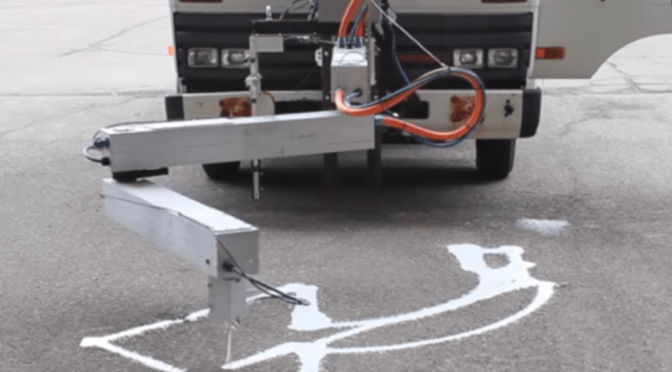
In the above video, University of Minnesota-Duluth Associate Professor Ryan Rosandich tests a prototype of a robotic arm he developed to paint messages and markings on roadways. He calls the machine “The MnDOT Robot.”

During a test run in October 2015, the MnDOT robot painted a right-turn arrow and the word “ahead” on pavement at MnDOT’s Pike Lake station in Duluth.

Rosandich hopes commercial companies will show an interest in further developing his proof-of-concept technology into something that road authorities can use regularly to make work easier, faster and safer for their employees.

Companies interested in commercializing this technology can contact Andrew Morrow at amorrow@umn.edu.

Editor’s Note: The paint used in the above demonstration was diluted due to the cold weather at the time of the demonstration and does not reflect the condition of the paint expected in a typical application.

Road Surface Monitors Could Help Reduce Salt Usage

MnDOT is testing a mobile road condition monitor that uses infrared technology to detect hazardous ice, snow or wet conditions without even touching the pavement.

Maintenance crews hope the device, called the High Sierra Surface Sentinel, could help them better determine when it’s time to apply salt when they’re plowing. The mobile sensor reports air temperature, surface temperature and road friction data.

“The biggest reason we’re looking at this is for the friction reading,” said MnDOT Salt Solutions Coordinator Joe Huneke. “Typically, when operators are patrolling their route and the road looks like it’s getting icy, they’ll err on the side of caution and apply salt — and it may not need it.”

The device being tested by snow and ice crews in northern Minnesota would also provide real-time surface weather conditions. Currently, plow operators and supervisors must enter road conditions into a computer or relay them by phone, a time-consuming process that operators are not always able to perform in a timely manner.

The biggest potential benefit, however, is lower salt consumption.

“Sometimes you get a light cold snow event where it might look like there’s a little ice on the road, but, in fact, you have good friction numbers and you don’t need salt. Once you put chemical down, you’re committed to it,” Huneke said.

District 1 snow and ice crews are evaluating the unit pictured below for its accuracy and effectiveness in determining slippery conditions. It will be compared with another device tested in District 3 that also uses infrared technology to determine how slippery the road is, and technology being tested in District 6 that uses gravitational force to determine the road surface friction.

MnDOT it testing a mobile surface condition sensor that provides real-time surface weather condition of roadways.
MnDOT it testing this mobile road condition sensor, which provides real-time surface weather condition of roadways.

Related Research

MnDOT’s Office of Maintenance has its own research program designed to let maintenance personnel test innovative ideas to keep our roads smooth, snow-free and safe. They even put out a monthly bulletin featuring new ideas and technologies. (You can find the back issues here.)

Other winter maintenance research projects are featured in MnDOT’s 2011-2013 Maintenance Operations Research Report  (PDF, 9 MB, 98 pages)

MnDOT Plow Drivers Invent New, Hybrid Plow Design

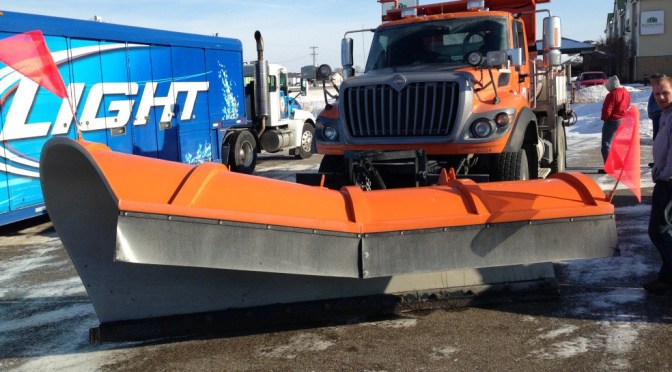
If the plow pictured above looks like two different plows welded together, it’s because they are.

Minnesota Department of Transportation snow plow operators in southwestern Minnesota have invented an experimental plow that uses the wind to cast snow from the road without impeding traffic or the operator’s view.

Manufactured for MnDOT by Fall Plows, the plow incorporates half of a traditional bull-dozer style plow with half of a Batwing-style plow.  It eliminates the large “ear” on the driver’s side of a Batwing style plow that can stick out into oncoming traffic during center-line snow removal.

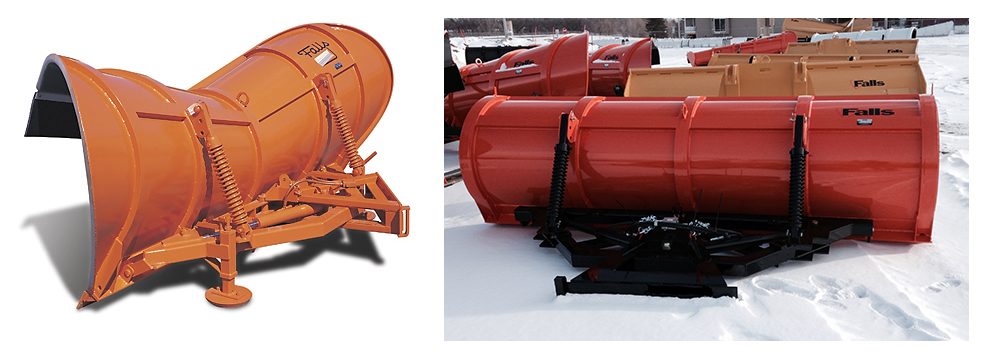
Half of the reversible batwing-style plow, pictured at left, was combined with half of the reversible bulldozer-style plow, pictured at right.
Half of the reversible batwing-style plow, pictured at left, was combined with half of the reversible bulldozer-style plow, at right.

District 8 Willmar Maintenance Supervisor Dennis Marty said he was looking for a reversible-style plow that could be used in the heavy winds and reduced visibility from blowing snow that are prevalent in western Minnesota.

When drivers are plowing against a northwest wind in rural Minnesota, the snow coming out of the chute will sweep across the truck and blind drivers, so operators needed a plow with a reversible system so they could throw the snow with the wind.

While an express plow with chutes on both ends (batwing-style), pictured above at left, was great for throwing snow to the right, when snow plow drivers took it down narrow two-lane roads, the plow stuck 2.5 feet into the oncoming lane and its big barrel partially blocked the headlights and the operator’s view.

So operators tried a regular one-way plow (pictured below), which resembles a funnel laid on it side, and put it on a reversible system that would allow operators to turn the plow both directions, so it could throw snow to the right or the left. However, this plow couldn’t blow snow high enough to the left, so snow piled in the left traffic lane.

One-way reversible plow.

Marty said he spent four to five years looking for a plow that combined the batwing and bull-dozer designs, but he couldn’t find anything sturdy and maintenance-free enough. Finally, he and Maintenance Research Program Administrator Ryan Otte sat down with Falls Plows in Little Falls, Minnesota and asked the company to build one.

The plow will be useful on low-volume roads that have little traffic during the middle of the night, which allows plow operators to cast the snow with the wind.

The Willmar office began using the experimental plow last winter and will be replacing all of its plows with it. Snow plow drivers from other areas of the state have been so impressed that at least two other maintenance districts have also ordered them.

Related Research

MnDOT’s Office of Maintenance has its own research program designed to let maintenance personnel test innovative ideas to keep our roads smooth, snow-free and safe. They even put out a monthly bulletin featuring new ideas and technologies. (You can find the back issues here.)

Other winter maintenance research projects are featured in MnDOT’s 2011-2013 Maintenance Operations Research Report  (PDF, 9 MB, 98 pages)

How Better Sign Management Could Save Minnesota Millions

Replacing traffic signs at the right time is an important science.

Waiting too long can endanger lives and expose an agency to a lawsuit. But replacing traffic signs prematurely could cost a single city tens of thousands of dollars per year.

If fully implemented, new recommendations developed by MnDOT and the Local Road Research Board (LRRB) could save public agencies as much as $41 million over three years by helping them better manage their signs and meet new federal requirements on retroreflectivity without replacing signs prematurely. Here’s how:

Reducing Inventories

At a purchase price of $150 to $250 a piece, plus $20 per year for maintenance, the cost of an unnecessary traffic sign adds up. (Maintenance costs involve replacing signs that have been vandalized, knocked down, or that no longer meet required levels of retroreflectivity.)

In a case study of townships in Stevens County, Minnesota, researcher Howard Preston found that nearly a third of traffic signs were not required and served no useful purpose. The average township has 180 signs, which results in an annual maintenance cost of $3,600. The average county has 10,000 signs — an annual maintenance cost of $200,000.

Public agencies could save a collective $26 million* just by removing unnecessary or redundant signs from the field, Preston said. A traffic sign maintenance handbook developed by the LRRB and MnDOT guides agencies through that process.

Longer  Lives

Traffic signs have more life in them than the typical 12-year manufacturer’s warranty, Preston said. But how often agencies replace them varies throughout the state.

Whereas small municipalities may replace signs on an individual basis through spot-checking for retroflectivity, MnDOT has a schedule. Each of the agency’s 400,000 signs is replaced within 18 years of installation.

Preston found that MnDOT could safely extend the service life of its signs to 20 years, which would save an estimated $1.3 million within the first few years of implementation.

Assuming (in lieu of a research-backed benchmark) that local municipalities would likely start replacing signs around the 15-year mark to ensure compliance with the federal law, Preston estimates that townships, cities and counties could avoid a collective $6 million in unnecessary costs per year just by adhering to the minimum 20-year replacement schedule recommended by the study.

Agencies are required by federal law to have a method in place for ensuring that signs maintain adequate retroreflectivity. A replacement schedule based on science is one way; regular physical inspection is another.

Researchers, who consulted other state’s studies and also examined signs in the field, determined that the life of the modern sign in Minnesota is at least 20 years.

It’s possible that traffic signs actually retain their retroreflectivity for 30 years or more, but further study is needed since sheeting materials on today’s traffic signs haven’t been deployed long enough to know, researchers say.

A test deck at the MnROAD facility will track the condition of Minnesota signs over the next decades — and perhaps push the  recommended replacement cycle longer.

*This figure  and the $41 million total above account for cost savings calculated over an initial, three-year period. Ongoing cost savings thereafter may be different, according to Preston.

Related Resources

Sign Maintenance Management Handbook (PDF, 13 MB, 119 pages)

Traffic Sign Life Expectancy study

Auto-Flaggers Keep Road Crews Safe, Save MnDOT Money

Like a traditional flagger, an Automatic Flagger Assistance Device directs drivers through work zones and other problem areas. But whereas traditional flagging requires workers to stand dangerously close to moving traffic, AFADs can be operated remotely, keeping the flaggers out of harm’s way.

“This is a very risky environment from our employees,” MnDOT Research Services Project Advisor Alan Rindels said. “Any flagger you talk to can recount a time he or she had to jump in a ditch to avoid a vehicle.”

Using a remote control, a single worker can easily operate two AFADs simultaneously, freeing up personnel to perform other tasks and speed up the completion of a road project. MnDOT estimates that the resulting cost savings can cover an AFAD’s purchase costs within two years.

MnDOT recently undertook a pilot implementation of three sets of AFADs, introducing them to maintenance staff and identifying the most appropriate situations for their use. Researchers reviewed past AFAD use in Minnesota, observed traditional flagger and AFAD operations in action, interviewed MnDOT maintenance personnel about their experiences and held two hands-on training sessions that were attended by more than 60 people.

Results showed that drivers obeyed the AFAD instructions and that AFADs work well for stationary construction projects. These successful demonstrations should encourage the wider use of AFADs and enhance worker safety in a cost-effective way.

MnDOT Research Services & Library produced the video above, which details the experiences of a MnDOT road crew who recently started working with AFADs.

(Bonus: Watch MnDOT flagger Joe Elsenpeter talk about jumping into a ditch to avoid being hit.)

*Note: This blog post was adapted from an article in the latest issue of our newsletter, Accelerator. Click here to subscribe.

Related Resources

Decoding the Deicers

The results of last season’s deicing study are in — just in time for our next snow.

Last winter, Minnesota State University researcher Steve Druschel set up experimental lanes at two Shakopee entertainment parks and a test site on a Mankato bridge to examine the life cycle of winter maintenance, from plowing and the application of chemicals to the drainage of chemical residue after the roadway has been treated.

What the Study Found

  • The majority of chloride appears to leave the roadway by plow ejection, vehicle carry-away or tire-spray spreading, rather than through storm drainage, even in warmer storms.
  • Pavements don’t hold chloride very long in a precipitation event, even after anti-icing/pre-treatment.
  • Deicer effectiveness. Warmer temperatures provide more melt from the deicer. Little melt was observed below
    10 degrees Fahrenheit unless sunlight provided warming, and prewetting produced no significant difference in deicer performance.
  • Dry pavements may be better candidates for pretreatment, with researchers noting that any wetness on the pavement ahead of a storm limited anti-icer effectiveness.
  • Truck traffic after deicer application was found to significantly improve deicer performance, resulting in both a wider and quicker melt.
  • Plow effectiveness. Even with different snow and temperature conditions, the evaluation of plow speed provided the same findings: snow rises higher in the curvature of the plow at higher speeds, creating a broader spray off the plow ends, and higher speeds decrease scrape quality.
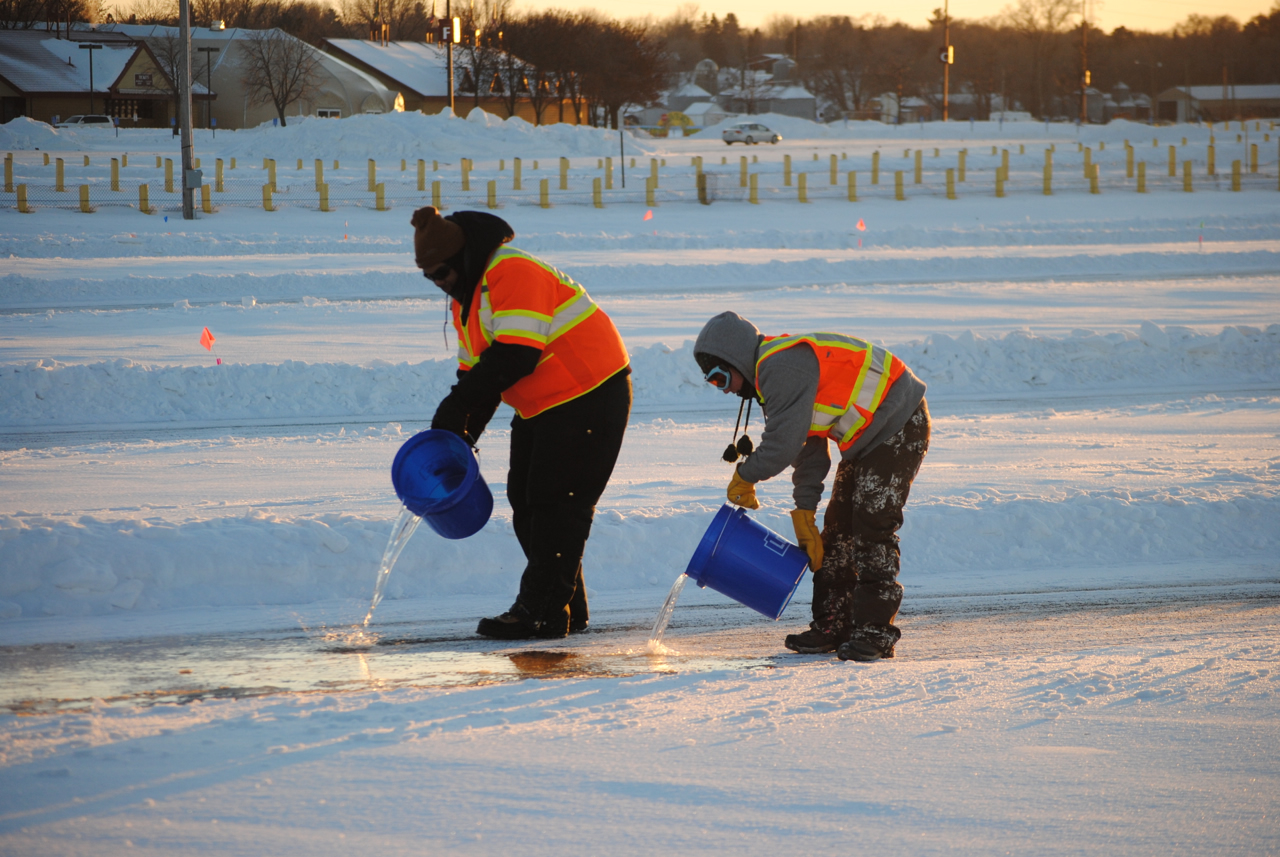
Students pour water to form ice on a test lane in Shakopee.

What’s Next?

The research team has proposed a third phase of this project to continue their work in the field, which is expected to include further examination of the impact of truck traffic on deicer effectiveness, variations in plow setup and expanded testing under varying weather conditions and snow structure.

Related Resources

Field Effects on Deicing and Anti-Icing Performance – Technical Summary (PDF, 1 MB, 2 pages); Final Report (coming soon)

Salt Brine Blending to Optimize Deicing and Anti-Icing Performance –Technical Summary (PDF, 1 MB, 2 pages) and Final Report (PDF, 11 MB, 151 pages) (previous study)