All posts by mndotresearch

New Project: Creating a Tool to Estimate Bridge Construction Time and Costs

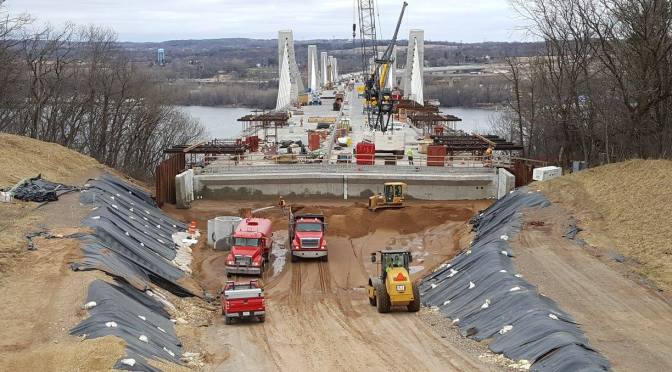
MnDOT recently executed a contract with WSB & Associates Inc. to begin work on a research project titled “Bridge Construction Time and Costs.”

The research project will help the State of Minnesota’s Bridge Office develop a guidance document and a tool for bridge construction time estimation to be used by MnDOT District project managers and construction staff. The tool will provide a range of production rates based on specific design criteria, being more concise based on the level of information available and will aid in evaluating the potential benefit for accelerated bridge construction (ABC) techniques.

“This research will enable District project managers, who may not have bridge knowledge or background, to complete project planning and scoping more effectively,” said Paul Johns of MnDOT’s Office of Construction and Innovative Contracting.

Mike Rief of WSB & Associates will serve as the project’s principal investigator. Johns will serve as technical liaison.

According to the initial work plan, the project is scheduled to be completed by early March 2018, and WSB & Associates will complete the following tasks:

  1. Conduct an existing practices literature review of current departments of transportation processes around the United States for bridge time and cost estimation.
  2. Review and compile actual case study bridge construction production rates and cost data for major bridge components from state-provided diaries, schedules and bridge plans.
  3. Evaluate and select the best software format and style for a bridge construction time estimation tool. Load state case study production rate data into estimation tool and run validation using bridges currently under construction.
  4. Produce a research report summarizing the literature review on best practices. Produce a user guide for bridge time estimation tool and training presentation.
  5. An optional task, if the budget allows, will include the development of a cost estimating tool. Cost estimation data would be gathered from the literature review and case study analysis during the development of bridge construction time estimation tool for efficiency.

Using SMART-Signal Data to Predict Red Light Running at Intersections

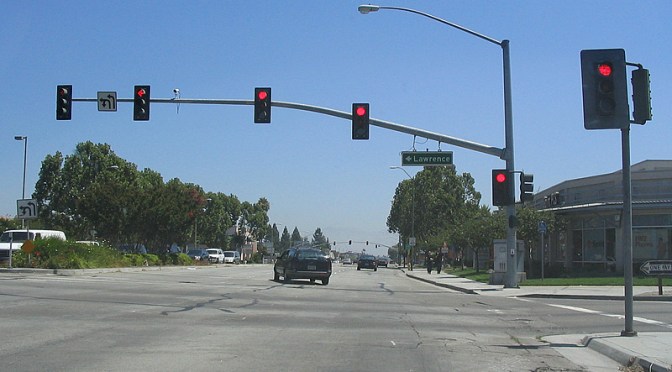
This project developed a methodology using traffic data collected by the SMART-Signal system to identify intersections prone to red light running and, therefore, serious crashes. This methodology could help MnDOT prioritize intersections for safety improvements.

“The essence of this project was to develop a toolbox that traffic engineers can use to determine an intersection’s safety performance,” said Henry Liu, Research Professor, University of Michigan Transportation Research Institute.

Liu served as the study’s principal investigator.

“This research provides a way to classify intersections that have a higher potential for red light running,” Mick Rakauskas, Former Research Fellow, HumanFIRST Program, University of Minnesota

What Was the Need?

Engineers traditionally measure an intersection’s safety using the number of crashes that actually occur there. However, collisions are rare and somewhat random events, and it can take a long time to collect enough data to accurately assess a single location’s safety.

Traffic conflicts—“close calls” in which one or both drivers must brake, swerve or take some other evasive action to avoid a crash—happen much more often than collisions do. As a result, many research projects use traffic conflicts as an alternative measure of safety.

Red light running (RLR) is one of the most common and dangerous causes of traffic conflicts at signalized intersections. While not every RLR event leads to a collision, it is often the first step in a process that ends in one.

Additionally, crashes caused when drivers run red lights are typically right-angle crashes, which are frequently severe. About 45 percent of right-angle collisions result in injury compared to about 25 percent of other crash types. Reducing right-angle-crash frequency can therefore significantly improve overall road safety and reduce costs related to traffic collisions.

MnDOT’s Safety Group wanted to determine whether it was possible to objectively and automatically identify intersections where RLR events are most likely to occur. Developing a methodology to identify the most dangerous intersections would help MnDOT prioritize locations for safety improvements.

What Was Our Goal?

Several previous MnDOT research projects had developed the SMART-Signal system, an automatic system that collects data from traffic signal controllers at signalized intersections. MnDOT has installed the system at more than 100 intersections in the Twin Cities. This project sought to develop tools that use SMART-Signal data to evaluate safety performance at intersections.

What Did We Do?

flowchart
This flowchart shows the methodology for determining whether an RLR event will result in a crossing conflict.

Researchers analyzed SMART-Signal data collected at the intersection of Boone Avenue and Trunk Highway 55 (TH 55) in Golden Valley between December 2008 and September 2009. This intersection is equipped with both stop-bar detectors and advance detectors located about 400 feet upstream of the intersection. Researchers used stop-bar-actuation data and details about traffic signal phases to identify RLR events at the intersection.

However, since most intersections are equipped only with advance detectors, this method cannot be used to measure RLR events at all intersections. As an alternative, re-searchers used vehicle-speed and traffic-volume data from the advance detectors, along with recorded traffic-signal-phase information from SMART-Signal, to identify potential RLR events. They compared these potential events to actual RLR events identified using stop-bar data and developed a formula to predict whether an RLR event would occur. This formula can be applied at intersections of major and minor roads that are not equipped with stop-bar detectors.

Researchers then used data from a minor road to develop a method that identified whether an RLR event would lead to a traffic conflict. In this method, an intersection is first divided into four conflict zones (two in each direction). When a vehicle from the main road enters the intersection, the method enables researchers to calculate when the vehicle enters and leaves each of the conflict zones it passes through. Then they determine whether a vehicle from the minor road is in the same conflict zone. Using this methodology, researchers estimated the number of daily traffic conflicts at other inter-sections on TH 55. These estimates were based on data collected in 2009 and between 2012 and 2015.

Finally, researchers developed a regression model to evaluate whether adding the number of predicted traffic conflicts to a more standard model that used average annual daily traffic (AADT) would correlate with the number of actual collisions at that site. They evaluated the model using data from seven four-legged intersections and two T-intersections on TH 13 and TH 55.

What Did We Learn?

The formula for predicting RLR events matched observations 83.12% of the time, based on more than 2,000 data points.

The number of daily crossing conflicts at TH 55 intersections ranged from 7.9 (at Glenwood Avenue in 2009) to 51.2 (at Winnetka Avenue in 2013).

While limited data were available for the regression model (as no site had more than four years of SMART-Signal data available, and there were only 11 crashes in total), the model suggests that estimated average traffic conflicts and minor-road AADT both contribute to accurate prediction of right-angle-crash frequency, while major-road AADT does not. Due to the limited data available, however, these conclusions should be considered preliminary.

What’s Next?

While there are currently no plans for follow-up studies, additional research efforts could include continuing to evaluate and improve the prediction model as more data are collected, and installing video cameras at intersections to validate the proposed methodologies.


This Technical Summary pertains to Report 2017-08, “Estimation of Crossing Conflict at Signalized Intersection Using High-Resolution Traffic Data,” published March 2017. 

AVL Technology Enables Smarter, More Efficient Mowing Operations

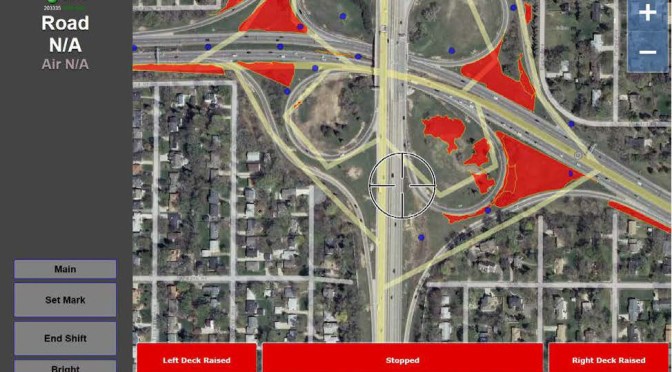
A pilot project was begun to study the use of AVL technology in mowing operations. Potential benefits include improved mowing efficiency, improved reporting and ease of supervision, reduced paperwork and reduced spread of noxious weeds.

“Using the data we get from the AVL project, we can estimate how long it will take to mow the entire system,” said Douglas Maki, Asset Management Engineer, MnDOT Metro District. “That way, we can plan far in advance of major holidays, when the most traffic comes through our system.”

“The AVL technology can be used to mark newly disruptive weed locations and anything else a mower operator might see, like potholes, damaged signs or guardrails, and excessive or dangerous debris in the field,” said Adrian Potter, Senior Associate, SRF Consulting Group, Inc.

Potter served as the project’s principal investigator.

What Was the Need?

MnDOT is responsible for mowing roadsides along 14,000 centerline miles of highways for environmental and safety reasons. This is an enormous and critical task, requiring efficient use of employee time and mowing equipment, and efforts to avoid the spreading of noxious weeds, which will lead to increased use of herbicides.

A promising technology that many departments of transportation (DOTs) have installed is automated vehicle location (AVL). AVL systems provide a precise geographic location for DOT-owned vehicles so that real-time data can be obtained on field operations. This technology has been used for snowplowing and other fleet vehicle operations. However, only a few DOTs have used it for mowing operations.

To determine if AVL technology should be used in its
mowing operations, MnDOT undertook a pilot project involving 30 of its mowers. The locations chosen were Metro District roadsides, as MnDOT had previously invested in creating a geographic information system map of noxious weeds on those roadsides.

What Was Our Goal?

The goals of the pilot project were to:

  • Generate protocols for hardware installation and software training.
  • Set up the system for communicating data from the mowers to internal MnDOT servers.
  • Develop accomplishment reports based on data collected by the AVL units.
  • Develop and provide initial training to operators and supervisors.
  • Optimize the mower routes used.

What Did We Do?

For the 2015 and 2016 mowing seasons, researchers fitted 30 Metro District tractors with AVL technology, sensors and communication equipment.

The first stage of the project focused on developing the software interface required for the AVL system. The application had to provide a view of the mower’s exact location so that the mower operator could avoid noxious weeds. Data would be collected through an in-vehicle controller unit and transferred to MnDOT for analysis via a Verizon AirCard system installed on each mower.

Mechanics installed metal racks within each of the 30 mowers to protect the Ameritrak AT-500 AVL hardware unit. A video screen was mounted on the top of the rack. A reporting system was developed for use by operators, supervisors and managers. Training sessions were scheduled at the start of each season and when new operators were hired.

Interior view of mower cab showing location of AVL unit.

What Did We Learn?

The project achieved its initial goals of developing protocols for hardware and software, creating electronic reporting and capturing real-time data.

The research team gained the following insights during the planning and field-testing stages of the project:

  • Substantial time is needed to adequately develop and test the AVL software and hardware.
  • Implementing the system also requires considerable time due to resource limitations, and after implementation, it takes multiple mowing seasons to quantify weed and herbicide reductions.
  • MnDOT mower operators and supervisors recognized the value of the AVL system in improving the efficient use of their time, eliminating the drafting of written reports, and giving MnDOT a more accurate record of acreage mowed.
  • Since the tractors operated at such slow speeds, the initial data captured were too imprecise to analyze. But with software adjustments, this issue was resolved.
  • Installation of the AVL unit could have an impact on the operation of the tractor because the additional electrical burden that the unit places on the tractor battery may require the tractor to be sent to the manufacturer for inspection.

What’s Next?

The initial success of the pilot project provided the basis for continued use of AVL technology in Metro District mowing operations during the 2017 season and possibly beyond. MnDOT is currently evaluating whether this project has provided enough data to expand AVL to other districts in the state. The investigators estimate that after full implementation, MnDOT could save $100,000 per year.

MnDOT may consider installing AVL technology in other agency equipment to optimize and monitor maintenance activities.


This Technical Summary pertains to Report 2017-11, “An Innovative Approach to Smarter Mowing, Utilizing Automated Vehicle Location to Enhance Mowing Operations,” published April 2017.

Additional materials:

Choosing Effective Speed Reduction Strategies for Roundabouts

Using survey results and prior research, this project developed a new resource to enable Minnesota local road engineers to select appropriate speed reduction measures for roundabouts. Further research is needed to determine the relative effectiveness of different measures alone and in combination.

“Although roundabouts are becoming common, single-vehicle crashes from drowsy, inattentive or unfamiliar drivers are still a concern, particularly in rural areas,” said Joe Gustafson, Traffic Engineer for Washington County. “This project provides an overview of existing speed reduction treatments that have been used in both roundabout and nonroundabout contexts, and a framework to properly evaluate the effectiveness of new treatments.”

“Rather than try to identify the right combination of treatments, the research was designed to give engineers a variety of options to consider for a given location,” said Susan Chrysler, Senior Research Scientist, Texas A&M Transportation Institute.

Gustafson served as the technical liaison for the study, and Chrysler was the principal investigator.

What Was the Need?

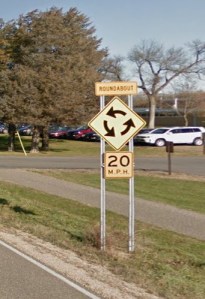
2017-14-p1-image

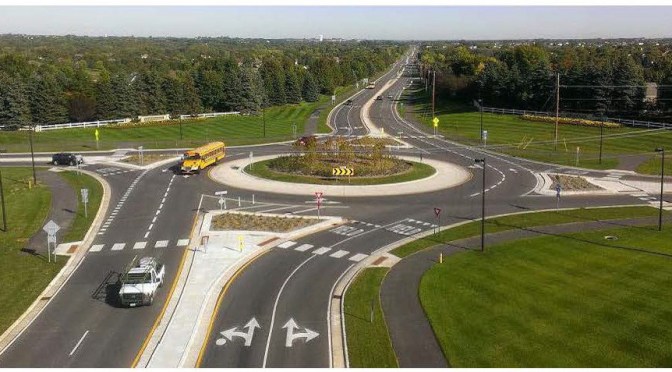
Roundabouts can provide a safer alternative to traditional intersection control devices like traffic signals and stop signs. Roundabouts have been proven to reduce crash severity by requiring drivers to decrease speed during the approach to the intersection. But failure to slow down sufficiently could result in a crash.

Signs and markings are key treatments used to communicate to drivers that they must slow down as they approach the roundabout. When navigated appropriately, roundabouts can eliminate or reduce the severity of crashes, reduce delays and reduce fuel consumption.

What Was Our Goal?

This project had two goals: to analyze existing research and conduct a survey of roundabout design and installation practitioners to determine best practices; and to develop a resource that engineers can use to identify appropriate speed reduction treatments for high-speed approaches to roundabouts.

What Did We Do?

Investigators surveyed transportation engineers from Minnesota and other states, along with technical consultants, to learn their experiences managing roundabouts with high-speed approaches. The survey addressed geometric design parameters and traffic control methods, changes in maintenance practices, crash history and speed reduction measures that were considered or eventually enacted.

Previous research on the subject was studied, including the Federal Highway Administration report Roundabouts: An Informational Guide and National Cooperative Highway Research Program Report 672: Roundabouts: An Informational Guide, Second Edition. Design manuals from four states were reviewed to provide a sample of the material avail-able to practitioners seeking guidance on design of high-speed roundabout approaches.

Based on their research, investigators provided information on the effectiveness of various treatments and on their installation and maintenance costs. They also developed a methodology for conducting a speed study to assist engineers in determining the most effective treatment for a given intersection. Treatments for alerting drivers that a round-about is ahead include traditional signs, pavement markings, illumination and other indicators, plus advanced devices like speed-activated, LED-enhanced warning signs.

What Did We Learn?

Each roundabout presents unique challenges. Local road engineers need to evaluate the characteristics of the intersection being considered (such as geometric design and adjoining land use) and the costs of installation and maintenance before recommending a specific treatment or combination of treatments.

Other findings include the following:

  • Speed reduction techniques found effective for horizontal curves, urban-rural transition zones and isolated rural intersections should be effective for rural roundabouts with high-speed approaches.
  • In rural locations, speed reduction treatments that have been used at railroad crossings, T-intersections and work zones may also be applicable to roundabouts.
  • Some unique treatments used internationally hold promise, but further study is needed before these treatments can be recommended for use in the United States.

What’s Next?

This study was the first phase of research. The findings provide the methodology to select, install and evaluate treatments at different locations. Further research is needed to accomplish the following:

  • Analyze the effectiveness of speed reduction treatments at different locations
  • Determine the impact of different combinations of treatments
  • Establish the comparative benefits of two or more treatments that fall within the same general cost and maintenance grouping
  • Analyze the impact of roundabout infrastructure (such as gateway treatments and illumination), various pavement markings and the long-term effects of specific signing treatments.

This Technical Summary pertains to the LRRB-produced Report 2017-14, “Strategies for Effective Roundabout Approach Speed Reduction,” published May 2017. 

Self-propelled auto-flagger keeps workers out of traffic

Working with a Minnesota manufacturer, researchers developed a moving automated flagger assistance device (AFAD) that signals traffic at work zones. The AFAD is operated remotely by a worker who can stand off the roadway out of traffic.

“Everybody who has used the mobile AFAD has liked it. We love our stationary AFAD unit. These units have really big stop-slow signs—they’re so visible,” said Jeremy Gjovik, Transportation Operations Supervisor, MnDOT District 3.

“The AFAD is a one-of-a-kind device. We were able to basically start from scratch and come up with a device that meets all the needs it was designed for,” said Edward Terhaar, Principal, Traffic Engineering, Wenck Associates, Inc.

Terhaar served as the principal investigator for the study.

What Was the Need?

According to data from the U.S. Bureau of Labor Statistics, 149 roadway workers were killed nationwide from 2003 to 2015 while flagging or directing traffic, and many near misses have been reported with the increase in distracted driving that has come with mobile device use.

In 2014, MnDOT trained over 60 state and district maintenance workers in the use of an automated flagger assistance device (AFAD). The AFAD has been embraced in Minnesota as a highly visible device that effectively directs traffic in stationary maintenance and construction projects while keeping flagging personnel off the road during operation.

The AFAD does not, however, suit moving operations (like pavement crack sealing) because the device requires towing. Engineers at MnDOT wanted to determine if the AFAD could be made into a mobile device that could be operated by a road crew near, but not on, the roadway.

What Was Our Goal?

MnDOT funded this research to develop a self-contained, self-propelled mobile AFAD for use on moving work zone roadway projects.

What Did We Do?

2017-09-p2-imageResearchers met with MnDOT engineers to identify the features that would be required in a moving AFAD. They determined that the device would have to be towable to a construction site with standard towing gear, operable remotely through wired or wireless controls, movable forward and in reverse, and able to use rechargeable onboard batteries.

The research team investigated existing self-propelled devices from the United States, Canada and Australia for moving wheeled objects, large and small, to see if they could be adapted to these needs. No suitable device was found.

After further consultation with the Technical Advisory Panel, researchers approached DJ Products of Little Falls, Minnesota, a company that designs and manufactures devices (including battery-operated devices) for moving trailers, dumpsters, shopping carts and aircraft.

Researchers met with DJ Products in February 2015, reviewed its products and agreed that DJ Products would develop a prototype vehicle on which the AFAD could be mounted. In August 2015, after evaluating and modifying designs, DJ Products hosted a demonstration of the prototype vehicle without the AFAD attached. The research team requested modifications, and in April 2016, the company presented a new self-propelled device with the AFAD attached.

What Did We Learn?

Initial field testing was delayed due to seasonal weather issues and device operating problems that required the replacement of components. In February 2017, a MnDOT operator tested the mobile AFAD on a crack-sealing project on State Highway 71 south of Sauk Centre.

The moving AFAD can be operated with a wired or wireless controller, as well as with controls on a handlebar mounted on the vehicle. Operators must use one remote for moving the wheeled unit, and the remote from the original AFAD for sign messaging. The new device moves forward and backward, can be towed with a standard hitch, and employs onboard batteries and a charger.

Setup and takedown require more effort than conventional flagging, but this effort is not considered cumbersome. The moving AFAD can be operated by one person standing 400 feet or more off the roadway, and the device is large enough to be easily seen and understood by road users.

The new device was used for only one hour initially. The sealing crew was outpacing the moving AFAD because the crack-sealing project entailed few repairs with greater distance between repair locations than is typical of such projects.

What’s Next?

The moving AFAD device can be used as is, and is still being tested by MnDOT. Further modifications will be requested, including enhancement of the battery-powered unit, as it currently requires a battery change to operate through an entire work shift.

Steering and controller design will likely be modified. Currently, the moving AFAD operates like a rear-wheel-drive vehicle and must be steered from its rear-wheel, traffic-facing axle, forcing the remote operator to guide it up the road as if backing up a boat trailer. MnDOT operators may ask that the device be redesigned to be steerable from the traffic-leading end of the vehicle, as if it were pulling the signage up the road, allowing for more intuitive control.

MnDOT personnel would also like to see the device’s controller integrated with the sign controller, eliminating the need for two controllers—one for moving, the other for operating the sign. Nevertheless, the device appears to be a promising option for mobile AFAD use by an operator who need not stand on the road to direct traffic.


This Technical Summary pertains to Report 2017-09, “Development of a Moving Automatic Flagger Assistance Device (AFAD) for Moving Work Zone Operations,” published March 2017. 


Previous research:

ATM Queue Warning Systems Can Reduce Freeway Crashes

ATM queue warning systems were developed and deployed on two freeways to alert motorists to queuing conditions ahead that could lead to rear-end crashes. At one test site, the prototype system substantially reduced crashes and near-crashes. At the other site, it reduced speed variances.

“The big lesson learned was that the detection method had to function quickly and display a message that was timely and accurate. This gains the trust and confidence of the motoring public,” said Brian Kary, Freeway Operations Engineer, MnDOT Metro District.

“Deploying the product of this research was not difficult. The challenge came in closing the gap to alert the drivers to slow down,” said John Hourdos, Director, Minnesota Traffic Observatory, University of Minnesota.

Kary served as the technical liaison for the study, and Hourdos was the principal investigator.

What Was the Need?

To reduce congestion and improve safety, MnDOT has deployed active traffic management (ATM) technology on two highways in the Twin Cities freeway network. The ATM system incorporates intelligent lane control signals (ILCS) placed over selected lanes at half-mile increments to warn motorists of incidents or hazards ahead. With advance warning, drivers can slow down and possibly avoid crashes.

The deployed system, however, does not specifically target the prevention of rear-end collisions, which are the most frequent type of crashes on freeways. Research has shown that rear-end collisions tend to occur during extended lines of stop-and-go traffic and at end-of-queue locations. Overhead, real-time electronic messages that warn of queuing conditions ahead can prepare motorists to reduce speed and avoid potential rear-end collisions. Such messages have the added benefit of improving mobil-ity since fewer crashes will improve traffic flow.

What Was Our Goal?

This project sought to develop and field-test two different prototypes for ATM queue warning systems. One prototype would address stop-and-go traffic and end-of-queue situations. The other would address shock waves, a crash-facilitating condition where there is a sudden change in traffic movement that causes a cascade of braking. The long-range goal of the project is to develop a unified ATM queue warning system that can be deployed at other locations within the freeway network.

What Did We Do?

Development of two prototype high-resolution ILCS warning systems began in 2014. The systems were then deployed on two high-traffic freeways in the Twin Cities: one on Interstate 35 West (I-35W) and the other on I-94. Both were still in operation in mid-2017.

The two locations have significantly different traffic conditions. On I-35W, congestion creates expanding queues that extend from the Trunk Highway 62 (TH 62) interchange to the 50th Street overpass. At the I-94 location, crashes are most likely to occur due to shock waves that can often quickly develop near the Portland Avenue overpass.

2017-20-p2-imageTo capture traffic data, researchers used either live video from closed-circuit-camera detector stations or data from existing in-pavement loop detectors. The ILCS units dis-played the message Slow Traffic Ahead, which would direct drivers to reduce speed due to the congested lanes ahead. Other messages, such as Prepare to Stop or Traffic Ahead 10 MPH, were considered but not tested during this initial study.
A server installed at the Minnesota Traffic Observatory at the University of Minnesota archived the time and location of each queue on I-94 and measured its duration and length. This provided the data needed to develop two algorithms that can be used to develop a rear-end-collision warning system that can be installed at freeway locations where similar queuing conditions exist.

What Did We Learn?

The data collected show that warning messages delivered by the ATM system can be effective in alerting drivers to queuing conditions. The ultimate benefit is a reduction in rear-end collisions in downstream locations on the freeway.

Data recorded at the I-35W location revealed that:

  • Messages delivered by the ILCS system helped drivers maintain a steady speed and eliminate stop-and-go travel.
  • The contents of warning messages should be crafted to have an impact on all motorists. Drivers responded differently to specific messages.
  • Queue warning systems can be made more effective through deployment of a real-time, lane-specific ILCS system and collection of high-resolution data.
  • Some drivers did not always heed the first queue warning message to decrease speed, but they did slow down further along the roadway.
  • There was no significant difference in impact between warning messages issued during the morning peak travel period and those issued during the evening peak.

In the first three months of queue warning system operation, the crash frequency re-corded at the I-94 test site was 9.34 crashes per vehicle miles traveled (VMT) and 51.8 near-crashes. This was a 22 percent decrease from the 11.9 crashes per VMT recorded at the site in 2013 monitoring data, and a 54 percent decrease from the 111.8 near-crashes recorded there in 2013.

The research showed that to prevent potential collisions, the ATM system had to deliver messages quickly and accurately to give drivers enough time to adjust their speeds. Also, the control algorithms developed in this project can provide the queue-estimation projections needed by MnDOT and other transportation departments to enhance the effectiveness of their ATM systems.

What’s Next?

While the deployment of the two queue warning system prototypes was a relatively cost-effective option, a longer trial period of two to three years is needed to ensure that the ATM system delivers sustainable benefits.


This Technical Summary pertains to Report 2017-20, “Development of a Queue Warning System Utilizing ATM Infrastructure System Development and Field Testing,” published June 2017. 

Seven Pilot Projects to Change Transportation Practice in Minnesota

Roadside fencing that protects endangered turtles, a toolkit for identifying potentially acid-producing rock and a device that could save MnDOT $200 million a year in pavement damage are just a few of the advancements that MnDOT hopes to make in the near future, thanks to seven recently funded research implementation projects.

Each spring, the governing board for MnDOT’s research program funds initiatives that help put new technology or research advances into practice. This year’s picks aim to improve the environment, reporting of traffic signal data, notification of lane closures and the design and quality of pavements.

Here’s a brief look at the projects (full proposals here):

Protecting the Environment and Wildlife

  • To avoid the leaching of potentially acid-generating rock during excavation projects, MnDOT hopes to develop a GIS-based risk-screening tool that identifies areas where PAG rock might be encountered. Guidance will be developed for identifying and handling PAG rock.

Found in bedrock throughout the state – especially northern Minnesota, PAG minerals can release acid upon contact with air or water, a danger to aquatic and human life.

“Anytime we dig, there is the potential to expose this stuff,” said Jason Richter, chief geologist.

  • Reducing roadway access for small animals, including endangered turtles, is a priority for MnDOT and the Minnesota Department of Resources. MnDOT will analyze the effectiveness of different types of small animal exclusion fences tried across the state and develop a standard set of designs for future projects.
Improved Reporting of Traffic Signal Data
  • A centralized hub of traffic signal data could benefit future vehicle-to-infrastructure (V2I) applications and assist with the modeling of transportation project impacts. Methods and tools will be developed for a regional database of intersection control information that extracts data from MnDOT’s recently acquired Central Traffic Signal Control System and soon-to-be adopted Signal Performance Measure application.
Real-Time Notice of Lane Closures
  • In this pilot project, 20 MnDOT arrow board messages will be equipped with technology that automatically reports lane closures on 511 and highway message boards, providing more timely motorist notification.
Longer-Lasting Roads and Improved Quality Control
  • This summer, a new quality assurance device called the Rolling Density Meter will be deployed on several pavement projects, eliminating the need for destructive sample cores.
    “This is the ultimate in compaction control,” said Glenn Engstrom, Office of Materials and Road Research director. If contractors obtain the right level of density when paving asphalt roads, MnDOT could eliminate $200 million per year in premature road failure.
  • In 2018, MnDOT plans to require Intelligent Compaction (a pavement roller technology that reduces workmanship issues) on all significant asphalt projects. A vehicle-mounted mobile imaging device will be piloted that collects necessary supportive roadway alignment data, without the need for survey crews.
  • Upgrades to MnDOT’s pavement design software, MnPAVE, (incorporating recycled unbound and conventional base material properties) will help increase the service life of Minnesota roads.

MnROAD Breaks New Ground

In June, MnROAD, the only cold-weather accelerated pavement testing facility of its kind in North America, begins construction on its third phase of research since 1994, the first time MnDOT has rebuilt in partnership with other states.

Dozens of new experiments are planned along MnROAD’s test tracks in rural Albertville: the high-volume original Interstate-94 westbound (built in 1973), the mainline I-94 westbound (originally opened in 1994) and an adjacent low-volume road closed track.

Six states and numerous  industry partners recently formed the National Road Research Alliance (NRRA) to co-sponsor  the reconstruction.

NRRA-prioritized research will support state and local needs, including effective use of fiber-reinforced concrete, asphalt overlays of concrete pavements, cold central plant recycling and concrete partial depth repairs to name a few.

MnROAD has two 3.5 mile test segments on Interstate 94 and one closed 2.5-mile low-volume road.

“The advantage of having these test  sections at MnROAD is we can take  bigger risks and push the envelope in terms of mix designs and layer thicknesses for both asphalt and concrete  layers that could not be done on a public roadway,” MnDOT Research Operations Engineer,   Dave Van Deusen said.

Forensic analysis of failed cells
Many old test cells will be dug up.  Before any reconstruction starts, however, each test section that is being reconstructed will receive a final forensic study. This allows researchers a look at each layer to see the distress that has occurred over the years—and make the final analysis of why it failed. There are always a lot of theories on the causes of what actually failed, but until the forensic is performed, there isn’t proof on what happened. These findings will help build longer-lasting pavements in the future.

The bid letting date for this year’s construction is April 28, but plans were made available for contractors on March 31. This should give the projects more exposure and generate more interest. Construction begins June 5 and continues until November 2017.

Focus Areas

  • HMA overlay and rehab of concrete and methods of enhancing compaction – States are looking for longer lasting HMA overlays of concrete. New mix designs were developed to promote long-term performance, including how reflective cracking effects can be minimized through design or other joint treatment.
  • Cold central plant recycling – Other states have used reclaimed asphalt pavement stockpiles into plant mix base course mixes (layers below the wear surface) to effectively recycle these materials in a controlled mix design. How can these layers best be used and what type of surface mix or chip seal can be placed on top?
  • Fiber reinforced concrete pavements – Nationally, states want to get a better understanding of the beneficial use of fibers in concrete pavement layers. Is it worth the cost? How can it be best used in both thin city streets and higher volume roadways? Can it be used in new construction and in concrete overlays? The research will provide the answers.
  • Long-term effects of diamond grinding – Each state has aggregates that have been used in concrete pavements that are considered reactive aggregates. Questions arise as to whether diamond grinding might accelerate deterioration in these pavements. What types of topical sealers can be used to treat the surface after the diamond grinding will also be tested.
  • Early opening strength to traffic – What effect does heavy traffic loading have on the long-term performance of full-depth concrete pavement, as well as fast–setting repairs? Test sections will be loaded by a pickup truck in one lane early enough to produce shallow ruts in the surface. In the other lane, a loaded 18-wheeler will travel over the new concrete immediately after it sets, and then sequentially every six hours up to 30 hours. The long-term effects of these early loadings will then be evaluated.
  • Optimizing the mix components for contractors – What effect do low-cementitious content mixes have on long-term performance and constructability of concrete pavements?  Two low cementitious content mixes will be studied to give agencies a better understanding of cost savings. Can these savings be achieved without significantly affecting long-term performance?
  • Compacted concrete pavement for local streets – Compacted concrete pavement is a form of roller compacted concrete that has a standard concrete pavement surface texture. The RCC industry has been successful in Michigan and Kansas constructing CCP pavement on local streets.  This research will determine if the texture that is accomplished is durable in harsh freeze-thaw climates.
  • Recycled aggregates in aggregate base and larger sub-base materials – States continue to look for effective ways to recycle materials into unbound bases. This research will add to MnROAD’s understanding of recycled bases and what seasonal strength values can be used for advanced mechanistic designs–and how they are affected by size/gradation.
  • Maintaining poor pavements– Road owners continually have less funding to maintain their roadway systems. What practices should be used for stabilizing both hot mix asphalt and Portland cement concrete roadways when longer-term repairs cannot be done due to funding levels?
  • Partial depth repair of concrete pavements – Agencies continually seek improved materials and methods for the repair of concrete pavements. In this study, up to 15 innovative concrete pavement repair materials will be evaluated on the concrete panels of the westbound I-94 bypass parallel to the MnROAD mainline.
  • Thin overlays-Experimenting with very thin overlays could provide a real benefit for a lot the roads currently out there. The premise is that with thin overlays, the ride can be smoother and the life of older roads can be extended.

“We don’t often get to reconstruct random roads these days, and when we do, we have much better specifications for low temperature cracking. By the same token, we have to maintain all those older roads built before we had performance grade binders,” said Dave Van Deusen, Materials and Road Research Lab principal engineer. “We will be doing this makeover on an original section of MnROAD built back in the 90’s.”

In one experiment, there is a head-to-head comparison of thin overlays on two sections of road. One section has a thick base and subbase under the asphalt. The other has a heavy asphalt top with very little base.

Van Deusen says if they can get an extra five years of life out of road using thin overlays, he would be pleased. Often, he admits, he is surprised by how long these “short-term” fixes actually last.

Stay up-to-date on construction by signing up for email alerts at mndot.gov/mnroad.  

A Look at Local Bridge Removal Practices and Policies

Many local agencies in Minnesota lack funding to construct and maintain all the bridges in their roadway network. One way to lower costs is to reduce the number of bridges.

In Minnesota, some township bridges are on roads with low usage that have alternative accesses for nearby residents, but local officials are reluctant to remove the bridges.

To identify possible changes to how redundant and low-use bridges are identified and removed in Minnesota, the Local Road Research Board conducted a transportation research synthesis, “Local Bridge Removal Policies and Programs,” that explores how other states make bridge removal decisions.

Fifteen state DOTs responded to a survey about their processes, with varying levels of state oversight identified for bridge removal decisions. Researchers also examined funding and incentives offered by some DOTs to local agencies for bridge removal, as well as criteria for considering bridge removal.

A literature search of bridge design manuals, inspection manuals and bridge programs was also conducted to identify related policies and programs.

Read the TRS to learn more about the various bridge removal policies and procedures in place in Minnesota and other states.

New Study: Experimental Shear Capacity Comparison Between Repaired and Unrepaired Girder Ends

MnDOT Research Services recently executed a contract with the University of Minnesota to begin work on a research study titled “Experimental Shear Capacity Comparison between Repaired and Unrepaired Girder Ends.”

The research will determine if a bridge repair to the TH 169 Nine Mile Creek Bridge near Edina and Minnetonka was sufficient to restore the original strength of a girder end in shear. Load testing to failure will be conducted on two repaired girder ends and two unrepaired girder ends that will be removed from the bridge. Objectives include a comparison of the failure load between the repaired ends and the unrepaired ends. The test results also will provide some answers to questions on whether shotcrete is a structural repair or if it is just a covering over of deterioration.

Carol Shield, professor at the University of Minnesota’s Department of Civil Engineering, Civil, Environmental, and Geo- Engineering, will serve as the research project’s principal investigator. Paul Pilarski, MnDOT bridge engineer, will serve as the study’s technical liaison.

According to the initial work plan in the contract, the project is scheduled to be completed by the end of March 2018.

Background

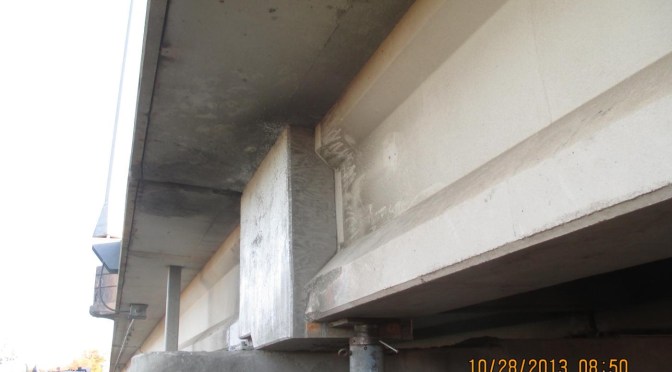
Over time, the south bound exterior girder ends on each side of Pier 4 and Pier 26 of the TH 169 Nine Mile Creek Bridge have suffered significant corrosion damage that exposed shear reinforcement, exterior flange prestressing strands, and the sole plate anchorages. Girder ends were repaired in September 201 3 by encasing a 4-foot length of the end using a system of dowels, additional shear reinforcement, and shotcrete. The bridge is scheduled for replacement in 2017.

There is interest in determining if the repair was sufficient to restore the original strength of the girder end in shear. Load testing to failure will be conducted on two repaired girder ends and two unrepaired girder ends that will be removed from the bridge. Objectives include a comparison of the failure load between the repaired ends and the unrepaired ends.

Project Objective

The ability to effectively repair corrosion damaged girder ends extends the useful life of prestressed concrete bridges. These repairs are significantly less expensive than replacing the bridge. Repairing bridges is also beneficial to the traveling public as travel is not interrupted, or interrupted for a significantly shorter time than for bridge replacement. Experimentally demonstrating that the repair restores the girders up to the design strength enhances the safety of the bridge and provides MnDOT with a documented substantiated repair method that can be applied to other bridge girders in a similar state.

Project Scope

When the southbound lanes of the TH 169 Nine Mile Creek Bridge are taken out of service, the contractor will remove four prestressed girders from the structure and deliver the south ends of them to the University’s Department of Civil Engineering Theodore V. Galambos Structures Lab. Two of the girders will have ends that have been repaired. The other two girders will be of the same shear design but will not have been repaired, nor show significant signs of corrosion. Once at the Galambos Laboratory decks will be cast on the girders. One end of each girder will be tested to failure using a setup designed to precipitate a shear failure. Failure loads between the repaired and original undamaged girder ends will be compared. The development of crack patterns under load will also be documented to further understand the behavior of the repair.

Assistance

MnDOT will make arrangements for transportation of the girder ends to the University’s Civil Engineering Building. MnDOT will request that the contractor provide weights of the cut girders prior to delivery. MnDOT will make arrangements with the contractor to take concrete cores from the short end of the cut girders and provide the existing bridge bearing pads. MnDOT will provide calculations for determining the required deck width and concrete strength to avoid a flexural failure.