All posts by Christine Anderson

Engaging the next generation of the transportation workforce

In July, CTS introduced the next generation of the workforce to transportation topics and careers during a two-week summer program. Thirty students entering seventh through ninth grade attended the CTS-hosted National Summer Transportation Institute, where they got hands-on experience with topics ranging from distracted driving to aeronautics to traffic management.

As part of the program, attendees toured campus, visited the U of M’s transportation-related labs, and learned tips on researching, studying, public speaking, and writing. In addition, participants learned about many aspects of transportation, including human factors, roadway safety, bridge design, surveying, and traffic simulation.

This slideshow requires JavaScript.

The camp also included outings to several MnDOT facilities, UPS, Metro Transit, the Minneapolis–St. Paul International Airport, the Minnesota Transportation Museum, and boat tours of the St. Croix River Crossing construction site and St. Paul Port Authority.

Highlights for attendees included riding the light rail and going behind the scenes in a Metro Transit control room, watching airplanes take off and exploring maintenance equipment at the airport, getting up close to bridge construction on the St. Croix River Crossing boat tour, and using a driving simulator to learn about distracted driving at UPS.

“I really enjoyed using the driving simulators,” said one of the ninth-grade program participants. “It was a hands-on experience that truly taught me the dangers of texting while driving and how much harder it really is.”

In post-program evaluations, parents reported that their children had learned valuable information about transportation topics, careers, and related education opportunities.

“This was one of the best camps we have ever experienced,” one parent said. “There was always a plan for college, and this program increased enthusiasm, preparedness, and maturity.”

“[The program] opened up my daughter’s horizon for future career choices and major focus areas after high school,” another parent said.

The program was sponsored by CTS with funding from the Federal Highway Administration administered by the Minnesota Department of Transportation (MnDOT).

To learn more, read the full article in the August issue of Catalyst.

Salt-tolerant sod and seed mixes bring greener roadsides to Minnesota

For Minnesota’s roadside grasses, life isn’t easy. To survive, grass must be able to withstand extreme stresses including drought, heat, disease, soil compaction, poor quality soils, and high levels of road salt. Ideally, it could survive all that while still looking lush and green.

“Many roadsides, especially in metropolitan areas, need to look good,” says Eric Watkins, associate professor in the Department of Horticultural Science. “In addition to aesthetics, quality roadside vegetation is needed to prevent erosion and maintain water quality from roadside runoff.”

In 2010, MnDOT noticed a number of its new sod and seed plantings were failing and asked U of M experts to take a look at its specification. “We saw the problem immediately,” Watkins says. “The specification was for a mix with a lot of Kentucky bluegrass, which needs a great deal of care and watering. There was clearly an opportunity for improvement.”

During the next several years, Watkins’ team, led by former graduate student Josh Friell, worked to identify the best seed and sod for use along Minnesota’s roadsides in research sponsored by the Minnesota Local Road Research Board and MnDOT. Findings are now available in a final report.

The study was completed in several stages. First, many different types of cool-season grasses were planted in the fall and assessed the following spring to determine their ability to establish and survive on roadsides in Minnesota. Next, researchers looked at the salt tolerance of those grasses.

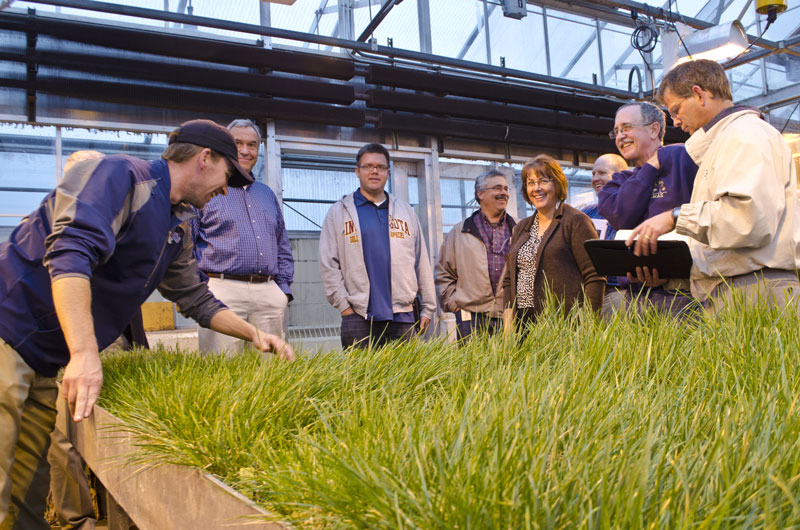
Eric Watkins (third from left) leads a greenhouse tour of grass mixtures.

“In cold-weather climates like Minnesota’s, salt tolerance is required because of the application of deicing salts in the winter,” Watkins explains. “To determine if a grass species could stand up to this stress, we applied different levels of salt solution to the different grass species in a greenhouse. We identified several types of fescue grass as the most salt tolerant.”

Based on the results of the first two stages, researchers developed and tested 50 different grass mixtures along Minnesota’s roadsides and evaluated the survival and performance of those plantings for two years. In addition, each mixture was planted under a movable rain-out shelter to determine drought tolerance. This phase of the study resulted in the identification of a mix of three types of fescue for planting on roadsides in Minnesota.

Finally, researchers needed to find out if the new grass mixture would work as sod (sod growers need to be able to harvest it properly from their sod fields). “Most sod currently grown in Minnesota is Kentucky bluegrass, which isn’t the best for winter survival when salt stress is a problem,” says Watkins. “We grew 51 different grass mixtures as sod for 22 months and found that contrary to popular belief, fine fescue mixtures produced sod of acceptable strength for harvest.”

MnDOT has applied the research to standard specifications for construction activities for salt-tolerant sod products, salt/shade/drought-tolerant turf seed mixtures, and a third-party certification program for ensuring performance standards are met based on past and current research results, says Dwayne Stenlund, MnDOT erosion control engineering specialist. Researchers are also working with the state’s sod growers to produce sod grown from the new seed blends.

Moving forward, the researchers plan to continue their work to improve Minnesota’s roadside grass plantings. “The reality is that the success of sod or seed plantings depends on a number of factors, including time of year, amount of water, soil preparation, temperature, and sod harvest depth,” Watkins says. “In our next project, beginning this spring, we will identify the most important factors for the success of roadside plantings and sod cultivation, and then help MnDOT update the specifications for managing new installations.”

Minnesota Bicycle and Pedestrian Counting Initiative highlighted in FHWA case study

Work on bike and pedestrian counting by University of Minnesota researchers and MnDOT has been highlighted as part of the FHWA’s Livable Communities Case Study Series.

The case study features the Minnesota Bicycle and Pedestrian Counting Initiative, led by the U of M’s Greg Lindsey and MnDOT’s Lisa Austin and Jasna Hadzic. Under the initiative, the team has developed general guidance and consistent methods for counting bikes and pedestrians. Team members have also worked with other state and local agencies to implement counting strategies across Minnesota.

The case study showcases the initiative as an example of how agencies can leverage partnerships to implement a successful counting program for nonmotorized traffic. These traffic counts can help agencies identify safety concerns, understand and communicate benefits of active transportation, prioritize investments, and analyze trends. According to the FHWA, the results can help inform decisions that make biking and walking viable transportation options in livable communities.

Read the case study on the FHWA Livability website.

Travel behavior study shows drivers are spending less time traveling

Something unprecedented has happened to Americans’ travel patterns. Even before the recent recession, total distance traveled per person had started to decline, and the rate of total vehicle travel had begun to steadily decrease as well.

In a new five-part series of research reports sponsored by MnDOT and the Metropolitan Council, University of Minnesota researchers are delving into a set of rich data encompassing more than four decades of travel behavior surveys to enable the region’s transportation planners to better understand how its residents make decisions about whether, when, where, and why to travel.

In the first study, researchers examined how changes in the accessibility of destinations—such as jobs, shopping, and leisure activities—have changed travel behavior in the past 20 years.

“We started with a detailed analysis of travel surveys conducted by the Metropolitan Council in 1990, 2000, and 2010,” says David Levinson, the study’s principal investigator and RP Braun/CTS Chair in the Department of Civil, Environmental, and Geo- Engineering. “We found that people are spending slightly less time in motion and more time at home. We also found that accessibility is a significant factor in determining not only travel behavior but overall time budgeting in general. In short, each person has to decide how they will use the time allotted to them each day, and many of those decisions are directly related to the transportation and land-use systems in place.”

A deeper look into the data sheds additional light on the relationship between accessibility and travel behavior. For example, trip durations for workers have gone up for all activities between 1990 and 2010. More noticeably, distances for trips have increased markedly: workers take jobs farther from their homes and shop farther from their homes. Travel speeds also increased for the average worker, due to more travel on faster suburban roadways that carry a larger share of all travel. In contrast, for non-workers, trip durations and overall travel time have gone down.

“Interestingly, although time, distance, and speed per trip has generally risen for workers, the number of those trips is declining,” Levinson says. “As a result, overall, fewer miles are being traveled and less time is being allocated to travel.”

Total time spent shopping also decreased for workers and for males, likely caused in part by an increase in online commerce. “The Internet has provided electronic accessibility, much as the transportation network has in the material world,” Levinson explains. “It helps to facilitate commerce, communication, education, and leisure. This may lead to a decreased need for people to travel, and account for more time spent at home.”

Jonathan Ehrlich, planning analyst with the Metropolitan Council, says the research “helps us get more value from our travel surveys and will aid in understanding how travel is changing, and what the risks are in the assumptions and models we use for planning and forecasting.”

The findings will prove useful not just for Twin Cities transportation planners but for planners and engineers worldwide. “Our models can be easily adapted to data from other cities or for other activities besides work,” Levinson says. “This creates an approach that can be used to gauge the impact of a transportation project from an accessibility standpoint and determine how that project will translate into time allocation.”

Other parts of the study will look at changes in telecommuting behavior over time, the effect of transit quality of service on people’s activity choices and time allocation, changes in travel behavior by age cohort, and analysis of bicycling and walking in light of land-use and transportation system changes.

Crossroads will feature coverage of these projects as they are completed.

Winter seminars highlight research on work-zone safety, culvert design, and more

Join us in person on the U of M campus or tune in online to the CTS winter research seminars. The seminars will highlight a sampling of the latest transportation research at the U of M.

Here’s this year’s seminar schedule:

Each seminar will be held in Room 50B at the Humphrey School of Public Affairs. Or, if you can’t make it in person, you can watch the seminars live online or view recordings posted after the events. For details about the live broadcasts, see the individual seminar web pages.

There’s no cost to attend, and each seminar qualifies for one Professional Development Hour.

Hope to see you there!

New permitted left-turn model helps improve intersection safety

In recent years, the transportation community has introduced significant changes to improve left-turn safety at signalized intersections—and for good reason. Nationally, intersection crashes represent one-fifth of all fatal crashes, and most of these are crashes involving left turns.

In response to this serious safety problem, the FHWA has adopted a new national standard for permissive left turns: the flashing yellow arrow. This signal warns drivers that they should proceed with a left turn only after yielding to any oncoming traffic or pedestrians. Flashing yellow arrow signals can help prevent crashes, move more traffic through an intersection, and provide additional traffic management flexibility.

Many transportation agencies, including MnDOT, are interested in using the new flashing yellow arrow signals to accommodate within-day changes: protected left turns (signaled by a green arrow) could be used when needed to lower crash risk, while permitted left turns (signaled by a flashing yellow arrow) could be used to reduce delay when crash risk is low.

“Of course, this requires being able to predict how the risk of left-turn crashes changes as intersection and traffic characteristics change within the course of a day,” says Gary Davis, a professor of civil, environmental, and geo- engineering at the University of Minnesota.

To help engineers make more informed decisions about when to use flashing yellow arrows, Davis is leading the development of a model that could help predict the probability of left-turn crash risk at a given intersection at different times of day. This model—which will ultimately be available as a set of spreadsheet tools—will help traffic engineers determine when the crash risk is sufficiently low to allow for the safe use of flashing yellow arrows. The project is sponsored by MnDOT and the Minnesota Local Road Research Board.

To develop the statistical model, the researchers needed to determine how the risk for left-turn crashes varies depending on time of day, traffic flow conditions, and intersection features (such as number of opposing lanes, number of left-turn lanes, and median size). The process included developing a database containing left-turn crash information, intersection features, and traffic volumes, as well as developing a set of 24-hour traffic pattern estimates to help fill gaps where hourly traffic volume counts were not available. The resulting statistical model uses this information to determine relative crash risk for every hour of the day at a given type of intersection.

Currently, Davis and his team are using the model to develop a spreadsheet tool that will allow traffic engineers to choose their type of intersection and enter the available turning movement count. The tool will then generate a specialized graph for that intersection showing the relative crash risk by time of day. Any time the crash risk is at or below the level identified as acceptable, engineers can consider using flashing yellow arrows.

“By simulating how crash risk changes as traffic conditions change, this model could help identify conditions when permitted left-turn treatments would be a good choice and what times of day a protected left turn might be a better option,” Davis says.

Moving forward, Davis is leading an additional project related to the use of flashing yellow arrows, funded by the Roadway Safety Institute. The project will first review video data of drivers making permitted left turns to characterize left-turn gap acceptance and turning trajectories. Then, Davis will incorporate the findings into the existing statistical model. To further improve the model’s accuracy, the study will compare the crashes described by the simulation model with reconstructed real-world left-turn crashes.

New crash report interface will improve usability and data quality

The data collected at the scene of a crash by law enforcement officers are important for more than just drivers and their insurance companies. The information is also used on a much larger scale by state agencies and researchers to analyze and evaluate crashes, trends, and potential countermeasures.

“Big decisions get made based on that data—million-dollar decisions,” says Nichole Morris, a research associate at the U of M’s HumanFIRST Laboratory. “So you have to be sure that what goes in to that report is high quality and reflects what actually happened at the scene of the crash.”

As part of an effort to improve this data quality in Minnesota, Morris is leading a team of HumanFIRST researchers in a project to redesign the electronic crash report interface used by law enforcement officers. The team’s goal is to create a new interface that improves the accuracy, speed, reliability, and meaningfulness of crash report data.police_guy

The project is occurring in conjunction with a redesign of Minnesota’s crash records database and is being sponsored by the Traffic Records Coordinating Committee (TRCC) at the Minnesota Department of Public Safety (DPS) and by MnDOT.

“In industry, they do this work all the time, looking at usability and design. But when you think about what a state does in terms of usability, nothing like this to our knowledge has ever been done. This makes it a very exciting and revolutionary project for Minnesota,” Morris says.

In the first phase of the project, the researchers completed a human factors analysis on the existing crash report interface to identify potential problem areas. This included a step-by-step task analysis and in-depth interviews with law enforcement officers.

During this process, the researchers identified several areas they hoped to improve. For instance, they wanted the new interface to be smarter, making better use of autofill features to reduce the amount of manual data entry.

Following the analysis, the team built two versions of a mock crash report interface for usability testing: a wizard and a form. In both versions, the researchers added decision aids to ease usability. They also significantly improved the system’s autofill capabilities, reducing the ratio of officer to system data entry from 6:1 to nearly 1:1.

The researchers then conducted four rounds of usability testing with law enforcement officers for both the wizard and the form. Results were split: half the officers preferred the wizard and half preferred the form. Because of these findings, the TRCC is planning to build full versions of both, Morris says, which will allow officers to use the version they prefer.

Going forward, the researchers plan to make a few more adjustments to the research prototype before handing it off to the state vendor, Appriss, which will build the new system. The team will then work collaboratively with Appriss to complete additional beta and usability testing before the new interface launches in January 2016.

“The results of the HumanFIRST prototypes are being combined with the vendor’s prior experience for a best-of-breed approach,” says Kathleen Haney, traffic records coordinator at DPS. “This is a fantastic project, and the results will be relevant for years to come.”

Read more about the project in the December 2014 CTS Catalyst.

Teen Driver Support System helps reduce risky driving behavior

Although teen drivers make up a small percentage of the U.S. driving population, they are at an especially high risk of being involved in a crash. In fact, drivers between ages 16 and 19 have higher average annual crash rates than any other age group.

To help teen drivers stay safe on the road, researchers at the U of M’s HumanFIRST Laboratory have been working for nearly 10 years on the development of the Teen Driver Support System (TDSS). The smartphone-based application provides real-time, in-vehicle feedback to teens about their risky behaviors—and reports those behaviors to parents via text message if teens don’t heed the system’s warnings.

TDSS provides alerts about speed limits, upcoming curves, stop sign violations, excessive maneuvers, and seat belt use. It also prevents teens from using their phones to text or call (except 911) while driving.

The research team recently completed a 12-month field operational test of the system with funding from MnDOT. The test involved 300 newly licensed teens from 18 communities in Minnesota.

To measure the effectiveness of the TDSS on driving behavior, the teens were divided into three groups: a control group in which driving behavior was monitored but no feedback was given, a group in which the TDSS provided only in-vehicle feedback to teens, and a group with both in-vehicle and parent feedback from the TDSS.

Preliminary results show that teens in the TDSS groups engaged in less risky behavior, especially the group that included parent feedback. These teens were less likely to speed or to engage in aggressive driving.

Although these results demonstrate that the TDSS can be effective in reducing risky driving behavior in teens, Janet Creaser, HumanFIRST research fellow and a lead researcher on the project, stresses that technology is not a substitute for parent interaction.

“The whole goal of our system is to get parents talking to their teens about safe driving.” Creaser says. “And maybe, if you’re a parent getting 10 text messages a week, you’ll take your teen out and help them learn how to drive a little more safely.”

Read the full article in the November issue of Catalyst.

Changing demographics and travel choices may shape a very different future

Though no one can predict the future, thinking about how today’s changes may shape the future of transportation in our country is more important now than ever before.

“It’s critical that we understand the significance of things that are taking place and prepare for what may come,” said former Utah Department of Transportation CEO John Njord in the opening session of the 25th Annual CTS Transportation Research Conference. “For us to be relevant in the transportation business, at a minimum we have to be adaptable to change, and ideally we want to be leading change in the transportation industry.”

In his current position at Tom Warne and Associates, Njord has gained an in-depth understanding of the trends affecting the future of transportation in the United States while spearheading the Transportation Research Board’s “Foresight” project—part of the organization’s forward-looking NCHRP Report 750 Series. The project addresses a wide range of topics, including: What if the oil-fueled auto era ends and revenue from gas taxes dries up? What if engineering practices must be upgraded to ensure resiliency to natural disasters as global warming continues? What if technology such as self-driving cars eliminates or reduces the need for human drivers? What if tomorrow’s economy requires radically different freight patterns?

Perhaps most significantly, the project explores the possibility that Americans are losing their appetite for driving. Vehicle-miles traveled (VMT) per capita been dropping since 2004, without any signs of recovery. “It’s impossible to know whether that number will start growing again, stay flat, or continue to drop,” Njord said.

Other trends make the future outlook equally complex. In 50 years the United States will likely be home to 100 million more people, so even if VMT per person stays flat or declines, it’s likely total VMT will be larger than it is today. The population is also aging: by 2030, 20 percent of the population will be over 65 and will likely drive less. In addition, Millenials are staying home longer and waiting until later in life to get married and have children—all of which affects their travel behavior.

To help transportation planners consider all possible futures, the Foresight project encourages the use of multiple-scenario planning. “We need to begin considering all the possible scenarios and generating plans that are independent and distinct from one another,” Njord advised. “The act of thinking about these things is fundamentally important, because the shift that is now taking place means we’re going to have to do things much differently in the next 50 years than what we’ve done in the past 50 years.”

Following Njord’s presentation, a panel of experts discussed how the the Foresight project could relate to what’s happening in the Twin Cities region. An article summarizing their comments is available in the July issue of Catalyst.

Primary seat belt law continues to save lives, money

Minnesota’s primary seat belt law continues to save lives and reduce serious injuries more than four years after being passed, according to a study by researchers at the U of M’s Humphrey School of Public Affairs.

The study examined Minnesota crash data collected from June 2009 (when the law was implemented) through June 2013 and compared it to expected data based on crash trends over time. Findings indicate that there were at least 132 fewer deaths, 434 fewer severe injuries, and 1,270 fewer moderate injuries than expected during this time.

According to the researchers, the safety benefits of the law translate into a savings of at least $67 million in avoided hospital charges, including nearly $16 million in taxpayer dollars that would have paid for Medicare and Medicaid charges.

The study was sponsored by the Minnesota Department of Public Safety and led by Humphrey School research fellow Frank Douma and Nebiyou Tilahun, a U of M graduate now on the faculty at the University of Illinois-Chicago.

The researchers also examined seat belt use data and survey results that measured support for the law. Findings show that support increased from 62 percent just before the law was passed to more than 70 percent in 2013, while the percentage of Minnesotans buckling up was at an all-time high of nearly 95 percent in 2013. This shows that some people are wearing their seat belts even though they don’t support the law.

When this increased seat belt use is combined with the reduction in fatalities and injuries, it further demonstrates that people are surviving—and even walking away from—crashes that may have had different results if the primary seat belt law had not been in effect.

Read the full article in the June issue of CTS Catalyst.