Tag Archives: transportation research

MnPASS: Two systems, both work

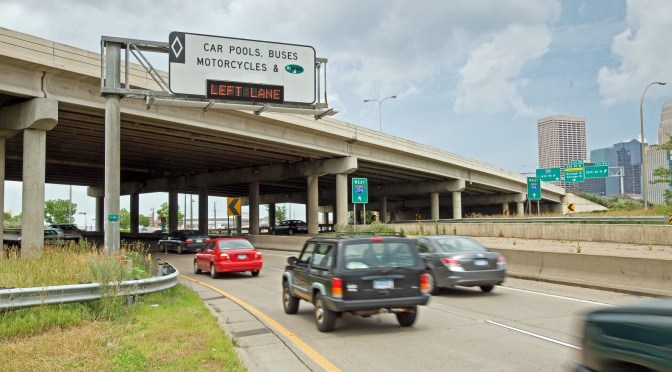
I-35W’s MnPASS lane, where vehicles can frequently enter and exit the high-occupancy toll lane, is just as safe as the MnPASS lane on I-394, where motorists only have a few shots to enter the system, a new study finds.

Researchers at the Minnesota Traffic Observatory undertook the MnDOT-funded study because of objections to open systems like the one on 35W.

“The federal government has very strong arguments against the open system. They’re saying it’s going to be dangerous – cause more disruption and more congestion,” said John Hourdos, director of the Minnesota Traffic Observatory. “We found that both roadways are working very well today because they were designed appropriately for their location.”

The definition of an open system is one that has more opportunity for access than restriction. On 35W, a dotted white lane means vehicles can enter the toll lane at will, and a solid line bars access.

Vehicles must have two occupants on-board or an electronic pay card to use the express lanes during rush hour.
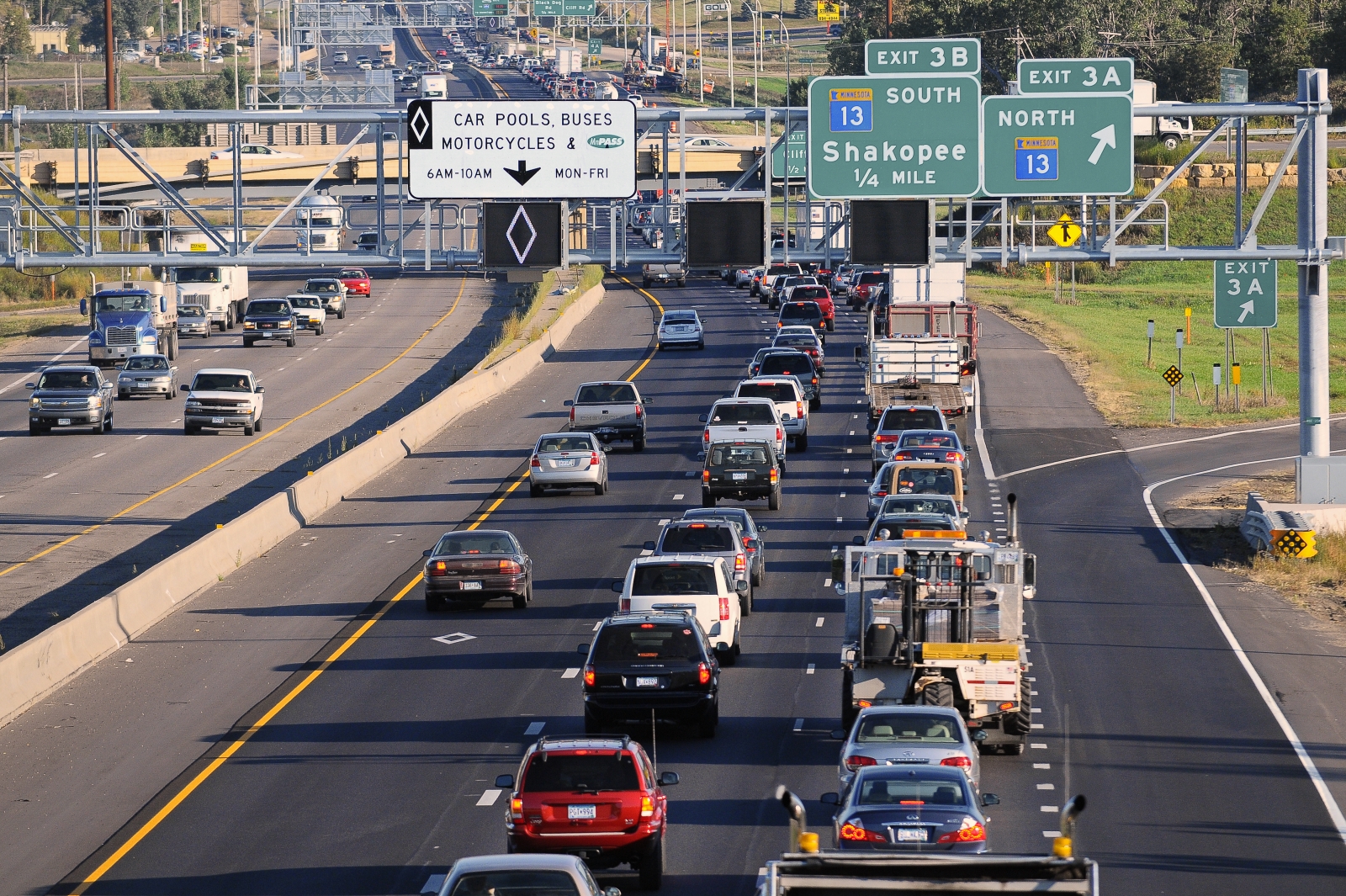
MnPASS on Highway 35W.

The reason I-35W allows vehicles to enter MnPASS more frequently than I-394 is because there are more ramps where new vehicles are entering the freeway and might want to get on MnPASS.

Researchers studied whether accidents are more likely to occur by studying the number of accident-inducing vehicle movements along the 35W corridor. They found that areas where accidents are mostly likely to occur are also where the lane would have to allow access anyway under a closed system like 394.

The study also looked at mobility, determining that MnPASS users have just as good free-flowing traffic under the open system.

Helpful tools

Researchers also created design tools that engineers can use to determine where access points should be on MnPASS lanes.

Until now, engineers have relied on rule of thumb. For example, the general guidance for allowing access on a closed system was 500 feet for every lane between the entrance ramp and the HOT.

The tools can be used to automatically determine how fluctuations in the MnPASS fee will affect congestion within the lane.

The fee to use MnPASS depends on the time of day.

As the express lane become more congested, the fee to use it increases. This slows the number of cars entering the lane, increasing the speed of the vehicles already in the lane.

“We ran the tool on three locations on 35W and found that, for example, on Cliff Road, you can increase the traffic by 75 percent and still be okay,” Hourdos said. “You have more leeway there than north of the crossroads of Highway 62 and 35W, for instance.”

 Related Resources

Peer Exchange: Pavement researchers face similar issues, financial pressures

Soaring construction costs and a rapidly aging infrastructure will require states to revolutionize how they maintain their roadways — but without each other’s help, they won’t be successful.

That was a key message from pavement researchers last week at a MnDOT-hosted peer exchange event, where pavement experts from around North America shared their ideas and research experiences.

“You’ve got to partner with other states, the FHWA and industry,” said Research Engineer Steve Bower of the Michigan Department of Transportation. “We can’t go it alone anymore.”

Researchers at the event reviewed recent pooled-fund studies conducted at MnROAD, MnDOT’s innovative pavement testing center, to review successful implementation strategies, develop common practices to calculate benefits and help prioritize research topics for MnROAD’s  core 2016 research and reconstruction.

The pavement engineers gathered for the event face similar problems in their home states, as demonstrated by the seven pooled fund projects that were discussed. These included developing a better understanding of pavement damage caused by oversized farm equipment, knowing when to chip seal a roadway, developing a test to predict asphalt cracking , creating a national design method for concrete overlays of asphalt roadways and improvements in diamond grinding of concrete pavements.

MnROAD leading the way

State research departments often lack the time or resources to focus on innovations that could reduce future maintenance costs. If not for Minnesota leading the effort on many of these topics and providing a top-notch research facility, the peer exchange attendees said much of this research just wouldn’t happen.

“We don’t have a closed-loop facility with all these different test sections that MnROAD has; no one does,” said Larry Wiser of the Federal Highway Administration’s Turner-Fairbank Highway Research Center.

Researchers came from Missouri, Maine, Texas, Illinois, Michigan, California, Ontario, Wisconsin, Indiana and Washington for the three-day workshop.

WisDOT Chief Materials Management Engineer Steven Krebs said the research done at MNROAD on the impact of modern farm implements on pavement was invaluable in drafting new state legislation. WisDOT was able to quantify the amount of damage done to the pavement and use the data to dispute mistruths and  misinformation. The state is now working with counties on possible remedies and weight-limit enforcement techniques.

Whereas Minnesota has taken the lead on studying such issues, it is now asking fellow states to not only participate in future such studies, but to also partner in the operations at MnROAD.  At the peer exchange, the response to this idea — especially from states closest to Minnesota — was positive, despite everyone’s lean budgets.

Peer exchange participants said more effort and funding is needed to implement research findings, which FHWA officials said costs significantly more than the research itself.

Past research also needs to be more accessible and there should be better sharing of information, particularly online, they said.

“This (peer exchange) gave us ideas to take back. Our research budget is getting tighter. It’s nice to be able to say, ‘You do a part of it and we’ll do a part of it,’ ” said California transportation researcher Joe Holland.

Further Resources

2014 Peer Exchange – Presentations

MnDOT looks for solution to noisy highway rumble strips

Rumble strips alert sleepy and inattentive motorists that they are about to veer off the highway or into the opposite lane of traffic. But the grating noise that prevents collisions can also be annoying to nearby residents.

Around Minnesota, more and more counties are facing push-back as they install shoulder rumble strips on roadways in populated areas. This is because county road shoulders are narrow — leading drivers to frequently hit the rumbles.

“There is a strong concern statewide that these noise complaints will raise enough concern that legislation may be passed reducing their use,” said technical liaison Ken Johnson of MnDOT’s Office of Traffic, Safety and Technology.

A European-developed style of rumble strip, called sinusoidal, could provide Minnesota a new means of warning drivers without as much stray highway noise.

Accident reduction

Rumble strips are patterns ground into asphalt that cause a vehicle to vibrate when its tires come close to the centerline or road edge. They help prevent lane departure crashes, which account for more than 50-percent of fatalities on the road system.

The sinusoidal rumble (below) has a sine wave pattern ground into the pavement, while the traditional rumble strip (top photo) doesn’t follow a wave pattern.

Photo courtesy of the Wirtgen Group
Creation of a Sinusoidal rumble strip. Photo courtesy of the Wirtgen Group

MnDOT’s Office of Traffic, Safety and Technology plans to test different designs of the Sinusoidal rumble strips to find the one with the highest level of interior vehicle noise and lowest level of exterior vehicle noise.

The navigability of sinusoidal rumbles by motorcycles and bicycles will also be evaluated. The project was recently funded with a research implementation grant from MnDOT’s Transportation Research Innovation Group.

If sinusoidal rumble strips are found to be effective, the chosen design will be used for centerlines and road shoulders in noise-sensitive areas throughout the state highway system. It is anticipated that counties will also adopt the design.

Unlike counties, most of MnDOT’s recent complaints have been for its centerline rumbles, which are required on all rural, high-speed undivided roads in Minnesota, Johnson said.

MnDOT has considered allowing more exceptions due to residential noise concern; however, doing so could result in more fatal and serious crashes. Sinusoidal rumbles are seen as a possible alternative for these noise-sensitive areas.

The Local Road Research Board is also studying different designs of sinusoidal rumble strips in Polk County.

GPS-equipped mowers to save money, reduce noxious weeds

Putting GPS units on MnDOT highway mowers is expected to speed mowing operations and cut herbicide usage by 50-percent in metro area ditches, reducing groundwater contamination.

MnDOT’s Metro District highway maintenance division will be one of the first — if not the first — state agencies in the country to equip the majority of its maintenance tractors with Automated Vehicle Location systems.

Not only will crews be able to effortlessly track their progress — reducing paperwork and freeing time for other maintenance activities — but the AVL’s live mapping software will help them avoid noxious weed patches, thereby reducing their spread.

Last year, MnDOT tested the GPS software on five mowers.

“AVL alone enables the tracking of vehicle positions, but when combined with equipment sensors and an on-board monitor with user interface, it becomes a very innovative way to reduce operation costs,” said MnDOT Project Engineer Trisha Stefanski, who applied for funding from MnDOT’s Transportation Research Innovation Group for the pilot project.

Vehicle tracking systems have been shown to reduce chemical usage by crop farmers, improve route efficiencies in truck driving and help cities and counties track snowplows.

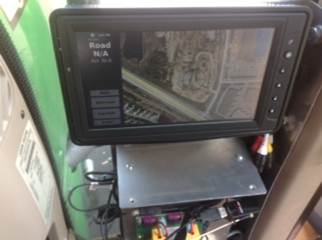
The on-screen mapping shows the location of weed patches, so mowers can avoid them, reducing their spread.

MnDOT Metro, which tested five AVL units last year, hopes to equip as much of its remaining fleet as possible.

In the grant application, Stefanski estimated the technology will pay for itself in about a year’s time, largely due to herbicide savings.

Noxious weeds

MnDOT is required by law to manage certain noxious weeds along its highways. Each year, weed inspectors survey one-quarter of metro ditches for weeds, which enables them to concentrate eradication efforts on the worst areas.

Touch-screen maps will contain the noxious weed locations so operators can see weed patches and mow around them.

Herbicide usage is estimated to drop an estimated $100,000 to $150,000 per year. (This estimate was based on the original funding request. Final numbers haven’t been released.)

Operators can use the on-screen map to mark the location of new patches of noxious weeds.

Noxious weeds like Wild Parsnip — which can cause painful skin boils — might even be eradicated, reducing the risk for field crews, such as construction workers and Adopt a Highway volunteers.

Until now, maintenance crews have relied on paper maps to identify weed locations, which is less effective.

“What’s better, looking at a live screen when you’re going down the road and seeing where weeds are coming up, or trying to refer to a piece of paper?” Stefanski said.

Other advantages

The AVL equipment will also allow for automated reporting.

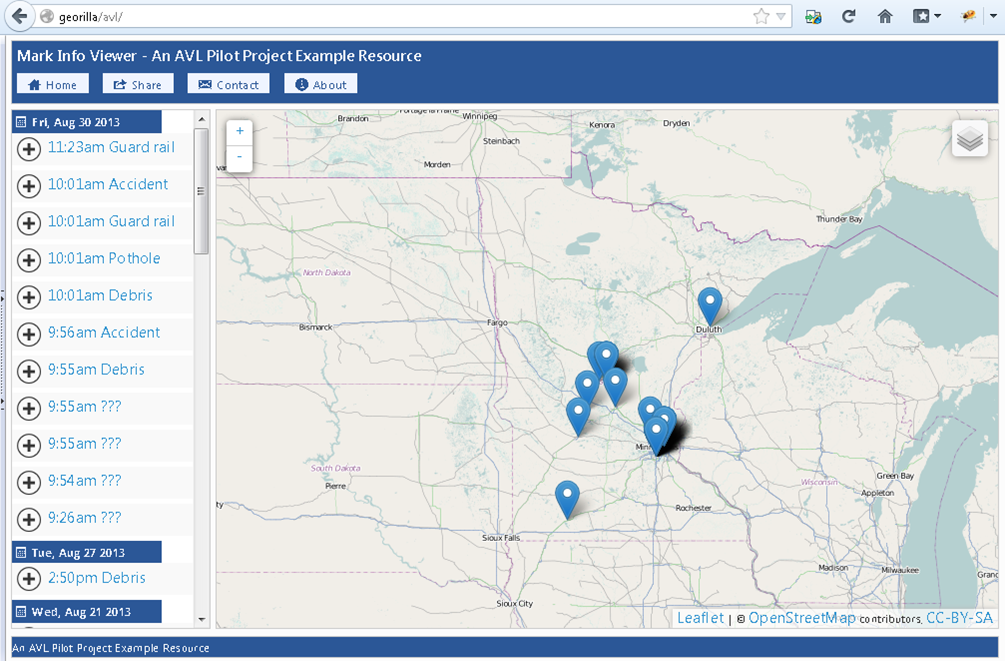
Mower operators can use the on-board AVL monitor to mark the location of guardrail hits, potholes, washed-out culverts, debris and unmarked noxious weeds.

Operators can electronically mark the location of guardrails, debris, potholes and more.

Currently, operators must track their activities using hand-written forms or spreadsheets in the office.

The AVL system will also automatically track their location history, allowing operators to optimize their routes based on how long it took to mow segments in the past.

It will also be easier to answer questions from the public, who want to know the last time a certain ditch was mowed.

“Making everything geographically located adds so much analysis opportunity,” Stefanski said.

MnDOT also has AVL technology on an herbicide applicator to better track where it’s sprayed. Other future potential applications including pothole patching and road sweeping operations, Stefanski said.

Research Drives Change At Rest Stops

In an effort to encourage more use of safety rest areas and reduce drowsy driving, the Minnesota Department of Transportation is bolstering amenities and plans to install new signage at select rest areas across the state.

Drowsy driving is conservatively estimated to cause at least 1,550 deaths nationwide each year and $12.5 billion in monetary damage.

Motorists would stop more frequently at rest areas if they knew what rest areas offered, according to market research completed in 2009.

MnDOT will design and install highway symbol signs to advertise the amenities at 13 rest areas in a pilot project funded by MnDOT’s Transportation Research Implementation Group.

“We are using this as a way to entice drivers to take a break, pull over and refresh before returning to the road,” said Robert Williams, MnDOT Safety Rest Area Program Manager and the project proponent.

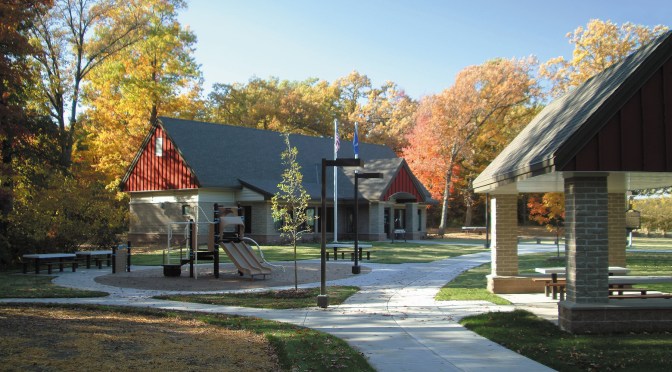
Rest areas in Brainerd and Cass Lake, Minn., can now offer a tourism-related gift shop, thanks to a change in state law.
Rest areas in Brainerd and Cass Lake, Minn., can now offer a tourism-related gift shop, thanks to a change in law.

Amenities differ greatly between rest areas within the state, as well as across the country; this depends on when they were built and whether they are located on an interstate, state highway or toll road.

Older, smaller rest areas may only have a bathroom and picnic area, while newer facilities often have features such as children’s play areas, staffed travel counters and dog runs.

In the future, the state may consider new amenities such as gift shops, adult exercise equipment to rejuvenate motorists, electrical vehicle charging stations and perhaps even electrification stations to allow truck drivers to power their TV or refrigerator without idling their vehicle.

Research has found that as the spacing of rest areas increases beyond 30 miles, the number of drowsy driving crashes goes up exponentially, Williams said.

Each sign will advertise up to six amenities.

Proposed Signage

Symbols on each sign will identify up to six amenities, such as in the example above, which depicts an assisted restroom, gift shop, ticket sales, EV charging stations, childrens’ playlot and adult exercise equipment.

MnDOT will evaluate the pilot project to determine if the symbol signs are effective in communicating to travelers the amenities offered at individual rest areas and if the signs were a factor that encouraged them to stop.

If the two-year project goes well, the state may add similar signs to the remaining 39 Class I safety rest areas (those rest areas equipped with flush toilets).

Some of the signs will require a request to FHWA for experimentation.  The intent is to install the signs in the summer of 2015 at rest areas on northbound I-35, eastbound I-94, as well as at the Brainerd Lakes Area Welcome Center on Hwy. 371.

Rest Area Offerings Increase

Although travelers and state DOTs would often like to introduce new amenities, state and federal laws limit what states can offer.

Toll roads and highways built before 1960 (the Interstate era), mostly in the East Coast or Chicago area, have fewer federal restrictions than rest areas in Minnesota and may feature restaurants or convenience stores.

Changes to Minnesota state law in 2005 and recent changes to federal law in MAP-21 now allow limited commercial activities, such as tourism-related gift shops and ticket sales at rest areas. MnDOT and its partners have taken advantage of some of these changes at its visitor centers in Brainerd/Baxter and Cass Lake.

In addition, the state is exploring the concept of using rest areas as transit transfer facilities, where long-distance bus carriers and regional transit lines can exchange passengers.

These transit hubs would shorten travel times for long-distance travelers and allow the rest areas to serve multiple functions while providing a comfortable waiting area for passengers.

Rest areas
Pilot locations are circled.

Flume research simulates Red River flooding to test road protections

Flooding in the Red River Valley is an almost annual occurrence, and the cost to roads, property and lives is huge.

Highway 1 gets torn up year after year, only to be rebuilt in time for next year’s flood, joke residents in the little town of Oslo, which becomes an island whenever the roads close.

While not much can be done to prevent swollen farm fields from overflowing, what if a road embankment itself could be bolstered to prevent physical damage to the underlying structure of the road?

“We can’t just raise the road because it would create backwater upstream,” explained JT Anderson, Assistant District 2 Engineer. “Our best bet is to let the water over-top the road and try to protect the road when it does.”

Researchers have built a flume inside the University of Minnesota’s St. Anthony Falls Laboratory to test six methods of embankment protection specific to the needs of towns like Oslo.

“It is not uncommon for one over-topping site to have a half-mile long stretch of road being damaged,” said university research engineer Craig Taylor. “One road being protected should cover the cost of the study and the cost of deploying the erosion control product for that road.”

Nationally, research of this kind has mostly been restricted to high-intensity flooding.

“Those really high-depth, short duration events, you can only protect an embankment with concrete and boulders,” Taylor said. “With longer duration, low-depth floods, we may be able to protect roads with soft armoring, like reinforced vegetation.”

The damage in northern Minnesota has been the worst on east-west roads, where the river flow runs perpendicular to the center of the road, causing the road to act like a dam and the water to jump at the edges.

“It eventually eats through that road embankment and makes the road collapse,” Anderson explained.

Researchers will examine how a cross-section of a road holds up under various erosion control methods at different levels and speeds of water-flow.

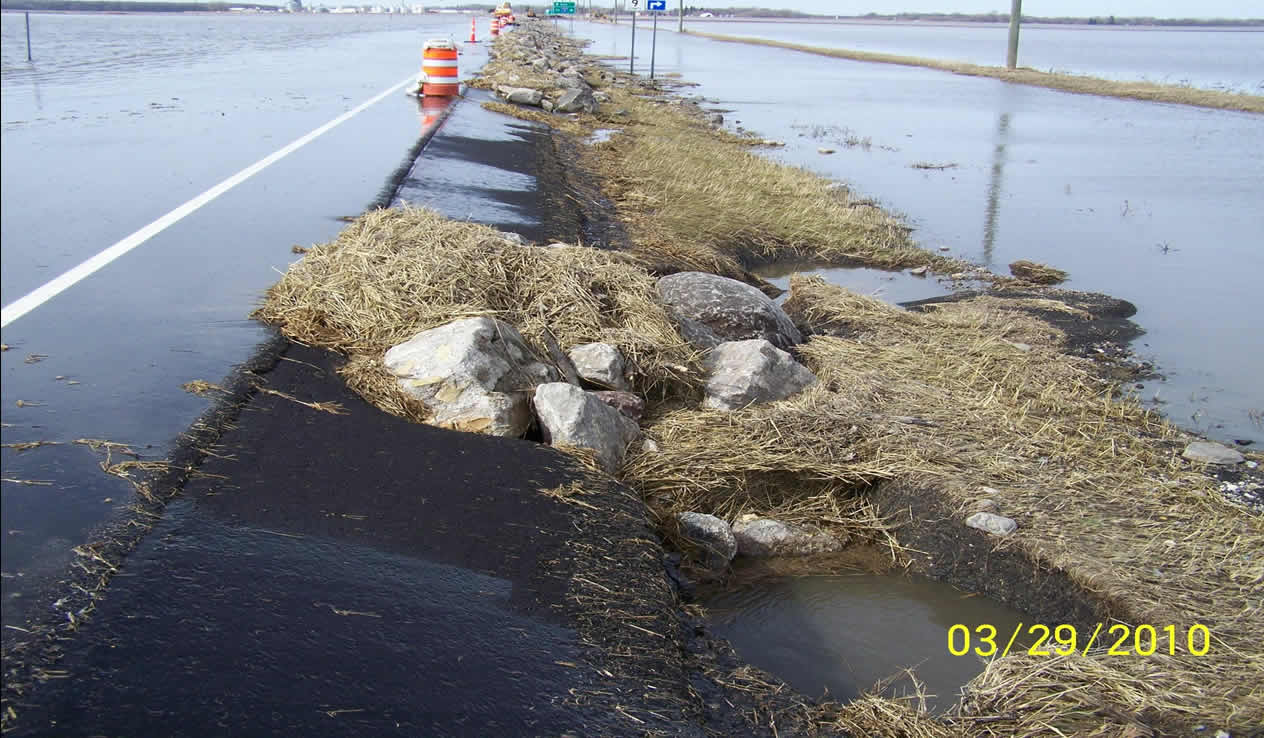
The damage from flooding was less in 2010 after engineers added rocks and vegetation to the side of Highway 9, near Ada.
The damage from flooding was less in 2010 after engineers added rocks to the side of Highway 9, near Ada, Minn.

One test will be to slow the flow of water by covering the road shoulder with a rubberized membrane and temporary water-filled tubes.

Permanent schemes — such as turf reinforcement mats and rocks — will also be tested.

“These methods have been deployed in the field, but you never really know under which conditions they survived or failed,” Taylor said.

In the Red River Valley, MnDOT engineers have tried a combination of vegetation and boulders, as well as concrete blocks covered with topsoil, to protect highways. Flattening a slope is another option.

“I expect that a single erosion protection technique will not cover every situation our road embankments may be exposed to at any given location,” Anderson said.  “Rather, I expect we would look at using several different techniques in concert to develop an effective erosion protection system for the expected velocities.”

Value capture alternative finance model tested on Highway 610

Those who use the roads in Minnesota are generally those who pay for them — through gasoline and vehicle taxes.

But motorists aren’t the only ones who benefit when a new interchange is built or a highway is improved. Home and business values along the corridor go up and the price of undeveloped land can skyrocket.

With highway funds strapped, a new method of funding road expansion, called “real estate value capture,” is garnering attention.

This emerging technique strives to identify beneficiaries of transportation improvements beyond just the highway user, so they provide their fair share of the costs — a concept not dissimilar from residential street assessment.

For instance, a local government might dedicate the additional property tax revenue generated due to a new highway to offset some construction costs, or collect fees on land that is developed near an interchange.

However, value capture is a relatively new technique that has been used primarily for transit projects. To be considered for roads or bridges, questions need to be addressed about potential revenue, impacts and public acceptability.

In a new case study, researchers use a long-delayed planned extension of Highway 610 in Maple Grove to model the impact of a completed highway on nearby property values, and, for the first time, quantify the potential revenues from several value capture strategies.

With properties near new highway exits worth an additional $65,450 more per acre, researchers calculated that $37.1 million in revenue could be generated through assessments on existing development and impact fees for future development.

Other strategies explored include tax-increment financing and private-public development of undeveloped parcels, in which revenue generated by that development is split.

“This research demonstrates a way to estimate the value of transportation improvement and to communicate that to the public,” said principal investigator Jerry Zhao, an associate professor of public administration at the University of Minnesota’s Humphrey School of Public Affairs.

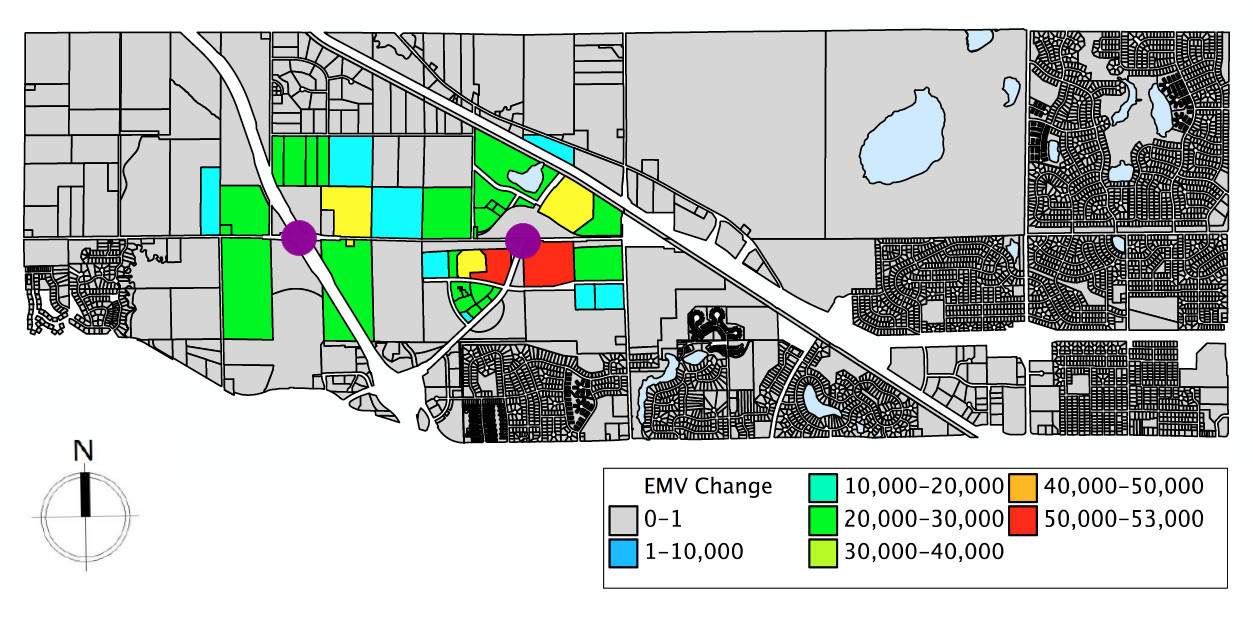
This map projects the anticipated increase in estimated market value (EMV Change) of parcels near Highway 610 that will result from completion of the highway and construction of exits at the two locations marked in purple. The impacted parcels are currently vacant, farmland or residential.
Study links:
    • Real Estate Value Capture: An Emerging Strategy to Pay for New Transportation Infrastructure – Technical Summary (PDF, 1 MB, 2 pages);  Final Report (PDF, 5 MB, 36 pages).

MnROAD earns concrete pavement association award

Staff from MnROAD, the Minnesota Department of Transportation’s cold weather road research facility in Albertville, Minn., were presented with the Marlin J. Knutson Award for Technical Achievement by the American Concrete Pavement Association in December.

The award cites the facility’s well-deserved reputation for being a place where both agency and industry ideas are put to the test. This award was presented as a tribute to the agency’s commitment to learning and putting ideas into practice.

The Marlin J. Knutson Award for Technical Achievement is presented to an individual or group who has made significant contributions to advance the development and implementation of technical innovations and best practices in the design and construction of concrete pavements.

(far right) Gerald Voigt, ACPA president and CEO, presented MnDOT with the Marlin J. Knutson Award for Technical Achievement during a ceremony in December. Receiving the award are (from left) Luke Johanneck, Bernard Izevbekhai, Roger Olson, Tom Burnham, Glenn Engstrom, Maureen Jensen and Sue Mulvihill. (Photo courtesy of the ACPA)
(Far right) Gerald Voigt, ACPA president and CEO, presented MnDOT with the Marlin J. Knutson Award for Technical Achievement. Receiving the award are (from left) Luke Johanneck, Bernard Izevbekhai, Roger Olson, Tom Burnham, Glenn Engstrom, Maureen Jensen and Sue Mulvihill. (Photo courtesy of the ACPA)

“MnROAD is helping to make roads last longer, perform better, cost less, construct faster, and have minimal impact on the environment,” said Gerald Voigt, ACPA president and CEO. “It is a model for other agencies to follow.”

MnROAD is a pavement test track initially constructed between 1991-1993. It uses various research materials and pavements and finds ways to make roads last longer, perform better, cost less to build and maintain, be built faster and have minimal impact on the environment. MnROAD consists of two unique road segments located next to Interstate 94.

Staff from the MnROAD facility in Albertville were recognized during the ACPA’s Distinguished Service and Recognition Awards ceremony in December. (Photo by David Gonzalez)

This article, authored by Rich Kemp, originally appeared in Newsline, MnDOT’s employee newsletter. 

New study to shed light on environmental impacts of deicers

Even naturally derived products like corn syrup and beet juice can impact the environment when applied to salt mixtures for winter roadways.

A wide range of products, including the ones mentioned above, are added to deicing mixes to limit the amount of salt needed for Minnesota roads each winter. However, although information is available about the corrosive properties of various deicing chemicals, less is known about the toxicity of these compounds, especially to the aquatic environment.

Thanks to a recently completed project sponsored by the Clear Roads Pooled Fund, MnDOT winter maintenance personnel will better understand the relative toxicity of eight common deicing agents, which also include non-organics like Magnesium Chloride, Calcium Chloride and Potassium Acetate.

“Because the state has been trying a lot of different alternative chemicals, we wanted to get a better handle on the environmental impacts,” said MnDOT engineer Tom Peters, the technical liaison for the 26-member, Minnesota-led pooled fund for winter maintenance research.

In January, researchers plan to release a concise summary of the toxicity rankings to help winter highway maintenance managers consider both expected levels of service and potential harm to the environment when selecting a deicer.

A Dec. 3 webinar available on the Clear Roads website discusses their findings.

About Clear Roads

Minnesota is the lead state for the Clear Roads Pooled Fund, which conducts rigorous testing of winter maintenance materials, equipment and techniques. Other recent and upcoming research (see our Technical Summary on the program) includes a winter maintenance cost-benefit analysis toolkit, snow removal techniques at extreme temperatures and environmental factors that can cause fatigue in snowplow operators.

You can learn more about Clear Roads via the project’s e-newsletter.