Tag Archives: MnDOT
Deicing treatments tested at Valleyfair, Canterbury Park
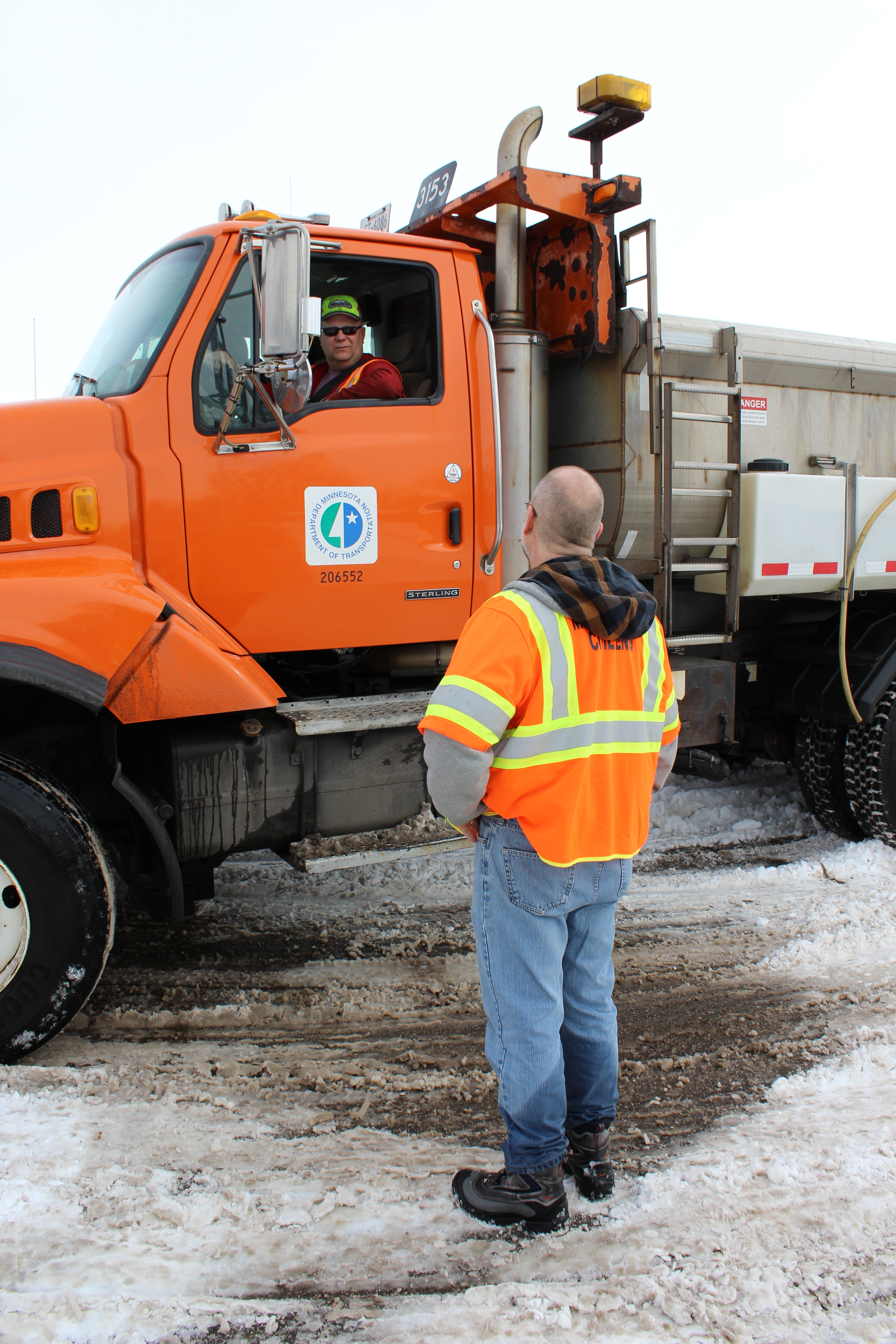
Excalibur and the High Roller may be closed for the season, but Valleyfair Amusement Park still has one attraction open for the season: a driving track for Minnesota snowplow drivers.
MnDOT-funded researchers are studying the effects of weather and vehicle traffic on different deicing treatments in the parking lots of Valleyfair and Canterbury Park in Shakopee, Minn.
It’s been a busy winter, but each week MnDOT Metro District snowplow drivers make one last stop before heading home, to apply different combinations of salt and anti-icing chemicals to nine 1,000-foot driving lanes. They also drive over each lane multiple times to test the effect of traffic.
“We’re running trucks up to 30 miles per hour with different speeds, wind conditions, traffic conditions and pre-wetting chemicals,” said Steve Druschel, a researcher with the Minnesota State University, Mankato. “Each lane is its own experimental unit.”

Professor Druschel’s students will review more than 17,000 photos from time-lapsed cameras to document how the snow melted in each experimental run.
“The influence of factors like pavement type and age, traffic volume, truck proportion, weather conditions and sun presence will be assessed to evaluate which techniques have special advantages for certain situations or roadways,” said Maintenance Research and Training Engineer Tom Peters.
In 2010, Druschel tested 25 anti-icing compounds in 1,500 different combinations in a laboratory to study the effectiveness of different deicers.
“Public work superintendents commented, ‘Great work. It looks good, except it’s all in the lab. Beakers aren’t what people drive on,’ ” Druschel said. “So we’re taking it from the two-inch ice cup to the real world in phase two of this study.”
With rock salt prices quadrupled, finding the most cost-effective methods of treatment is important.
This latest research will help determine the best times for applying anti-icing treatments and examine whether certain chemicals — such as a pre-storm liquid treatment that costs twice as much — melt enough snow to be worth the extra cost.
Test runs in Shakopee are strictly experimental, but in Mankato students are analyzing how real-world salting treatments are working on the North Star Bridge.
An article in the Mankato Free Press tells how Druschel’s team is collecting road melt runoff and documenting bridge traffic. (Big trucks, for instance, squeeze more water out of the snow.)

Students plan to use time-lapsed photos, along with weather data and snowplow records, to determine what chemical treatments worked best – and when.
With the multi-pronged research project, Druschel hopes to put definitiveness to what some snowplow drivers have already tried in the field.
“The key to it is not so much that we’re so smart and we have a better idea or are inventing something new,” he said. “We’re just trying to enhance what they are already doing.”
Helpful resources
Salt Brine Blending to Optimize Deicing and Anti-Icing Performance –Technical Summary (PDF, 1 MB, 2 pages) and Final Report (PDF, 11 MB, 151 pages) (previous study)
Smartphone app guides blind pedestrians through work zones (updated)
Each year, approximately 17 percent of road construction work zone fatalities nationwide are pedestrians.
At special risk are the visually impaired, who rely on walking and public transportation to get around.
A major challenge for them is crossing the street — which is even more difficult if an intersection is torn up.
MnDOT has invested significant effort to accommodate pedestrians, particularly those with disabilities, in temporary traffic control situations. This includes requiring temporary curb ramps and alternative routes when a sidewalk is closed.
Researchers, funded by MnDOT, have now developed a cell phone application to guide blind pedestrians around a work-zone.

Building on previous work to provide geometric and signal timing information to visually impaired pedestrians at signalized intersections, the smartphone-based navigation system alerts users to upcoming work zones and describes how to navigate such intersections safely.
The smartphone application uses GPS and Bluetooth technologies to determine a user’s location. Once a work zone is detected, the smartphone vibrates and announces a corresponding audible message. The user can tap the smartphone to repeat the message, if needed.
The federal government strongly encourages states to provide either audible warnings or tactile maps at work zones where visually impaired pedestrians are expected to be impacted.
“The smartphone application is a step in that direction,” said MnDOT technical liaison Ken Johnson. “It’s a way to see if this type of way-finding device would work.”
Since smartphone use is still limited, the state is also interested in special equipment that could relay the audible warnings at affected work zones.
“However, smartphone use is increasing in the general population, as well as with persons with disabilities, and there will likely be a day when it will be rare to not have a smartphone and this tool could meet road agency needs,” Johnson said.
Before developing the smartphone application, researchers surveyed 10 visually impaired people about their experiences at work zones and what types of information would be helpful in bypass or routing instructions.
The University of Minnesota research team, led by Chen-Fu Liao, tested the smartphone application by attaching four Bluetooth beacons to light posts near a construction site in St. Paul.
Additional research is now needed to conduct experiments with visually impaired users and evaluate system reliability and usefulness.
*Update 4/29/2014: Check out this story from KSTP on the app.
More information
Development of a Navigation System Using Smartphone and Bluetooth Technologies to Help the Visually Impaired Navigate Work Zones Safely — Final Report (PDF, 1 MB, 86 pages)
Flume research simulates Red River flooding to test road protections
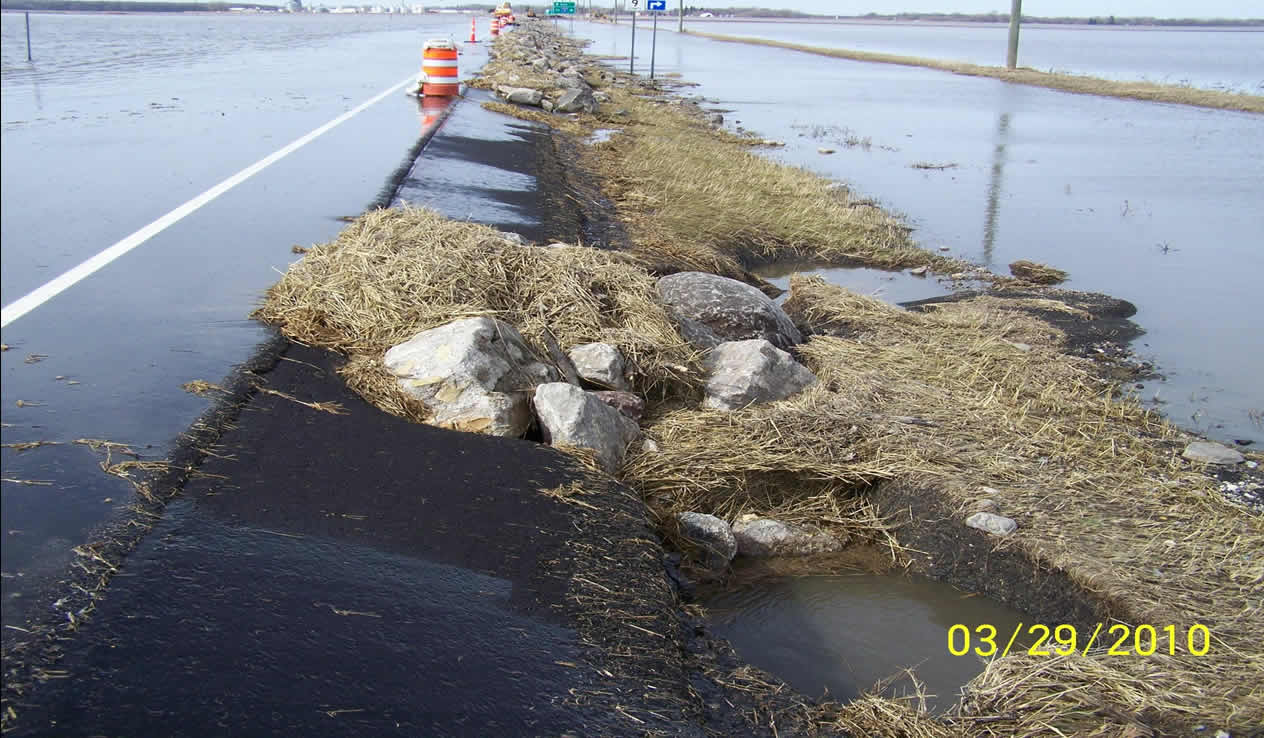
Flooding in the Red River Valley is an almost annual occurrence, and the cost to roads, property and lives is huge.
Highway 1 gets torn up year after year, only to be rebuilt in time for next year’s flood, joke residents in the little town of Oslo, which becomes an island whenever the roads close.
While not much can be done to prevent swollen farm fields from overflowing, what if a road embankment itself could be bolstered to prevent physical damage to the underlying structure of the road?
“We can’t just raise the road because it would create backwater upstream,” explained JT Anderson, Assistant District 2 Engineer. “Our best bet is to let the water over-top the road and try to protect the road when it does.”
Researchers have built a flume inside the University of Minnesota’s St. Anthony Falls Laboratory to test six methods of embankment protection specific to the needs of towns like Oslo.
“It is not uncommon for one over-topping site to have a half-mile long stretch of road being damaged,” said university research engineer Craig Taylor. “One road being protected should cover the cost of the study and the cost of deploying the erosion control product for that road.”
Nationally, research of this kind has mostly been restricted to high-intensity flooding.
“Those really high-depth, short duration events, you can only protect an embankment with concrete and boulders,” Taylor said. “With longer duration, low-depth floods, we may be able to protect roads with soft armoring, like reinforced vegetation.”
The damage in northern Minnesota has been the worst on east-west roads, where the river flow runs perpendicular to the center of the road, causing the road to act like a dam and the water to jump at the edges.
“It eventually eats through that road embankment and makes the road collapse,” Anderson explained.
Researchers will examine how a cross-section of a road holds up under various erosion control methods at different levels and speeds of water-flow.

One test will be to slow the flow of water by covering the road shoulder with a rubberized membrane and temporary water-filled tubes.
Permanent schemes — such as turf reinforcement mats and rocks — will also be tested.
“These methods have been deployed in the field, but you never really know under which conditions they survived or failed,” Taylor said.
In the Red River Valley, MnDOT engineers have tried a combination of vegetation and boulders, as well as concrete blocks covered with topsoil, to protect highways. Flattening a slope is another option.
“I expect that a single erosion protection technique will not cover every situation our road embankments may be exposed to at any given location,” Anderson said. “Rather, I expect we would look at using several different techniques in concert to develop an effective erosion protection system for the expected velocities.”
Warning system could protect drivers from traffic ‘shock waves’
Two summers ago, the Minnesota Department of Transportation installed electronic message boards on parts of Interstates 35W and 94 to help warn drivers of crashes and to recommend speed levels during periods of high congestion.
Now, MnDOT would like to use the devices — officially known as Intelligent Lane Control Signs (ILCS) — to advise drivers of sudden stopping or slowing of traffic. Many crashes occur when drivers cannot react quickly enough to these changes.
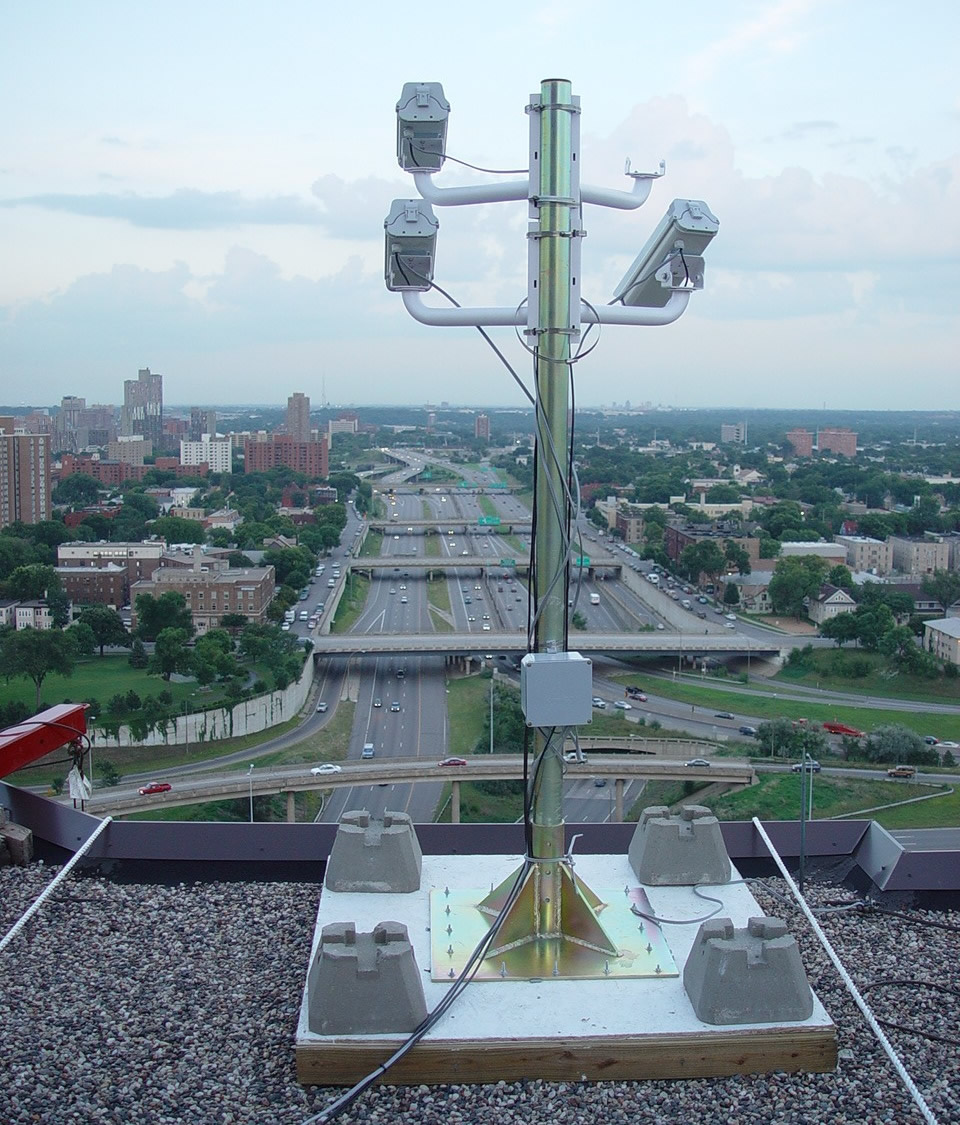
The Minnesota Traffic Observatory (shown in the feature photo above) is developing a warning system to detect such problematic traffic patterns and issue automatic advisories to drivers.
Shock waves on I-94
A section of I-94 in downtown Minneapolis, where southbound I-35W and westbound I-94 converge, may have the highest crash rate in the state.
As shown in the video above, vehicles constantly slow down and speed up here during rush hour, which causes a ripple effect called “shock waves.”
“There’s a crash every two days,” said University of Minnesota researcher John Hourdos, whose students watched over a year’s worth of video footage to document every accident and near accident. “They’re not severe crashes — no one has died for as long as I can remember, and most happen at slow speeds — but they cause a lot of delays for the traveling public.”
When statistics were still being kept, this section of I-94 had the highest number of accidents in the state, with approximately 150 crashes and 400 near crashes observed in 2003.
Researchers developed a program 10 years ago to detect “shock wave” patterns in the traffic, but they couldn’t develop a practical solution until the state invested in electronic message boards.
The University of Minnesota deployed cameras and sensors on three downtown rooftops in 2002 to observe traffic patterns. They provide seamless coverage of the entire area, allowing researchers to watch vehicles from the moment they enter and exit the area. MnDOT has added additional cameras and detectors to watch over this roadway section. For the past year, the combined efforts of MnDOT and the university have provided data from 26 cameras and 12 traffic sensors for the two-mile section that includes the high-crash frequency location.
Thanks to the message boards, Hourdos and his team can now create an automated system to warn drivers when conditions for “shock waves” are greatest, using an algorithm he developed in the previous study.

Crosstown interchange
A newer problem that researchers hope to tackle is the lineup of cars on I-35W southbound during rush hour at the newly reconstructed Crosstown interchange.
Although two lanes of traffic are provided for eastbound Highway 62 at the I-35W/62 split, these vehicles must later converge into one lane, due to the Portland Avenue exit. This causes a back-up on the 62 ramp that stretches back to 35W.
Hourdos said developing an algorithm to detect these queues is a different problem than what goes on with I-94, since there is a constant stoppage of cars and no rolling shockwaves.
“Combining the two methodologies will form a more robust solution and a single implementable driver warning system,” Hourdos said.
Researchers might target other problems areas should the state install additional ILCS message boards elsewhere in the Twin Cities.
Value capture alternative finance model tested on Highway 610
Those who use the roads in Minnesota are generally those who pay for them — through gasoline and vehicle taxes.
But motorists aren’t the only ones who benefit when a new interchange is built or a highway is improved. Home and business values along the corridor go up and the price of undeveloped land can skyrocket.
With highway funds strapped, a new method of funding road expansion, called “real estate value capture,” is garnering attention.
This emerging technique strives to identify beneficiaries of transportation improvements beyond just the highway user, so they provide their fair share of the costs — a concept not dissimilar from residential street assessment.
For instance, a local government might dedicate the additional property tax revenue generated due to a new highway to offset some construction costs, or collect fees on land that is developed near an interchange.
However, value capture is a relatively new technique that has been used primarily for transit projects. To be considered for roads or bridges, questions need to be addressed about potential revenue, impacts and public acceptability.
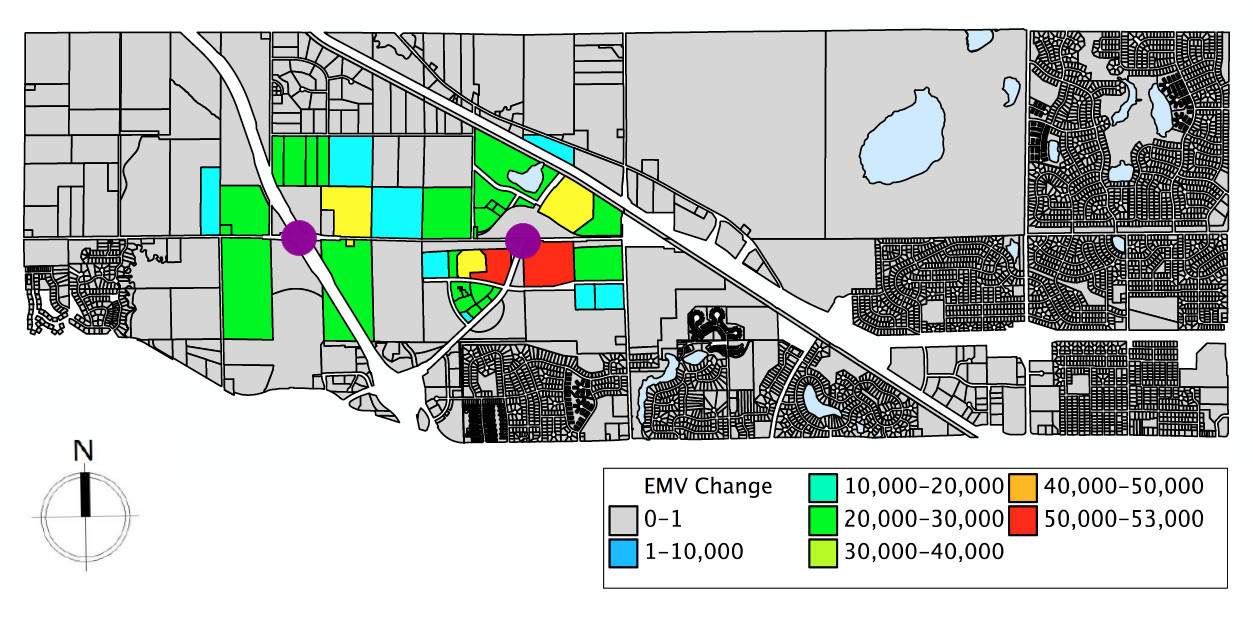
In a new case study, researchers use a long-delayed planned extension of Highway 610 in Maple Grove to model the impact of a completed highway on nearby property values, and, for the first time, quantify the potential revenues from several value capture strategies.
With properties near new highway exits worth an additional $65,450 more per acre, researchers calculated that $37.1 million in revenue could be generated through assessments on existing development and impact fees for future development.
Other strategies explored include tax-increment financing and private-public development of undeveloped parcels, in which revenue generated by that development is split.
“This research demonstrates a way to estimate the value of transportation improvement and to communicate that to the public,” said principal investigator Jerry Zhao, an associate professor of public administration at the University of Minnesota’s Humphrey School of Public Affairs.

Study links:
- Real Estate Value Capture: An Emerging Strategy to Pay for New Transportation Infrastructure – Technical Summary (PDF, 1 MB, 2 pages); Final Report (PDF, 5 MB, 36 pages).
Three common questions about bike lanes, answered
If you’ve ever driven near a bike lane and not known what to do, you’re not alone.
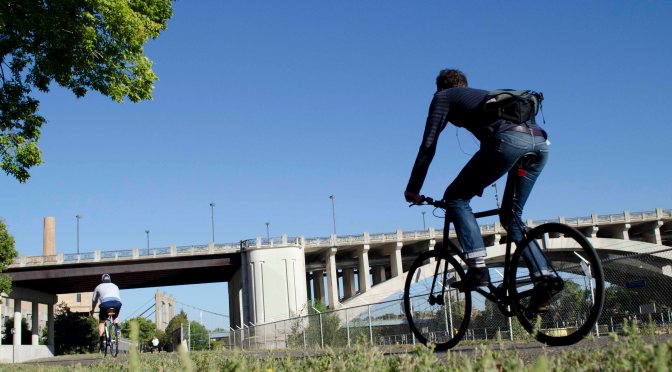
A forthcoming video from the Local Road Research Board seeks to answer common questions about on-street bike lanes and help bicyclists and motorists better understand the rules. The video is due to be released this spring; in the meantime, we thought we’d give you a sneak preview by addressing three common misconceptions about bike lane rules and safety.
1) Are bicyclists required to use a bike lane, when present?
No. Although bike lanes usually provide the smoothest, safest and most efficient method of transportation — for everybody — they are not required to use them. They are allowed to ride outside bike lanes to make turns or avoid debris, and they still have the option of using an adjacent trail where available.
2) Are vehicles allowed to enter bike lanes?
Yes, but only to park or turn onto a driveway or street. Motorists should treat bike lanes like any other lane of traffic and yield to approaching bicyclists, but they do have the right to enter bike lanes when turning.
3) Do bicyclists have to follow the same rules as motorists?
Yes. Bicycles are considered vehicles under Minnesota state law and have the same rights and responsibilities. Cyclists are required to obey stop signs and signal their turns, just like motorists.

Watch for the LRRB’s new bike safety video on Crossroads this spring. In the meantime, check out MnDOT’s tips on bicycle safety.
Innovative pavement textures reduce noise, improve fuel economy
What if something as simple as changing the texture of the pavements we drive on could not only increase safety, but also reduce noise pollution and boost our vehicles’ fuel economy?
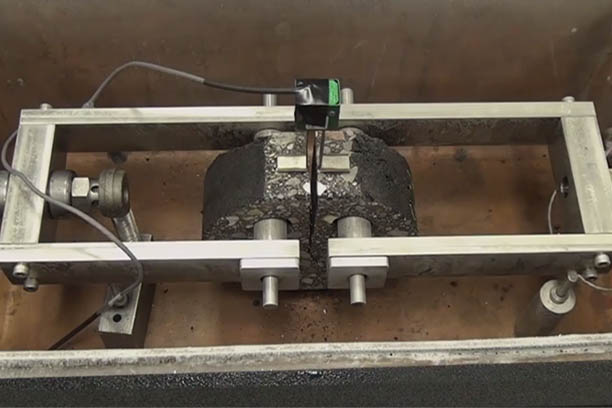
It’s possible, according to the latest research from MnROAD, the state’s one-of-a-kind pavement research facility. In a new report, investigators detail how quieter pavement textures, such as those applied by grinding grooves into pavements with diamond-coated saw blades (see the photo above), may also reduce rolling resistance — the force that resists a tire as it moves across the pavement’s surface.
The potential benefits to the public are significant. A 10-percent reduction in rolling resistance could reduce the U.S. public’s fuel consumption by 2–3 percent, eliminate up to $12.5 billion in fuel costs each year (as well as cutting carbon emissions). Add on the cost savings from reducing noise pollution (building noise barriers along highways can cost as much as $3 million per mile), and it’s clearly a win-win situation.
In the study, researchers used an innovative line-laser profiler to develop three-dimensional representations of test pavement surface textures. They then investigated the relationship between these surface characteristics and data on rolling resistance that was collected during a 2011 study using a special test trailer developed by researchers in Poland. This year, the same trailer will be used to conduct a second round of rolling resistance measurements at MnROAD.
The research is related to an ongoing pooled-fund study on concrete pavement surface characteristics. The goal is to produce data that will allow MnDOT to identify ideal ranges for surface characteristics that improve pavements’ quietness and ride quality while keeping them safe and durable.
Learn more
- Pavement Texture Evaluation and Relationships to Rolling Resistance Final Report (PDF, 2.9 MB, 136 pages) and Technical Summary (PDF, 1 MB, 2 pages)
- PCC Surface Characteristics – Rehabilitation Final Report (PDF, 2.8 MB, 104 pages) and Technical Summary (PDF, 1 MB, 2 pages)

MnROAD earns concrete pavement association award
Staff from MnROAD, the Minnesota Department of Transportation’s cold weather road research facility in Albertville, Minn., were presented with the Marlin J. Knutson Award for Technical Achievement by the American Concrete Pavement Association in December.
The award cites the facility’s well-deserved reputation for being a place where both agency and industry ideas are put to the test. This award was presented as a tribute to the agency’s commitment to learning and putting ideas into practice.
The Marlin J. Knutson Award for Technical Achievement is presented to an individual or group who has made significant contributions to advance the development and implementation of technical innovations and best practices in the design and construction of concrete pavements.

“MnROAD is helping to make roads last longer, perform better, cost less, construct faster, and have minimal impact on the environment,” said Gerald Voigt, ACPA president and CEO. “It is a model for other agencies to follow.”
MnROAD is a pavement test track initially constructed between 1991-1993. It uses various research materials and pavements and finds ways to make roads last longer, perform better, cost less to build and maintain, be built faster and have minimal impact on the environment. MnROAD consists of two unique road segments located next to Interstate 94.

This article, authored by Rich Kemp, originally appeared in Newsline, MnDOT’s employee newsletter.
Culvert research aims to protect endangered small fish

(Photo courtesy of the Minnesota Department of Natural Resources)
In a new study funded by the Minnesota Department of Transportation, engineers are trying to ensure that new culverts do not degrade the habitat of an endangered fish in southern Minnesota.
The state has already researched how to better accommodate fish passage at river and stream crossings. Now it is looking at design guidelines for culverts that specifically impact the Topeka shiner, a small endangered fish found in five Midwestern states.
In Minnesota, the Topeka shiner is known to live in at least 57 streams, totaling 605 miles, within the Big Sioux and Rock River watersheds.
“The Topeka shiner is reported to have been erased from about 50 percent of its historic range in Iowa and much of its range in Minnesota, which is why Minnesota is so intent on doing what it can to help this fish thrive here,” said Alan Rindels, MnDOT’s project coordinator for the research.
The Topeka shiner is endangered due to the degradation of stream habitat, stream channelization, non-native predatory fishes and construction within waterways.
Culverts might impede the passage of this small minnow for a number of reasons, including that they might be too long, lack sufficient depth or carry water too fast.

In addition, long culverts block sunlight, which possibly discourages fish from swimming through. Typically, older culverts are replaced with longer culverts to improve road safety and minimize maintenance costs. To eliminate or minimize impacts to the Topeka shiner, the state is trying to determine if light mitigation strategies are necessary.
Researchers from the University of Minnesota’s St. Anthony Falls Research Laboratory will monitor a newly installed culvert (110 feet in length) and a few other culverts in critical Topeka shiner habitat streams during spawning and fall movement.
Additionally, a laboratory-based light manipulation experiment will examine the behavior of the warm-water fish when presented with a dark culvert.
Guidelines for culvert design in Topeka shiner habitat will be developed based on these results, as well as examples from neighboring states. The state is also collaborating with the U.S. Fish and Wildlife Service and affected Minnesota counties.
- Current research: Culvert Length and Interior Lighting Impacts to Topeka Shiner Passage (PDF, 271 KB, 1 page)
- Previous report: Accommodating Fish Passage at River Crossings (PDF, 781 KB, 2 page)