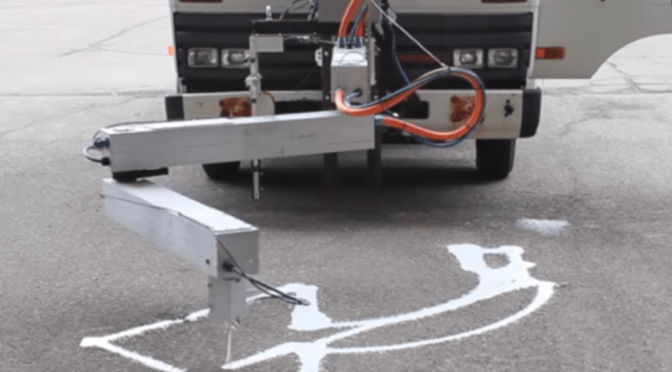
In the above video, University of Minnesota-Duluth Associate Professor Ryan Rosandich tests a prototype of a robotic arm he developed to paint messages and markings on roadways. He calls the machine “The MnDOT Robot.”
During a test run in October 2015, the MnDOT robot painted a right-turn arrow and the word “ahead” on pavement at MnDOT’s Pike Lake station in Duluth.
Rosandich hopes commercial companies will show an interest in further developing his proof-of-concept technology into something that road authorities can use regularly to make work easier, faster and safer for their employees.
Companies interested in commercializing this technology can contact Andrew Morrow at amorrow@umn.edu.
Editor’s Note: The paint used in the above demonstration was diluted due to the cold weather at the time of the demonstration and does not reflect the condition of the paint expected in a typical application.
Roadways for humans can sometimes create roadblocks for fish, but researchers hope to establish a set of culvert design practices to help aquatic creatures get where they’re going.
Many fish depend on mobility along a river for feeding and spawning. Where roads meet rivers, however, culverts can block fish and other aquatic organisms that can’t navigate changes in current, lighting and other factors.
Waterway barriers threaten an already endangered species of minnow known as the Topeka shiner (pictured above). It can also be a big problem for economically important fish such as trout or northern pike. That’s why the Minnesota Department of Natural Resources prefers building bridges to culverts.
However, bridges are not always economically feasible, and so MnDOT is working closely with the DNR to develop culverts that protect both public safety and the environment.
Culverts allow water to pass under roads. Occasionally, they can harm a stream’s fish habitat by inadvertently acting as a barrier to fish passage or migration. There are nearly 11,000 culverts in Minnesota.
Sediment Content
Recent research suggests that installing boxed culverts differently could greatly improve fish passage.
Culverts are typically placed a little below the streambed with the expectation that the stream flow will naturally fill them with sediment. Researchers tested that assumption and found it to not always be accurate.
“We found that pre-filling the culvert with sediment that replicates the streambed as part of the installation process helped prevent upstream erosion and the development of vertical drops that can become barriers to aquatic movement,” said Jessica Kozarek, a University of Minnesota research associate. “In addition, pre-filling the culvert helped ensure the sediment remained inside the culvert flows were high and water moved quickly during rainstorms.”
MnDOT has been working with the DNR to identify the conditions that determine whether a newly installed culvert will naturally fill with sediment, replicating surrounding streambed conditions, or whether a stream’s water flow will transport sediment out of a culvert.
Using an experimental flume at the University of Minnesota’s St. Anthony Falls Laboratory, researchers tested MnDOT’s standard box culvert design under a variety of stream conditions.
Laboratory simulations suggest that filling a culvert with sediment at installation, rather than allowing it to fill over time is, with some exceptions, generally the best approach for low- and moderate-grade streams. Additionally, steep, fast-moving waters require a filled culvert with structures such as larger rocks to keep sediment in place. These structures also create steps, pools and riffles that enable fish to rest as they move upstream.
MnDOT will use this latest research, along with conclusions from other recent studies, to create a guide for fish-friendly culvert designs.
“Of all the things we’ve studied, there are maybe three or four research projects. This manual will pull it all together,” said Petra DeWall, state waterway engineer at the Minnesota Department of Transportation.
Further research is underway to determine whether aquatic organisms are deterred by low light conditions in long, dark culverts. Researchers are also looking into whether mussel spat rope could be used to create a rough bottom to reduce water speed in culverts with no sediment.
A handful of county highway department employees in the Rochester area gathered recently at the Olmsted County Public Works Service Center for a presentation and live demonstration by University of Minnesota Research Fellow Brian Davis about his team’s work involving light detection and ranging – or LiDAR.
“LiDAR is like radar, but with light,” Davis said. “It gives you information about what’s around the sensor.”
Event attendees gather around a sedan outfitted with a spinning LiDAR sensor. (Photo by Micheal Foley, MnDOT)
Davis and his fellow researchers have outfitted a sedan with special LiDAR equipment and other technology that is capable of capturing a 360-degree, 3-D view of a scene in real time.
“We use the car as a test bed,” Davis said. “We have a lot of different types of sensors on the car that we use for the different projects that we’re working on. Right now we have a LiDAR sensor on top. Sometimes we have a high-accuracy GPS receiver in there. We have a cellular modem. We have a handful of inertial sensors. So it’s a lot of different stuff that we use to cater to the application.”
For his presentation, Davis showed the attendees some of the data his team had already collected.
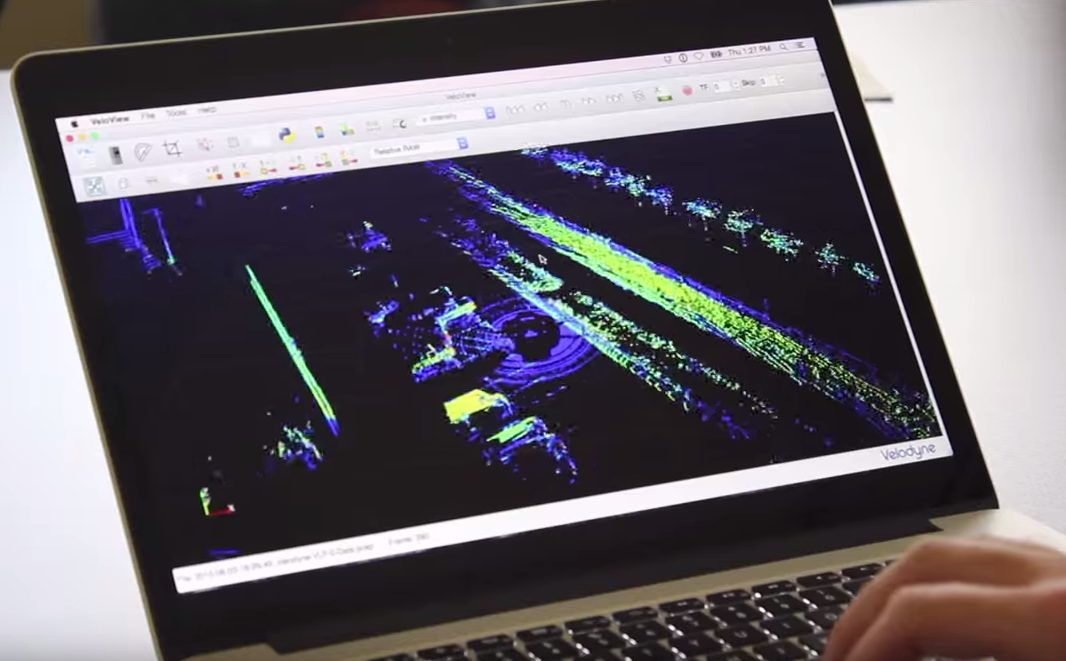
Davis presents data that shows the LiDAR-equipped sedan moving along a roadway. (Photo by Micheal Foley, MnDOT)
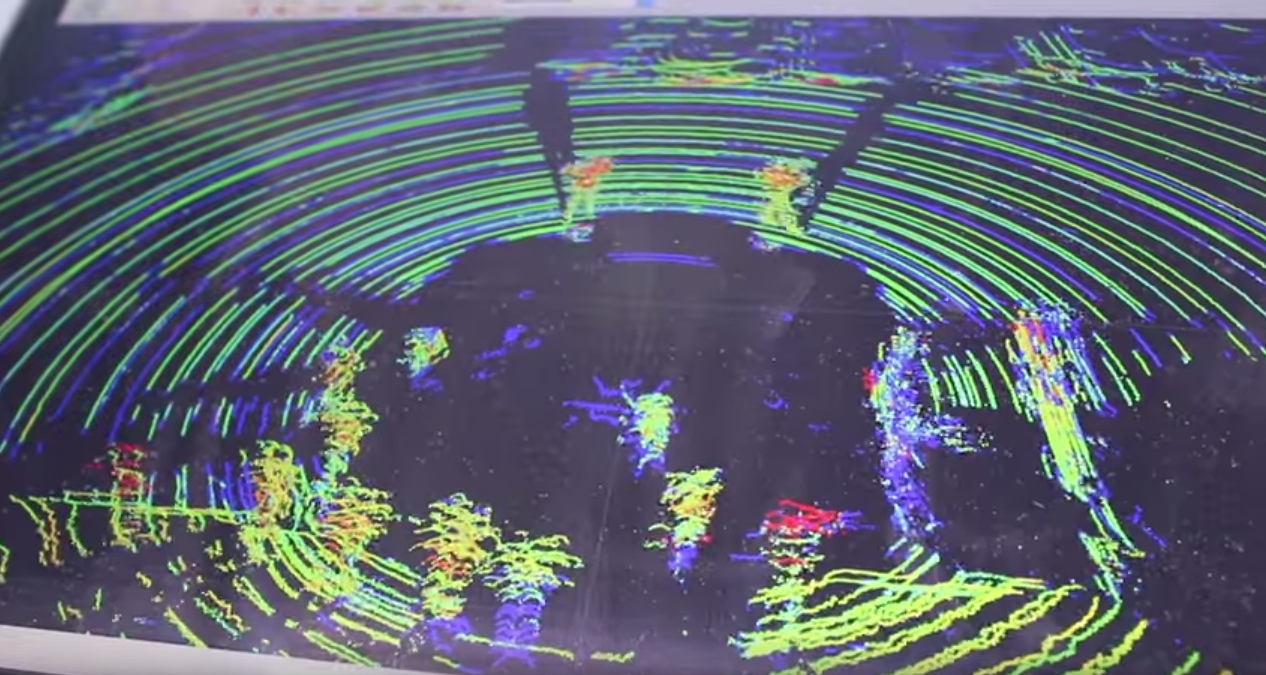
“We showed a handful of pre-collected data at a handful of intersections around Rochester and Minneapolis,” Davis said. “What it shows is the point cloud collected by the sensor – just the raw point cloud with no post-processing done. In that information you can see people moving through it, cars moving through it, buses and light rail trains.”
Event attendees move around the sedan to see how the LiDAR sensor views them. (Photo by Micheal Foley, MnDOT)
After the presentation, Davis led the group to the parking lot for a close-up look at the technology and how it collects data and displays that data in real time. Le Sueur County GIS manager Justin Lutterman was among those who could envision possible applications for LiDAR.
“It’ll be interesting to see where this can go,” Lutterman said. “I’m sure the private industry will take off with this and emergency management, or the sheriffs and ambulances, would appreciate this kind of technology on their vehicles for a situation they might have to recreate. Roads and traffic designers would be able to monitor their resources, pavements, traffic counts and things like that.”
Over the coming months, researchers will gather more data to develop a workshop for county personnel interested in learning more about LiDAR and how it can be applied in their transportation systems.
“The next steps for this project are to collect some data with the car at intersections. Then we can use that information to fine tune our algorithms,” Davis said. “What the algorithms are going to do is take that raw data and give us useful information, like the number of cars, or the time a car passes through an intersection. That all feeds into the workshop we’re developing. The workshop is going to be for county GIS workers, traffic engineers and county engineers who are interested in learning about these technologies.”
Bridges over Minnesota waterways need to be protected from currents by a field of interlocking angular rocks called riprap. Without these rocks along the abutment, moving water could wear away the soil that supports a bridge’s foundation. The faster the water, the larger the riprap must be to provide adequate protection.
While some parts of Minnesota have quarries rich with angular rock, other parts don’t – particularly the northwest and western regions. Bridge projects in those areas sometimes resort to the expensive practice of trucking in stones. Other times field stones are used, but they are less effective and must be replaced more often.
There soon could be a better option thanks to research coordinated by the Minnesota Department of Transportation and funded by the Minnesota Local Road Research Board.
At a few test sites around the state, researchers have used a grout mixture to cement smaller, rounded rocks together at a bridge abutment. Once applied to the rocks, the mixture forms what is called “matrix riprap.” The concept is in use in Europe for many bridge piers, but MnDOT was more interested in learning how it could be used on bridge abutments.
Matrix riprap is currently in use in Minnesota at the following bridges:
Highway 23 over the Rum River in Milaca
Highway 8 over Lake Lindstrom channel in Lindstrom
Prairie Road over Coon Creek in Andover
A MnDOT crew applies grout to rounded rocks at a bridge abutment in Milaca in May 2012. The grout cements the rocks together to form matrix riprap, which has shown to be significantly stronger than conventional riprap.
In May 2012, matrix riprap was placed at the Milaca bridge, which sits alongside a high school. Researchers hoped the use of matrix riprap would prevent vandals from removing the riprap rock and throwing it into the river. According to Nicki Bartelt, a MnDOT assistant waterway engineer, the matrix riprap has proven to be extremely strong and effective.
“Not only is matrix riprap significantly stronger than regular riprap, but it helps prevent vandalism as well,” Bartelt said. “The Milaca installation has been in place for three years now. It looks pretty good and it’s weathering well.”
In the lab, matrix riprap held up extremely well on mechanical pull tests and hydraulic flume tests. In fact, researchers were unable to determine the matrix riprap fail point on many tests, even after applying 10 times the shear stress that regular riprap can withstand. Matrix riprap was tested with both angular and round rock with no change in performance.
A new matrix riprap installation recently went in on the Highway 95 bridge over the Rum River in Cambridge. Later this summer, plans call for an installation on the Highway 60 bridge over the north fork of the Zumbro River in Mazeppa.
“The Highway 60 bridge is being replaced, and the river there has extremely high velocities, so we’re using the matrix riprap instead of regular riprap just because of the size of rocks that would be needed,” Bartelt said.
At least two more installations are planned for 2016. In the future, researchers plan to determine the fail point for matrix riprap. They also hope to study potential environmental effects the grout may have underwater.
MnDOT has also worked with local governments that have tried matrix riprap for themselves. One municipality is trying it as a heavy duty erosion control measure. The concept is catching on outside Minnesota as well.
“We have gotten a lot of inquiries from other states, and we have lent out the spec a lot,” Bartelt said. “Iowa, New Hampshire, Maine, Indiana, Wisconsin and Illinois are among the states to express interest. We have talked to a lot of people about it, so they tend to use our research.”
Motorists are experiencing less delay on metro-area highways, thanks to major changes to the Twin Cities’ ramp metering system.
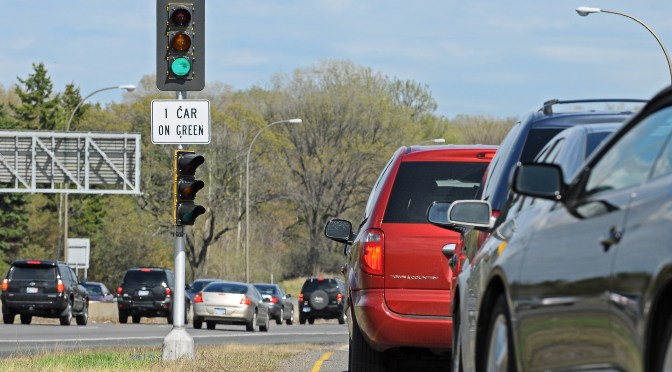
The Minnesota Department of Transportation has reconfigured ramp meters to be more in sync with real conditions. With changes to the turn-on and turn-off criteria, the meters are actually running for a shorter period of time and are only activated when needed.
Ramp meters are traffic lights placed on freeway entrance ramps that control the frequency that vehicles can enter the highway. Sensors embedded in the pavement collect the vehicle traffic data used to time approximately 440 ramp meters.
Staff at the Regional Transportation Management Center, which manages the ramp meters, say the whole system is operating better because of changes that were implemented approximately one year ago (based off a 2012 study).
University of Minnesota-Duluth professor Eil Kwon developed the system’s new software algorithms. In a case study of Highway 100, he found that the delay on the mainline dropped by nearly half.
On northbound Highway 100, the amount of “delayed vehicle hours” — defined as the vehicle hours of traffic flow with speeds less than 45 mph — that motorists experienced dropped 48 percent during the months of October and November in 2012 when compared to the same period in 2011. During the same time period, total volume on that section of northbound Highway 100 increased by 2.7 percent, Kwon said. In spring 2013, the amount of delayed vehicle hours had been reduced by 17 percent.
These results are preliminary, as additional analysis is needed to determine if these results are typical throughout the system on other freeway corridors. However, based on a personal savings of $16.50 per hour, the scenario described above represents a cost savings to motorists of $1,353 to $3,447 per day (depending on the season). That’s as much as $339,150 to $861,640 per year for just a six-mile stretch of highway.
More efficient
Under the old system, each ramp meter would turn on based on current traffic conditions, but the criteria to turn on were easily met, causing the meters to turn on too soon. The old system did not have turn-off criteria, allowing meters to run until a pre-set time of day.
With the new system, improvements were made to make the meters respond more appropriately to current traffic conditions. The turn-on criteria were improved so that meters come on only when needed, and turn-off criteria were added, allowing meters to turn off when traffic conditions improved.
The new metering system is particularly effective at reducing the number of meters operating on light traffic days.
“On days like the ones leading up to Thanksgiving, where traffic may be 10-to-15 percent less than normal, instead of, say, 150 ramp meters being on at a particular time, now maybe only 50 ramp meters will be operating,” explained MnDOT Freeway System Operations Engineer Jesse Larson.
Upgrades to the ramp metering system also allow for a better picture of what traffic is like at a given moment, because it’s now based on corridor density rather than traffic flow.
Traffic flow is the measurement of the number of vehicles passing a given point. Using traffic flow was flawed, in that similar traffic flows can occur at different speeds. The old system couldn’t differentiate between 1,000 cars passing by at 20 miles per hour versus 1,000 cars passing at 60 miles per hour, for example.
Corridor density, on the other hand, is the number of vehicles per lane per mile. By measuring density instead of traffic flow, the system has a more accurate picture of what current conditions are like on the freeway.
Another bonus: ramp meters will no longer release a bunch of cars simultaneously once an entrance ramp fills up. That’s because the system can now detect the ramp filling up and release the extra cars gradually instead.
Twin Cities ramp meters now turn on and off based on live traffic conditions.
MnDOT is testing a mobile road condition monitor that uses infrared technology to detect hazardous ice, snow or wet conditions without even touching the pavement.
Maintenance crews hope the device, called the High Sierra Surface Sentinel, could help them better determine when it’s time to apply salt when they’re plowing. The mobile sensor reports air temperature, surface temperature and road friction data.
“The biggest reason we’re looking at this is for the friction reading,” said MnDOT Salt Solutions Coordinator Joe Huneke. “Typically, when operators are patrolling their route and the road looks like it’s getting icy, they’ll err on the side of caution and apply salt — and it may not need it.”
The device being tested by snow and ice crews in northern Minnesota would also provide real-time surface weather conditions. Currently, plow operators and supervisors must enter road conditions into a computer or relay them by phone, a time-consuming process that operators are not always able to perform in a timely manner.
The biggest potential benefit, however, is lower salt consumption.
“Sometimes you get a light cold snow event where it might look like there’s a little ice on the road, but, in fact, you have good friction numbers and you don’t need salt. Once you put chemical down, you’re committed to it,” Huneke said.
District 1 snow and ice crews are evaluating the unit pictured below for its accuracy and effectiveness in determining slippery conditions. It will be compared with another device tested in District 3 that also uses infrared technology to determine how slippery the road is, and technology being tested in District 6 that uses gravitational force to determine the road surface friction.
MnDOT it testing this mobile road condition sensor, which provides real-time surface weather condition of roadways.
Related Research
MnDOT’s Office of Maintenance has its own research program designed to let maintenance personnel test innovative ideas to keep our roads smooth, snow-free and safe. They even put out a monthly bulletin featuring new ideas and technologies. (You can find the back issues here.)
In the search for a quieter rumble strip, Minnesota may have found a winner in California.
California’s standard rumble strip design outperformed Minnesota’s and Pennsylvania’s in a comparison study along a rural highway near Crookston, Minnesota. (Read the recently published report.)
“California’s rumble strip still gave significant feedback to drivers, but it was significantly less noticeable outside the vehicle,” said engineering consultant Ed Terhaar, who performed a noise analysis with acoustical engineer David Braslau on behalf of the Minnesota Local Road Research Board.
A California-style sinusoidal rumble strip, installed along a Polk County Highway.
Although they serve as an effective warning to drivers, rumble strips can cause unwanted noise when a vehicle drifts over a centerline or edgeline.
Both the LRRB and the Minnesota Department of Transportation, which is sponsoring a companion study, are interested in finding a new design that still captures the driver’s attention, but minimizes the sound heard by neighboring residents.
Polk County tests
Terhaar and Braslau’s research showed that Minnesota and California’s designs produce a similar level of interior noise. Although external decibel levels are not that different from each other either, Minnesota’s rumble strip has a considerably stronger tone that can be heard further away.
“California’s sound is less sharp, less intrusive and less noticeable,” Braslau said. “Minnesota’s has a really sharp peak. So while the absolute sound level of California’s isn’t all that much lower, its perception is less.”
Testing was performed using three different vehicles – a passenger car, pickup truck and semi-trailer truck – at three different speeds – 30, 45 and 60 miles per hour.
In general, Pennsylvania’s rumble strip had both a quieter interior and exterior sound than California’s and Minnesota’s.
Like Pennsylvania, California’s rumble strip has what is called a sinusoidal design – a continuous wave pattern that’s ground into the pavement (it’s the style commonly used in Europe and has been called a “mumble strip” because it’s quieter). The main difference between the two is that California’s wave length is 14 inches, while Pennsylvania’s is 24 inches.
Minnesota’s design is much different than the sinusoidal pattern used by the other two states.
“It’s not a continuous wave – it’s basically chunks of pavement taken out at certain intervals with flat pavement in between. It’s more of an abrupt design, whereas California and Pennsylvania’s are more continuous and smooth,” Terhaar explained.
The next step for researchers is to test variations of the California rumble strip design at MnDOT’s Road Research Facility (MnROAD).
The 8-inch rumble strip tested in Crookston is the typical edgeline design used by Polk County, but it was found to be too narrow for semi tires, so MnDOT will look at wider designs in its follow-up study. Researchers will also look at the impacts to motorcyclists and bicyclists, as well as the California rumble strip’s centerline striping capability.
The Minnesota rumble strip, at left and also pictured in top photo, and California rumble strip, right.
The Minnesota Department of Transportation is testing a crowdsourcing application that will allow motorists to update winter weather road conditions on the state’s 511 system.
The Regional Transportation Management Center is planning a soft launch of Citizen Reporting in April, initially inviting MnDOT employees to post their experiences on routes they travel. By next winter, the RTMC hopes to invite the public to do the same.
“We suspect that citizen reporters will be similar in ethic to the kinds of people who volunteer to be weather spotters,” said MnDOT Transportation Program Specialist Mary Meinert, who assists with day-to-day operations of 511.
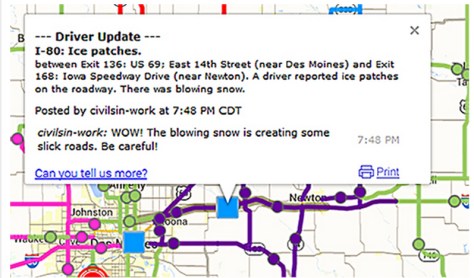
Iowa launched Citizen Reporting in November. Here is an example of a citizen report.
Currently, MnDOT maintenance crews report road conditions, but Greater Minnesota lacks 24/7 coverage and its reports can become quickly outdated, especially on highways that aren’t plowed as frequently or lack traffic cameras, said 511 System Coordinator Kelly Kennedy Braunig.
Citizen reporting, especially on weekends, will help keep that information fresh.
“We try to explain on the website that we only update from 3–6 a.m., 3–6 p.m. Monday through Friday and as road conditions change, but we still get many emails requesting more frequent road condition information,” Braunig said.
Even a recent comment on MnDOT’s Facebook page pointed out the limitations in one area of the state: “Updates [only] come during government work hours.”
Growing Service
It’s actually a welcome sign that the public wants more from 511.
Seven years ago, when Braunig applied for her job, not many people used 511. In fact, at the time, she wasn’t even aware of the service, which provides information to travelers on weather-related road conditions, construction and congestion.
Today, 511’s online program and mobile app are accessed by more than 5,000 people per day during the winter (and about half as many during the summer). Data comes from MnDOT’s construction and maintenance offices, as well as state trooper data and incident response. This real-time information is available for all of Minnesota.
In the Twin Cities metro area, more than 700 traffic cameras allow MnDOT and State Patrol dispatchers to check the condition of 170 miles of highways and monitor traffic incidents at any time. Rochester, Duluth, Mankato and Owatonna also have cameras for incident management and traffic monitoring.
The 511 system’s greatest challenge is in Greater Minnesota, where road condition information is used daily by schools, ambulance personnel and truckers, as well as the traveling public, but information isn’t updated frequently outside of business hours. Citizen reporting will be a beneficial resource.
Other states
Other northern states face similar challenges as Minnesota, but have been able to improve the timeliness of road condition data with assistance from truckers and other motorists.
In Wyoming, more than 400 citizen reporters (primarily truckers) call in road conditions to the Transportation Management Center. In Idaho, citizen reporters directly put the information into the 511 system. Minnesota will be the fifth state to adopt citizen reporting, following Iowa, which launched its service in November 2014.
Like Iowa, Minnesota’s citizen reporting will initially focus on winter roads.
To participate, people will need to take an online training module and then register their common routes, perhaps the highways they take to work or their way to the cabin on the weekends. These contributions will be marked as a citizen report on the website.
“Minnesota truck drivers are loyal users of the 511 system and we suspect they will also make some of our best reporters,” Meinert said.
Minnesota is part of a 13-state consortium that shares a 511 service technology provider. States with citizen reporting recently shared their experiences in a Peer Exchange sponsored by North/West Passage, a transportation pooled fund that is developing ways to share 511 data across state lines.
“With citizen reporting we hope to give people a voice and a chance to participate,” Braunig said.
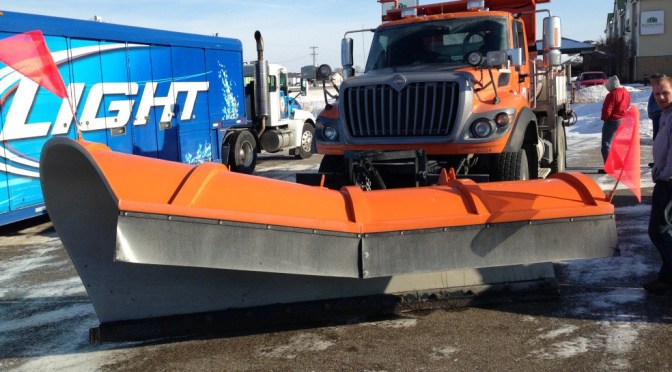
If the plow pictured above looks like two different plows welded together, it’s because they are.
Minnesota Department of Transportation snow plow operators in southwestern Minnesota have invented an experimental plow that uses the wind to cast snow from the road without impeding traffic or the operator’s view.
Manufactured for MnDOT by Fall Plows, the plow incorporates half of a traditional bull-dozer style plow with half of a Batwing-style plow. It eliminates the large “ear” on the driver’s side of a Batwing style plow that can stick out into oncoming traffic during center-line snow removal.
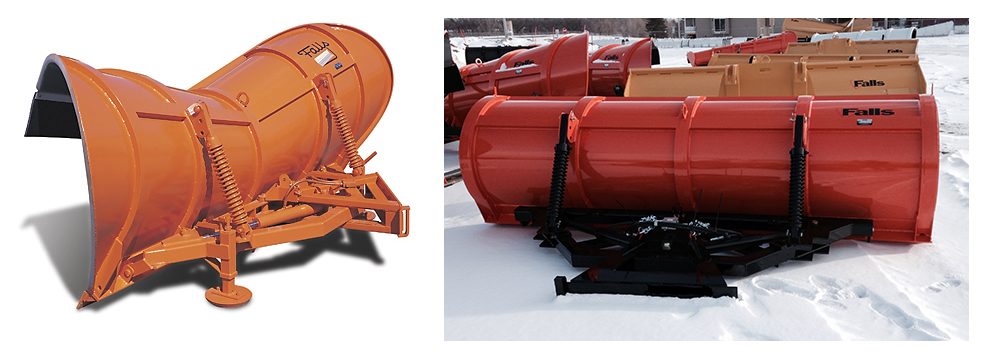
Half of the reversible batwing-style plow, pictured at left, was combined with half of the reversible bulldozer-style plow, at right.
District 8 Willmar Maintenance Supervisor Dennis Marty said he was looking for a reversible-style plow that could be used in the heavy winds and reduced visibility from blowing snow that are prevalent in western Minnesota.
When drivers are plowing against a northwest wind in rural Minnesota, the snow coming out of the chute will sweep across the truck and blind drivers, so operators needed a plow with a reversible system so they could throw the snow with the wind.
While an express plow with chutes on both ends (batwing-style), pictured above at left, was great for throwing snow to the right, when snow plow drivers took it down narrow two-lane roads, the plow stuck 2.5 feet into the oncoming lane and its big barrel partially blocked the headlights and the operator’s view.
So operators tried a regular one-way plow (pictured below), which resembles a funnel laid on it side, and put it on a reversible system that would allow operators to turn the plow both directions, so it could throw snow to the right or the left. However, this plow couldn’t blow snow high enough to the left, so snow piled in the left traffic lane.
One-way reversible plow.
Marty said he spent four to five years looking for a plow that combined the batwing and bull-dozer designs, but he couldn’t find anything sturdy and maintenance-free enough. Finally, he and Maintenance Research Program Administrator Ryan Otte sat down with Falls Plows in Little Falls, Minnesota and asked the company to build one.
The plow will be useful on low-volume roads that have little traffic during the middle of the night, which allows plow operators to cast the snow with the wind.
The Willmar office began using the experimental plow last winter and will be replacing all of its plows with it. Snow plow drivers from other areas of the state have been so impressed that at least two other maintenance districts have also ordered them.
Related Research
MnDOT’s Office of Maintenance has its own research program designed to let maintenance personnel test innovative ideas to keep our roads smooth, snow-free and safe. They even put out a monthly bulletin featuring new ideas and technologies. (You can find the back issues here.)
Your drive home may be a few minutes quicker today thanks to a team of researchers who are making it easier for Minnesota engineers to retime traffic signals.
It normally costs $3,500 to retime a signal due to the time involved in collecting the data and optimizing timings. But over the past several years, MnDOT-funded research has helped develop the SMART Signal system, which not only collects traffic and signal-phase data automatically, but also identifies under-performing traffic signals and generates optimal signal timing plans with minimal human intervention.
Traffic delays typically grow 3 to 5 percent per year due to outdated signal timing; however, most traffic signals in the United States are only re-timed every two to five years (or longer).
“Large-scale deployment of the SMART Signal system will significantly change the state-of-the-practice on signal re-timing because MnDOT won’t have to retime a traffic signal based on a fixed schedule,” said University of Michigan researcher Henry Liu (formerly a University of Minnesota professor), who began developing the system in the mid-2000s. “Instead, because of the reduced cost of signal data collection and performance measurement, signal retiming becomes performance-driven rather than schedule-based.”
MnDOT (along with many cities and counties) embeds loop detectors in road pavements that notify a traffic signal that a vehicle is present. Staff normally must manually track wait times to determine how the signal timing is affecting traffic.
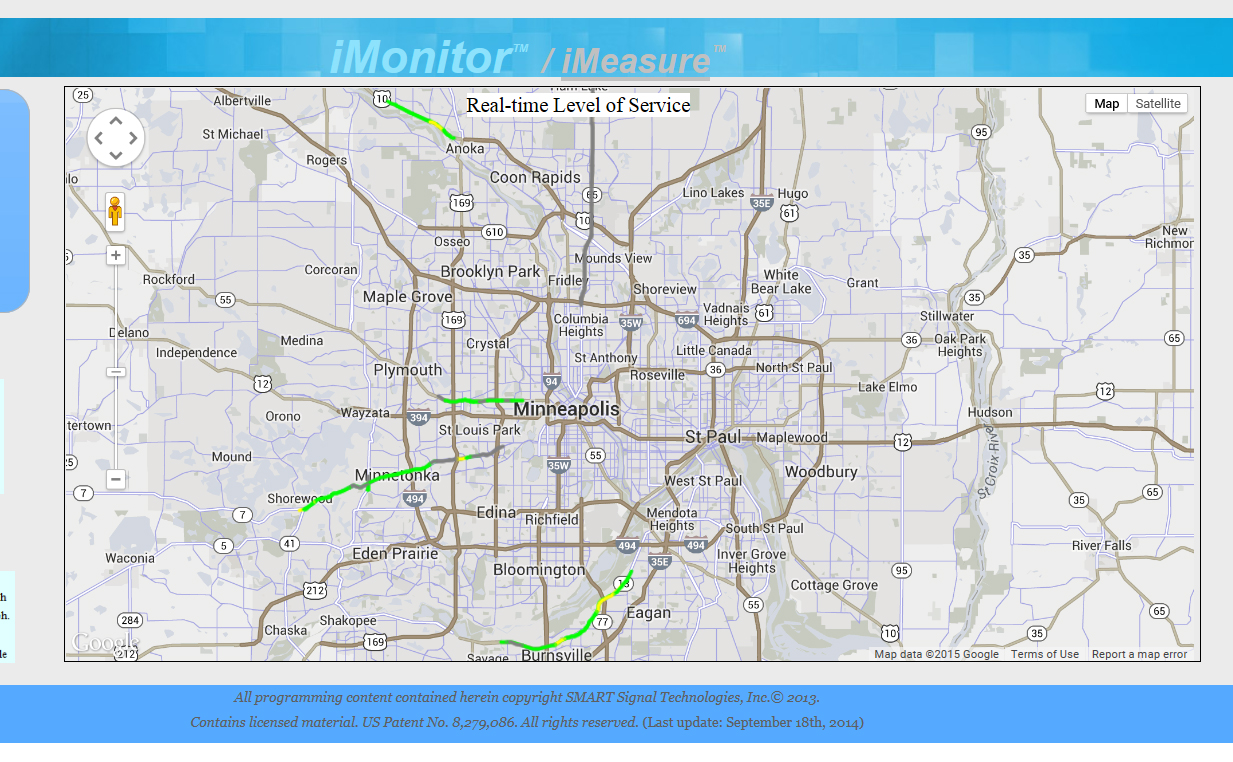
But SMART Signal automates much of this process by recording how long a vehicle waits at an intersection and automatically reporting the data (along with signal timing) to a central server. The data — viewable in real-time on this website — can then be analyzed to determine traffic patterns and optimal signal timing.
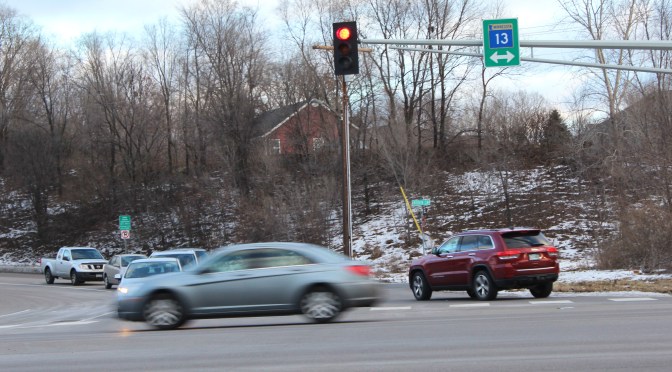
Recent enhancements to the SMART Signal system were successfully tested on Highway 13 in Burnsville, reducing vehicle delay there by 5 percent. The benefit could be in the double digits for corridors with worse traffic delays.
SMART Signal — which stands for Systemic Monitoring of Arterial Road Traffic — has been installed at more than 100 Minnesota intersections and is currently in the process of commercialization.
The latest research optimizes the system’s ability to reduce traffic delays by developing a framework to diagnose problems that cause delays at traffic signals and an algorithm that automatically optimizes the signal plan to address these problems. The software upgrade has since been integrated into all SMART Signal intersections.
Across the country, the financial benefit of retiming signals has been shown to be tremendous. On San Jose Boulevard in Jacksonville, Florida, for instance, traffic delays in one corridor dropped 35 percent and resulted in an annual estimated fuel savings of $2.5 million.*
“Data collection and performance monitoring are critical for improving traffic signal operations, and yet before the development of the SMART Signal system, these tasks were prohibitively expensive for most agencies because of the number of signals involved,” Liu said.
Future Applications
Liu is also looking at other potential applications for SMART Signal :
Improving safety at intersections with unusually high crash rates and predicting which intersections are likely to have elevated crash rates in the future.
Developing traffic signal timing models for diverging diamond intersections.
Determining how traffic and vehicle routes are affected by construction lane closures and detours on signalized highways.
A real-time adaptive signal control, which would automatically adjust signal timings based on current conditions, is not currently feasible with the SMART Signal system because it would require additional vehicle sensors. The latest SMART Signal research does, however, automate the data collection and calculations that would help the development of such a system.
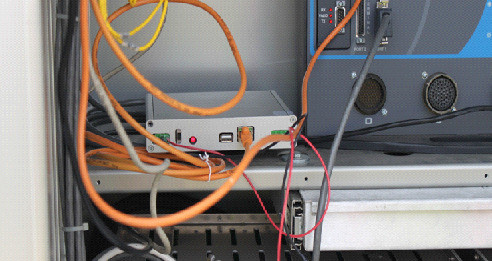
A data collection unit collects event-based traffic and signal data and sends it to a remote center for analysis.
*The Benefits of Retiming Signals,” ITE Journal, April 2004
Note: This blog post was adapted from an article in the latest issue of our newsletter, Accelerator. Click here to subscribe.