
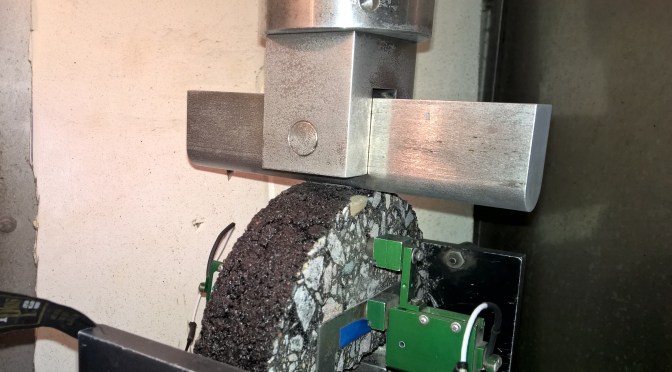
The Minnesota Department of Transportation is working with other state agencies in a pooled fund study to improve methods for testing crack resistance of asphalt mixtures. To expand options further, MnDOT asked researchers to evaluate alternative tests with standard lab equipment. The new tests produced repeatable results. Methods include the semicircular bend (SCB) test in a nontypical configuration, a dynamic modulus test of smaller asphalt mixture samples, a bending beam rheometer (BBR) test of mixtures, and a BBR of asphalt material for binder selection.
Continue reading Testing Methods for Crack Resistance in Asphalt Materials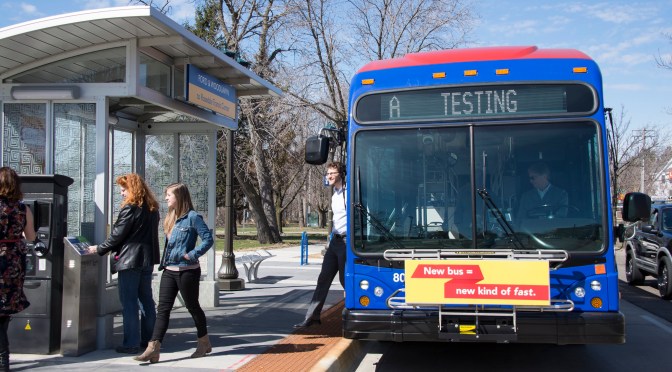
Impact of Arterial Bus Rapid Transit on Traffic and Users
Video and statistical analyses showed that arterial bus rapid transit (ABRT) along Snelling Avenue in Minneapolis-St. Paul had no significant impact on traffic volume and wait times at intersections. Survey results demonstrated that users prefer the A Line over local bus service and consider it roughly equivalent to express bus, light rail and commuter rail service. Though ABRT has not converted automobile drivers to transit riders, users enjoy its easy payment format, cleanliness, route service and convenience. This study also provided recommendations for future ABRT line design considerations.
Continue reading Impact of Arterial Bus Rapid Transit on Traffic and Users
New Tools to Optimize Truck Station Locations
The Minnesota Department of Transportation (MnDOT) has 137 truck stations across the state. These stations house and allow maintenance of MnDOT highway equipment as well as provide office and work space for highway maintenance staff. Within 20 years, 80 of these stations will need to be replaced as they reach the end of their effective life spans. Researchers developed a geographic information system based modeling tool to determine the most effective locations for truck stations in the state. Using data from many sources, a new research study has determined that MnDOT could rebuild 123 stations, relocate 24 on land available to MnDOT and combine two. MnDOT would save millions of dollars using the location optimization alternatives over the 50-year life cycle of a typical truck station.
Continue reading New Tools to Optimize Truck Station Locations
Study Suggests 70 Percent RAP for Minnesota Gravel Road Surfaces
Researchers examined mixtures of recycled asphalt pavement (RAP) and aggregate for new gravel road surface layers in the lab and in the field. Although test results did not align perfectly, and field results were somewhat uneven, findings suggest that mixtures with 70 percent RAP content can reduce dust generation. After a year of service these roadways can match all-aggregate gravel road performance in terms of strength, but with a smoother ride.
Continue reading Study Suggests 70 Percent RAP for Minnesota Gravel Road Surfaces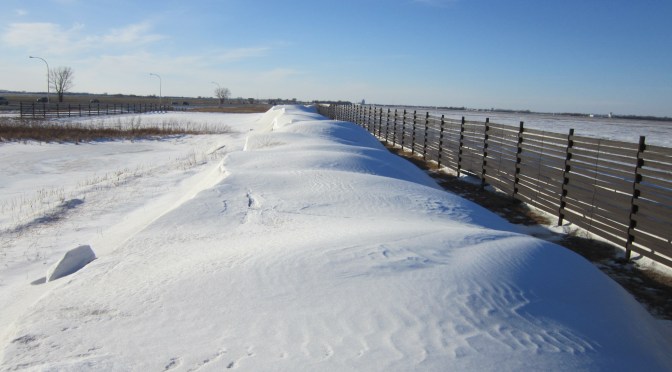
Study Underway to Harness Renewable Energy from Minnesota’s Highways
Sound barriers and snow fences along highways have the potential to provide clean energy in Minnesota.
A newly funded MnDOT study, Harnessing Solar Energy through Noise Barriers and Structural Snow Fencing, is investigating how to utilize existing noise barriers and snow fences on Minnesota highways to harvest clean, cost-effective energy.
Continue reading Study Underway to Harness Renewable Energy from Minnesota’s Highways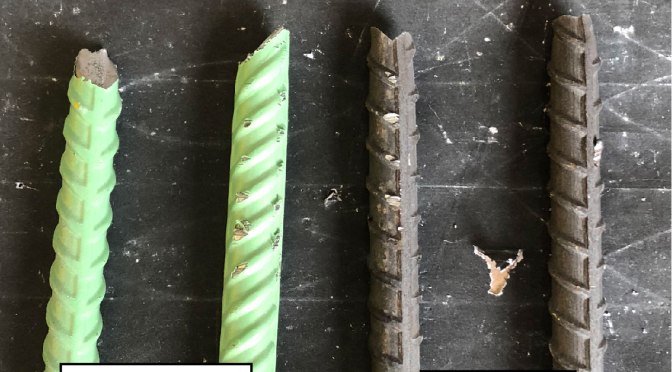
Using Chemical Adhesives to Post-Install Epoxy-Coated Rebar in Concrete
The Minnesota Department of Transportation (MnDOT) had suspended the use of post-installed epoxy-coated rebar for concrete barrier repairs as a precautionary measure because chemical adhesives used in the process are not designed for use with coated bars. But laboratory testing (conducted in a recent MnDOT-sponsored research study) has now shown that using these adhesives with coated rebar for post-installation works well and provides a safety level 200 to 300 times that predicted by manufacturer specifications. MnDOT is considering research recommendations to modify the installation process in order to resume using coated rebar in post-installed concrete crash barriers.
Continue reading Using Chemical Adhesives to Post-Install Epoxy-Coated Rebar in Concrete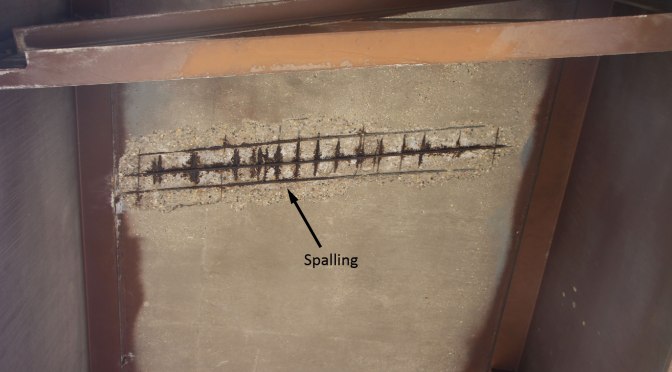
Epoxy-Coated Rebar Bridge Decks Outperform Mixed Rebar Decks
Bridge decks reinforced with one layer of epoxy-coated rebar and a bottom layer of uncoated steel rebar show corrosion damage sooner than decks constructed with all epoxy-coated rebar. Inspection methods should be enhanced to add a rating for cracking density on the underside of bridge decks. Repairs to mixed rebar decks should be conducted once a key deck surface inspection element has received a condition rating of two and held that rating for seven years, which is sooner than the average repair time of 8.5 years.
Continue reading Epoxy-Coated Rebar Bridge Decks Outperform Mixed Rebar Decks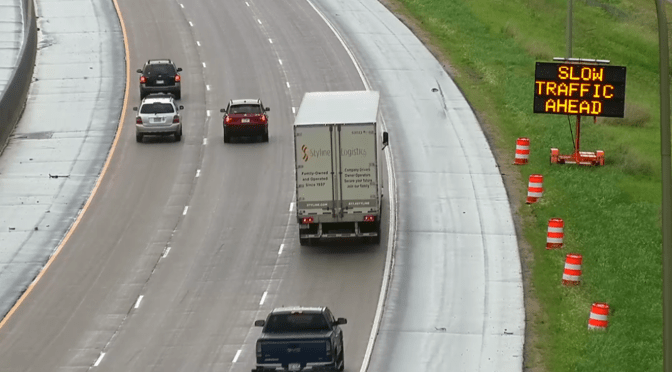
Speed Notification System Warns Drivers Approaching Urban Work Zones
Using an innovative method to calculate vehicle trajectories and gather large amounts of driver data, researchers tested and evaluated the new Smart Work Zone Speed Notification system and determined that its messages successfully influenced drivers to reduce their speed.
Continue reading Speed Notification System Warns Drivers Approaching Urban Work Zones
Evaluating the Use of Central Traffic Signal Control Systems
MnDOT sought to determine the full range of intersection control information (ICI) currently used in the state and how it could best be made accessible for state transportation system needs. Researchers created the Regional Database of Unified Intersection Control Information, a machine-readable, cloud-based unified ICI system. They determined steps MnDOT could take toward more effective use of its central traffic signal control system, such as mitigating traffic disruption around construction zones and participating more fully in emerging technologies such as vehicle information systems and vehicle automation.
Continue reading Evaluating the Use of Central Traffic Signal Control Systems
Sediment Control Log Guidance for Field Applications
Researchers tested sediment control logs in the lab and in the field to determine the relative filtration capabilities of these devices. They also developed design guidelines for correct selection and contributed to ongoing educational efforts.
Continue reading Sediment Control Log Guidance for Field Applications Crossroads