Tag Archives: road

New Project: Design guidance and best practices for the use of light fill for sustainable road construction

Lightweight Fill (LWF) materials—including Tire Derived Aggregates (TDAs), expanded shale/clay, foamed glass, and recycled glass aggregates—show strong potential for sustainable road construction, yet important knowledge gaps remain. Their environmental impacts, long‑term performance, and construction requirements are not fully understood, especially under Minnesota’s freeze‑thaw cycles and high groundwater conditions. Concerns such as leachate production, potential trench settlement, and challenges faced by local road departments highlight the need for further investigation.

This research seeks to address these gaps by reviewing existing practices, evaluating both environmental and mechanical performance, and developing data‑driven recommendations for using LWF materials in road construction. A detailed assessment will help clarify how these materials behave in pavement structures and embankments and how they interact with water‑sensitive environments. A decision matrix will be used to compare LWF materials and support future project planning.

To achieve these goals, the study will evaluate environmental impacts such as leachate risks, analyze long‑term structural integrity, and conduct Life Cycle Assessment (LCA) and Life Cycle Cost Analysis (LCCA) to assess sustainability and financial feasibility. The research will also develop recommended construction techniques that improve performance and support Minnesota’s climate goals and broader sustainability initiatives.

“Lightweight fill materials show promise for sustainable road construction, and Minnesota looks to learn from what has been done previously,” said Andrew Witter, Sherburne County Public Works Director and County Engineer. “This project will evaluate how these materials behave in local conditions and develop guidance for local counties and cities. The results will help agencies make informed decisions for the benefit of the transportation infrastructure in Minnesota.”

The Objectives:

  1. Document existing research and practices related to LWF materials in road construction.
  2. Evaluate the environmental impacts of LWF materials, focusing on leachate risks and interactions with water-sensitive environments.
  3. Analyze the long-term performance and structural integrity of LWF materials in both pavement structures and embankments.
  4. Compare LWF materials in a decision matrix to guide future project decisions.
  5. Perform Life Cycle Assessment (LCA) and Life Cycle Cost Analysis (LCCA) to assess the sustainability and financial feasibility of LWF materials.
  6. Provide recommendations to develop construction techniques that optimize the use of LWF materials and align with Minnesota’s climate goals and broader sustainability initiatives.

Project Details:

  • Estimated Start Date: 06/25/2025
  • Estimated Completion Date: 06/30/2027
  • Funding: Local Road Research Board
  • Principal Investigator: Michele Lanotte
  • Co-Principal Investigators: Angela Farina
  • Technical Liaison: Andrew Witter

Details of the research study work plan and timeline are subject to change.

To receive email updates about this project, visit MnDOT’s Office of Research & Innovation to subscribe.
Evaluating the Traffic Safety Benefits of J-Turns in Minnesota

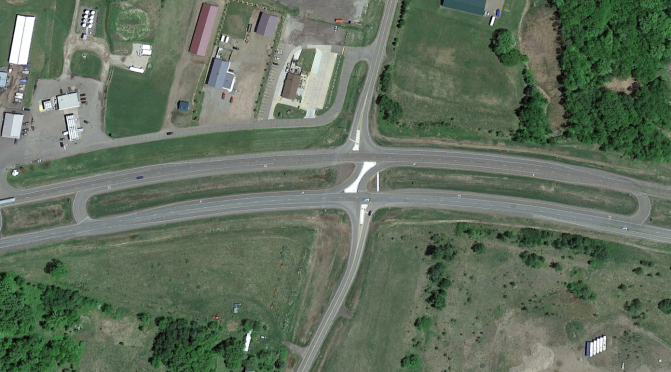
MnDOT traffic engineers are increasingly installing J-turn intersections on high-speed, multilane expressways to limit potential crash points. An analysis of crash data from intersections before and after the installation of J-turns demonstrated significant safety benefits from this alternative design. MnDOT researchers also explored crash history differences among J-turn intersections with varying characteristics. Consistent with the results from a previous study, this analysis found a clear decrease in fatal and other serious crashes after a J-turn was installed.

Continue reading Evaluating the Traffic Safety Benefits of J-Turns in Minnesota

Study Suggests 70 Percent RAP for Minnesota Gravel Road Surfaces

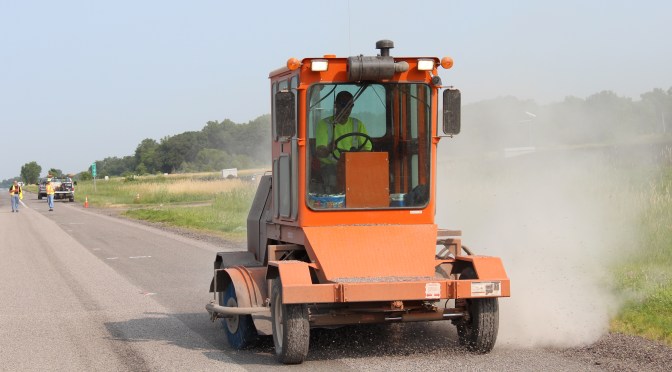
Researchers examined mixtures of recycled asphalt pavement (RAP) and aggregate for new gravel road surface layers in the lab and in the field. Although test results did not align perfectly, and field results were somewhat uneven, findings suggest that mixtures with 70 percent RAP content can reduce dust generation. After a year of service these roadways can match all-aggregate gravel road performance in terms of strength, but with a smoother ride.

Continue reading Study Suggests 70 Percent RAP for Minnesota Gravel Road Surfaces

Chip sealing: not just for local roads anymore (video)

Chip-sealing — spraying an asphalt emulsion over existing pavement and then covering it with fine aggregate — is a cost-effective alternative to resurfacing asphalt pavements. Traditionally, however, it has only been used on rural and low-volume urban roadways.

During a recent visit to MnROAD, we filmed a road crew chip-sealing a test section on I-94 and spoke with MnDOT Research Project Supervisor Tom Wood, who explained why chip sealing can also be an effective treatment for high-volume roadways.

*Note: This story was updated on 08/12/2014 to clarify that the chip sealing shown in the video involves spraying an “asphalt emulsion” rather than “hot liquid asphalt,” as stated in an earlier version of this post.

Permeable pavements could protect the environment, save taxpayer dollars

KSTP has a nice story today on the Minnesota Department of Transportation’s ongoing research into permeable pavements at the MnROAD research facility. (The video isn’t embeddable on WordPress, but you can find a direct link here.)

Permeable pavements (also known as “porous” or “pervious” pavements) are designed to allow water to pass through roadways and infiltrate directly into the underlying aggregate and soil. Their primary effect is to reduce stormwater runoff, which carries harmful materials from the road’s surface out into waterways. Of course, reducing runoff also mitigates the need for the kinds of costly drainage structures that are normally required to manage stormwater. Permeable pavements also reduce noise and mitigate the potential for hydroplaning, among other documented benefits.

These types of pavements are already used in some areas in Minnesota — mainly in parking lots and city streets — and MnDOT has been studying their potential use for full-depth roadway pavements. As the video indicates, so far the results have been encouraging. (You can read more about MnDOT’s ongoing research on the MnROAD website.)

As a side note, the amount of water these pavements can absorb is quite impressive. Last month, we posted a new Local Road Research Board video on stormwater management. In one scene, a public works crew dumps what appears to be several hundred gallons of water onto a permeable pavement and watch as it disappears almost instantaneously. (Watch the clip here.)

Here are the results of some recent permeable pavement studies here in Minnesota: