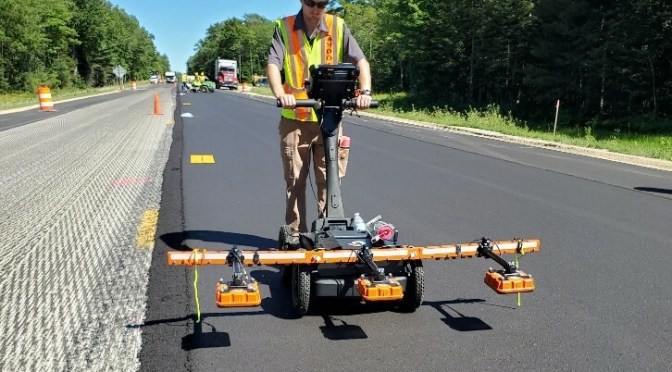
Asphalt pavements with polymer-modified binders (PMBs) perform better than pavements with unmodified asphalt binders. While pavements with PMBs may cost more initially, performance is improved in the long run. In a recent study, researchers compared the performance and life cycle costs of modified and unmodified binders and found that modified binders are more cost-effective, even for local low-volume roads.
Continue reading Comparing the Cost-Effectiveness of Asphalt Binders for Local RoadsFuture of Mobility: Urban air mobility
June 26, 2023
What’s next in transportation?
The Future of Mobility series collects the perspectives of top U researchers and other national experts. In 17 articles, the authors scan the horizon and reflect on critical transportation topics. Each article recommends action steps for public officials and policymakers.
CTS is highlighting the articles over the course of the year. This month, we explore two aviation-related articles: Safety and Urban Air Mobility by Demoz Gebre-Egziabher and Advanced Air Mobility by Susan Shaheen and Adam Cohen.
Autonomous aircraft and drones that can move people and goods in new ways are coming to our cities, writes Gebre-Egziabher. Often referred to as urban air mobility (UAM), these new transportation concepts are the flying equivalent of the autonomous car—and they raise just as many important questions about safety, use, and operations. Local communities and agencies are stakeholders that must have a say in safety and provide clear guidance to those developing technologies for UAM, he says.
Shaheen and Cohen write that aviation is undergoing rapid change around the world. A variety of technological advancements and industry investments in electrification, alternative fuels, automation, vertical take-off and landing aircraft, uncrewed aircraft systems, and air traffic management are enabling innovations in aircraft designs, services, and business models. They recommend driving the industry forward with an emphasis on social and environmental benefits, including humanitarian, aeromedical, and emergency response.
New Project: Assessing Methods to Mitigate Cognitive and Physical Declines That Influence Driving Performance of Older Drivers
Supporting older drivers to safely age in place as they experience age-related declines is important as many Minnesota drivers are reaching retirement age. Minnesotans, 65 years and older, are expected to represent 20% of the state population by 2025, with an overall increase of 122% from 2010-2040. While older drivers are generally safe drivers, those aged 75-85 face the highest risks from injury.
Continue reading New Project: Assessing Methods to Mitigate Cognitive and Physical Declines That Influence Driving Performance of Older DriversWith new signal timing method, Twin Cities traffic could flow more smoothly
Reprinted from Catalyst, May 12, 2023.
Eliminating intersection bottlenecks is one of the most persistent and difficult challenges for traffic engineers. A new mathematical theory called “max-pressure signal control” has been proven to achieve maximum throughput for entire city road networks, but it has not yet been used in practice. In a new study, U of M researchers brought the theory several steps closer to real-world use and found that it could offer many benefits to Minnesota road users.
“For most intersections and demand periods, we found that max-pressure control offered significant improvement over current signal timings,” says Michael Levin, an assistant professor with the Department of Civil, Environmental, and Geo- Engineering. “Large reductions in delay—sometimes over 50 percent—suggest that this new method of signal timing could achieve higher throughput during peak demand and be more responsive to queues.”
To achieve these findings, researchers began by addressing some aspects of max-pressure signal timing that would make it difficult to implement in a real-world setting. First, researchers addressed its assumption that all roadways had separate turning lanes by adapting the mathematical model to accommodate mixed travel lanes.
Another drawback of the original formula is that the signal control doesn’t operate on a cycle; this could cause long wait times when demand is uneven and make the signal cycle unpredictable for both drivers and pedestrians.
“To solve this issue, we modified the formula to include a maximum waiting time and require that the phase selection follows a cycle,” Levin says. “This allows traffic engineers to create an ordered set of phases for each intersection.”
Once the updated version of max-pressure control was developed, researchers tested it in simulations of two corridors in Hennepin County, Minnesota. The simulations revealed numerous potential benefits including reduced environmental impacts and reduced road user costs resulting from travel time savings and lower fuel costs.
“The findings show that our new max-pressure control formula will reduce the average queue length during peak hours and that vehicles will not wait as long at intersections,” Levin says. “We can also predict higher throughput and faster vehicle speeds, all of which will mitigate congestion and improve quality of life.”
In addition, a cost-benefit analysis shows that the total value of travel time savings is considerably larger than the cost to implement max-pressure control.
The project’s success led researchers to explore the possibility of a real-world pilot project with available traffic signal hardware. They found that the traffic signal technology currently used in Hennepin County could be upgraded to support a pilot study, laying the groundwork for a future real-world test of this promising new signal timing method.
The project was funded by the Minnesota Local Road Research Board (LRRB). Phase two of the work, also funded by the LRRB, is underway.
Writer: Megan Tsai
More Information
- MnDOT Phase I Project page
- Final report, Phase 1
- Phase 2 Project Page
Strategies improve pollinator roadside habitat, reduce costs
First published in Catalyst, May 22, 2023.
Transportation agencies revegetate roadsides after construction projects to provide road stability, stormwater filtration, and visual appeal. Revegetation is also a good opportunity to create pollinator-friendly habitat. However, planting and maintaining ditches can be expensive, funds for such projects are usually limited, and there isn’t much data on which methods actually work.
Continue reading Strategies improve pollinator roadside habitat, reduce costsMultimodal trip planner to make travel easier in Greater Minnesota, rural areas
Reprinted from Catalyst, May 9, 2023
When a person wants to take a trip across the country, they can choose from a variety of travel planning apps to help make that happen. But what if the trip they want to take is from Mankato to New Ulm, or within their own community, using non-personal transportation?
The Minnesota Department of Transportation has launched a pilot project to bring trip planning and payment technology for daily trips to areas less dense than urban settings.
Residents and visitors in southern and western Minnesota now have the ability to plan for and, in some cases, pay for public transit and intercity bus trips using the Transit app. Travel and route information for these agencies went live within Transit on March 1.

Transit, a free app available for download in Google Play or the Apple App Store, is used in more than 300 cities around the world. It allows users to see route and travel options for public transit and connecting services. Select agencies also have in-app ticketing, allowing riders to pay for fares electronically and then show their device to transit drivers to ride.
“This pilot with the Transit app focuses on rural areas because this technology has not yet been made available outside of Minnesota’s big cities,” says Elliott McFadden, MnDOT’s Greater Minnesota Shared Mobility Program coordinator. “The project will be the first to bring the latest technology to make it easier to plan and take trips in many communities in Greater Minnesota.”
The pilot will run through April 2024 and is funded by two innovation grants from the Federal Transit Administration at a cost of $1.9 million.
U of M researchers led by Alireza Khani will evaluate the project to help determine whether this technology should be scaled to the rest of the state. Focusing on southern Minnesota, the research team will work closely with MnDOT’s project management team and the platform development team to study these questions:
- How do residents of the region benefit from having access to a variety of mobility options through an integrated platform?
- To what extent does the platform help increase transit ridership and reduce personal vehicle use?
- How can the features of the platform—such as route planning or pricing—be optimized for greater system efficiency and benefits for all residents?
“Our goal is to provide the data and analysis policymakers need to make the most effective transit investments,” says Khani, an associate professor in the Department of Civil, Environmental, and Geo- Engineering.
(Adapted from a MnDOT press release, March 1, 2023.)
More Information
New Project: Mitigating Tenting of Transverse Cracks and Joints in Asphalt Pavement
More than 60% of Minnesota’s roadways consists of asphalt pavement. When transverse cracks occur in asphalt, our frigid winters can cause a secondary distress known as pavement tenting, crack heaving, or lipping. As ice accumulates in the base materials underneath, it causes pavement on both sides of the transverse cracks and joints to heave.
Continue reading New Project: Mitigating Tenting of Transverse Cracks and Joints in Asphalt PavementMonitoring Bumble Bee Populations in the Twin Cities Metro – Lessons Learned
In a project funded by MNDOT, entomologists developed an innovative method for surveying bumble bee populations alongside roadways. The researchers have recently published an article in Biological Conversations, Vol 283 focusing on the lessons learned about sampling when surveying these quick-moving bees.
Continue reading Monitoring Bumble Bee Populations in the Twin Cities Metro – Lessons LearnedUnderstanding Transit and Shared Mobility Preferences in Greater Minnesota Post-COVID
Public transit and shared mobility use sharply decreased during the pandemic. To remain viable, transit agencies and other transportation services in Greater Minnesota need to recover customers. A recent project identified rider preferences, safety measures and service improvements to increase interest in and use of alternative transportation.
Continue reading Understanding Transit and Shared Mobility Preferences in Greater Minnesota Post-COVIDThe Role of Gender and Identity in Travel Behavior
Ensuring the transportation system is accessible and welcoming to all demographics requires understanding how different genders interact with the transportation system. Insight gained from a new project into the impacts of gender and other identities on travel needs, challenges and experiences will aid MnDOT in advancing transportation equity.
Continue reading The Role of Gender and Identity in Travel Behavior