
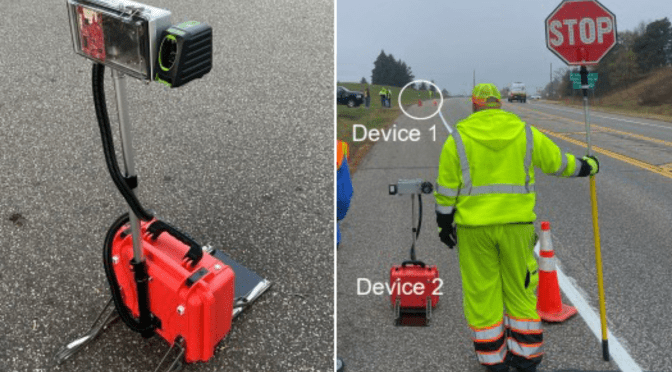
Motorists driving dangerously in work zones present a safety risk to workers and themselves. Alerting these drivers about their driving behavior before they reach the work zone could reduce the number of work zone crashes and enhance work zone safety. This project developed and evaluated the performance of a device that provides audio and visual alerts to drivers whose vehicles are approaching work zones at a high speed and on a dangerous trajectory.
Flaggers who maintain traffic flow through work zones on state and county roads have a very high-risk job with 41 out of every 100,000 killed annually. Preemptively warning errant drivers that present a risk to the safety of flaggers could significantly reduce the number of deaths and injuries.
This project developed and evaluated a low-cost device that automatically detects vehicles dangerously approaching work zones by tracking vehicle trajectories, detecting potential intrusions, and giving audio and visual alerts that warn drivers to reduce vehicle speeds. If effective, the device could serve as a tool to encourage safer driving as vehicles approach work zones and improve safety outcomes.
What Did We Do?
After refining the device’s design based on feedback from transportation agencies, investigators devised a compact, toolbox-style unit. The device, which weighs approximately 15 pounds, is equipped with foldout stabilizing brackets, a telescoping pole and a radar sensor on the pole that collects simultaneous measurements to estimate each vehicle’s distance, velocity, orientation and lane position.
Vehicles posing a risk to a work zone, including those approaching the flagger, can trigger an audiovisual alert (a car horn and strobe light) 40 to 60 meters downstream of the deployed device.
Device testing occurred at six locations: one rural site, three urban sites, a staged pedestrian crossing and a suburban/rural corridor. Devices at four sites collected data to validate the device’s tracking and warning performance; devices at the remaining two sites enabled the audiovisual alerts to vehicles posing a risk.
At the suburban/rural corridor site, two devices tracked vehicles. The upstream device tracked and alerted vehicles up to 60 meters upstream of the downstream unit, and thereafter the downstream device tracked vehicles and alerted drivers until they reached the flagger near the start of the work zone.
What Did We Learn?
In the first test with audiovisual alerts, no vehicles posed a risk and consequently triggered no alerts. While the data indicated some occurrences of vehicles with speeds over the warning threshold, these speeds need to remain for three consecutive radar frames to trigger the audiovisual alert, which did not occur. This was a positive indication that the devices were effective at not issuing false alerts.
“The field-testing results are encouraging for the potential future use of a low-cost, easy-to-transport device that can make work zones safer for state and county workers,” said Wayne Sandberg, director and engineer, Washington County Public Works.
The second test triggered 11 upstream alerts in 1.5 hours. Six drivers reduced vehicle speed after the first warning, and five triggered the reinforcing downstream alert. Of those five drivers, four slowed and one ignored both warnings.
Vehicles received the upstream warnings 100 to 130 meters from the downstream device at 35 to 40 mph in work zones with a posted speed limit of 30 mph. Vehicles traveling 10 mph over the limit required approximately 30 meters to slow to 30 mph. Because the upstream device alerted these vehicles 60 meters in advance, there was adequate distance for drivers to react appropriately.
If the four drivers who responded to the downstream unit only were traveling at a speed of 30 mph, they would require approximately 25 meters to come to a full stop if they exhibited stronger braking when their vehicles were closer to the flagger. Again, all alerts were issued 40 to 60 meters before the work zone, indicating that vehicles had adequate stopping distance and confirming the effectiveness of device placement.
Overall, the results suggested that the lane-level tracking and speed–distance warnings functioned reliably. The warnings effectively influenced driver behavior and prompted sufficient deceleration before the work zone.
What’s Next?
These results offer promising data to support further use of the alert device. But additional testing and refinements are needed. The refinements include GPS-informed dynamic thresholds; finalized strobe patterns for better visibility; and guidance for device setup, including mounting height and spacing.

