
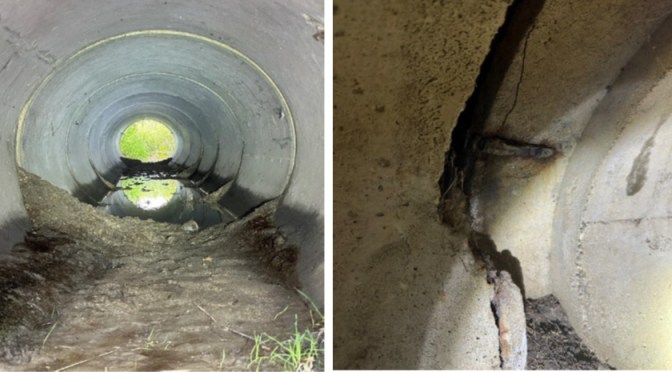
Culverts are essential components of urban and rural infrastructure that guide and channel water under roads and embankments. The most common failure affecting culverts is joint separation between segments of the concrete pipes. This project examined the predictors and factors that lead to joint separations in culverts to determine practices that will decrease future separations.
Approximately 20% of state-owned concrete culverts in Minnesota have experienced joint separations. Water and supportive soil may then seep through the gap into the pipe, leading to roadway settlement and culvert failure.
This project sought to identify the primary factors that contribute to joint separation and recommend mitigation strategies and construction practices that will reduce future occurrences. The results will inform MnDOT strategies and practices for installing round concrete pipe culverts to protect infrastructure and reduce maintenance costs.
What Did We Do?
An examination of the Transportation Asset Management System (TAMS) HydInfra database, MnDOT’s culvert and storm drainage asset management system, helped to identify the extent of joint separations in concrete pipes throughout the state. A decision tree based algorithm then used culvert location, geometry and condition data to predict the probability that joints in a pipe would separate.
A field survey of concrete culverts examined factors that may influence joint separation, including site conditions, soil types, pipe connections, pipe ages and districts. In the summer of 2024, 86 culverts from multiple districts were investigated to observe a variety of joint details, pipe sizes and joint separation severity. Further, a survey of MnDOT staff collected information and opinions about the likely causes of joint separations and potential solutions.
Finite difference and finite element modeling were used to investigate the primary factors that correlate joint separations with the impacts of traffic loading, embankment weight, soil freeze-thaw and elevation changes in the water table.
What Did We Learn?
Geographic location, such as the county and route number of the culvert, was the best predictor of joint separation—more so than geometric features such as culvert size or installation depth.
Examination of the TAMS HydInfra database also found that joint separation occurred most often in southern Minnesota counties with a high density of intermittent streams.
Further, most pipes affected by infiltration, inslope cavities or roadway voids also experienced joint separation, confirming the correlation that joint separations lead to additional issues.
“This project identified probable causes of joint separation to help improve standards and construction practices for culverts while also offering new ways to leverage our hydraulic infrastructure database to support future asset management needs,” said Nicholas Olson, state hydraulic engineer, MnDOT Bridge Office.
Field surveys indicated separations regularly occurred near the ends of culvert pipes or in the first untied joint from the end of the pipe. In some instances, other damage such as concrete joint breakage occurred alongside the joint separation.
The most common solution from MnDOT staff members was to install pipe ties on all joints to prevent separation. Other possible causes of joint separation suggested by staff included insufficient compaction of backfill material around the pipe and freeze-thaw damage at the ends of pipes with cohesive soil caps due to the caps expanding more than the backfill material compacted around the pipe.
The computer modeling results demonstrated that embankment self-weight and traffic loading exert their highest demands toward the center of the road in contrast to field inspections that found joint separations at the ends of the concrete pipes.
Soil freezing or changes in the water table level exert greater forces than traffic at the ends of pipes, indicating these factors are more likely to cause joint separations.
Investigators concluded that the expansion and contraction of freezing soil are the most likely driving forces for culvert joint separation. The most significant factors determining the extent of joint separation from soil freezing were the length of the culvert pipes (longer segments induced more separation) and the amount of soil expansion upon freezing.
What’s Next?
Based on project findings and the responses from MnDOT staff, investigators recommend installing pipe ties on all culvert pipe joints and ensuring backfill material is properly compacted.
They also suggest additional work to classify the frost heave susceptibility of typical bedding and cohesive cap materials.

