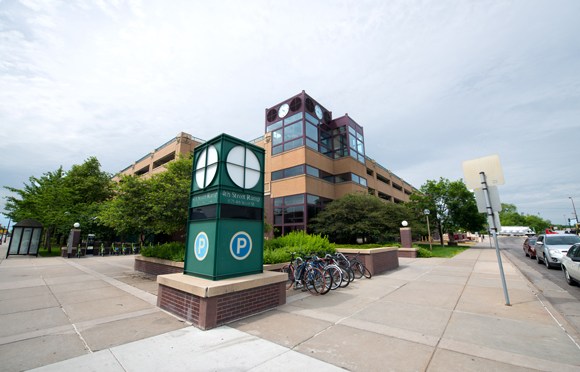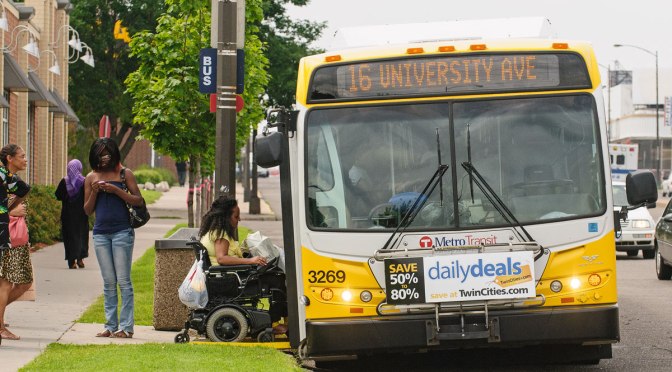
Transit ridership dropped significantly last year in Minneapolis, Duluth and other cities during the COVID-19 pandemic.
Continue reading New Project: Understanding Post-COVID Safety Concerns, Perceptions and Preferences of Transit and Shared Mobility Users in MinnesotaCategory Archives: Traffic and Safety
Urban Rapid Transit Reduces Traffic on Nearby Roads
Light rail transit and bus rapid transit in the Twin Cities provide urban residents with fast, safe and reliable transportation. These transitways have the potential to attract more riders and further reduce automobile traffic, relieving the growth of congestion on nearby roads as people decide to be transitway passengers rather than motorists.
Continue reading Urban Rapid Transit Reduces Traffic on Nearby RoadsLocal Guidance for Bicycle Facility Design
A quick reference guide is now available to help local agency planners and designers select the best bicycling facilities for their system. This guide walks local agencies through the selection and design process, and directs users to specific places within design manuals for details on facility questions.
Continue reading Local Guidance for Bicycle Facility DesignSmartphone App Gives Crossing Guidance to the Visually Impaired
In a recent research project, MnDOT sought to validate a smartphone app designed to guide pedestrians who are blind or visually impaired through signalized and unsignalized intersections. The project succeeded in showing the app’s effectiveness in tests at six intersections in Stillwater, Minnesota.
Continue reading Smartphone App Gives Crossing Guidance to the Visually ImpairedUnderstanding Rural Pedestrian Travel Behavior and Safety Issues
In collaboration with the Advocacy Council for Tribal Transportation and other tribal members, University of Minnesota researchers monitored 10 roadway sites specified as safety risks for pedestrians on four rural Minnesota reservations. Analysis of videos and group brainstorming produced a shortlist of potential countermeasures that could be incorporated into future highway projects.
Continue reading Understanding Rural Pedestrian Travel Behavior and Safety IssuesNew Project: Cost/Benefit Analysis of Fuel Efficient Speed Control Using Signal Phasing and Timing Data
Due to rising fuel costs and environmental impact, consumers are increasingly aware of fuel efficiency (MPG) in the vehicles they purchase, which is reflected in increasing hybrid and electric vehicle sales. A major source of fuel consumption is acceleration and deceleration cycles caused by stopping at red lights—acceleration from a full stop requires significant power.
Continue reading New Project: Cost/Benefit Analysis of Fuel Efficient Speed Control Using Signal Phasing and Timing DataRichfield “Sweet Streets” Improve Quality of Life, Traffic Times Citywide
Complete streets is an approach to road planning and design that considers and balances the needs of all transportation users.
Richfield, Minnesota, located south of Minneapolis, began a Complete Streets redesign in 2013. So how did it turn out? A retrospective study has found that while construction impacts remain on the minds of business owners and residents, Richfield’s program has improved community life and traffic times citywide. Safety and multimodal use are expected to improve.
Continue reading Richfield “Sweet Streets” Improve Quality of Life, Traffic Times CitywideNew Project: Pedestrian User Experience at Roundabouts
Roundabouts reduce the severity of crashes at intersections, but transportation agencies have received some feedback from pedestrians indicating that roundabouts, especially larger multi-lane roundabouts, can be difficult to navigate.
Continue reading New Project: Pedestrian User Experience at RoundaboutsHow Well Do Stop Lines Work as a Safety Feature?
How well do the stop lines at stop-controlled intersections actually work as a safety feature? Through an extensive safety study and a before-after field observation, a recent Minnesota Local Road Research Board study showed that the assumed safety effects of stop lines as a means of influencing driver behavior are not well supported by the evidence.
Continue reading How Well Do Stop Lines Work as a Safety Feature?Smartphone-Based Coaching for New Teen Drivers May Offer Long-Term Benefits
This article was originally published in Catalyst, August 2020.
More than five years ago, U of M researchers studied a group of new teen drivers to gauge the effects of real-time, in-vehicle coaching with their innovative Teen Driver Support System (TDSS) smartphone application. Now, a follow-up study offers new understanding about the system’s long-term effectiveness in reducing risky driving behavior.
Continue reading Smartphone-Based Coaching for New Teen Drivers May Offer Long-Term Benefits