
All posts by Nick


Video: Minnesota Statewide Bicycle Plan

Bicycle and pedestrian-counting project wins CTS partnership award
(Feature image courtesy Michael McCarthy, Center for Transportation Studies.)
Earlier this year, we wrote about the Minnesota Bicycle and Pedestrian Counting Initiative, a project that developed guidelines and protocols to help transportation planners accurately count non-motorized traffic. This groundbreaking research involved a diverse partnership of state and local officials, University of Minnesota faculty, and private and nonprofit organizations.
On Wednesday, April 23, the project team (photo above) was honored with an award from the Center for Transportation Studies. Team members accepted the CTS Research Partnership Award in a ceremony at the McNamara Alumni Center in Minneapolis. The award is given each year to projects that have resulted in “significant impacts on transportation” and that draw on “the strengths of their diverse partnerships” to achieve their results.
The video below, produced by CTS, explains the importance of the project. MnDOT is now in the process of implementing the research results by installing permanent counters and using portable counters in select locations around the state. MnDOT plans to use the information for a variety of purposes, including planning, safety analysis, investment planning and quality-of-life analysis.
Project team members will present their research findings at the North American Travel Monitoring Exposition and Conference in July. The conference’s focus is on “Improving Traffic Data Collection, Analysis, and Use.”
*Bonus: Read about last year’s Research Partnership Award-winner, a MnDOT-led, multi-state effort to reduce low-temperature cracking in asphalt pavements.
Learn more about the project:
- Technical Summary (PDF)
- Final Report (PDF)

Video: What is the LRRB?

Minnesota Bike Lanes: Learning to Share the Road

Video: Answers to Common Questions About Gravel Roads

Video: How to Navigate a Multi-Lane Roundabout

New technology aimed at making rural intersections safer
This video above showcases a new kind of intersection conflict warning system being developed for use primarily by local agencies at rural, two-way stop intersections. Called the ALERT System, it uses a simple but ingenious combination of radar, wireless communication and flashing LEDs to alert drivers to the presence of approaching vehicles, thereby helping them identify safe gaps in the cross traffic and avoid potentially deadly collisions.
These types of systems are nothing new; MnDOT and other state DOTs have been developing them for more than a decade under the ENTERPRISE pooled fund program. MnDOT also recently kicked off a three-year project to deploy 20–50 of its Rural Intersection Conflict Warning Systems at selected at-risk intersections across the state. The main difference with the ALERT System is that it’s designed to be cheaper and easier to deploy than existing ICWS technologies. While that might sound like an incremental improvement, the difference for cash-strapped local agencies could be huge.
Since the ALERT System uses solar power, it doesn’t have to be hooked up to the power grid — which means that, in theory, county public works crews could install it themselves. The system also uses a simplified controller that doesn’t require a traffic signal technician to install and maintain, and detects vehicles using radar rather than in-pavement sensors. These factors might encourage greater adoption of ICWS technologies, which studies have shown to reduce both the frequency and severity of crashes.
The project is now in its second phase. It still faces a number of hurdles before could be ready to deploy, but Vic Lund, the traffic engineer for St. Louis County and the project’s main champion, says the results so far have been encouraging. In the video below, Lund shares his thoughts on the project, its challenges and the future of Intelligent Transportation Systems in Minnesota.
Learn more:
- Warning system aims to alert drivers to potential crashes (Catalyst article)
- Advanced LED Warning Signs for Rural Intersections Powered by Renewable Energy (Technical Summary)
- Advanced LED Warning Signs for Rural Intersections Powered by Renewable Energy (Research Report – Phase 1)
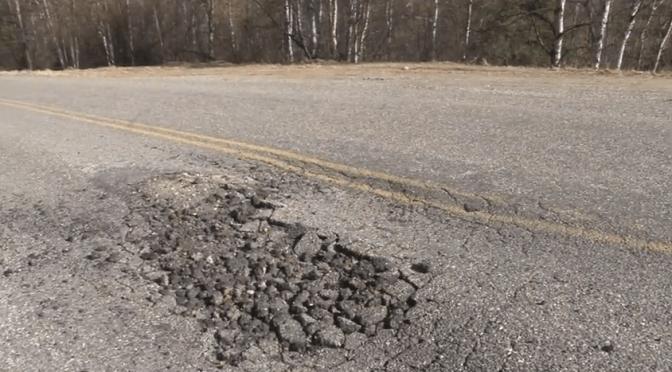
New videos show how frost heave ravages roads
Regardless of whether you’re familiar with the term “frost heave,” if you live in Minnesota and drive on the roads, you’re already familiar with its destructive capacity. Many of the dips, bumps, potholes and cracks that appear on our roads every spring are a direct result of frost heave, which occurs when water accumulates in the soil beneath the pavement and begins freezing and then thawing along with the changing seasons. The resulting expansion and contraction weakens the road base and leaves it susceptible to damage from traffic loading.
These new videos produced by the Local Road Research Board explain how frost heave works, and describe some of the strategies public works departments use to combat it. The top video is is the shortened, executive-summary version, while the bottom video is the full, 13-minute version meant for transportation professionals.

Patching pavement with microwaves and magnetite
On Wednesday, I had a chance to watch a demonstration of a uniquely Minnesotan pavement patching technology that combines an industrial-strength microwave with a special asphalt mix. What makes it “uniquely Minnesotan?” In addition to having been developed by University of Minnesota researchers and a Monticello-based company (and with some funding from MnDOT), this innovative method involves a special asphalt mix using magnetite, a mineral that abounds on Minnesota’s Iron Range.
It also addresses a very Minnesotan transportation problem: winter pavement repair. In the video above, Kirk Kjellberg of Microwave Utilities, Inc., highlights some of the benefits of using the 50,000-watt microwave to heat the pavement during patching. In addition to creating a longer-lasting patch, the microwave is considerably faster than many alternative techniques. The technology is still relatively new, but its supporters claim it allows for pavement repairs in the middle of winter that are as strong and durable as the ones road crews do in the summer.
The demonstration, which was organized for members of the Local Road Research Board, took place at MnDOT’s District 3 training facility in St. Cloud.
See also:
- “Three Ways to Cook a Pothole” (June 5, 2013)
- In the news: innovative U of M and MnDOT pothole repair technology (April 30, 2013)
 Crossroads