

MnDOT sought to determine the full range of intersection control information (ICI) currently used in the state and how it could best be made accessible for state transportation system needs. Researchers created the Regional Database of Unified Intersection Control Information, a machine-readable, cloud-based unified ICI system. They determined steps MnDOT could take toward more effective use of its central traffic signal control system, such as mitigating traffic disruption around construction zones and participating more fully in emerging technologies such as vehicle information systems and vehicle automation.
Continue reading Evaluating the Use of Central Traffic Signal Control SystemsAll posts by mndotresearch

Sediment Control Log Guidance for Field Applications
Researchers tested sediment control logs in the lab and in the field to determine the relative filtration capabilities of these devices. They also developed design guidelines for correct selection and contributed to ongoing educational efforts.
Continue reading Sediment Control Log Guidance for Field Applications
Preparing Roads for Connected and Autonomous Vehicles
Proprietary technologies, industry competition and federal regulatory concerns are slowing the advent of defined standards for connected and autonomous vehicles (CAVs). Researchers investigated the state of CAV implementation to help local agencies begin preparing for the infrastructure needs of these vehicles. CAV-friendly options are considered for eight infrastructure categories. Since truck platooning is the likely first application of this technology, and optical cameras appear imminent as an early iteration of sensing technology, researchers suggest that wider pavement striping and well-maintained, uniform and visible signage may effectively serve the needs of CAVs in the near future while enhancing infrastructure for today’s drivers.
Continue reading Preparing Roads for Connected and Autonomous Vehicles
Bus–Highway Connections Make Transit More Competitive With Driving
Researchers developed a method for associating travel times and travel costs with transit mobility. In an evaluation of bus–highway system interactions, investigators found that park-and-ride lots and managed lanes put suburban and walk-up urban transit options on equal footing. Bus–highway system interactions improve access to job locations and have improved transit access to job sites by about 20 percent compared to automobile access. When wage-related costs are included, the benefit of automobile use over transit use diminishes significantly.
Continue reading Bus–Highway Connections Make Transit More Competitive With Driving
New project: Effectiveness of Teenage Driver Support System
The Minnesota Local Road Research Board (LRRB) has funded a follow-up study to determine whether a monitoring system it field tested for new drivers, called the Teen Driver Support System (TDSS), affected teenagers’ long-term driver behavior.
Continue reading New project: Effectiveness of Teenage Driver Support System
Concrete Grinding Residue Doesn’t Appear to Negatively Affect Roadside Vegetation and Soil
A new MnDOT research study determined that depositing concrete grinding residue (CGR) slurry at specific rates on roadside vegetation and soil may not cause lasting harm to plant growth and soil quality; however, follow-up research is recommended.
Continue reading Concrete Grinding Residue Doesn’t Appear to Negatively Affect Roadside Vegetation and Soil
Rout-and-Seal Offers Slight Cost–Benefit Over Clean-and-Seal Repairs
In a recently completed study, Minnesota researchers compare the performance and cost-benefit of the clean-and-seal versus rout-and-seal techniques for repairing asphalt pavement cracks.
Continue reading Rout-and-Seal Offers Slight Cost–Benefit Over Clean-and-Seal Repairs
MnDOT’s Smart Bridge Sensors Are Leveraged to Measure Vertical Displacement
A Minnesota Department of Transportation research study has developed a new method for estimating vertical displacements on bridges using accelerometers installed on the Interstate 35W St. Anthony Falls Bridge in Minneapolis. The dual-model approach shows potential for using these sensors to measure vertical displacement on steel, cable-stayed and other less-stiff bridges where traffic generates higher vibration frequencies. The method expands the industry’s knowledge of how to use smart sensors in new ways.
What Was the Need?
Since September 2008, the I-35W St. Anthony Falls Bridge has carried traffic over the Mississippi River in Minneapolis and funneled sensor data to researchers and MnDOT bridge engineers. This smart bridge features over 500 sensors that monitor strain, load distribution, temperature, bridge movement, and other forces and functions.
Sensors help designers and bridge managers learn more about how bridges shift and flex over time. Concrete expands and contracts, and bearings shift; sensor systems continuously gather data about these minute changes, offering an alternative to time-consuming inspection.

Researchers continue to identify potential uses for sensor data and new ways to use such information to analyze bridge properties and performance. In a 2017 study about monitoring bridge health, researchers learned to distinguish and associate specific vibration frequencies with structural damage, weather conditions and other factors. These frequencies were gathered by accelerometers, which measure structural vibrations triggered by traffic and environmental conditions.
Decks, piers and other structural elements displace vertically under loads and environmental conditions. Researchers and bridge managers wanted to know if accelerometers could be used to measure vertical displacements and help monitor bridge health.
What Was Our Goal?
MnDOT needed a procedure for measuring and monitoring vertical displacement on bridges under traffic and environmental forces. Investigators would use the sensor systems on the I-35W St. Anthony Falls Bridge to design and analyze this procedure.
“We need to learn more about sensors because we don’t have a lot of experience with them. This study gave us valuable information about accelerometers and the information they provide,” said Benjamin Jilk, Complex Analysis and Modeling Design Leader, MnDOT Bridge Office.
What Did We Do?
Indirect analysis and measurement of vertical displacements rely on estimations obtained through modeling. Investigators evaluated the most well-developed approach for measuring vibration frequencies like those tracked by accelerometers and refined the method. The team developed a dual-model approach: One model estimates loads and the other estimates displacements.
In a laboratory, investigators evaluated the impact of loading on displacement and vibration frequencies on a girder with contact sensors and accelerometers under moving and stationary loads. Researchers applied the dual-model analysis to laboratory displacement readings to compare the effectiveness of the model with contact sensor responses to loading.
Using laboratory data, investigators tuned the dual-model approach to accelerometer data available from the I-35W St. Anthony Falls Bridge. The research team then applied its identified tuning approach to the data from the bridge’s 26 accelerometers to determine the procedure’s suitability for estimating vertical displacement from vibration response on this bridge and its potential for other structures in the MnDOT bridge system.
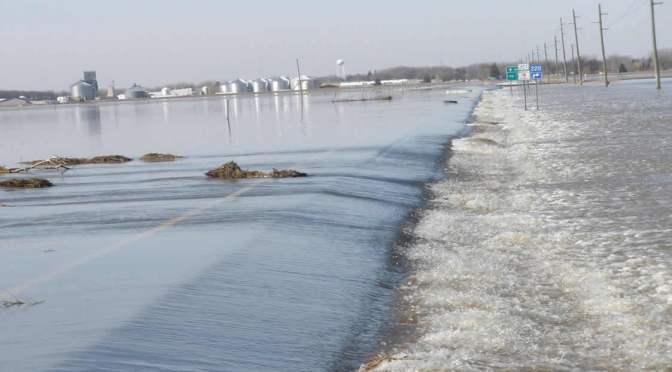
New Project: Extreme Flood Risks to Minnesota Bridges and Culverts
Extreme flooding is a threat to Minnesota’s transportation infrastructure and the safety and economic vitality of its communities. A spate of recent flooding events around the state has demonstrated this and heightened the level of concern. Furthermore, climate change — a factor not traditionally accounted for in the design of the state’s infrastructure — is projected to enhance precipitation and the threat of flooding in coming decades.
Given this, MnDOT is undertaking an effort to better predict the threat flooding poses to its bridges, large culverts and pipes, which may be increasingly called upon to convey higher, more frequent flood flows than they were designed for.
The state transportation research program recently launched a two-year extreme flood vulnerability analysis study, which will develop a methodology for characterizing the vulnerability of the state’s bridges, large culverts, and pipes to flooding.
The effort builds upon the previously completed Flash Flood Vulnerability and Adaptation Assessment Pilot Project (2014), which scored bridges, large culverts, and pipes in MnDOT Districts 1 and 6 for flood vulnerability, allowing detailed assessments of adaptation options for each of their facilities to be prioritized.
This new study, which will be conducted by WSP, aims to develop and test ways to enhance the vulnerability scoring techniques used in the previous study and ensure their applicability throughout the state. Researchers will not actually undertake the statewide assessment, but specify an approach that could be used for it. They will also explore how the outputs of the analysis can be incorporated into MnDOT’s asset management systems. The results of this work will be a clear path forward for MnDOT to use for prioritizing adaptation actions — a key step towards enhancing agency resilience and maintaining good fiscal stewardship.
Project scope
The primary intent of this study is to develop a methodology for characterizing the flood vulnerability of bridges, large culverts, and pipes statewide. As part of the development process, the methodology will be tested on a limited, but diverse, set of assets across the state. Following a successful proof of concept, recommendations will be made on how the outputs (i.e., the vulnerability scores) can be incorporated into the state’s asset management systems.
By determining which facilities are most vulnerable to flooding through the techniques developed on this project, MnDOT can prioritize where adaptation measures will make the biggest impact, ultimately decreasing asset life-cycle and road user costs. Without the development of assessment techniques, adaptation measures run the risk of being implemented in a more reactive and/or ad-hoc fashion, with less regard to where the biggest “bang for the buck” can be realized.
This project will produce several technical memorandums, and is expected to be completed in early 2021.

Culvert Design Manual Provides Guidance for Accommodating Fish Passage
Several years of research have culminated in the publication of a culvert design manual that promotes the safe passage of fish and other aquatic organisms, as well as stream connectivity, throughout the state.
“Engineers designing culverts for Minnesota’s diverse ecological regions will benefit from this document, which offers sound guidance from many practicing experts about how to design culverts that allow aquatic organism passage and preserve stream integrity,” said Petra DeWall, former Bridge Waterway Engineer, Minnesota Department of Transportation (MnDOT).
What Was the Need?
Minnesota’s 140,000 miles of roads and approximately 92,000 miles of streams and rivers meet at tens of thousands of places. Culverts are a cost-effective solution to allow traffic to cross over smaller waterways. Historically, culverts have been designed with the safe passage of vehicles in mind. Recently, a state and national appeal for the safe passage of fish and other aquatic organisms, as well as for waterway integrity and connectivity, has influenced culvert design.

MnDOT has supported many research projects examining fish and aquatic organism passage (AOP) through culverts, and nationally, a number of published resources exist on appropriate design. Because of the variety of ecological regions in the state, the range of culvert geometries and many other factors, no single solution can accommodate AOP through culverts statewide. A comprehensive culvert design guide was needed to inform designers about solutions that can effectively facilitate the movement of fish and other aquatic organisms in Minnesota while maintaining healthy streams.
What Was Our Goal?
The objective of this project was to produce a comprehensive and accessible culvert design guide that could be used by Minnesota practitioners to design culverts for AOP and stream connectivity. The guide would provide the following benefits:
• More efficient culvert design and permitting process for AOP.
• A central definition of typical designs, which would improve contractors’ familiarity with designs and lower construction costs.
• Avoidance of designs that could be detrimental to the natural environment.
• Avoidance of designs likely to lead to roadway damage and need for repairs.
• Fishery improvement through increased stream connectivity.
What Did We Do?
To determine the scope of the guide, researchers worked with experts from the Minnesota Department of Natural Resources (DNR), the U.S. Forest Service and others with knowledge of civil engineering, AOP and stream geomorphology.
They then sought information for the guide from a wide range of authoritative resources. A literature search examined current and past research by the research team and others; guidance documents from federal agencies; guidance from other states; permit requirements from the DNR and other agencies; and databases of fish populations, stream attributes and culvert data. The literature search also sought to reveal gaps in knowledge where further research specific to Minnesota was needed.
Additionally, researchers surveyed a cross section of highway design engineers and managers from MnDOT, county and city agencies, resource agencies and engineering consultants to identify current design practices for AOP and stream connectivity, and the degree of their effectiveness.
What Did We Learn?
The project resulted in the Minnesota Guide for Stream Connectivity and Aquatic Organism Passage Through Culverts, a thorough guide for culvert designers, hydraulic engineers and others involved in culvert design and construction in Minnesota. Topics addressed in the guide include:
• The need for culvert designs that include AOP and stream connectivity, as well as the current regulatory context.
• An overview of culvert design, categories of design methods that incorporate AOP and waterway connectivity, and a list of best practices.
• Site characteristics, analysis and tools related to energy dissipation, hydraulic analysis for AOP and sediment transport.
• A design method selection chart, information on certain designs and references for further information.
• Further guidance about design issues such as multiple barrel and floodplain culverts, grade control, retrofits and other cost considerations.
What’s Next?
The culvert design guide will be made available to users online. Future considerations for this project include an associated webinar and efforts to coordinate information presented in the guide with expectations and permitting requirements of MnDOT departments charged with culvert creation and implementation. Additional research is underway to assess culverts and fish passage with respect to storm vulnerability and future hydrologic scenarios.
This post pertains to the MnDOT and LRRB-produced Report 2019-02, “Minnesota Guide for Stream Connectivity and Aquatic Organism Passage Through Culverts,” published January 2019.
 Crossroads