
Tag Archives: Minnesota


Flume research simulates Red River flooding to test road protections
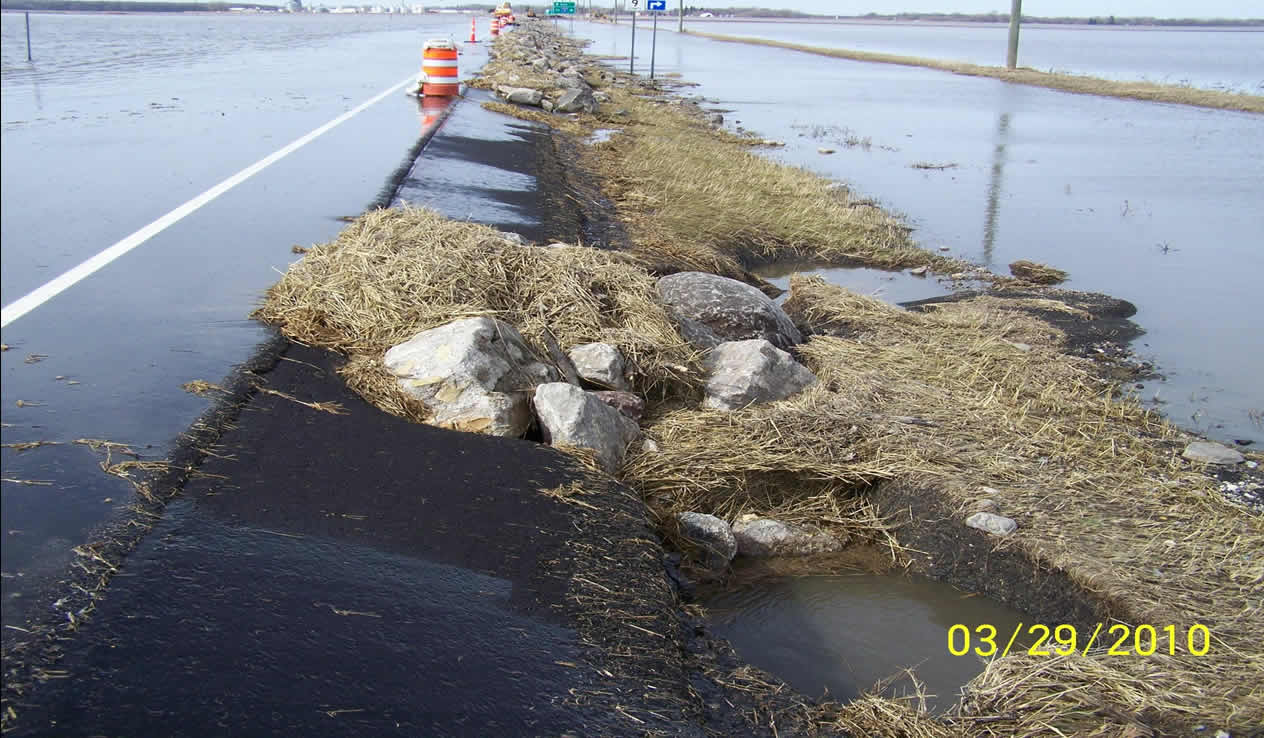
Flooding in the Red River Valley is an almost annual occurrence, and the cost to roads, property and lives is huge.
Highway 1 gets torn up year after year, only to be rebuilt in time for next year’s flood, joke residents in the little town of Oslo, which becomes an island whenever the roads close.
While not much can be done to prevent swollen farm fields from overflowing, what if a road embankment itself could be bolstered to prevent physical damage to the underlying structure of the road?
“We can’t just raise the road because it would create backwater upstream,” explained JT Anderson, Assistant District 2 Engineer. “Our best bet is to let the water over-top the road and try to protect the road when it does.”
Researchers have built a flume inside the University of Minnesota’s St. Anthony Falls Laboratory to test six methods of embankment protection specific to the needs of towns like Oslo.
“It is not uncommon for one over-topping site to have a half-mile long stretch of road being damaged,” said university research engineer Craig Taylor. “One road being protected should cover the cost of the study and the cost of deploying the erosion control product for that road.”
Nationally, research of this kind has mostly been restricted to high-intensity flooding.
“Those really high-depth, short duration events, you can only protect an embankment with concrete and boulders,” Taylor said. “With longer duration, low-depth floods, we may be able to protect roads with soft armoring, like reinforced vegetation.”
The damage in northern Minnesota has been the worst on east-west roads, where the river flow runs perpendicular to the center of the road, causing the road to act like a dam and the water to jump at the edges.
“It eventually eats through that road embankment and makes the road collapse,” Anderson explained.
Researchers will examine how a cross-section of a road holds up under various erosion control methods at different levels and speeds of water-flow.
One test will be to slow the flow of water by covering the road shoulder with a rubberized membrane and temporary water-filled tubes.
Permanent schemes — such as turf reinforcement mats and rocks — will also be tested.
“These methods have been deployed in the field, but you never really know under which conditions they survived or failed,” Taylor said.
In the Red River Valley, MnDOT engineers have tried a combination of vegetation and boulders, as well as concrete blocks covered with topsoil, to protect highways. Flattening a slope is another option.
“I expect that a single erosion protection technique will not cover every situation our road embankments may be exposed to at any given location,” Anderson said. “Rather, I expect we would look at using several different techniques in concert to develop an effective erosion protection system for the expected velocities.”

Value capture alternative finance model tested on Highway 610
Those who use the roads in Minnesota are generally those who pay for them — through gasoline and vehicle taxes.
But motorists aren’t the only ones who benefit when a new interchange is built or a highway is improved. Home and business values along the corridor go up and the price of undeveloped land can skyrocket.
With highway funds strapped, a new method of funding road expansion, called “real estate value capture,” is garnering attention.
This emerging technique strives to identify beneficiaries of transportation improvements beyond just the highway user, so they provide their fair share of the costs — a concept not dissimilar from residential street assessment.
For instance, a local government might dedicate the additional property tax revenue generated due to a new highway to offset some construction costs, or collect fees on land that is developed near an interchange.
However, value capture is a relatively new technique that has been used primarily for transit projects. To be considered for roads or bridges, questions need to be addressed about potential revenue, impacts and public acceptability.
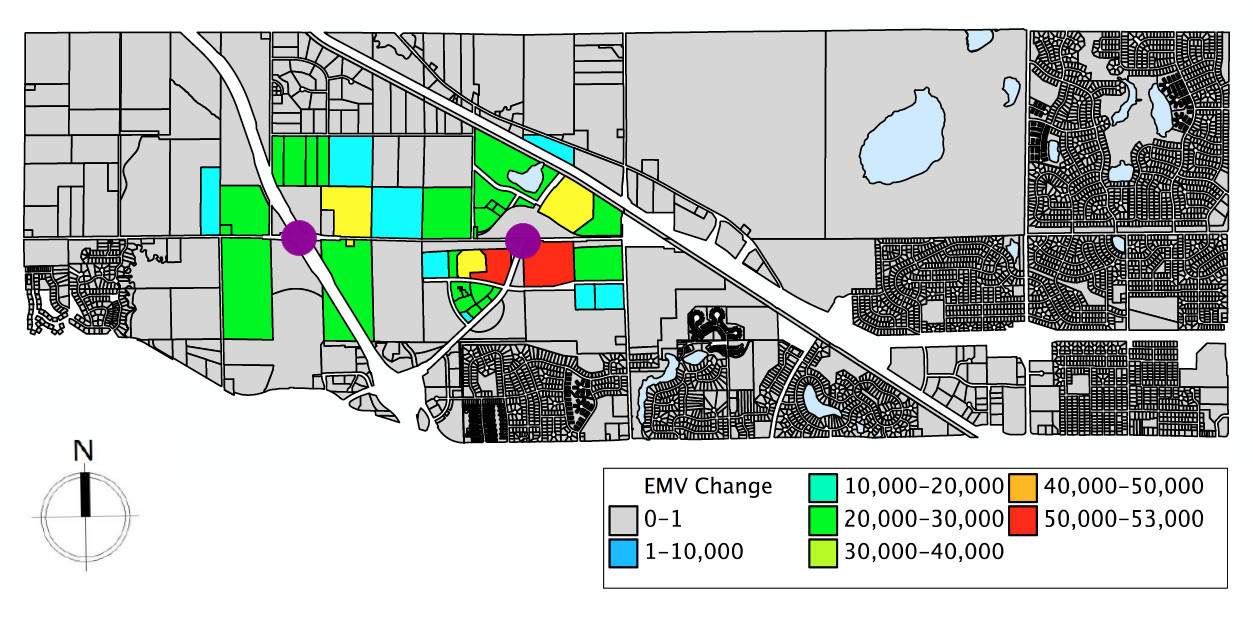
In a new case study, researchers use a long-delayed planned extension of Highway 610 in Maple Grove to model the impact of a completed highway on nearby property values, and, for the first time, quantify the potential revenues from several value capture strategies.
With properties near new highway exits worth an additional $65,450 more per acre, researchers calculated that $37.1 million in revenue could be generated through assessments on existing development and impact fees for future development.
Other strategies explored include tax-increment financing and private-public development of undeveloped parcels, in which revenue generated by that development is split.
“This research demonstrates a way to estimate the value of transportation improvement and to communicate that to the public,” said principal investigator Jerry Zhao, an associate professor of public administration at the University of Minnesota’s Humphrey School of Public Affairs.
Study links:
- Real Estate Value Capture: An Emerging Strategy to Pay for New Transportation Infrastructure – Technical Summary (PDF, 1 MB, 2 pages); Final Report (PDF, 5 MB, 36 pages).

Minnesota Bike Lanes: Learning to Share the Road

Video: How to Navigate a Multi-Lane Roundabout

Reducing confusion at two-lane roundabouts
Minnesotans have grown accustomed to roundabouts as they’ve proliferated throughout the state, but many motorists are still confused by the less common two-lane roundabout.
While roundabouts have been shown to reduce vehicle delay and severe crashes, the few Minnesota cities with this type of multi-lane roundabout have had a prevalence of driver mistakes.
In Woodbury, two such roundabouts were converted into smaller, one-circulating-lane designs due to driver confusion.
The City of Richfield had no such option at the high-volume Portland Avenue and 66th Street, a formerly signalized intersection that carries about 30,000 vehicles per day. (See video)
Crash-prone and congested prior to its reconstruction in 2008, a two-lane roundabout seemed to be the practical solution for this intersection. But although the roundabout reduced overall crashes, the intersection still had more fender benders than designers were comfortable with, according to City Engineer Kristin Asher.
“The crashes were primarily related to improper left-turns from the outside lane and failure to yield at the entry,” she said.
Not only were drivers unsure which lanes they should use to enter or exit the roundabout, they didn’t know how to respond to other cars inside the roundabout. (See news story)
“People don’t understand they have to yield to both lanes inside the roundabout,” explained University of Minnesota researcher John Hourdos.
In a recently completed study funded by the Minnesota Local Road Research Board, researchers from the Minnesota Traffic Observatory examined whether sign and pavement marking changes would improve performance.
The city of Richfield extended the solid lines leading up to the intersection from 50 to 250 feet to encourage drivers to choose the correct lane before entering the roundabout. It also replaced fish-hook-style roundabout signs with traditional lane designation signs and did away with complex striping patterns.
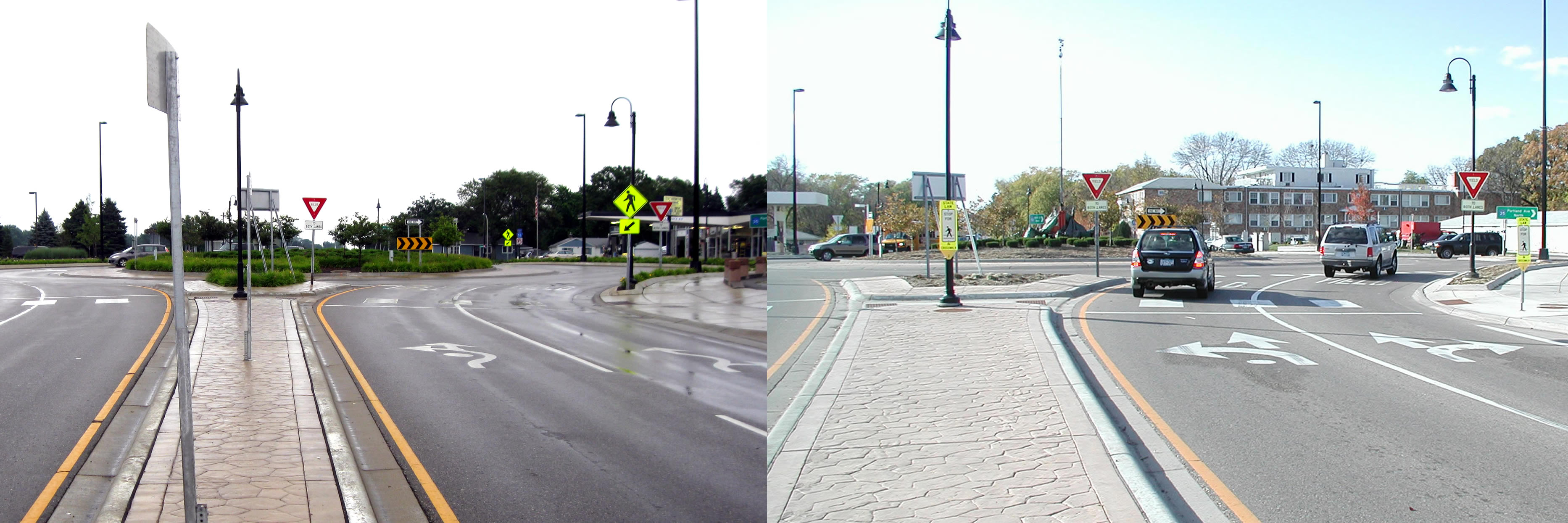
(Courtesy City of Richfield)
Hourdos examined two years of traffic data to see how motorists responded to the improvements that were made in 2011.
He found 50 percent more drivers entered the correct lane from the get-go, which led to a reduction in improper turns within the roundabout. Lane violations were also reduced by 20 percent.
“One of the main problems was drivers didn’t know they have to choose one of the two lanes,” Hourdos explained. “Then once they were inside the roundabout, they were forced to either deviate from their course or commit a violation.”
The city also increased sign visibility to address yielding problems; however, these changes didn’t seem to make a difference.
With state and federal guidelines lacking much guidance for how to sign two-lane roundabouts, the LRRB is funding a new study for three other multi-lane roundabouts: in St. Cloud, at Highway 169/494 and one planned for the future realignment of County Roads 101 and 61 between Chanhassen and Shakopee.
Report: Eff ect of Signing and Lane Markings on the Safety of a Two-Lane Roundabout (PDF, 4 MB, 72 pages)
Update (1/30/2014): Watch the LRRB’s new video on how to navigate a multi-lane roundabout.
New study to shed light on environmental impacts of deicers
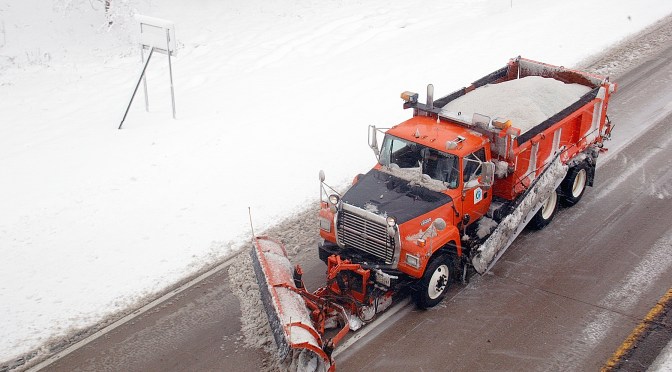
Even naturally derived products like corn syrup and beet juice can impact the environment when applied to salt mixtures for winter roadways.
A wide range of products, including the ones mentioned above, are added to deicing mixes to limit the amount of salt needed for Minnesota roads each winter. However, although information is available about the corrosive properties of various deicing chemicals, less is known about the toxicity of these compounds, especially to the aquatic environment.
Thanks to a recently completed project sponsored by the Clear Roads Pooled Fund, MnDOT winter maintenance personnel will better understand the relative toxicity of eight common deicing agents, which also include non-organics like Magnesium Chloride, Calcium Chloride and Potassium Acetate.
“Because the state has been trying a lot of different alternative chemicals, we wanted to get a better handle on the environmental impacts,” said MnDOT engineer Tom Peters, the technical liaison for the 26-member, Minnesota-led pooled fund for winter maintenance research.
In January, researchers plan to release a concise summary of the toxicity rankings to help winter highway maintenance managers consider both expected levels of service and potential harm to the environment when selecting a deicer.
A Dec. 3 webinar available on the Clear Roads website discusses their findings.
About Clear Roads
Minnesota is the lead state for the Clear Roads Pooled Fund, which conducts rigorous testing of winter maintenance materials, equipment and techniques. Other recent and upcoming research (see our Technical Summary on the program) includes a winter maintenance cost-benefit analysis toolkit, snow removal techniques at extreme temperatures and environmental factors that can cause fatigue in snowplow operators.
You can learn more about Clear Roads via the project’s e-newsletter.
New videos show how frost heave ravages roads
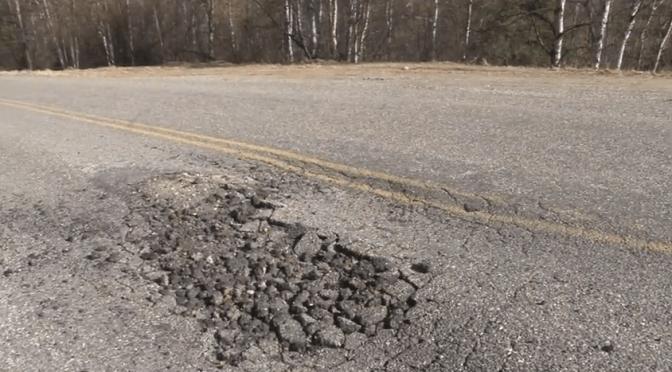
Regardless of whether you’re familiar with the term “frost heave,” if you live in Minnesota and drive on the roads, you’re already familiar with its destructive capacity. Many of the dips, bumps, potholes and cracks that appear on our roads every spring are a direct result of frost heave, which occurs when water accumulates in the soil beneath the pavement and begins freezing and then thawing along with the changing seasons. The resulting expansion and contraction weakens the road base and leaves it susceptible to damage from traffic loading.
These new videos produced by the Local Road Research Board explain how frost heave works, and describe some of the strategies public works departments use to combat it. The top video is is the shortened, executive-summary version, while the bottom video is the full, 13-minute version meant for transportation professionals.

Patching pavement with microwaves and magnetite
On Wednesday, I had a chance to watch a demonstration of a uniquely Minnesotan pavement patching technology that combines an industrial-strength microwave with a special asphalt mix. What makes it “uniquely Minnesotan?” In addition to having been developed by University of Minnesota researchers and a Monticello-based company (and with some funding from MnDOT), this innovative method involves a special asphalt mix using magnetite, a mineral that abounds on Minnesota’s Iron Range.
It also addresses a very Minnesotan transportation problem: winter pavement repair. In the video above, Kirk Kjellberg of Microwave Utilities, Inc., highlights some of the benefits of using the 50,000-watt microwave to heat the pavement during patching. In addition to creating a longer-lasting patch, the microwave is considerably faster than many alternative techniques. The technology is still relatively new, but its supporters claim it allows for pavement repairs in the middle of winter that are as strong and durable as the ones road crews do in the summer.
The demonstration, which was organized for members of the Local Road Research Board, took place at MnDOT’s District 3 training facility in St. Cloud.
See also:
- “Three Ways to Cook a Pothole” (June 5, 2013)
- In the news: innovative U of M and MnDOT pothole repair technology (April 30, 2013)

New LRRB videos focus on work zone safety
The Minnesota Local Road Research Board is a major source of funding for transportation research in the state. Occasionally, it also produces educational videos designed to raise public awareness of important transportation topics.
Two new video offerings from the LRRB (embedded above and below) are focused on save driving in work zones. While not directly research-related, they might prove a useful resource to transportation professionals. More importantly, they serve to remind us all of the very real and dramatic consequences of work zone crashes, of which there are approximately 2,000 per year in Minnesota.
You might want to also check out some of their other recent YouTube offerings, including explanations of why we need stop signs and speed limits, as well as a fascinating look at how potholes are patched.
 Crossroads