Tag Archives: Minnesota

Research assesses roles and impacts of Minnesota’s local airports

Reprinted from Catalyst, January 22, 2025

To better understand how Minnesota’s small public airports affect their local economies, researchers from the Transportation Policy and Economic Competitiveness Program (TPEC) at the University of Minnesota’s Humphrey School of Public Affairs chose three to profile from across the state. They shared their findings at the 2024 CTS Transportation Research Conference in a presentation highlighting the complex roles and community impacts of local airports.

The profile study built on a 2018 TPEC project that explored the value of airfreight networks for Minnesota’s medical supply chain. In addition, the researchers aimed to update information from a 2019 Minnesota Department of Transportation (MnDOT) study that examined the economic impact of 126 of the state’s 133 public airports.

“We were prompted by questions from several stakeholders, including TPEC advisory board members, to see if there were any travel changes or other impacts from the COVID-19 pandemic or high levels of inflation that had happened since those other studies were completed,” said Frank Douma, director of state and local policy and outreach at the Humphrey School’s Institute for Urban and Regional Infrastructure Finance (IURIF) and the project lead. The research team also included Barbara Rohde, IURIF researcher and licensed pilot, and Audrey Clark, an urban/regional planning graduate student.

Data for the three airport profiles was gathered through interviews with airport and city officials in February and May of 2024.

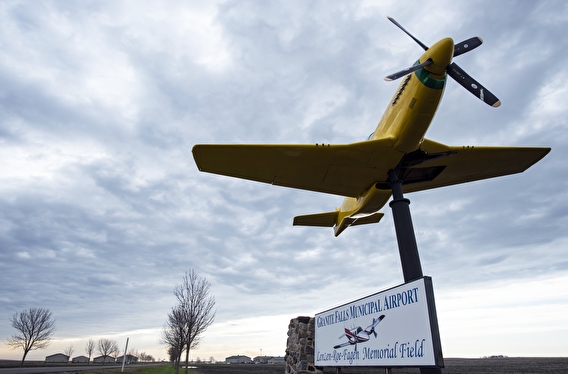
Granite Falls Municipal Airport

Plane mounted at entrance to Granite Falls Airport

Unique among the three airports studied, the Granite Falls Municipal Airport in west central Minnesota receives no federal funding and attributes its ongoing success to the support of MnDOT and the local business community. A primary user for this 152-acre, one-runway airport is one of the biggest energy and ethanol firms in the Midwest—Fagen, Inc. The company hosts visitors from all parts of the US who travel to Granite Falls in corporate jets for meetings and tours.

The airport is also an active UPS hub—vital for supporting local resident and business needs—and draws tourists with a local bi-annual airshow held in association with the Fagen Fighters WWII Museum that showcases a collection of working aircraft from the era.  

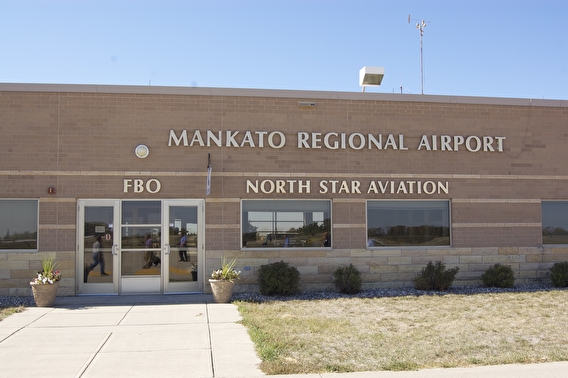
Mankato Regional Airport

“It may be a surprise to some, but the Mankato Regional Airport is the second busiest in the state, following Minneapolis-St. Paul International,” Douma said of the airport located in south-central Minnesota. 

Most of the operations on the airport’s two runways support and serve student pilots; North Star Aviation, a major US flight school, trains 700 aviation students who log more than 40,000 flight hours annually.  “As a person who has taken many flight school lessons, I was so impressed,” said Rohde. “These kids fly until 11 at night to get their time in.” The school provides a direct recruitment pipeline to Minneapolis-based Sun Country Airlines.

The airport also serves the area’s retail, agriculture, and health care industries, which include:

  • A 450,000-square-foot Walmart Distribution Center that opened in 2015 and is undergoing a major expansion.
  • Veterinarians who board planes every morning to travel the country for swine testing.
  • Mayo Clinic helicopters, based here to take advantage of the central location.

Roseau Municipal Airport

Ten miles south of the Canadian border, Roseau Municipal Airport mostly serves the Polaris company’s 1,500-employee manufacturing facility, ferrying executives and researchers across the US from the airport’s single paved runway. Additionally, the airport focuses on supporting community development and health care access with medevac transportation.

Conclusions and next steps

Local airports contribute significantly to the economic competitiveness, community pride, and identity of the Minnesota cities that host them, the researchers found. However, the nature of those contributions is different for each airport, encompassing transportation links, business facilitation, tourism, and emergency services.

A subgroup of TPEC advisory board members recently formed to further expand this research and seek national, state, and institutional partnerships.

—Jacqueline Bass, CTS program editor

Related resources

Rural Needs, Statewide Answers: Demographics, Health Care Access, and Community Engagement

Monday, May 13, 2024, 9:00–11:30 am, In Person

Join CTS for their annual all councils meeting to explore topics related to CTS’s 2024 theme of Rural Needs, Statewide Answers: Improving Transportation for All Communities.

The event is free to attend, but registration is required. Please register by Friday, April 26

Continue reading Rural Needs, Statewide Answers: Demographics, Health Care Access, and Community Engagement

New revenues needed to fill transportation funding gap

What’s next in transportation?

The Future of Mobility series collects the perspectives of top U researchers and other national experts. In 17 articles, the authors scan the horizon and reflect on critical transportation topics. Each article recommends action steps for public officials and policymakers.

Continue reading New revenues needed to fill transportation funding gap

Seven Pilot Projects to Change Transportation Practice in Minnesota

Roadside fencing that protects endangered turtles, a toolkit for identifying potentially acid-producing rock and a device that could save MnDOT $200 million a year in pavement damage are just a few of the advancements that MnDOT hopes to make in the near future, thanks to seven recently funded research implementation projects.

Each spring, the governing board for MnDOT’s research program funds initiatives that help put new technology or research advances into practice. This year’s picks aim to improve the environment, reporting of traffic signal data, notification of lane closures and the design and quality of pavements.

Here’s a brief look at the projects (full proposals here):

Protecting the Environment and Wildlife

  • To avoid the leaching of potentially acid-generating rock during excavation projects, MnDOT hopes to develop a GIS-based risk-screening tool that identifies areas where PAG rock might be encountered. Guidance will be developed for identifying and handling PAG rock.

Found in bedrock throughout the state – especially northern Minnesota, PAG minerals can release acid upon contact with air or water, a danger to aquatic and human life.

“Anytime we dig, there is the potential to expose this stuff,” said Jason Richter, chief geologist.

  • Reducing roadway access for small animals, including endangered turtles, is a priority for MnDOT and the Minnesota Department of Resources. MnDOT will analyze the effectiveness of different types of small animal exclusion fences tried across the state and develop a standard set of designs for future projects.
Improved Reporting of Traffic Signal Data
  • A centralized hub of traffic signal data could benefit future vehicle-to-infrastructure (V2I) applications and assist with the modeling of transportation project impacts. Methods and tools will be developed for a regional database of intersection control information that extracts data from MnDOT’s recently acquired Central Traffic Signal Control System and soon-to-be adopted Signal Performance Measure application.
Real-Time Notice of Lane Closures
  • In this pilot project, 20 MnDOT arrow board messages will be equipped with technology that automatically reports lane closures on 511 and highway message boards, providing more timely motorist notification.
Longer-Lasting Roads and Improved Quality Control
  • This summer, a new quality assurance device called the Rolling Density Meter will be deployed on several pavement projects, eliminating the need for destructive sample cores.
    “This is the ultimate in compaction control,” said Glenn Engstrom, Office of Materials and Road Research director. If contractors obtain the right level of density when paving asphalt roads, MnDOT could eliminate $200 million per year in premature road failure.
  • In 2018, MnDOT plans to require Intelligent Compaction (a pavement roller technology that reduces workmanship issues) on all significant asphalt projects. A vehicle-mounted mobile imaging device will be piloted that collects necessary supportive roadway alignment data, without the need for survey crews.
  • Upgrades to MnDOT’s pavement design software, MnPAVE, (incorporating recycled unbound and conventional base material properties) will help increase the service life of Minnesota roads.

10 Ways Transportation Research Keeps Minnesotans Moving in the Winter

As the first big snow and ice storms sweep through parts of Minnesota today, we’d like to remind you of some of our great winter weather research studies. Here’s a list of some of this winter-related research from MnDOT and the Local Road Research Board:

Living snow fences

Living snow fences are trees, shrubs, native grasses, wildflowers, or rows of corn crops located along roads or around communities and farmsteads. These living barriers trap snow as it blows across fields, piling it up before it reaches a road, waterway, farmstead or community. Through multiple research efforts, MnDOT continues to advance its practices for living snow fences. Willow plants, which are which are inexpensive and fast-growing, are a new form of snow fence. MnDOT has also developed a tool that allows the agency to better offer a competitive payment to farmers.

Related studies:

Permeable pavement

According to recent studies, researchers believe Minnesota could eliminate salt usage on low-volume local roads by switching to permeable pavements. Permeable pavements — pavements that allow water to seep through them — have been studied in some Minnesota cities, and a research project is currently underway to further investigate how much salt reduction can be expected.

Related studies:

Traffic recovery during winter storms

MnDOT’s Metro District developed a way to automatically determine when to stop plowing a highway after a snow storm. The method involves measuring traffic flow to determine when road conditions have recovered. Current practice calls for maintenance workers to visually inspect traffic lanes. The automated technique could potentially be more accurate and save time and costs.

Related study:

Salt and other deicing chemicals

Minnesota winters are no joke, and Minnesotans still need to get wherever they’re going despite harsh snow and ice conditions. That’s why MnDOT is constantly researching new and improved versions of salt and other deicing chemicals to keep roads safe at the least amount of damage to lakes, rivers and groundwater.

Related studies:

Snowplow blades

A couple years ago, MnDOT snowplow operators in southwestern Minnesota invented an experimental plow that uses the wind to cast snow from the road without impeding traffic or the operator’s view. This winter, MnDOT intends to test multiple types of snowplow blades as part of a larger research project comparing types of deicers.

Related study:

Snowplow technology

While a lot of research has been done on the plow itself, MnDOT hasn’t forgotten to invest in research to improve in-cabin snowplow technology as well. Some of the great technology recently developed to assist snowplow drivers, includes a driver assist application that a MnDOT plow driver used last winter to navigate a storm and rescue stranded motorists. The agency is also studying equipment factors that can cause fatigue in snowplow operators.

Related studies:

Salt-resistant grasses

When the snow melts every spring, the damage salt does to roadside grass is obvious. That’s why researchers have spent years looking into developing and implementing salt-tolerant grasses on roadside settings. The result of this effort has been the introduction and use of salt-tolerant sod and seed mixtures that are made up primarily of fine fescue species. MnDOT is also studying how chlorides are transported within watersheds in order to better focus efforts to reduce deicer usage in  areas where it will have the biggest environmental impact.

Related studies:

Cold-weather cracking prediction test

MnDOT has developed a test that can tell whether a contractor’s proposed asphalt mix will cause the road to crack in the winter. Building roads using better asphalt mixes leads to less cracking and fewer potholes. The test is expected to save the state about $2 million per year.

Related studies:

Pedestrian snow removal

It’s not all about cars and trucks. Minnesotans still ride bikes and walk in the winter. That why MnDOT assembled a comprehensive review of existing practices and policies from other states, as well as a summary of valuable publications that could be referenced while developing a new policy.

Related study:

Maintenance Decision Making

MnDOT research led to the development of a Maintenance Decision Support System and related components provide real-time, route-specific information to snow plow drivers, as well as recommended salt application levels. These recommendations have reduced chemical usage while still achieving performance targets for snow and ice clearance.

Related studies:

Knowing While Mowing: GPS Keeps Maintenance Workers Out Of the Weeds

As temperatures fall and days get shorter, MnDOT Metro District maintenance workers are wrapping up a season of mowing grass along roadsides and in medians that they hope will prove a little more efficient than in the past.

Thanks to a research project that installed GPS devices in tractor cabs, operators have a better sense of exactly which areas they need to mow and which areas should be left alone. Five Metro District tractors were tested in 2015. This year, more than 40 tractors were fitted with the automated vehicle location (AVL) technology, which includes a GPS antenna, an on-board central processing unit (CPU) and an in-cab screen with a user interface.

Trisha Stefanski, Metro District asset management engineer, expects one of the biggest benefits of the project to be a reduction in herbicide use. Maintenance crews use herbicide to control the spread of noxious weeds that sometimes get spread during mowing operations. Mapping exactly where noxious weeds are, and providing that information to operators on a real-time, in-cab screen and user interface helps them mow around those areas.

“We’re really hoping it will reduce the amount of herbicide that we’re putting on our roadways by 50 percent,” Stefanski said. “We’re not certain that will be the number, but that’s what we’re hoping for. We think just not mowing those areas will not spread as many noxious weeds and so we don’t have to apply as much herbicide.”

Metro District operators, such as Jesse Lopez, give the AVL technology rave reviews.

“Basically you can see what you shouldn’t mow and what you should mow. So, it makes it easy for me. It’s just like playing a game,” Lopez said. “This actually helps me to optimize what my job is. I know exactly where I’m at and where I’m going. I think everyone should use it – absolutely everybody who is in a mowing situation or a plowing situation.”

In addition, the AVL technology helps maintenance supervisors keep tabs on exactly where their operators are in real time. It also helps supervisors complete reports by automatically providing the geographic areas where mowing has been completed.

Stefanski says the project has gone really well, and she hopes collecting more data over another mowing season will show real savings on herbicide use. In the meantime, she is thinking of other ways AVL technology could be applied to maintenance operations.

“What I really like about the project is that we are taking something used in a lot snow plows and a lot of other technologies – cars, other things, maybe UPS uses them – and we’re putting it into maintenance operations,” Stefanski said. “Having it for mowing, we can also use it for smooth pavements. We can also use it for other things in mowing operations.”

Drone Project Earns State Government Innovation Award

The MnDOT Office of Aeronautics and Aviation was recognized last month for the drone research project that also involved the Office of Bridge and Structures and MnDOT Research Services.

The Humphrey School of Public Affairs, in partnership with the Bush Foundation, presented a State Government Innovation Award to recognize great work and to encourage an environment that allows agencies to deliver better government services to Minnesotans through creativity, collaboration and efficiency.

The project, titled Unmanned Aircraft Systems (UAV) Bridge Inspection Demonstration Project, found that using drones for bridge inspections improves safety, lessens traffic disruption and reduces work time. For one type of bridge, inspection time shrank from eight days to five.

In the video, Jennifer Zink, MnDOT state bridge inspection engineer, explains the project, along with Tara Kalar, MnDOT associate legal counsel; Cassandra Isackson, director of MnDOT Aeronautics; and Bruce Holdhusen, MnDOT Research program engineer.

The initial drone project drew significant media coverage and a lot of attention from other state departments of transportation from all over the country.

A second phase of the project was approved year and is currently underway. A third phase is already in the planning stages.

More information

Drones, slope slide prevention among MnDOT’s research implementation picks

Developing the guidance needed to begin using drones  for bridge inspections statewide is among the Minnesota Department of Transportation’s latest batch of research implementation projects.

MnDOT recently announced the selection of a dozen research implementation projects for funding in Fiscal Year 2017.  In addition to continuing MnDOT’s pioneering drone research, top initiatives aim to improve the accuracy of bridge load ratings and map slopes statewide to identify locations that are vulnerable to flash flooding.

Each winter, MnDOT solicits proposals from staff who want to put local or national research into practice in their day-to-day work.

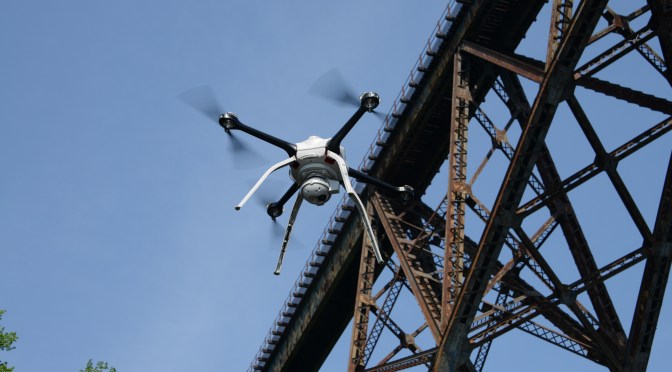
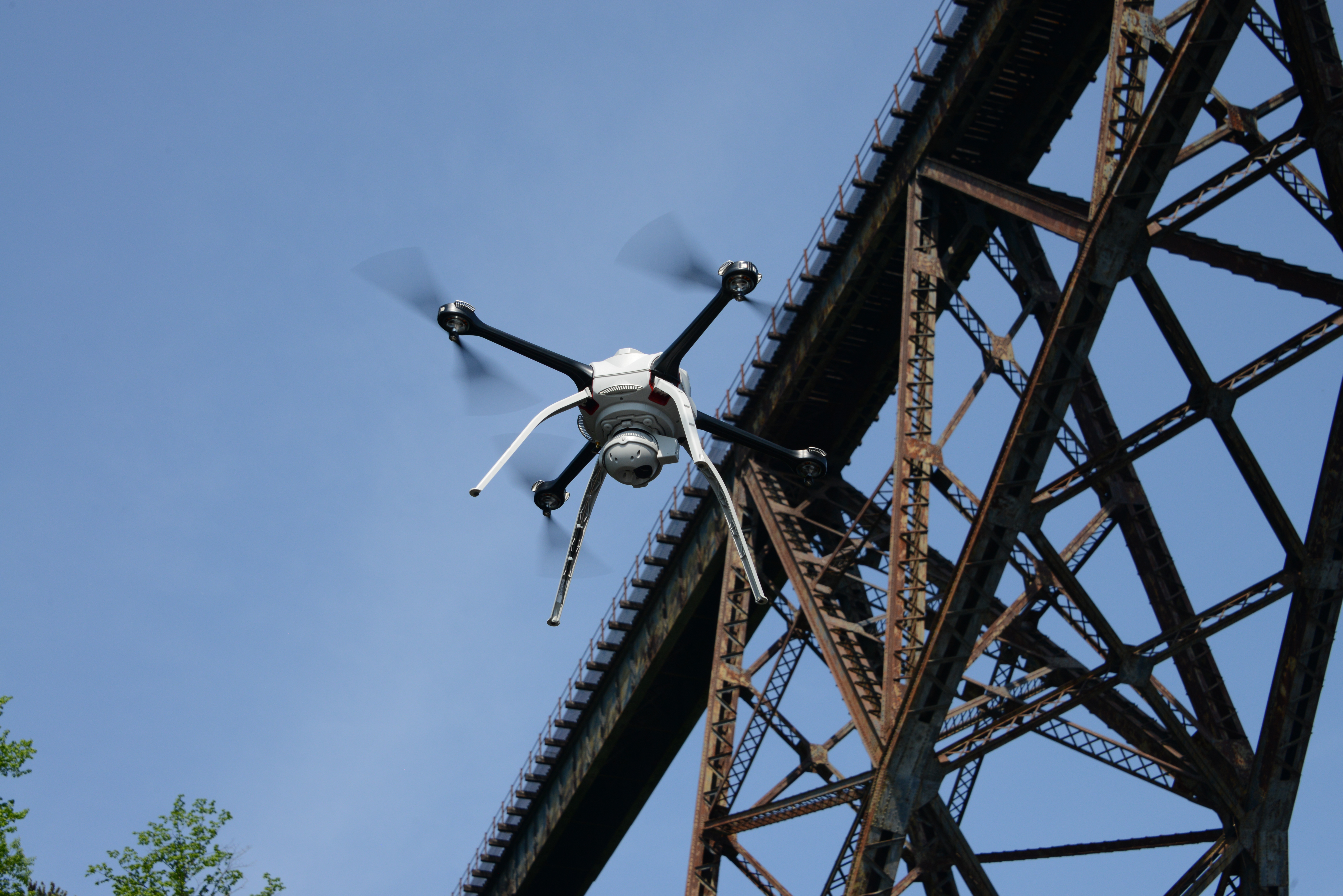
MnDOT is researching how data and images collected by drones, such as the Aeryon Skyranger shown here, could aid bridge inspectors.
MnDOT is researching how best to integrate drones into its bridge inspection procedures.

The state research program’s governing board then selects projects for funding based on benefits, impacts on the department and support from management.

Project champions take previously proven concepts and help MnDOT turn them into useful practices and procedures to make the state’s transportation system better. Funds can be used for equipment, consultant services or researcher assistance.

“The research implementation program fills the gap between research and deployment of new methods, materials and equipment,” Bruce Holdhusen, MnDOT Research Services senior engineer, said.

Here are the 12 newly funded research implementation projects by category:

Bridge and Structures

  • Improving Quality of Bridge Inspections Using Unmanned Aircraft Systems (UAS)
  • Prestressed Concrete Beam Shear Rating
  • OmniScan Phased Array Ultrasonic Corrosion Imaging System

Environmental

  • MnDOT Slope Vulnerability Assessments

Maintenance Operations

  • Ultra-thin Bonded Wearing Course (UTBWC) Snow and Ice and Wind Effects

Materials and Construction

  • Cold In-Place Recycling (CIR) for Bituminous Over Concrete (BOC)
  • Geogrid Specification for Aggregate Base Reinforcement
  • Balanced Design of Asphalt Mixtures
  • Cone Penetration Testing (CPT) Design Manual for State Geotechnical Engineers

Policy and Planning

  • One-year Pilot Test and Evaluation of ASTM DOT Package Compass Portal

Traffic and Safety

  • Improve Traffic Volume Estimates from Regional Transportation Management Center (RTMC)
  • Understanding Pedestrian Travel Behavior and Safety in Rural Settings

The Future is Now: MnDOT Goes High-Tech

When it comes to creating the transportation system of the future, MnDOT is already doing its research and laying the groundwork for great things to come.

13-JamesBenhamTechnology300
James Benham, JB Knowledge, speaks at the Transportation Conference. (Photo by Rich Kemp)

Last month at Minnesota’s Transportation Conference, a keynote session by JB Knowledge CEO James Benham titled “Future Forecast: How Drones, Sensors, and Integrated Apps are Rewriting the Rules” inspired many people in the room.

Among the topics Benham cited in his talk were the Internet of Transportation, unmanned aerial vehicles (drones) and 3-D printing, which MnDOT is already studying or even using.

Internet of Transportation

MnDOT recently produced series of white papers on technological trends that could impact transportation infrastructure in Minnesota.

In January, MnDOT Research Services published these papers in a report titled “The Transportation Futures Project: Planning for Technology Change.”

GoogleCar
Google is one of many companies developing autonomous vehicle technology that researchers believe will make driving nearly extinct by 2040. (Photo courtesy of Google)

The report details how the transportation system can accommodate such imminent innovations as autonomous vehicles, mobile web services, mobility as a service, information and communication advances, infrastructure sensors and energy and fuel alternatives.

For example, researchers predict that driving faces near-extinction by 2040, when non-autonomous vehicles will no longer be allowed on public roads at most times. As a result, total transportation-related fatalities may drop 90 percent, road geometry, sightlines and other design priorities may shift, and capacity and speed limits will likely increase on most major roadways.

Unmanned Aerial Vehicles (Drones)

Drone
MnDOT is researching how data and images collected by drones could aid bridge inspectors.

When it comes to drones, MnDOT is already conducting important research that the rest of the nation is closely following. Tara Kalar and Jennifer Zink from MnDOT, and Barritt Lovelace of Collins Engineers, spoke about their efforts at last month’s conference.

Last year, MnDOT Research Services published a report titled “Unmanned Aerial Vehicle (UAV) Bridge Inspection Demonstration Project” that detailed how MnDOT could use drones to perform bridge inspection functions. The initial research project tested one drone’s capability in a variety of bridge inspection scenarios last summer at four Minnesota bridges.

In November, researchers conducted a second research phase to test a more specialized drone at the Blatnik Bridge in Duluth that coincided with that bridge’s regularly scheduled inspection.

A few weeks ago, researchers secured funding to conduct a research implementation project that aims “to implement a statewide UAS (unmanned aircraft systems) bridge inspection contract, which will identify overall cost effectiveness, improvements in quality and safety, and future funding sources for both state and local bridges,” according to the project proposal.

3-D Printing

Benham’s talk also addressed 3-D printing, which Chad Hanson, a District 6 project manager, has already used successfully.

Hanson spoke at the conference about his experience using 3-D printing to create a model of the Red Wing Bridge project that brought the project idea to life. According to Hanson, the model enhanced public engagement and informed preliminary design efforts for the bridge.

Chad Hanson photo
Chad Hanson, District 6 engineer, used 3-D-printing to create a model of the Red Wing Bridge that was used during the project’s public engagement events. (Photo by Mike Dougherty)

Partners, stakeholders and members of the public could see, touch and hold the 3-D printed models, which accentuated the project’s engagement process.