

Applying a protective surface—or chip seal—to existing asphalt on relatively low-traffic roads is a pavement preservation method used by many transportation agencies. Yet despite its popularity, chip seals can cause various issues. Some agencies have found that applying a fog seal following a chip seal is a cost-effective strategy for improving asphalt performance and public satisfaction.
Continue reading Putting Research Into Practice: Fog Sealing Chip Sealed Roads Can Improve PerformanceTag Archives: LRRB

Investigating Max-Pressure Traffic Signal Timing
Inadequately timed traffic signals at intersections are a major contributor to traffic congestion and increased travel times. Adaptive signal timing can detect and respond to real-time vehicle queues, resulting in more efficient vehicle movement through a corridor than traditional traffic signals. A revised max-pressure traffic signal controller could decrease delays and increase vehicle throughput at intersections.
Continue reading Investigating Max-Pressure Traffic Signal Timing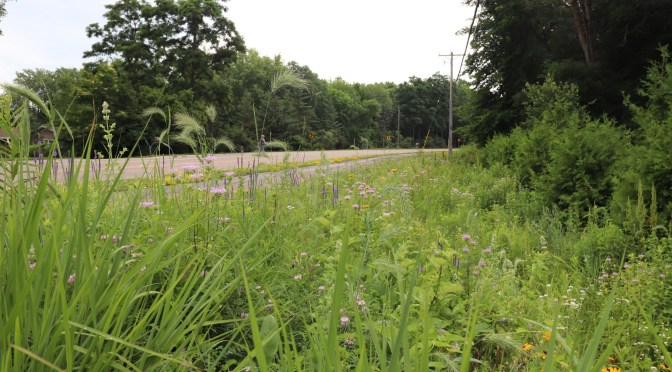
Improving Pollinator Habitat Through Cost-Effective Roadside Revegetation
Pollinating insect populations are declining worldwide. Revegetating roadsides after construction offers an opportunity to create pollinator-friendly habitat. Local agencies and MnDOT have new tools and strategies to cost-effectively derive multiple benefits from roadside revegetation efforts.
Continue reading Improving Pollinator Habitat Through Cost-Effective Roadside Revegetation
Pond Maintenance Strategies to Retain Phosphorus
Cities and counties depend on stormwater retention ponds to protect water quality in lakes and streams. New research sponsored by the Minnesota Local Road Research Board has identified cost-effective methods for ensuring pollutants remain in pond sediment and are not released into other bodies of water.
Continue reading Pond Maintenance Strategies to Retain Phosphorus
Increasing Cold In-Place Recycling Efficiency for Pavement Rehabilitation
New tools will help local road engineers reliably estimate the curing time of a cold in-place recycling (CIR) layer. Researchers identified factors that affect asphalt curing when a CIR method is used to know when pavement is sufficiently hardened, which will minimize delays in road construction and reopening.
Continue reading Increasing Cold In-Place Recycling Efficiency for Pavement Rehabilitation
Putting Research Into Practice: Decision-Making Tools for Roadway Management
New guidance and a process framework will help local agency engineers with varying levels of expertise and resources benefit from the experiences of their peers. Using these tools, engineers can take manageable, proactive steps to prioritize investments that maintain and preserve transportation networks.
Continue reading Putting Research Into Practice: Decision-Making Tools for Roadway Management
Innovative Materials and Technologies for Sustainable Pavement Infrastructure
In search of enhanced pavement damage detection practices, researchers investigated two innovative additives to asphalt binders: graphite nanoplatelets and taconite concentrates. They also examined the ability of microwave energy to restore subsurface cracking.
Continue reading Innovative Materials and Technologies for Sustainable Pavement Infrastructure
Improved In-Vehicle Lane Departure Warning System Approaches Commercial Use
Using an earlier lane departure warning system (LDWS) that employs standard GPS data rather than expensive cameras or maps, Minnesota researchers have enhanced and refined the system, moving closer to an affordable product to warn drivers about dangerous lane drift and approaching curves.
Continue reading Improved In-Vehicle Lane Departure Warning System Approaches Commercial Use
Separated Bike Lanes: Filling the Gaps in Design Guidance
In recent years, many U.S. cities have been installing separated bicycle lanes (SBLs) as part of their nonmotorized transportation networks. SBLs are bicycle pathways that employ paint and a vertical element as a buffer to separate motor vehicle traffic from bicycle traffic. They reduce crash risk, increase safety and comfort, and encourage more people to use bicycles as transportation.
Continue reading Separated Bike Lanes: Filling the Gaps in Design Guidance
Low-Cost Pavement Condition Forecasting Software Eases Local Road Planning
The Minnesota Local Road Research Board (LRRB) has added pavement condition forecasting technology to an existing, web-based roadway inventory tool that will enable counties to generate low-cost maps and reports that help them prioritize their work by showing how roadway conditions will look under different construction scenarios for decades to come.
Continue reading Low-Cost Pavement Condition Forecasting Software Eases Local Road Planning Crossroads