
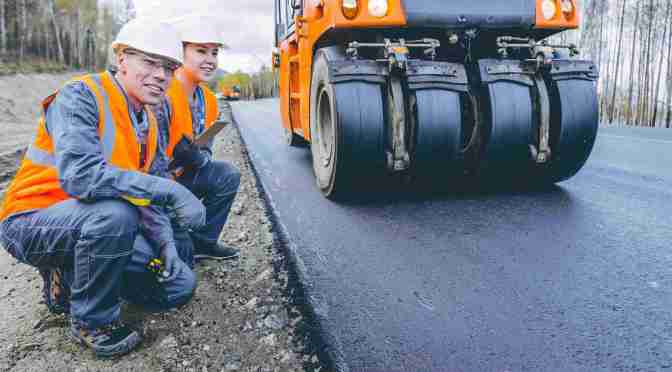
Local transportation agencies in Minnesota continue to face worker shortages as many struggle to hire and retain employees. Recognizing this challenge, the Minnesota Local Road Research Board partnered with Minnesota LTAP to develop marketing resources for local transportation agencies to use to recruit and retain roadway maintenance workers.
Continue reading Staffing up: Resources to Grow Your Roadway Maintenance WorkforceTag Archives: LRRB
New Project: Use of MNCORS to Support AV Operations in Rural Minnesota
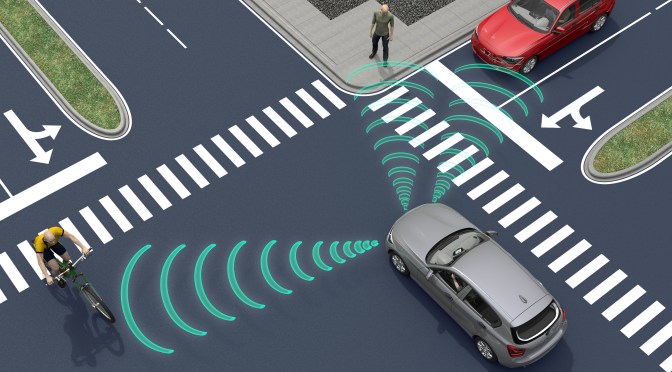
Autonomous vehicles (AVs) have infrastructure requirements such as lane lines, centerlines and intersection signs to guide camera-enabled steering control functions. But many rural roads do not have lane markings or are unpaved, and intersections might be missing components to guide AVs.
Continue reading New Project: Use of MNCORS to Support AV Operations in Rural Minnesota
Introducing a New Red-Light Running Warning System that Can Potentially Reduce Human Errors at Intersections
Red light violations remain a prominent issue and high contributor to serious crashes and casualties at signalized intersections. An ongoing research project, funded by the Local Road Research Board, and Federal Highway Administration (FHWA) State Transportation Innovation Council (STIC) Incentive program, is developing and testing a warning system that signals drivers as they approach a red light and prompts them to decelerate.
Continue reading Introducing a New Red-Light Running Warning System that Can Potentially Reduce Human Errors at Intersections
Using Alternative Technologies to Detect Vehicles at Signalized Intersections
In Minnesota and across the country, the most common traffic signals are those that are actuated by a device embedded in the road that detects the presence of a vehicle at the intersection. While these embedded devices can last for decades, they don’t always detect modern vehicles, such as electric cars, or vulnerable road users, such as bicycles or motorcycles. New research evaluated the performance of video- and radar-based detection systems, which are becoming more readily available, under a variety of Minnesota weather conditions.
Continue reading Using Alternative Technologies to Detect Vehicles at Signalized Intersections
NCITE Webinar: LRRB Mini-Roundabout Guidance
Tuesday, August 6, 10-11 a.m., free to attend
Increasingly, local agencies are opting for mini-roundabouts for some locations instead of traditional roundabouts, which typically require a larger footprint than a standard four-way intersection. Mini-roundabouts are characterized by a small diameter and fully traversable islands (central island and splitter islands).
Join the Apex Engineering Group for a presentation on the Local Road Research Board project, Mini-Roundabout FAQs. Project team members Michael Marti and Zach Heimer with SRF Consulting Group and Jon Pratt with the City of Detroit Lakes will discuss this new guidance.
The guidebook defines mini and compact roundabouts and provides selection criteria on when to use them as well as details regarding the center treatment. The FAQ format provides easy navigation to technical information.
If you have difficulty accessing the meeting, use the meeting ID and passcode:
- Meeting ID: 251 050 866 163
- Passcode: tGP6ix

New Project: Comparative Analysis of Grade-Separated Pedestrian Infrastructure and At-grade Treatments
Grade-separated intersection crossings allow pedestrians to cross over or under traffic lanes. Several factors determine whether a specific location is appropriate for a grade-separated crossing, such as volumes of vehicle and pedestrian traffic, number of lanes to cross, and vehicle speed and visibility.
Continue reading New Project: Comparative Analysis of Grade-Separated Pedestrian Infrastructure and At-grade Treatments
New Project: Long-Term Field Performance Evaluation of Chip Seals
Chip seals are an economical road surface treatment that MnDOT and counties use to enhance existing pavement performance and service life. A thin layer of asphalt emulsion sprayed on the pavement surface and mixed with aggregate chips can address minor pavement distresses and seal the pavement surface to reduce the impacts of further wear.
Continue reading New Project: Long-Term Field Performance Evaluation of Chip Seals
Finding High-Performing Aggregate Bases for Long-Lasting Pavement
Two county roads provided a testing ground for three combinations of aggregate bases and asphalt binders. Results from more than two decades of research and monitoring of pavement test sections validated previous conclusions. A larger gradation aggregate base showed superior performance over the pavement life cycle when compared with the standard aggregate base. Additionally, sections constructed without transverse joints to allow natural thermal cracking outperformed sections with sawn and sealed joints.
Continue reading Finding High-Performing Aggregate Bases for Long-Lasting Pavement
Effectively Alerting the Public About Local Road Closures
Navigation apps can be valuable timesavers for drivers in Minnesota. To maximize their use, these apps need traffic information that is timely and accurate. While state highway closures are reported effectively, reporting road closures on local roads and highways is inconsistent. This project aimed to improve local road closure reporting by exploring the development of a streamlined reporting system and creating guidance for reporting local road closures to third-party navigation apps.
Continue reading Effectively Alerting the Public About Local Road Closures
New Project: Improving and Developing Pavement Design Inputs and Performance Functions for Cold Recycled Pavement Layers
Local agencies in Minnesota use cold recycling technologies for flexible pavement rehabilitation because of their economic and environmental benefits. The three main methods are cold in-place recycling (CIR), cold central plant recycling (CCPR), and stabilized full-depth reclamation (SFDR).
Continue reading New Project: Improving and Developing Pavement Design Inputs and Performance Functions for Cold Recycled Pavement Layers
