
Tag Archives: autonomous

Future of Mobility: Urban air mobility

June 26, 2023

What’s next in transportation?

The Future of Mobility series collects the perspectives of top U researchers and other national experts. In 17 articles, the authors scan the horizon and reflect on critical transportation topics. Each article recommends action steps for public officials and policymakers.

CTS is highlighting the articles over the course of the year. This month, we explore two aviation-related articles:  Safety and Urban Air Mobility by Demoz Gebre-Egziabher and Advanced Air Mobility by Susan Shaheen and Adam Cohen.

Autonomous aircraft and drones that can move people and goods in new ways are coming to our cities, writes Gebre-Egziabher. Often referred to as urban air mobility (UAM), these new transportation concepts are the flying equivalent of the autonomous car—and they raise just as many important questions about safety, use, and operations. Local communities and agencies are stakeholders that must have a say in safety and provide clear guidance to those developing technologies for UAM, he says.

Shaheen and Cohen write that aviation is undergoing rapid change around the world. A variety of technological advancements and industry investments in electrification, alternative fuels, automation, vertical take-off and landing aircraft, uncrewed aircraft systems, and air traffic management are enabling innovations in aircraft designs, services, and business models. They recommend driving the industry forward with an emphasis on social and environmental benefits, including humanitarian, aeromedical, and emergency response.
New Project: Designing An Autonomous Service to Cover Transit Last Mile in Low-Density Areas

Public transportation provides a safe, convenient, affordable, and eco‐friendly mobility service. However, due to its fixed routes and limited network coverage, it is sometimes difficult or impossible for passengers to walk from a transit stop to their destination. This inaccessibility problem is also known as the “transit last mile connectivity problem”.

Continue reading New Project: Designing An Autonomous Service to Cover Transit Last Mile in Low-Density Areas

Shared Autonomous Vehicles: Dispatch Model Optimizes Service

This article was originally published in Catalyst, May 2020.

Waymo and Uber have started trials of shared autonomous vehicle (SAV) service in several US cities. Without the expense of drivers, autonomous service could one day make the cost of a ride so low that people choose SAVs for their daily transportation needs instead of owning a vehicle.

Continue reading Shared Autonomous Vehicles: Dispatch Model Optimizes Service

Preparing Roads for Connected and Autonomous Vehicles

Proprietary technologies, industry competition and federal regulatory concerns are slowing the advent of defined standards for connected and autonomous vehicles (CAVs). Researchers investigated the state of CAV implementation to help local agencies begin preparing for the infrastructure needs of these vehicles. CAV-friendly options are considered for eight infrastructure categories. Since truck platooning is the likely first application of this technology, and optical cameras appear imminent as an early iteration of sensing technology, researchers suggest that wider pavement striping and well-maintained, uniform and visible signage may effectively serve the needs of CAVs in the near future while enhancing infrastructure for today’s drivers. 

Continue reading Preparing Roads for Connected and Autonomous Vehicles

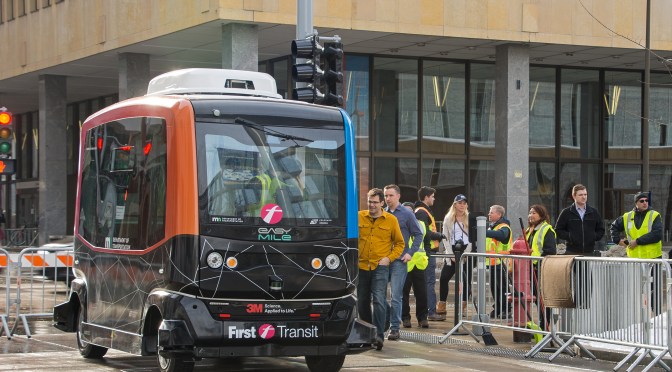
MnDOT Chooses EasyMile for Autonomous Shuttle Bus Project

ST. PAUL, Minn. – The Minnesota Department of Transportation chose EasyMile, a France-based company specializing in driverless technology, to lead its autonomous shuttle bus pilot project. MnDOT announced in June it will begin testing the use of an autonomous shuttle bus in a cold weather climate.

“We’re excited to partner with EasyMile to help MnDOT test autonomous technology,” said Jay Hietpas, MnDOT state traffic engineer and project manager. “Their expertise will help us learn how these vehicles operate in a winter weather environment so we can advance this technology and position MnDOT and Minnesota as a leader.”

EasyMile, which has a location in Colorado, has conducted driverless technology cold weather tests in Finland and Norway. Minnesota will be their first cold weather test site in the U.S. EasyMile will use its EZ10 electric shuttle bus that has already transported 160,000 people more than 60,000 miles in 14 countries. The shuttle was tested in various environments and traffic conditions. During these tests, the shuttle operated crash-free.

The shuttle operates autonomously at low speeds on pre-mapped routes. It can transport between six and 12 people.

Initially, it will be tested at MnROAD, which is MnDOT’s pavement test facility. Testing will include how the shuttle operates in snow and ice conditions, at low temperatures and on roads where salt is used.

Testing is scheduled to start in November and go through February 2018. The shuttle will also be showcased during the week of the 2018 Super Bowl.

Hietpas said 3M will also be a partner in the project so the company can research various connected vehicle concepts including sensor enhancement and advanced roadway safety materials. When optimized, these materials would aid in safe human and machine road navigation.


Read more about the autonomous shuttle bus pilot project:


Related MnDOT research: