New Project: Phase 3 of Drone Bridge Inspection Research Focuses on Confined Spaces

MnDOT recently entered into a contract with Collins Engineers Inc. to complete a third phase of research testing drones for bridge inspections, with a new focus on confined spaces.

This Phase 3 project is titled “Improving Quality of Bridge Inspections Using Unmanned Aircraft Systems.” Jennifer Wells, MnDOT maintenance bridge engineer, will serve as the project’s technical liaison. Barritt Lovelace, regional manager for Collins Engineering, will serve as principal investigator.

“Phase 3 will allow us to utilize a new drone specific to confined space inspections,” Wells said. “This new drone is meant to reach places the prior drones could not, which will supplement our efforts nicely.  Also, Phase 3 will include more bridge inspections in order to get a more comprehensive feel for cost and time savings.”

The increasing costs of bridge inspections are a concern for MnDOT. The use of unmanned aircraft systems (UAS) has been shown to reduce costs, improve the quality of bridge inspections, and increase safety. The UAS can deploy a wide range of imaging technologies including high definition still, video, and infrared sensors, and data can be analyzed using 3D imaging software.

MnDOT completed a small research project in 2015 to study the effectiveness of UAS technology applied to bridge safety inspections. The project team inspected four bridges at various locations throughout Minnesota and evaluated UAS’ effectiveness in improving inspection quality and inspector safety based on field results.

A second research effort demonstrated UAS imaging on the Blatnik Bridge and investigated UAS use for infrared deck surveys. Additionally, a best practices document was created to identify bridges that are best suited for UAS inspection.

It is the goal, based on this next phase of research, to implement a statewide UAS bridge inspection plan, which will identify overall cost effectiveness, improvements in quality and safety, and future funding sources for both state and local bridges.

Collins Engineering will also investigate a collision tolerant drone — the Flyability Elios — for confined space inspections.

As part of the Phase 3 project, Collins Engineering will:

  • Review current Federal Aviation (FAA) rules, technical literature, owners and industry experiences, and ongoing UAS research.
  • Develop bridge inspection list based on Phase II research regarding best practices. Approximately 20-25 bridges will be inspected under this contract depending on location and size.
  • Develop a field work plan for the bridge inspection list. If approvals for these bridges cannot be obtained, suitable alternatives will be chosen. This field work plan will address safety concerns, FAA, and other agency requirements.
  • Establish a work schedule and deliverable submission schedule.
  • Establish methods of access and schedule equipment.
  • Receive training on the Flyability collision tolerant drone for use in the study.
  • Perform field work at the selected bridges to collect imagery and evaluate the technology to accomplish the project goals.
  • Inspect known deficiencies identified during previous inspections with the use of the UAS to evaluate the ability to identify deficiencies using photos and video.
  • Enter bridge inspection data in Minnesota’s Structure Information Management System (SIMS) providing element condition ratings, photos, videos, etc. based on UAS imagery and information.
  • Prepare a draft report to document project activities, findings and recommendations.

The Phase 3 project is scheduled to be complete by July 2018.

MnDOT Improves on Award-Winning Use of Drones for Bridge Inspection

MnDOT’s efforts to study whether drones can help bridge inspectors are progressing, and the second phase project has been completed. (Meanwhile, a third project has just begun.)

Phase 1 of this research project demonstrated that drones can reduce safety risks and inconvenience to bridge inspectors and the traveling public. Phase 2 shows that new drones, designed with vertical and horizontal camera and sensor capabilities for structure inspections, give bridge inspectors safe access to under-deck areas that were previously difficult or impossible to reach. The new drones cost even less than the unit tested in Phase 1.

“Using a drone rather than snoopers for bridge inspection can save significant time and cost. The FHWA approves of this use as well. It’s another tool for inspectors to employ,” said Jennifer Wells, Principal Engineer on Mobility, MnDOT Office of Bridges and Structures.

“We were one of the first transportation agencies and contractors to test and use this new technology for bridge inspections. Drones let bridge inspectors collect more data and collect it more safely and efficiently,” said Barritt Lovelace, Regional Manager, Collins Engineers, Inc.

What Was the Need?

MnDOT and local bridge owners have 600 bridge inspectors who monitor more than 20,000 bridges in Minnesota. Each bridge must be inspected once every 24 months. Bridges in poor condition and those considered fracture-critical (where failure of a single component could cause collapse) must be inspected every 12 months. Large bridges can take weeks to fully inspect and often require inspectors to dangle from ropes or stand in buckets on the end of “snoopers,” cranes that reach from the bridge deck to below-deck level to put inspectors within sight of under-deck elements.

Snoopers are expensive and require traffic lane closures, presenting safety risks to the traveling public and inspectors. MnDOT established in a Phase 1 study that unmanned aircraft systems (UAS) significantly augment inspection findings with infrared and imaging data while reducing safety risks to inspectors and the public. The project earned a 2016 Minnesota State Government Innovation Award as well as awards and recognition from such groups as the American Public Works Association.

UAS designed specifically for structure inspections were unavailable during Phase 1. The UAS used in that phase had key operational limitations, including the inability to proceed when concrete and steel bridge components blocked Global Positioning System (GPS) signals. When that happened, the drone simply returned to base automatically.

What Was Our Goal?

In Phase 2, MnDOT wanted to test the use of an upgraded UAS to examine larger and more challenging bridges. The new UAS, which was specially designed for structure inspections, featured more robust imaging and infrared data-gathering capabilities, and was more flexible to control. Its operational capabilities also were not diminished by the loss of GPS signals. Results from UAS inspections and traditional bridge inspection methods would be compared for quality and cost-effectiveness.

What Did We Do?

Investigators selected a prototype senseFly albris UAS to inspect four bridges:

  • The Blatnik Bridge over the St. Louis River between Duluth, Minnesota, and Superior, Wisconsin, a 7,980-foot-long steel through-arch bridge with steel deck trusses.
  • A 362-foot-long two-span steel high truss bridge over the Red River in Nielsville, Minnesota.
  • A 263-foot-long corrugated steel culvert in St. Paul.
  • The Stillwater Lift Bridge, a 10-span structure over the St. Croix River with six steel through-truss spans and one movable span.

For each bridge or structure, researchers prepared detailed safety and inspection plans to identify and mitigate potential hazards, inspection needs and Federal Aviation Administration (FAA) requirements. Researchers conducted and evaluated UAS and standard inspection methods for each inspection site, analyzing results in terms of access technique, data collection and usefulness for interim and special inspections.

What Did We Learn?

The senseFly albris UAS offered a clear operational upgrade over the Phase 1 unit. It can operate without GPS; the camera lens can turn up and down at 90-degree angles; and protective shrouds and ultrasonic sensors prevent the propellers from striking bridge elements.

Thermal image of a bridge deck taken by a drone.

For some inspection functions, lane closures can be curtailed or eliminated altogether. The drone worked well in the high, confined spaces of the Blatnik Bridge and should provide under-deck inspection details otherwise unavailable or too costly for any tall bridge in the MnDOT system. This UAS identifies and measures clearances, rope access anchor points and other pre-inspection conditions for planning large-scale or emergency inspections. Photogrammetry software can be used with the UAS to develop three-dimensional models of bridges and bridge sites. Using infrared thermal sensors, the UAS can detect delamination of concrete while flying adjacent to lanes of traffic. For smaller, confined spaces on bridges and culverts, the senseFly albris may not be ideal. Despite its protective shrouds, it is not as collision-tolerant as needed for very tight spaces.

Currently no UAS replicates hands-on inspection functions like cleaning, sounding, measuring and tactile testing. But the UAS is an additional tool that provides conventional and improved data safely. The FAA and the MnDOT Office of Aeronautics no longer require private pilot certification for drone operators. A new, streamlined certification and licensing procedure makes drone use more practical.

Costs were significantly lower with UAS inspections than with conventional approaches. Conventional inspection of the Blatnik Bridge would have required four snoopers, an 80-foot lift and eight days of inspection, at a cost of about $59,000 (without the cost of mobilizing equipment and traveling). The UAS Blatnik Bridge inspection would contract as a five-day, $20,000 project.

What’s Next?

Phase 3, which began in the summer of 2017, uses the senseFly albris and the Flyability Elios, a collision-tolerant drone more suited to confined spaces such as box girders or culverts. During this phase, researchers will identify which situations are best suited for drone use, what parameters should govern drone use in bridge inspections, and how UAS can be integrated into standard inspection operations at a county and district level.


This Technical Summary pertains to Report 2017-18, “Unmanned Aircraft System Bridge Inspection Demonstration Project Phase II,” published June 2017.

Building More Accurate Traffic Modeling for Twin Cities Construction Projects

MnDOT is exploring different software options for developing a “mesoscopic dynamic traffic model” that can more accurately predict road construction impacts than current macroscopic models like the Twin Cities Regional Travel Demand Forecasting Model.

“Dynamic traffic assignment is an emerging model type, and there are a lot of software platforms with different methodologies. MnDOT was interested in reviewing their pros
and cons,” said Jim Henricksen, Traffic Forecaster, MnDOT Metro District, who helped lead a recent research project that analyzed different software packages.

“A team maintains the Twin Cities Regional Travel Demand Forecasting Model. Any mesoscopic model would require a similar maintenance effort to keep the model from becoming obsolete as construction adds new lanes,” said John Hourdos, Director, Minnesota Traffic Observatory, University of Minnesota, and principal investigator for the study.

What Was the Need?

Traffic modeling is a valuable tool used in transportation planning to predict the impacts of new construction or maintenance projects. MnDOT currently has modeling tools available in two scales: macroscopic and microscopic. Macroscopic-scale planning level tools such as the Twin Cities Regional Travel Demand Forecasting Model predict driver route choice and the number of drivers that will travel on a given road at a given time. Microscopic-scale traffic simulation, on the other hand, models driver behaviors such as gap acceptance or acceleration rates. MnDOT uses microscopic-scale simulation to plan capacity-increasing projects, but the tool is only feasible on the corridor level because generating the simulation requires a large amount of data and computing power.

To bridge these two scales, MnDOT is developing a mesoscopic-scale dynamic traffic assignment (DTA) model for the Twin Cities. This model falls between microscopic- and macroscopic-scale modeling in scope and complexity. It simulates the movement of individual vehicles based on traffic flow equations rather than driving rules, which requires less detail and computing time than a microscopic simulation and can be used over a wider area. MnDOT will use this model for applications such as staging construction seasons to minimize the disruption caused by multiple large projects, or coordinating traffic modeling across the road networks operated by MnDOT, counties and cities.

To assist in developing this system, MnDOT needed information about the capabilities of available modeling software packages in addition to the needs, desires and restrictions of the agencies and consultants who will be using the model.

What Was Our Goal?

The goal of this project was to better understand the capabilities of commercially avail-able modeling software packages to address MnDOT’s modeling and simulation needs.

What Did We Do?

Investigators interviewed stakeholders about their understanding of and need for mesoscopic traffic simulation and DTA. Stakeholders included individuals who have used or requested data from the Twin Cities Regional Travel Demand Forecasting Model maintained by the Metropolitan Council. Investigators also reviewed four case studies of mesoscopic DTA models used in Manhattan; San Francisco; Detroit; and Jacksonville, Florida.

To supplement the findings from the interviews and case studies, investigators conducted a comprehensive review of the claimed capabilities of six commercially avail-able traffic simulation software packages: TransModeler, Aimsun, DynusT/DynuStudio, Dynameq, Cube Avenue and Vissim. Investigators didn’t test the software, but instead reviewed manufacturers’ documentation and literature to identify limitations of their methods and whether those methods are applicable to MnDOT’s needs.

Traffic in a highway work zone.
DTA can aid in staging multiple major construction projects in the Twin Cities to minimize the disruption they cause to travelers.

What Did We Learn?

To compare the capabilities of the various simulation software packages, investigators created a matrix that included comprehensive notations about a software package’s claimed features that may not fully meet MnDOT’s simulation needs. For example, some software packages claim to model actuated signals, but they create models based on Highway Capacity Manual assumptions rather than real-world conditions.

DynusT is the most commonly used simulation program, possibly because it is open-source and the easiest software to use, although it requires DynuStudio, a commercial graphical user interface and data management system. DynusT also has some limitations, such as not considering the individual lanes in each roadway segment, which would limit its effectiveness in modeling roads where individual lanes have imbalanced densities.

Most interviewees had only limited experience with mesoscopic modeling. Incorporating traffic signals in a simulation network is a significant challenge, according to interviewees, because currently a database of signal timings isn’t available.

While all four of the DTA case studies reviewed required more data, calibration and validation than older models, each of the developers reported that these challenges had been mitigated, and the models created could answer complex questions that previous models couldn’t.

What’s Next?

Traffic simulation and modeling is a fast-developing field, particularly mesoscopic-scale modeling. Each of the software packages reviewed in this project has had at least two new versions in the past 18 months, and while their modeling approaches are fundamental to the software in some cases, in other cases capabilities will be added or improved as software develops.

The foundation of a mesoscopic model for the Twin Cities has been built and tested in Transmodeler (with significant pro bono work from the software developer). However, MnDOT has also used its existing DynusT model for several projects beyond its initial purpose, and the agency will use the information gathered in this project to determine which approach is more practical for MnDOT and its consultants based on cost, capabilities and data availability. Transmodeler is generally more powerful, but it will also incur greater costs, particularly since every consultant would need to acquire its own copy of the software.


This Technical Summary pertains to Report 2017-10, “Framework and Guidelines for the Development of a Twin Cities Mesoscopic DTA Model,” published April 2017.

Using Recycled Concrete Aggregate in New Concrete Pavement Mixes

Using recycled pavement as aggregate in new concrete mixes can save money and promote environmental sustainability. New design methods published in a new research report allow engineers to create more durable mixes from recycled aggregate than in the past, reducing the need for virgin aggregate, a diminishing and expensive resource.

“This report shows that a lot can be done with recycled aggregate,” said Matt Zeller, Executive Director, Concrete Paving Association of Minnesota. “We can get the strength up to that of concrete with virgin aggregate by bumping our mix design and lowering our water-to-cement ratio.”

“Concrete pavement made with RCA can be beneficial both economically and environmentally,” said Farhad Reza, Professor, Minnesota State University, Mankato, Department of Mechanical and Civil Engineering.

Reza served as the project’s principal investigator.

What Was the Need?

When pavements are due for reconstruction, the old pavement is frequently crushed to aggregate-sized particles and used as the base course for new pavement. In the 1980s, MnDOT and other state transportation agencies began using such recycled aggregate in the concrete course as well. But this latter practice was discontinued by the early 1990s due to mid-slab cracking observed in pavements constructed with such concrete. Using recycled concrete aggregate (RCA) in the base course has continued, however.

Newer mechanistic-empirical design methods and performance engineered mixtures have led to improved RCA mixtures. For example, concrete mixtures now have lower water-to-cement ratios. These advances present an opportunity to re-evaluate the use of recycled aggregates in concrete mixes, which aligns with two important trends: the diminishing availability of virgin, high-quality aggregate, and the growing federal emphasis on sustainable design. Using recycled concrete as aggregate fulfills the three basic principles of sustainability: performance, environmental stewardship and cost-effectiveness.

What Was Our Goal?

Researchers sought to evaluate the performance of selected sections of concrete pavement in Minnesota that had been constructed with RCA; examine field samples and lab mixes; and develop guidelines for successful use of recycled aggregate in new concrete pavements.

What Did We Do?

Researcher vibrates RCA mix samples in a box.
Investigators vibrated RCA mixes in sample boxes to prepare the mixes for mechanical analysis.

After a literature search on the use of RCA in new concrete pavements, investigators examined the following issues:

  • Historical Performance. The research team gathered and compared data on performance, ride quality and durability for 212 miles of RCA pavement and for 212 miles of regular concrete pavement in the state. Both pavement samples had been built in the same time period and had had similar traffic levels.
  • Materials and Constructability. Investigators analyzed the ride quality of two-lift (or two-layer) concrete pavement test sections built in 2010 at the MnROAD test facility, using modeling to project long-term performance based on the historical evaluation. They conducted tests on nine cores pulled from the RCA pavements and tested new mixes made with recycled aggregate from Olmsted County, Minnesota. For comparison, they tested virgin aggregates from a Mankato, Minnesota, plant and fines from a Henderson, Minnesota, site.
  • Life-Cycle Cost Analysis. The research team conducted a life-cycle cost analysis of new RCA mixes and traditional concrete mixes, comparing their performance and cost-effectiveness.
  • RCA Guidelines. Based on the historical analysis, laboratory testing and modeling, and life-cycle cost analysis, the researchers developed new guidelines for the design and construction of pavements containing RCA in concrete mixes.

What Did We Learn?

Results showed that using RCA in concrete pavements can save money and is a sustain-able practice that produces durable concrete pavement.

  • Historical Performance. Most of the existing pavement studied had not reached the terminal ride quality index of 2.5—the level that generally indicates a major pavement rehabilitation must be performed. Analysis showed that rehabilitation is required, on average, at about 27 years of service for RCA pavements and at 32 years for standard concrete pavements.
  • Materials and Constructability. Mix design can be adjusted to achieve traditional strength levels that older RCA mixes did not reach. Elimination of fines and stricter adherence to gradation specifications for concrete aggregate can achieve workable and durable mixes that are less likely to suffer excess drying shrinkage. Pavements designed in this way meet the standards of the Federal Highway Administration’s INVEST program for sustain-ability in highway construction.
  • Life-Cycle Cost Analysis. Long-life RCA pavements are more economical in cost-benefit terms than are thinner, shorter-life RCA pavements.
  • RCA Guidelines. Researchers developed specification recommendations and design guidelines for the use of RCA in new pavement construction. Trial mixes are critical, and absorption and compressive strength must be examined before use. Recycled fines are not recommended, but otherwise RCA can be used in the full range of aggregate sizes between minimum and maximum. Recycled concrete pavement may not produce enough aggregate for both pavement and base course, but acquiring extra RCA to make the base course 70 percent recycled and 30 percent virgin makes the new pavement economical and sustainable.

What’s Next?

Keeping detailed records on mix designs used and tracking mix performance over time will help MnDOT to further refine its use of recycled aggregate in concrete mixes and will provide robust data on the performance of more sophisticated RCA mixes. A research team may want to consider using lower-quality recycled concrete as a bottom lift and higher-quality recycled concrete with virgin aggregate in the top lift. Methods for managing water input with recycled aggregate to achieve proper water-to-cement ratios warrant further study.


This Technical Summary pertains to Report 2017-06, “Evaluation of Recycled Aggregates Test Section Performance,” published February 2017.

New Project: Creating a Tool to Estimate Bridge Construction Time and Costs

MnDOT recently executed a contract with WSB & Associates Inc. to begin work on a research project titled “Bridge Construction Time and Costs.”

The research project will help the State of Minnesota’s Bridge Office develop a guidance document and a tool for bridge construction time estimation to be used by MnDOT District project managers and construction staff. The tool will provide a range of production rates based on specific design criteria, being more concise based on the level of information available and will aid in evaluating the potential benefit for accelerated bridge construction (ABC) techniques.

“This research will enable District project managers, who may not have bridge knowledge or background, to complete project planning and scoping more effectively,” said Paul Johns of MnDOT’s Office of Construction and Innovative Contracting.

Mike Rief of WSB & Associates will serve as the project’s principal investigator. Johns will serve as technical liaison.

According to the initial work plan, the project is scheduled to be completed by early March 2018, and WSB & Associates will complete the following tasks:

  1. Conduct an existing practices literature review of current departments of transportation processes around the United States for bridge time and cost estimation.
  2. Review and compile actual case study bridge construction production rates and cost data for major bridge components from state-provided diaries, schedules and bridge plans.
  3. Evaluate and select the best software format and style for a bridge construction time estimation tool. Load state case study production rate data into estimation tool and run validation using bridges currently under construction.
  4. Produce a research report summarizing the literature review on best practices. Produce a user guide for bridge time estimation tool and training presentation.
  5. An optional task, if the budget allows, will include the development of a cost estimating tool. Cost estimation data would be gathered from the literature review and case study analysis during the development of bridge construction time estimation tool for efficiency.

Using SMART-Signal Data to Predict Red Light Running at Intersections

This project developed a methodology using traffic data collected by the SMART-Signal system to identify intersections prone to red light running and, therefore, serious crashes. This methodology could help MnDOT prioritize intersections for safety improvements.

“The essence of this project was to develop a toolbox that traffic engineers can use to determine an intersection’s safety performance,” said Henry Liu, Research Professor, University of Michigan Transportation Research Institute.

Liu served as the study’s principal investigator.

“This research provides a way to classify intersections that have a higher potential for red light running,” Mick Rakauskas, Former Research Fellow, HumanFIRST Program, University of Minnesota

What Was the Need?

Engineers traditionally measure an intersection’s safety using the number of crashes that actually occur there. However, collisions are rare and somewhat random events, and it can take a long time to collect enough data to accurately assess a single location’s safety.

Traffic conflicts—“close calls” in which one or both drivers must brake, swerve or take some other evasive action to avoid a crash—happen much more often than collisions do. As a result, many research projects use traffic conflicts as an alternative measure of safety.

Red light running (RLR) is one of the most common and dangerous causes of traffic conflicts at signalized intersections. While not every RLR event leads to a collision, it is often the first step in a process that ends in one.

Additionally, crashes caused when drivers run red lights are typically right-angle crashes, which are frequently severe. About 45 percent of right-angle collisions result in injury compared to about 25 percent of other crash types. Reducing right-angle-crash frequency can therefore significantly improve overall road safety and reduce costs related to traffic collisions.

MnDOT’s Safety Group wanted to determine whether it was possible to objectively and automatically identify intersections where RLR events are most likely to occur. Developing a methodology to identify the most dangerous intersections would help MnDOT prioritize locations for safety improvements.

What Was Our Goal?

Several previous MnDOT research projects had developed the SMART-Signal system, an automatic system that collects data from traffic signal controllers at signalized intersections. MnDOT has installed the system at more than 100 intersections in the Twin Cities. This project sought to develop tools that use SMART-Signal data to evaluate safety performance at intersections.

What Did We Do?

flowchart
This flowchart shows the methodology for determining whether an RLR event will result in a crossing conflict.

Researchers analyzed SMART-Signal data collected at the intersection of Boone Avenue and Trunk Highway 55 (TH 55) in Golden Valley between December 2008 and September 2009. This intersection is equipped with both stop-bar detectors and advance detectors located about 400 feet upstream of the intersection. Researchers used stop-bar-actuation data and details about traffic signal phases to identify RLR events at the intersection.

However, since most intersections are equipped only with advance detectors, this method cannot be used to measure RLR events at all intersections. As an alternative, re-searchers used vehicle-speed and traffic-volume data from the advance detectors, along with recorded traffic-signal-phase information from SMART-Signal, to identify potential RLR events. They compared these potential events to actual RLR events identified using stop-bar data and developed a formula to predict whether an RLR event would occur. This formula can be applied at intersections of major and minor roads that are not equipped with stop-bar detectors.

Researchers then used data from a minor road to develop a method that identified whether an RLR event would lead to a traffic conflict. In this method, an intersection is first divided into four conflict zones (two in each direction). When a vehicle from the main road enters the intersection, the method enables researchers to calculate when the vehicle enters and leaves each of the conflict zones it passes through. Then they determine whether a vehicle from the minor road is in the same conflict zone. Using this methodology, researchers estimated the number of daily traffic conflicts at other inter-sections on TH 55. These estimates were based on data collected in 2009 and between 2012 and 2015.

Finally, researchers developed a regression model to evaluate whether adding the number of predicted traffic conflicts to a more standard model that used average annual daily traffic (AADT) would correlate with the number of actual collisions at that site. They evaluated the model using data from seven four-legged intersections and two T-intersections on TH 13 and TH 55.

What Did We Learn?

The formula for predicting RLR events matched observations 83.12% of the time, based on more than 2,000 data points.

The number of daily crossing conflicts at TH 55 intersections ranged from 7.9 (at Glenwood Avenue in 2009) to 51.2 (at Winnetka Avenue in 2013).

While limited data were available for the regression model (as no site had more than four years of SMART-Signal data available, and there were only 11 crashes in total), the model suggests that estimated average traffic conflicts and minor-road AADT both contribute to accurate prediction of right-angle-crash frequency, while major-road AADT does not. Due to the limited data available, however, these conclusions should be considered preliminary.

What’s Next?

While there are currently no plans for follow-up studies, additional research efforts could include continuing to evaluate and improve the prediction model as more data are collected, and installing video cameras at intersections to validate the proposed methodologies.


This Technical Summary pertains to Report 2017-08, “Estimation of Crossing Conflict at Signalized Intersection Using High-Resolution Traffic Data,” published March 2017. 

AVL Technology Enables Smarter, More Efficient Mowing Operations

A pilot project was begun to study the use of AVL technology in mowing operations. Potential benefits include improved mowing efficiency, improved reporting and ease of supervision, reduced paperwork and reduced spread of noxious weeds.

“Using the data we get from the AVL project, we can estimate how long it will take to mow the entire system,” said Douglas Maki, Asset Management Engineer, MnDOT Metro District. “That way, we can plan far in advance of major holidays, when the most traffic comes through our system.”

“The AVL technology can be used to mark newly disruptive weed locations and anything else a mower operator might see, like potholes, damaged signs or guardrails, and excessive or dangerous debris in the field,” said Adrian Potter, Senior Associate, SRF Consulting Group, Inc.

Potter served as the project’s principal investigator.

What Was the Need?

MnDOT is responsible for mowing roadsides along 14,000 centerline miles of highways for environmental and safety reasons. This is an enormous and critical task, requiring efficient use of employee time and mowing equipment, and efforts to avoid the spreading of noxious weeds, which will lead to increased use of herbicides.

A promising technology that many departments of transportation (DOTs) have installed is automated vehicle location (AVL). AVL systems provide a precise geographic location for DOT-owned vehicles so that real-time data can be obtained on field operations. This technology has been used for snowplowing and other fleet vehicle operations. However, only a few DOTs have used it for mowing operations.

To determine if AVL technology should be used in its
mowing operations, MnDOT undertook a pilot project involving 30 of its mowers. The locations chosen were Metro District roadsides, as MnDOT had previously invested in creating a geographic information system map of noxious weeds on those roadsides.

What Was Our Goal?

The goals of the pilot project were to:

  • Generate protocols for hardware installation and software training.
  • Set up the system for communicating data from the mowers to internal MnDOT servers.
  • Develop accomplishment reports based on data collected by the AVL units.
  • Develop and provide initial training to operators and supervisors.
  • Optimize the mower routes used.

What Did We Do?

For the 2015 and 2016 mowing seasons, researchers fitted 30 Metro District tractors with AVL technology, sensors and communication equipment.

The first stage of the project focused on developing the software interface required for the AVL system. The application had to provide a view of the mower’s exact location so that the mower operator could avoid noxious weeds. Data would be collected through an in-vehicle controller unit and transferred to MnDOT for analysis via a Verizon AirCard system installed on each mower.

Mechanics installed metal racks within each of the 30 mowers to protect the Ameritrak AT-500 AVL hardware unit. A video screen was mounted on the top of the rack. A reporting system was developed for use by operators, supervisors and managers. Training sessions were scheduled at the start of each season and when new operators were hired.

Interior view of mower cab showing location of AVL unit.

What Did We Learn?

The project achieved its initial goals of developing protocols for hardware and software, creating electronic reporting and capturing real-time data.

The research team gained the following insights during the planning and field-testing stages of the project:

  • Substantial time is needed to adequately develop and test the AVL software and hardware.
  • Implementing the system also requires considerable time due to resource limitations, and after implementation, it takes multiple mowing seasons to quantify weed and herbicide reductions.
  • MnDOT mower operators and supervisors recognized the value of the AVL system in improving the efficient use of their time, eliminating the drafting of written reports, and giving MnDOT a more accurate record of acreage mowed.
  • Since the tractors operated at such slow speeds, the initial data captured were too imprecise to analyze. But with software adjustments, this issue was resolved.
  • Installation of the AVL unit could have an impact on the operation of the tractor because the additional electrical burden that the unit places on the tractor battery may require the tractor to be sent to the manufacturer for inspection.

What’s Next?

The initial success of the pilot project provided the basis for continued use of AVL technology in Metro District mowing operations during the 2017 season and possibly beyond. MnDOT is currently evaluating whether this project has provided enough data to expand AVL to other districts in the state. The investigators estimate that after full implementation, MnDOT could save $100,000 per year.

MnDOT may consider installing AVL technology in other agency equipment to optimize and monitor maintenance activities.


This Technical Summary pertains to Report 2017-11, “An Innovative Approach to Smarter Mowing, Utilizing Automated Vehicle Location to Enhance Mowing Operations,” published April 2017.

Additional materials:

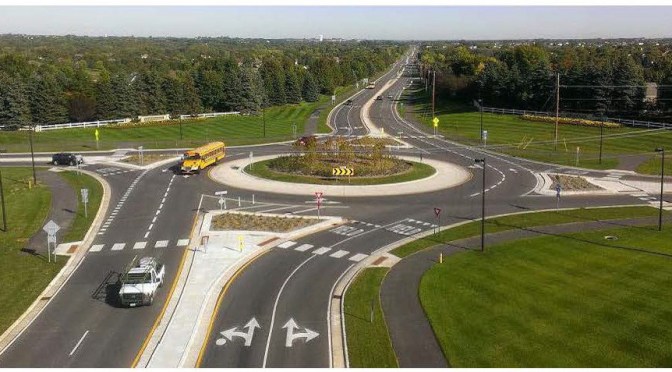
Choosing Effective Speed Reduction Strategies for Roundabouts

Using survey results and prior research, this project developed a new resource to enable Minnesota local road engineers to select appropriate speed reduction measures for roundabouts. Further research is needed to determine the relative effectiveness of different measures alone and in combination.

“Although roundabouts are becoming common, single-vehicle crashes from drowsy, inattentive or unfamiliar drivers are still a concern, particularly in rural areas,” said Joe Gustafson, Traffic Engineer for Washington County. “This project provides an overview of existing speed reduction treatments that have been used in both roundabout and nonroundabout contexts, and a framework to properly evaluate the effectiveness of new treatments.”

“Rather than try to identify the right combination of treatments, the research was designed to give engineers a variety of options to consider for a given location,” said Susan Chrysler, Senior Research Scientist, Texas A&M Transportation Institute.

Gustafson served as the technical liaison for the study, and Chrysler was the principal investigator.

What Was the Need?

2017-14-p1-image

Roundabouts can provide a safer alternative to traditional intersection control devices like traffic signals and stop signs. Roundabouts have been proven to reduce crash severity by requiring drivers to decrease speed during the approach to the intersection. But failure to slow down sufficiently could result in a crash.

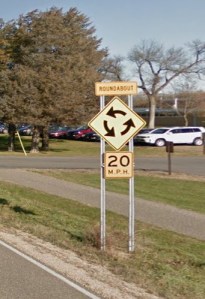
Signs and markings are key treatments used to communicate to drivers that they must slow down as they approach the roundabout. When navigated appropriately, roundabouts can eliminate or reduce the severity of crashes, reduce delays and reduce fuel consumption.

What Was Our Goal?

This project had two goals: to analyze existing research and conduct a survey of roundabout design and installation practitioners to determine best practices; and to develop a resource that engineers can use to identify appropriate speed reduction treatments for high-speed approaches to roundabouts.

What Did We Do?

Investigators surveyed transportation engineers from Minnesota and other states, along with technical consultants, to learn their experiences managing roundabouts with high-speed approaches. The survey addressed geometric design parameters and traffic control methods, changes in maintenance practices, crash history and speed reduction measures that were considered or eventually enacted.

Previous research on the subject was studied, including the Federal Highway Administration report Roundabouts: An Informational Guide and National Cooperative Highway Research Program Report 672: Roundabouts: An Informational Guide, Second Edition. Design manuals from four states were reviewed to provide a sample of the material avail-able to practitioners seeking guidance on design of high-speed roundabout approaches.

Based on their research, investigators provided information on the effectiveness of various treatments and on their installation and maintenance costs. They also developed a methodology for conducting a speed study to assist engineers in determining the most effective treatment for a given intersection. Treatments for alerting drivers that a round-about is ahead include traditional signs, pavement markings, illumination and other indicators, plus advanced devices like speed-activated, LED-enhanced warning signs.

What Did We Learn?

Each roundabout presents unique challenges. Local road engineers need to evaluate the characteristics of the intersection being considered (such as geometric design and adjoining land use) and the costs of installation and maintenance before recommending a specific treatment or combination of treatments.

Other findings include the following:

  • Speed reduction techniques found effective for horizontal curves, urban-rural transition zones and isolated rural intersections should be effective for rural roundabouts with high-speed approaches.
  • In rural locations, speed reduction treatments that have been used at railroad crossings, T-intersections and work zones may also be applicable to roundabouts.
  • Some unique treatments used internationally hold promise, but further study is needed before these treatments can be recommended for use in the United States.

What’s Next?

This study was the first phase of research. The findings provide the methodology to select, install and evaluate treatments at different locations. Further research is needed to accomplish the following:

  • Analyze the effectiveness of speed reduction treatments at different locations
  • Determine the impact of different combinations of treatments
  • Establish the comparative benefits of two or more treatments that fall within the same general cost and maintenance grouping
  • Analyze the impact of roundabout infrastructure (such as gateway treatments and illumination), various pavement markings and the long-term effects of specific signing treatments.

This Technical Summary pertains to the LRRB-produced Report 2017-14, “Strategies for Effective Roundabout Approach Speed Reduction,” published May 2017. 

Self-propelled auto-flagger keeps workers out of traffic

Working with a Minnesota manufacturer, researchers developed a moving automated flagger assistance device (AFAD) that signals traffic at work zones. The AFAD is operated remotely by a worker who can stand off the roadway out of traffic.

“Everybody who has used the mobile AFAD has liked it. We love our stationary AFAD unit. These units have really big stop-slow signs—they’re so visible,” said Jeremy Gjovik, Transportation Operations Supervisor, MnDOT District 3.

“The AFAD is a one-of-a-kind device. We were able to basically start from scratch and come up with a device that meets all the needs it was designed for,” said Edward Terhaar, Principal, Traffic Engineering, Wenck Associates, Inc.

Terhaar served as the principal investigator for the study.

What Was the Need?

According to data from the U.S. Bureau of Labor Statistics, 149 roadway workers were killed nationwide from 2003 to 2015 while flagging or directing traffic, and many near misses have been reported with the increase in distracted driving that has come with mobile device use.

In 2014, MnDOT trained over 60 state and district maintenance workers in the use of an automated flagger assistance device (AFAD). The AFAD has been embraced in Minnesota as a highly visible device that effectively directs traffic in stationary maintenance and construction projects while keeping flagging personnel off the road during operation.

The AFAD does not, however, suit moving operations (like pavement crack sealing) because the device requires towing. Engineers at MnDOT wanted to determine if the AFAD could be made into a mobile device that could be operated by a road crew near, but not on, the roadway.

What Was Our Goal?

MnDOT funded this research to develop a self-contained, self-propelled mobile AFAD for use on moving work zone roadway projects.

What Did We Do?

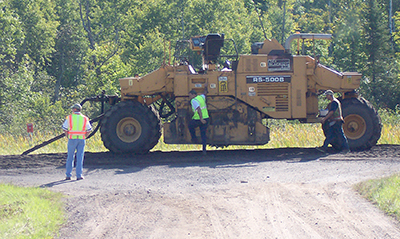
2017-09-p2-imageResearchers met with MnDOT engineers to identify the features that would be required in a moving AFAD. They determined that the device would have to be towable to a construction site with standard towing gear, operable remotely through wired or wireless controls, movable forward and in reverse, and able to use rechargeable onboard batteries.

The research team investigated existing self-propelled devices from the United States, Canada and Australia for moving wheeled objects, large and small, to see if they could be adapted to these needs. No suitable device was found.

After further consultation with the Technical Advisory Panel, researchers approached DJ Products of Little Falls, Minnesota, a company that designs and manufactures devices (including battery-operated devices) for moving trailers, dumpsters, shopping carts and aircraft.

Researchers met with DJ Products in February 2015, reviewed its products and agreed that DJ Products would develop a prototype vehicle on which the AFAD could be mounted. In August 2015, after evaluating and modifying designs, DJ Products hosted a demonstration of the prototype vehicle without the AFAD attached. The research team requested modifications, and in April 2016, the company presented a new self-propelled device with the AFAD attached.

What Did We Learn?

Initial field testing was delayed due to seasonal weather issues and device operating problems that required the replacement of components. In February 2017, a MnDOT operator tested the mobile AFAD on a crack-sealing project on State Highway 71 south of Sauk Centre.

The moving AFAD can be operated with a wired or wireless controller, as well as with controls on a handlebar mounted on the vehicle. Operators must use one remote for moving the wheeled unit, and the remote from the original AFAD for sign messaging. The new device moves forward and backward, can be towed with a standard hitch, and employs onboard batteries and a charger.

Setup and takedown require more effort than conventional flagging, but this effort is not considered cumbersome. The moving AFAD can be operated by one person standing 400 feet or more off the roadway, and the device is large enough to be easily seen and understood by road users.

The new device was used for only one hour initially. The sealing crew was outpacing the moving AFAD because the crack-sealing project entailed few repairs with greater distance between repair locations than is typical of such projects.

What’s Next?

The moving AFAD device can be used as is, and is still being tested by MnDOT. Further modifications will be requested, including enhancement of the battery-powered unit, as it currently requires a battery change to operate through an entire work shift.

Steering and controller design will likely be modified. Currently, the moving AFAD operates like a rear-wheel-drive vehicle and must be steered from its rear-wheel, traffic-facing axle, forcing the remote operator to guide it up the road as if backing up a boat trailer. MnDOT operators may ask that the device be redesigned to be steerable from the traffic-leading end of the vehicle, as if it were pulling the signage up the road, allowing for more intuitive control.

MnDOT personnel would also like to see the device’s controller integrated with the sign controller, eliminating the need for two controllers—one for moving, the other for operating the sign. Nevertheless, the device appears to be a promising option for mobile AFAD use by an operator who need not stand on the road to direct traffic.


This Technical Summary pertains to Report 2017-09, “Development of a Moving Automatic Flagger Assistance Device (AFAD) for Moving Work Zone Operations,” published March 2017. 


Previous research:

ATM Queue Warning Systems Can Reduce Freeway Crashes

ATM queue warning systems were developed and deployed on two freeways to alert motorists to queuing conditions ahead that could lead to rear-end crashes. At one test site, the prototype system substantially reduced crashes and near-crashes. At the other site, it reduced speed variances.

“The big lesson learned was that the detection method had to function quickly and display a message that was timely and accurate. This gains the trust and confidence of the motoring public,” said Brian Kary, Freeway Operations Engineer, MnDOT Metro District.

“Deploying the product of this research was not difficult. The challenge came in closing the gap to alert the drivers to slow down,” said John Hourdos, Director, Minnesota Traffic Observatory, University of Minnesota.

Kary served as the technical liaison for the study, and Hourdos was the principal investigator.

What Was the Need?

To reduce congestion and improve safety, MnDOT has deployed active traffic management (ATM) technology on two highways in the Twin Cities freeway network. The ATM system incorporates intelligent lane control signals (ILCS) placed over selected lanes at half-mile increments to warn motorists of incidents or hazards ahead. With advance warning, drivers can slow down and possibly avoid crashes.

The deployed system, however, does not specifically target the prevention of rear-end collisions, which are the most frequent type of crashes on freeways. Research has shown that rear-end collisions tend to occur during extended lines of stop-and-go traffic and at end-of-queue locations. Overhead, real-time electronic messages that warn of queuing conditions ahead can prepare motorists to reduce speed and avoid potential rear-end collisions. Such messages have the added benefit of improving mobil-ity since fewer crashes will improve traffic flow.

What Was Our Goal?

This project sought to develop and field-test two different prototypes for ATM queue warning systems. One prototype would address stop-and-go traffic and end-of-queue situations. The other would address shock waves, a crash-facilitating condition where there is a sudden change in traffic movement that causes a cascade of braking. The long-range goal of the project is to develop a unified ATM queue warning system that can be deployed at other locations within the freeway network.

What Did We Do?

Development of two prototype high-resolution ILCS warning systems began in 2014. The systems were then deployed on two high-traffic freeways in the Twin Cities: one on Interstate 35 West (I-35W) and the other on I-94. Both were still in operation in mid-2017.

The two locations have significantly different traffic conditions. On I-35W, congestion creates expanding queues that extend from the Trunk Highway 62 (TH 62) interchange to the 50th Street overpass. At the I-94 location, crashes are most likely to occur due to shock waves that can often quickly develop near the Portland Avenue overpass.

2017-20-p2-imageTo capture traffic data, researchers used either live video from closed-circuit-camera detector stations or data from existing in-pavement loop detectors. The ILCS units dis-played the message Slow Traffic Ahead, which would direct drivers to reduce speed due to the congested lanes ahead. Other messages, such as Prepare to Stop or Traffic Ahead 10 MPH, were considered but not tested during this initial study.

A server installed at the Minnesota Traffic Observatory at the University of Minnesota archived the time and location of each queue on I-94 and measured its duration and length. This provided the data needed to develop two algorithms that can be used to develop a rear-end-collision warning system that can be installed at freeway locations where similar queuing conditions exist.

What Did We Learn?

The data collected show that warning messages delivered by the ATM system can be effective in alerting drivers to queuing conditions. The ultimate benefit is a reduction in rear-end collisions in downstream locations on the freeway.

Data recorded at the I-35W location revealed that:

  • Messages delivered by the ILCS system helped drivers maintain a steady speed and eliminate stop-and-go travel.
  • The contents of warning messages should be crafted to have an impact on all motorists. Drivers responded differently to specific messages.
  • Queue warning systems can be made more effective through deployment of a real-time, lane-specific ILCS system and collection of high-resolution data.
  • Some drivers did not always heed the first queue warning message to decrease speed, but they did slow down further along the roadway.
  • There was no significant difference in impact between warning messages issued during the morning peak travel period and those issued during the evening peak.

In the first three months of queue warning system operation, the crash frequency re-corded at the I-94 test site was 9.34 crashes per vehicle miles traveled (VMT) and 51.8 near-crashes. This was a 22 percent decrease from the 11.9 crashes per VMT recorded at the site in 2013 monitoring data, and a 54 percent decrease from the 111.8 near-crashes recorded there in 2013.

The research showed that to prevent potential collisions, the ATM system had to deliver messages quickly and accurately to give drivers enough time to adjust their speeds. Also, the control algorithms developed in this project can provide the queue-estimation projections needed by MnDOT and other transportation departments to enhance the effectiveness of their ATM systems.

What’s Next?

While the deployment of the two queue warning system prototypes was a relatively cost-effective option, a longer trial period of two to three years is needed to ensure that the ATM system delivers sustainable benefits.


This Technical Summary pertains to Report 2017-20, “Development of a Queue Warning System Utilizing ATM Infrastructure System Development and Field Testing,” published June 2017. 

Minnesota's transportation research blog