This article was originally published in Catalyst, November 2020.
As momentum for connected and automated vehicles (CAVs) continues to build in Minnesota, researchers in the U’s Transportation Policy and Economic Competitiveness (TPEC) program are working to understand how CAV technology could serve transportation-disadvantaged communities. CAVs offer the potential to provide greater mobility and equity for many people, but public engagement is essential to ensure all user needs are understood and addressed.
This article was originally published in Catalyst, November 2020.
Electric scooters let riders move quickly between the roadway and the sidewalk, but these sometimes-unpredictable travel patterns can pose risk for riders and the people around them. Making scooters smarter is the goal of a new U of M research project funded by the National Science Foundation (NSF). Under the $1.2 million Cyber-Physical Systems grant, a cross-disciplinary team will study smart tracking systems on scooters for ensuring safe and smooth interaction with other vehicles and pedestrians.
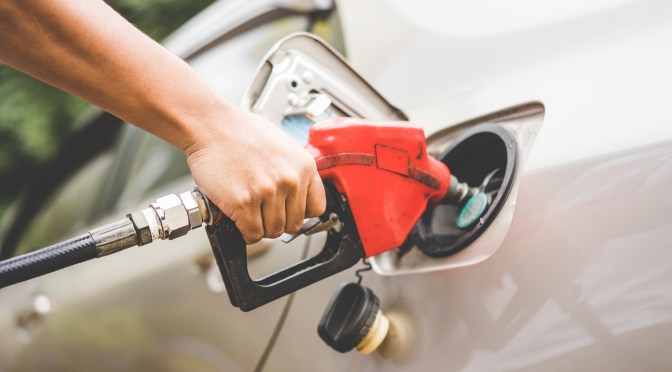
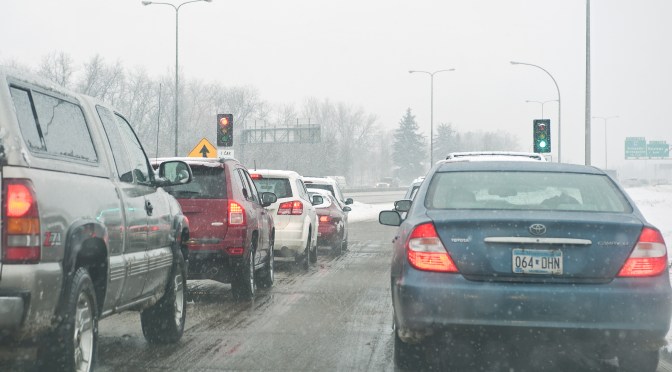
Due to rising fuel costs and environmental impact, consumers are increasingly aware of fuel efficiency (MPG) in the vehicles they purchase, which is reflected in increasing hybrid and electric vehicle sales. A major source of fuel consumption is acceleration and deceleration cycles caused by stopping at red lights—acceleration from a full stop requires significant power.
A recent study determined the effectiveness of a two-cell iron-enhanced stormwater filtration basin to remove phosphorus from highway stormwater runoff collected from 2012 to 2018. Researchers recommended design changes that would allow for more accurate monitoring of these filter basins.
Complete streets is an approach to road planning and design that considers and balances the needs of all transportation users.
Richfield, Minnesota, located south of Minneapolis, began a Complete Streets redesign in 2013. So how did it turn out? A retrospective study has found that while construction impacts remain on the minds of business owners and residents, Richfield’s program has improved community life and traffic times citywide. Safety and multimodal use are expected to improve.
Minnesota is experiencing warmer winters and an increase in freeze-thaw events may negatively impact pavement systems. However, the impacts of these recent climate changes on freeze-thaw cycles have not been well studied.
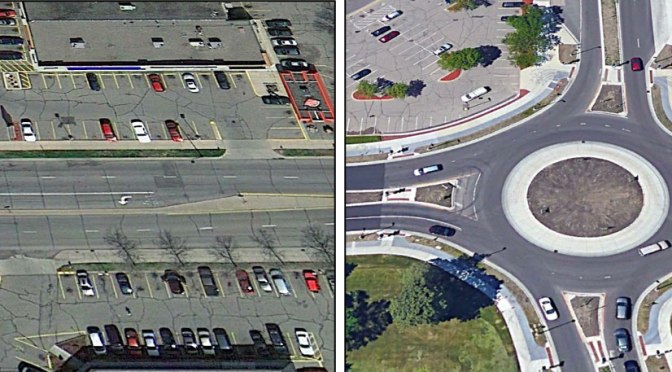
Roundabouts reduce the severity of crashes at intersections, but transportation agencies have received some feedback from pedestrians indicating that roundabouts, especially larger multi-lane roundabouts, can be difficult to navigate.
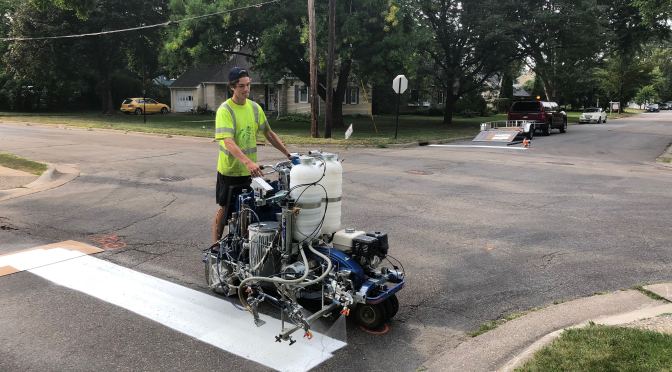
How well do the stop lines at stop-controlled intersections actually work as a safety feature? Through an extensive safety study and a before-after field observation, a recent Minnesota Local Road Research Board study showed that the assumed safety effects of stop lines as a means of influencing driver behavior are not well supported by the evidence.
The availability of hybrid electric utility vehicles expands the field of choices for a fleet manager looking to replace or expand fleets. In order to justify new vehicle purchases, fleet managers of local agencies need to determine how choices impact budgets and operations.
This article was originally published in Catalyst, August 2020.
On August 1, 2007, the I-35W Saint Anthony Falls Bridge collapsed in Minneapolis. Its replacement, open to traffic just over a year later, was instrumented with more than 500 sensors to record the new structure’s behavior and evaluate the effectiveness of different monitoring strategies. A 10-year review of the bridge’s monitoring system is now available from U of M researchers.






 Crossroads