Category Archives: Multi-modal

Access Across America: University of Minnesota ranks accessibility to jobs by transit

New research from the Accessibility Observatory at the University of Minnesota ranks 46 of the 50 largest (by population) metropolitan areas in the United States for accessibility to jobs by transit.

The new rankings, part of the Access Across America study begun last year, focus on accessibility, a measure that examines both land use and transportation systems. Accessibility measures how many destinations, such as jobs, can be reached in a given time.

“This project provides the most detailed evaluation to date of access to jobs by transit,” says Andrew Owen, director of the Observatory. “We directly compare the transit accessibility performance of America’s largest metropolitan areas.”

The findings have a range of uses and implications. State departments of transportation, metropolitan planning organizations, and transit agencies can apply the evaluations to performance goals related to congestion, reliability, and sustainability. In addition, detailed accessibility evaluation can help in selecting between project alternatives and prioritizing investments.

“It can help reveal how the costs and benefits of transportation investments are distributed,” Owen says.

Top 10 metro areas: job accessibility by transit (January 2014)

  1. New York
  2. San Francisco
  3. Los Angeles
  4. Washington
  5. Chicago
  6. Boston
  7. Philadelphia
  8. Seattle
  9. Denver
  10. San Jose

The report—Access Across America: Transit 2014—presents detailed accessibility values for each of the 46 metropolitan areas, as well as detailed block-level color maps that illustrate the spatial patterns of accessibility within each area. In addition, time-lapse map videos for each area are forthcoming and new analysis of the data from the accessibility to jobs by transit rankings will be published periodically. Upcoming reports in the Access Across America series will explore more detailed aspects of transit accessibility to jobs, including accessibility to jobs of different wage levels and a comparison with accessibility by car.

In the study, rankings were determined by a weighted average of accessibility, giving a higher weight to closer jobs. Jobs reachable within 10 minutes were weighted most heavily; jobs were given decreasing weight as travel time increases up to 60 minutes. Travel times were calculated using full transit schedules for the 7:00 to 9:00 a.m. period. The calculations include all components of a transit journey, including “last mile” access and egress walking segments and transfers.

“Accessibility is the single most important measure in explaining the effectiveness of the urban transportation system,” says David Levinson, University of Minnesota civil engineering professor and principal investigator on the project.

According to Owen, accessibility can be measured for various transportation modes, to different types of destinations, and at different times of day. “There are a variety of ways to define accessibility,” Owen explains, “but the number of destinations reachable within a given travel time is the most directly comparable across cities.”

The research is sponsored by the Center for Transportation Studies at the University of Minnesota. Accessibility Observatory reports, including the analysis of job accessibility by auto published last year and interactive maps, are available on the Access Across America: Transit 2014 web page.

Why is all the colored concrete deteriorating so fast?

There’s nothing like colored concrete to make a crosswalk, sidewalk or breezeway look snazzy.

But the extra touch that many cities are putting into their downtown streetscapes may not be so pretty in just a few short years.

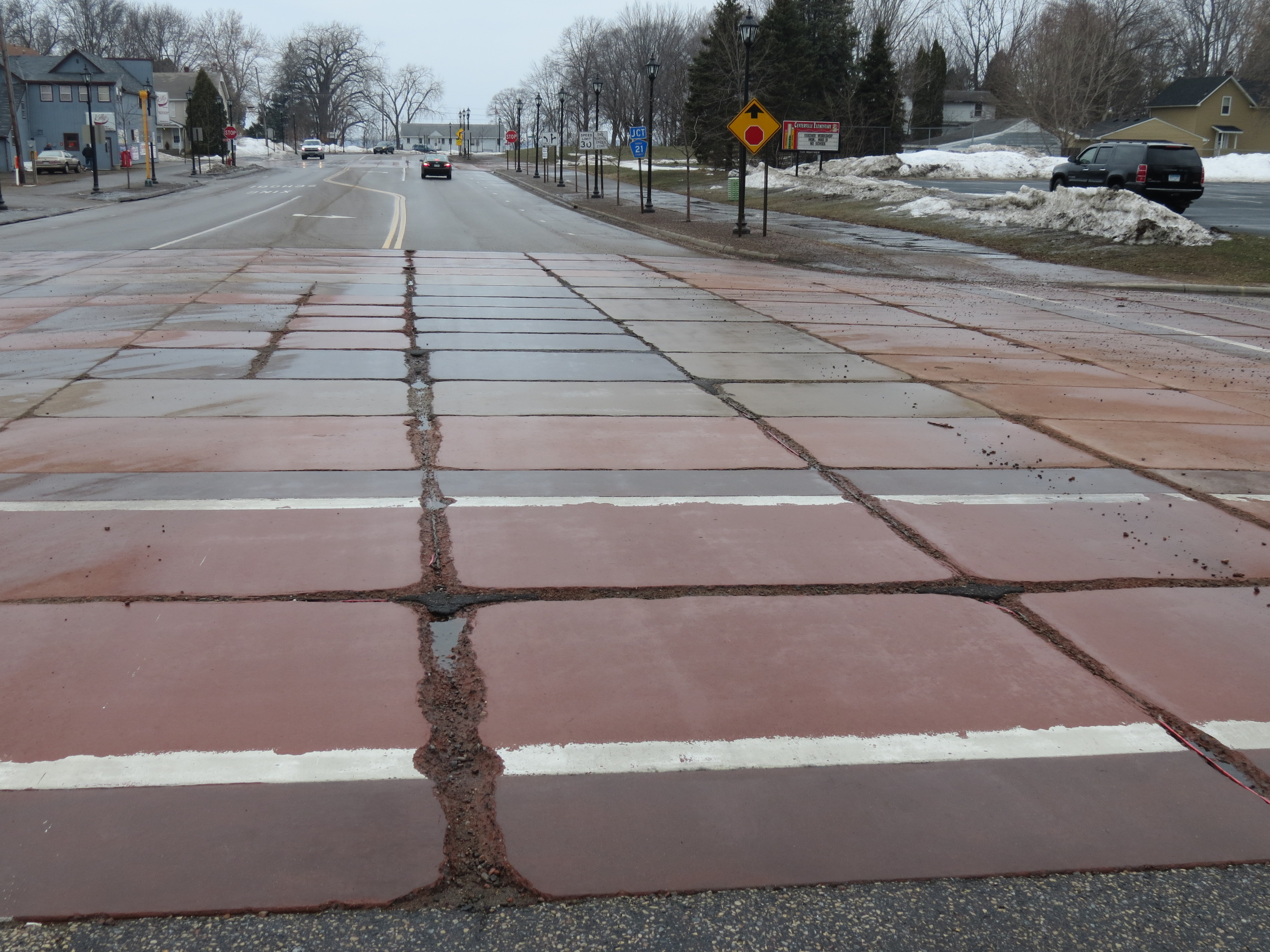
Early cracking has prompted the city of Vadnais Heights to tear up its colored concrete, and the city of Centerville — which installed colored concrete only six years ago — plans to follow suit, said MnDOT’s Senior Road Research Engineer Tom Burnham.

Both cities participated in a recent study, sponsored by the Local Road Research Board and conducted by MnDOT, to determine what is causing the early deterioration.

Across Minnesota, many of the estimated 45 colored concrete projects have experienced early deterioration, particularly microcracking near contraction joints. While this type of distress also occurs with regular concrete, it appears to be accelerated in the colored concrete projects, within five years in some instances.

Although the newly released study identifies likely causes for the failing colored concrete, further research is needed to evaluate proposed solutions.

Findings

Researchers determined that the colored concrete mixtures have likely been too porous for Minnesota winters, allowing deicing chemicals to leach in and wreak havoc. Although not quite as problematic for sidewalks and medians — which aren’t salted as heavily — it is especially bad for colored crosswalks.

A denser concrete mixture (one formed with less water) is recommended; however, constructing the concrete panels this way will require extra steps.

“There are chemicals that can be added to the mixture to artificially lower that water-to-concrete ratio,” Burnham said. “This will allow a  denser mixture to be more easily placed.”

The city of Centerville plans to tear up its colored concrete. This photo shows early joint deterioration.
Color in vogue

Although there was a spate of colored concrete construction in Ramsey County in the late 1990s, it has only come into fashion in the rest of the state within the last five to six years, according to Burnham.

“You go to almost any community and they’re installing it — on their sidewalk and medians and also crosswalks,” said Burnham, who coordinated the research study.

Because of the added expense, cities may be very disappointed in the results.

The city of Stillwater, which installed a colored concrete panel crosswalk on its main street just two years ago (see top photo), is already experiencing cracking and deterioration in several panels.

Possible remedies

Although reducing the porosity of the colored concrete mixture should help,  it won’t solve everything.

Another issue is the curing. The typical white curing product can’t be applied like it is with standard concrete, so curing the colored panels is more challenging, Burnham explained.

There are possible remedies, however, to assist with the curing, such as wet burlap or curing blankets.

Adding complexity to the issue are the new deicing chemicals on the market, which are also impacting regular road materials.

Several test samples showed evidence of chemical attack of the cement paste and fine aggregates, as well as an alkali-silica reaction, which can cause cracking or spalling and isn’t normally seen in regular concrete.

“Is there anything unique with the coloring that would accelerate the observed chemical reactions? We didn’t feel we had enough samples and knowledge at this point to conclusively say,” Burnham said.

Different construction techniques could go a long way toward increasing the livelihood of colored concrete; however, it could take several years of observation to determine if other methods work.

MnROAD is considering adding colored concrete panels to its facility for testing.

Until more questions are answered, MnDOT researchers are recommending repair techniques and alternative streetscaping ideas to cities, such concrete stains, pavers or colored high friction surface treatments.

In addition to sharing the findings with cities and counties, Burnham wants to educate contractors.

“We hope this research is a wake-up call for the colored concrete industry too because we don’t want the industry to die in Minnesota,” he said. “If it can work, we want cities and counties to be able to use it.”

*Editor’s Note: This story was updated 09/04/2014 to specify that this research project was funded entirely by the Local Road Research Board, and that MnDOT conducted the research.

Related Resources
  • Investigation and Assessment of Colored Concrete Pavement — Final Report (PDF, 20 MB, 368 pages); Technical Summary (forthcoming)

Parking availability system takes aim at truck driver fatigue

MnDOT, in partnership with the Federal Highway Administration, is test-deploying a high-tech system to help combat drowsy driving and keep truck drivers in compliance with federal hours-of-service regulations.

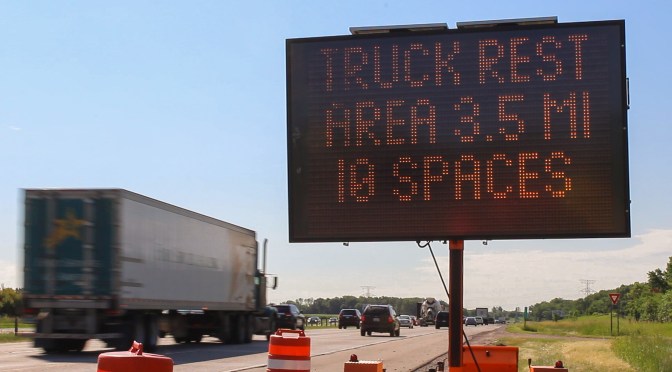
Developed by researchers at the University of Minnesota, the prototype system lets  drivers know when parking spaces are available at rest stops ahead. It has been deployed at several locations along the heavily traveled I-94 corridor between Minneapolis and St. Cloud.

From today’s MnDOT news release:

ST. PAUL, Minn. – New technology along the I-94 corridor west and northwest of the Twin Cities is helping truckers find safe places to park. Three Minnesota Department of Transportation rest areas are now equipped with automated truck stop management systems that tell truck drivers when parking spaces are available.

The technology will improve safety, lead to better trip and operations management by drivers and carriers and help MnDOT and private truck stop owners manage their facilities more effectively, according to John Tompkins, MnDOT project manager.

“So far, the results have been positive. We’ve had 95 percent accuracy in determining the availability of spaces,” he said.

Federal hours of service rules require truck drivers to stop and rest after 11 hours of driving. Tompkins said if drivers continue to drive beyond 11 hours, they could become fatigued and be forced to park in unsafe locations such as freeway ramps. They could also face legal penalties.

The problem of truck driver fatigue recently took the national spotlight when an allegedly drowsy driver slammed his semitrailer into a limousine carrying actor-comedian Tracy Morgan and six others. One passenger died in the crash.

The parking availability project is led by MnDOT Freight Project Manager John Tompkins and University of Minnesota professor Nikolaos Papanikolopoulos. MnDOT Research Services & Library produced the video above, which demonstrates the system in action. You can learn more about the project on the Center for Transportation Studies website.

Five Innovative Ways to Make Bicyclists and Pedestrians Safer

Last year, 41 people were killed while walking or biking on Minnesota roads and nearly 1,700 were injured.

Dozens of measures are available, however, for making roads safer for pedestrians and cyclists. Minnesota Department of Transportation Pedestrian and Bicycle Safety Engineer Melissa Barnes reviewed some of these design techniques in a recent presentation to city and state transportation engineers. (Watch the full webinar.)

We asked Barnes to highlight her favorite bike and pedestrian safety countermeasures used in Minnesota.

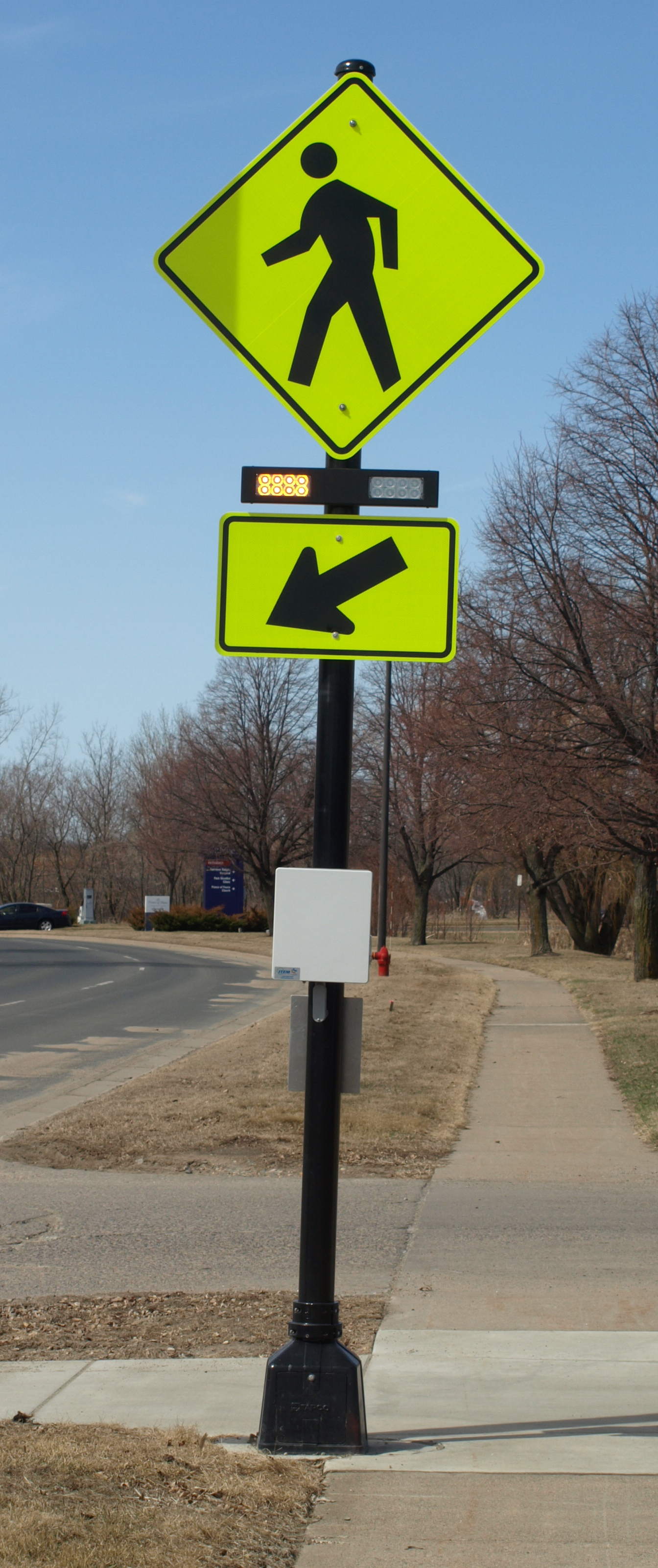
Rectangular Rapid Flashing Beacon RRFB

An unusually effective new pedestrian warning device, called the Rectangular Rapid Flashing Beacon, has become quite popular.

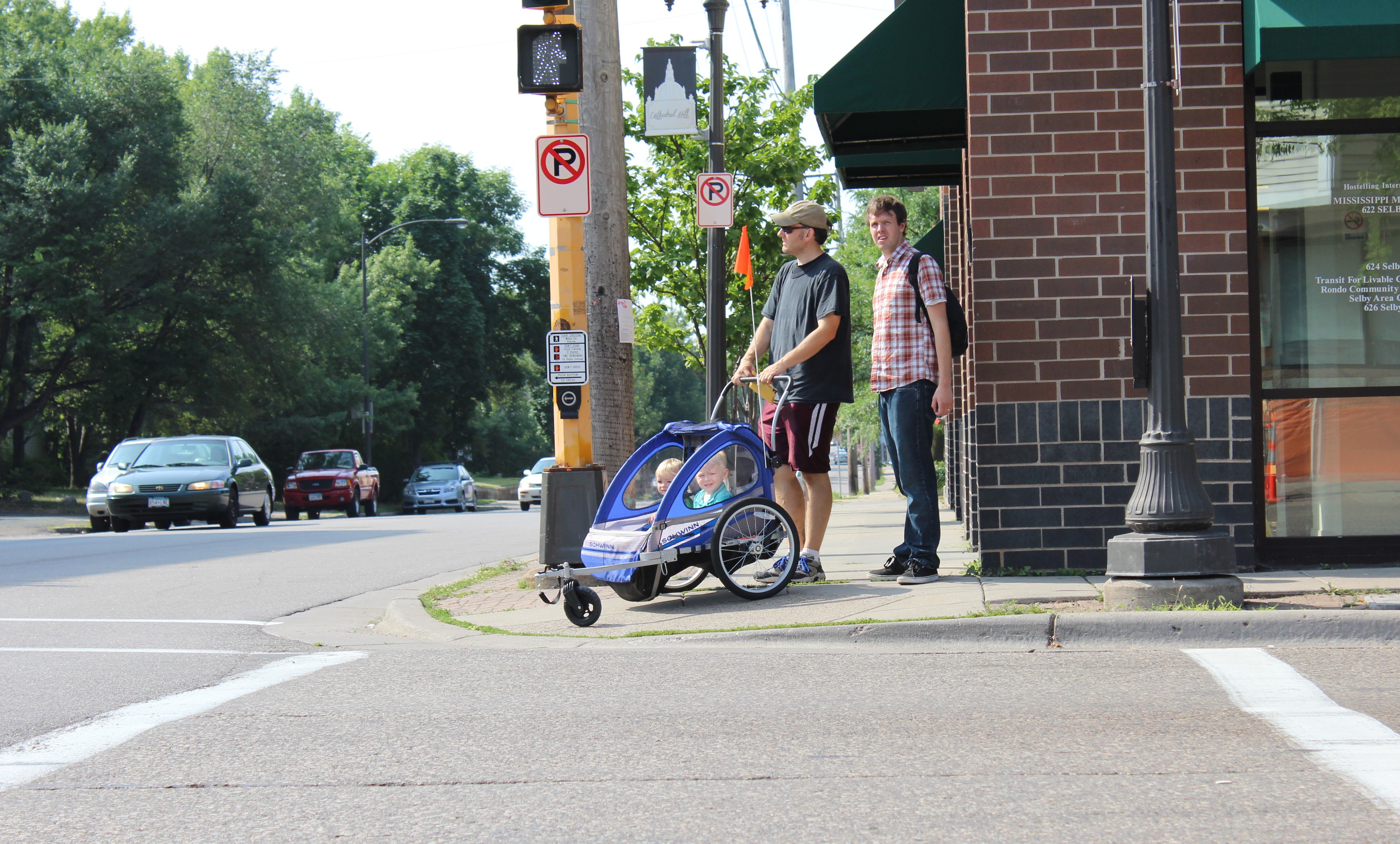
User-activated, the device alerts drivers to a pedestrian’s presence with a bright flashing beacon that “looks kind of like an ambulance or fire truck light,” Barnes said. (RRFBs can also be activated passively by a pedestrian’s presence.)

Studies have shown that the number of motorists stopping for pedestrians increases from 18 to 81 percent with the RRFB. Another plus: the device doesn’t appear to lose its effectiveness over time. After two years, compliance has been shown to still be more than 80 percent.

Advanced Stop Lines

It’s not uncommon for a motorist to stop for someone in a crosswalk, only for the vehicle following them to not see the pedestrian and veer around, driving through the crosswalk.

But an advanced stop line, placed 20 to 50 feet prior to a crosswalk, is effective at making both vehicles stop and see the person in the crosswalk.

“They are a really good option at an unsignalized, mid-block crossing,” said Barnes, although the stop line may not be a good option for a two-way stop.

Advanced stop lines have been shown to reduce pedestrian-vehicle conflict up to 90 percent; however, stop lines shouldn’t be placed too far in advance of the crossing, because motorists might then ignore them.

Leading Protected Interval

An innovative treatment called the Leading Protected Interval minimizes conflict by allowing pedestrians to enter a signalized intersection before vehicles do.

The walk signal begins three to seven seconds before the parallel street turns green by extending the time all lights are red.

A right turn on red can be prohibited with this device; however, even without the prohibition, the Leading Protected Interval has been shown to reduce crashes by 5 percent.

Protected Bike Lanes

Protected Bike Lanes

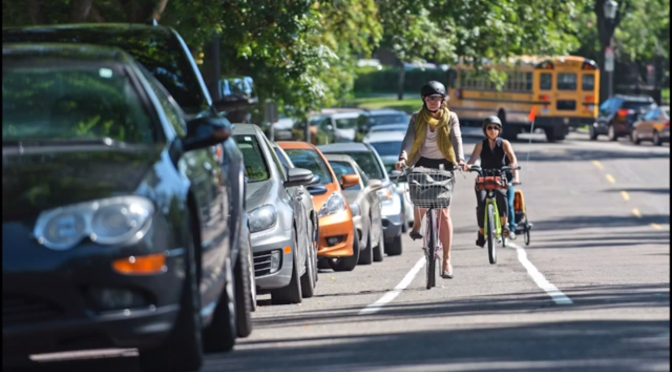
Bike lanes buffered from  traffic with some sort of physical barrier, even parked cars, will reduce all types of crashes. They also increase comfort levels for cyclists, helping keep bikes off the sidewalk.

“A lot of people are much more comfortable biking in these than a regular bike lane,” Barnes said. “It can be a very effective solution for places with lots of cyclists.”

Protected bike lanes, also called cycle tracks, also have a traffic-calming effect.

In New York City, the cycle track reduced all types of crashes an average of 40 percent and up to 80 percent on some roads.

“The challenge is how to design these at intersections,” Barns said. “It’s hard to get the turns right and get everybody visible. It’s pretty important to design these carefully at intersections.”

For those reasons, two-way cycle tracks work best on one-way streets, she said.

Flexible Bollards
Flexiblebollard
Photo courtesy of Reliance Foundry

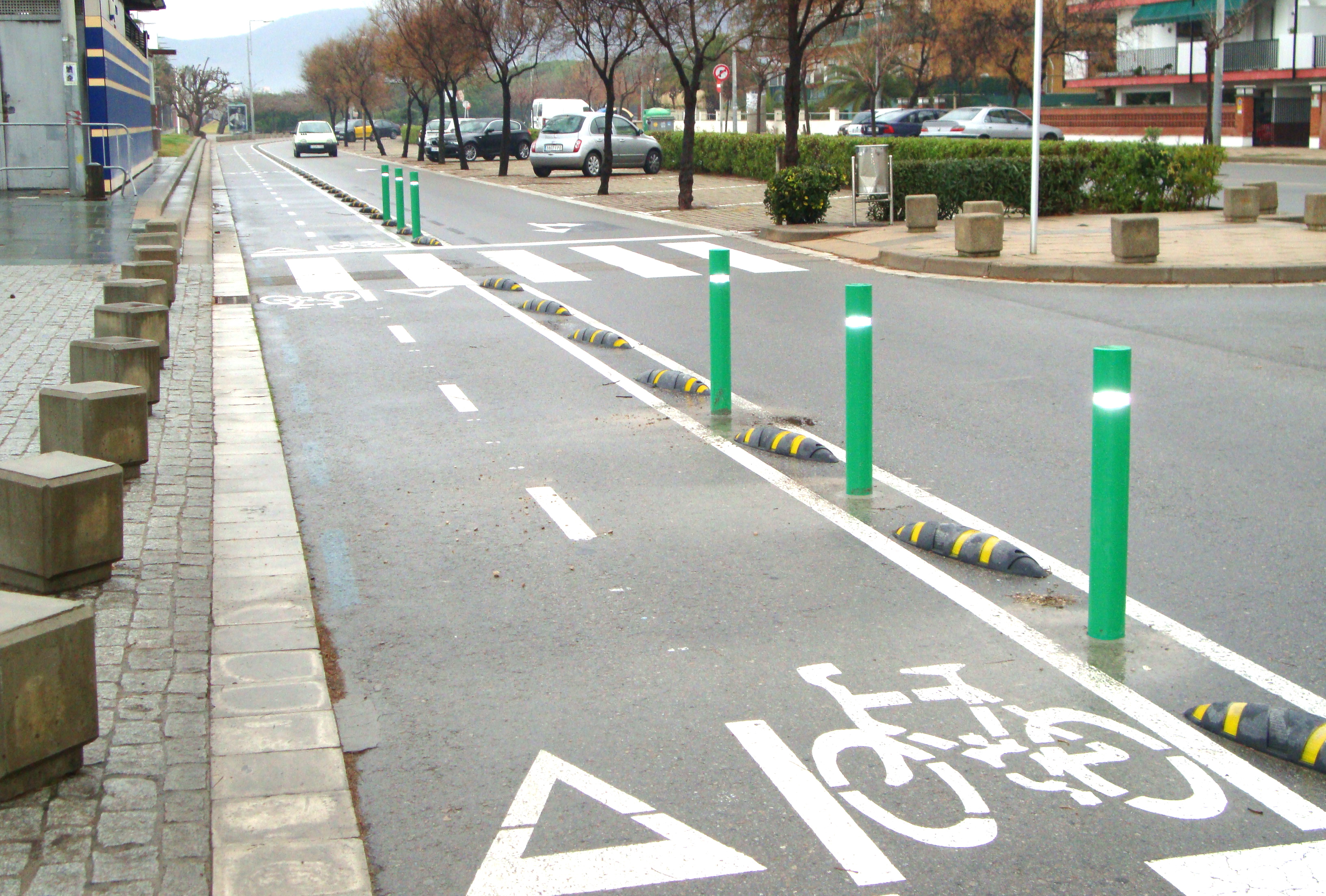
Flexible bollards create temporary curb lines that encourage vehicles to slow down. They can be installed easily and inexpensively.

Flexible bollards bend up to 90 degrees when struck by an errant vehicle. They do not physically stop a car, but encourage vehicles to stay within their lane. Although they can create additional maintenance, they are a good interim solution at locations that need an immediate fix, but have no funding to do so.

Unmanned aircraft systems create buzz of activity, but challenges remain

In late 2013, Amazon.com announced that it plans to someday use unmanned aircraft systems (UASs) to deliver packages. Amazon is not alone in considering these systems—the list of potential uses for this technology is rapidly expanding. Where is this technology headed, and what does it mean for the region, and for transportation?

State and national experts discussed these issues at an April 30 forum hosted by the Airport Technical Assistance Program (AirTAP), a part of CTS.

Often referred to as drones, modern UASs can be used for a broad range of activities, from aerial photography, surveying, precision agriculture, and communications to disaster response, wildlife research, and infrastructure protection.

Potential uses of UASs include precision agriculture.

A hurdle to broader use is the lack of rules and regulations. Last November the Federal Aviation Administration (FAA) released its first annual roadmap outlining policies, regulations, technologies, and procedures needed to safely integrate UASs into U.S. airspace; it plans to issue regulations by 2015.

“The greatest challenge is integrating UASs into the National Airspace System,” said Brigadier General Alan Palmer, director of the Center for UAS Research, Education, and Training at the University of North Dakota. “We want to do this safely, we want to do no harm, and we want to be sure not to violate somebody’s personal space. We do not have any regulations for standards, training, certification, or anything like them. But we will get there.”

Other concerns include privacy issues and the existing aviation/navigation infrastructure, which did not account for a future including UASs when it was built 50 years ago.

To learn more about the forum, read the full article in the June issue of Catalyst. In addition, a proceedings from the event will be available on the AirTAP website this summer.

New guidebook, training to facilitate safer pedestrian crossings

City and county engineers often struggle with how to respond to safety concerns about pedestrian crossings, with no scientific method for evaluating them.

In Long Lake, for example, the police department received numerous complaints about the safety of a particular pedestrian crossing. But when the crossing was videotaped, no one was observed using it.

This example — which was part of a research project funded by the Local Road Research Board — exemplifies the difficulties local governments face when they receive requests for a stop sign or signals at a crossing.

A pedestrian crossing control device.

A new manual and June 5 training workshop being held by the Minnesota Local Technical Assistance Program will provide cities and counties with step-by-step tools for evaluating a pedestrian crossing and identifying whether improvements are warranted.

The soon-to-be released guidebook* recommends when to install marked crosswalks and other enhancements based on the average daily vehicle count, number of pedestrians, number of lanes and average vehicle speed. It guides users how to rate a crossing for pedestrian service, and includes a flow chart to assist in decision-making.

The training is unique because it is based on actual video footage of existing crosswalks and the pedestrians which use them.

No guidance

Although vehicles are legally required to stop for pedestrians crossing at intersections and within marked crosswalks, they don’t always yield the right-of-way. And areas with high traffic volumes may not have adequate gaps for pedestrians to cross safely, leading to risk-taking.

Alan Rindels, a MnDOT research engineer, had previously looked for a methodology to evaluate a crosswalk’s effectiveness, but could not find an appropriate engineering analysis.

“What I kept coming up with were results based on the experience of an engineer or planner for what they ‘felt’ was a better crosswalk, such as additional pavement markings, lights or maybe a signal system,” he said.

Rindels finally found guidance in a Transportation Research Board webinar two years ago. Based on that, he asked the LRRB to develop a training methodology for Minnesota practitioners.

Uncontrolled pedestrian crossings

Unless specifically marked otherwise, every intersection is a pedestrian crossing, regardless of the existence of crosswalk markings or sidewalks. At mid-block locations, crosswalk markings legally establish the pedestrian crossing. Uncontrolled pedestrian crossings (which the guidebook focuses on) are locations that are not controlled by a stop sign, yield sign or traffic signal.

Defining where to place pedestrian crossing enhancements — including markings, signs and or other devices — depends on many factors, including pedestrian volume, vehicular traffic volume, sight lines and speed.

The LRRB developed a worksheet that engineers can use to evaluate an uncontrolled pedestrian crossing location in a systematic way, in accordance with the 2010 Highway Capacity Manual. Users note the level of lighting, distance from the nearest all-way stop and whether another location might serve the same pedestrian crossing more effectively.

The guidebook’s 11-step evaluation can identify what level of treatment is appropriate, ranging from overhead flashing beacons and traffic calming devices, such as curb bump-outs, to more expensive options like building overpass or underpass.

Hennepin County Senior Transportation Engineer Pete Lemke, who went through pre-training, said the guidebook will help engineers measure the pedestrian experience by “quantifying the delay at non-signalized intersections.”

“It will inform how we respond to concerns — whether that response is ‘the crossing fits the needs of what’s there’ or ‘we need to make changes or enhancements,'” he said.

Further Resources

Putting Research Into Practice: A Guide for Pedestrian Crossing Treatments at Uncontrolled Intersections – Technical Summary (1 MB, 2 pages); Final Report.

Training workshop – June 5 (register here)

* Consultant Bolton & Menks prepared the guidebook with guidance from a 21-member project team that included University of Minnesota researchers and engineers from the city of Eagan, Hennepin County, Carver County, Scott County, MnDOT, the Center for Transportation Studies and the Federal Highway Administration.

Bicycle and pedestrian-counting project wins CTS partnership award

(Feature image courtesy Michael McCarthy, Center for Transportation Studies.)

Earlier this year, we wrote about the Minnesota Bicycle and Pedestrian Counting Initiative, a project that developed guidelines and protocols to help transportation planners accurately count non-motorized traffic. This groundbreaking research involved a diverse partnership of state and local officials, University of Minnesota faculty, and private and nonprofit organizations.

On Wednesday, April 23, the project team (photo above) was honored with an award from the Center for Transportation Studies. Team members accepted the CTS Research Partnership Award in a ceremony at the McNamara Alumni Center in Minneapolis. The award is given each year to projects that have resulted in “significant impacts on transportation” and that draw on “the strengths of their diverse partnerships” to achieve their results.

The video below, produced by CTS, explains the importance of the project. MnDOT is now in the process of implementing the research results by installing permanent counters and using portable counters in select locations around the state. MnDOT plans to use the information for a variety of purposes, including planning, safety analysis, investment planning and quality-of-life analysis.

Project team members will present their research findings at the North American Travel Monitoring Exposition and Conference in July. The conference’s focus is on “Improving Traffic Data Collection, Analysis, and Use.”

*Bonus: Read about last year’s Research Partnership Award-winner, a MnDOT-led, multi-state effort to reduce low-temperature cracking in asphalt pavements.

Learn more about the project:

Bike to Work Day: progress in Minnesota, but miles to go

By Greg Lindsey

This blog post by University of Minnesota Professor Greg Lindsey was originally posted on the CTS Conversations blog.

April 9 is national Bike to Work Day, a day to celebrate those who choose bicycling as their principal mode of transportation for commuting, and a time to encourage more people to consider this healthy, efficient transportation option. Minnesota has much to celebrate in terms of bicycle commuting. Bike-Walk Twin Cities and Transit for Livable Communities are wrapping up the National Non-Motorized Pilot Program, a federally funded program to demonstrate the potential to increase biking and walking through focused investment in infrastructure and other interventions. Bicycle commuting rates in Minneapolis have climbed to 4.5%, and Minneapolis now ranks 20th in the nation in bicycle commute share. This is a noteworthy achievement, especially considering our notorious winter weather. These achievements, along with others such as the success of Nice Ride, our pioneering bike share program, have contributed to Minneapolis being named America’s most bike-friendly city by Bicycling Magazine. Celebration of these achievements – which represent hard work by hundreds of individuals and thousands of commuters – certainly is warranted.

But we only need look across municipal boundaries to know we had better put more energy into encouraging bicycling than into celebration. Bicycle commute rates in St. Paul remain below 2% less than half the Minneapolis rate, and rates in most suburban, exurban, and rural communities remain even lower. And the story remains essentially the same for all types of bicycle trips. Jessi Schoner, a doctoral candidate in the Department of Civil Engineering, is analyzing non-motorized mode shares for all trips recorded the Metropolitan Council’s recent Travel Behavior Inventory. Her analyses show that bicycling remains an urban phenomenon, with the share of all trips taken by bicycling highest in Minneapolis, followed by St. Paul, and then suburban and outlying communities. Why is this so? Better infrastructure no doubt is part of the reason, but there likely are other reasons, including housing patterns, access to employment, socio-demographic factors, and culture. Additional research is needed.

But this leads to additional reasons to be optimistic this Bike to Work Day: the commitments made by the Minnesota Department of Transportation (MnDOT) to foster multi-modal transportation systems and the agency’s investments in research to increase understanding of bicycle traffic patterns. In 2013, as part of the Minnesota Bicycle and Pedestrian Counting Initiative, MnDOT funded the installation of the state’s first two automated, continuous in-street bicycle counters. These counters, which monitor bicycle traffic around the clock, 365 days per year, will provide new insights into the bicycle traffic volumes and their daily and seasonal patterns. While bicycle traffic monitoring in Minnesota is only in its infancy, it represents progress towards establishing the evidence base we need to determine how to make bicycling safer and to invest in bicycle infrastructure.

And so celebrate this Bike to Work Day and thank your fellow Minnesotans for all they have accomplished. But also take time to reflect on the work that needs to be done to improve opportunities for cycling throughout the state, for we have miles to go.

Greg Lindsey is a professor at the University of Minnesota Humphrey School of Public Affairs. His areas of specialty include environmental planning, policy, and management. His current research involves studies of the relationship between the built environment and physical activity, specifically factors that affect the use of pedestrian and cycling infrastructure. Lindsey presented some of his bicycle and pedestrian data collection research at the 2014 Minnesota Transportation Conference held March 4-6.