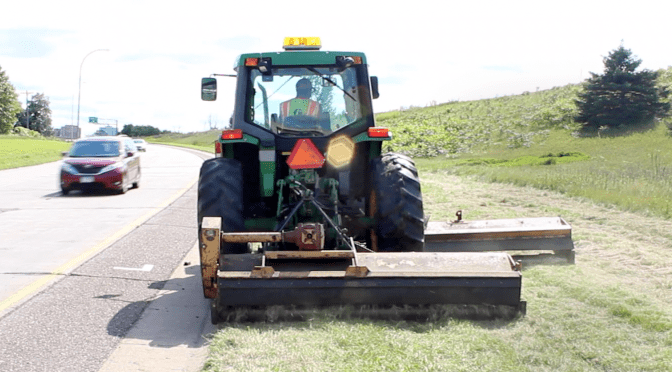
As temperatures fall and days get shorter, MnDOT Metro District maintenance workers are wrapping up a season of mowing grass along roadsides and in medians that they hope will prove a little more efficient than in the past.
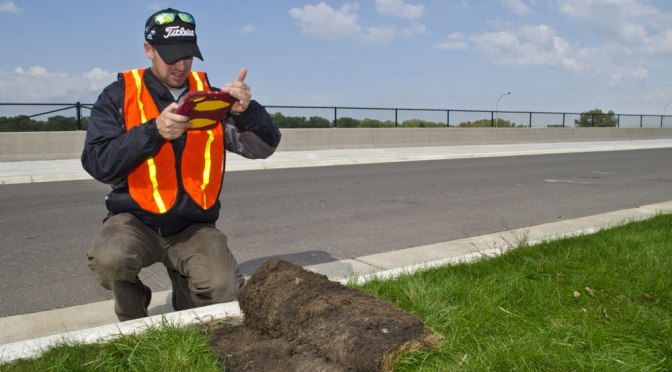
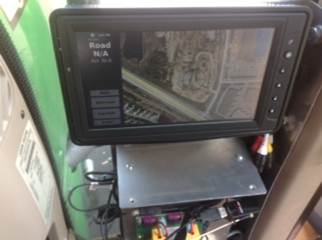
Thanks to a research project that installed GPS devices in tractor cabs, operators have a better sense of exactly which areas they need to mow and which areas should be left alone. Five Metro District tractors were tested in 2015. This year, more than 40 tractors were fitted with the automated vehicle location (AVL) technology, which includes a GPS antenna, an on-board central processing unit (CPU) and an in-cab screen with a user interface.
Trisha Stefanski, Metro District asset management engineer, expects one of the biggest benefits of the project to be a reduction in herbicide use. Maintenance crews use herbicide to control the spread of noxious weeds that sometimes get spread during mowing operations. Mapping exactly where noxious weeds are, and providing that information to operators on a real-time, in-cab screen and user interface helps them mow around those areas.
“We’re really hoping it will reduce the amount of herbicide that we’re putting on our roadways by 50 percent,” Stefanski said. “We’re not certain that will be the number, but that’s what we’re hoping for. We think just not mowing those areas will not spread as many noxious weeds and so we don’t have to apply as much herbicide.”
Metro District operators, such as Jesse Lopez, give the AVL technology rave reviews.
“Basically you can see what you shouldn’t mow and what you should mow. So, it makes it easy for me. It’s just like playing a game,” Lopez said. “This actually helps me to optimize what my job is. I know exactly where I’m at and where I’m going. I think everyone should use it – absolutely everybody who is in a mowing situation or a plowing situation.”
In addition, the AVL technology helps maintenance supervisors keep tabs on exactly where their operators are in real time. It also helps supervisors complete reports by automatically providing the geographic areas where mowing has been completed.
Stefanski says the project has gone really well, and she hopes collecting more data over another mowing season will show real savings on herbicide use. In the meantime, she is thinking of other ways AVL technology could be applied to maintenance operations.
“What I really like about the project is that we are taking something used in a lot snow plows and a lot of other technologies – cars, other things, maybe UPS uses them – and we’re putting it into maintenance operations,” Stefanski said. “Having it for mowing, we can also use it for smooth pavements. We can also use it for other things in mowing operations.”
Bees, butterflies and other pollinators busily work on our behalf to help our crops and wild plant life reproduce. Most plants cannot produce fruits and seeds without the aid of these little bugs.
MnDOT is taking steps to ensure that the habitat these creatures depend on gets the protection it needs.
In addition to recently signing an agreement with five other state DOTs to improve pollinator habitat along Interstate 35, a key migratory corridor for Monarch butterflies, MnDOT has just completed a review of other state and local government practices to identify more opportunities to use existing right-of-way to protect pollinators.
MnDOT set out to learn about the experiences of other state departments of transportation and local agencies in maintaining pollinator landscapes on highway rights of way through partnerships with individuals, groups or local agencies.
Results of the literature review are supplemented with findings from a survey of selected state DOTs and Minnesota counties. Nine state DOTs describe current practices or plans to develop new pollinator-specific partnerships; existing partnerships that have been expanded to address pollinators; and Adopt-a-Highway programs that support maintenance of vegetation in the right of way.
The Transportation Research Synthesis (TRS) may lead to enhancements to MnDOT’s existing practices or the development of a new pollinator-specific partnership program.
While MnDOT does not have a community partnership that focuses solely on promoting pollinator habitat, its Community Roadside Landscape Partnership Program allows Minnesota communities to partner with MnDOT to establish and maintain landscaping in the ROW along highways that traverse their communities, and these landscaping treatments may benefit pollinators.
MnDOT has also partnered with the Minnesota Board of Water and Soil Resources and the Minnesota Department of Natural Resources to establish more than 20 native seed mixes for use on Minnesota roadsides. MnDOT’s online PlantSelector tool includes a seed mix tab to help designers and novices select the right seed for the right place.
To mark Earth Day 2016, MnDOT Research Services is taking a glance at five stellar examples of current research projects at MnDOT that involve pollution control, wetland mitigation, road salt reduction and new ways of recycling pavement.
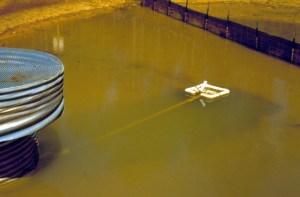
Temporary stormwater ponds with floating head skimmers can remove clean water from the surface of a settling pond.
Soil carried away in stormwater runoff from road construction sites can pollute lakes and rivers.
Stormwater settling ponds provide a place for this sediment to settle before the water is discharged into local bodies of water. However, since stormwater ponds have limited space, a mechanism is needed to remove clean water from the pond to prevent the overflow of sediment-laden water.
MnDOT-funded researchers designed temporary stormwater ponds with floating head skimmers that can remove clean water from the surface of the settling pond, using gravity to discharge water into a ditch or receiving body.
The study, which was completed in spring 2014, identified five methods for “skimming” stormwater ponds that can improve a pond’s effectiveness by 10 percent. MnDOT researchers also created designs for temporary stormwater ponds on construction sites with the capacity to remove approximately 80 percent of suspended solids.
These designs will help contractors meet federal requirements for stormwater pond dewatering. Researchers also determined how often a pond’s deadpool must be cleaned, based on watershed size and pool dimensions.
Stormwater infiltration rates at five swales were significantly better than expected based on published rates.
Stormwater can pick up chemicals and sediments that pollute rivers and streams. Roadside drainage ditches, also known as swales, lessen this effect by absorbing water. But until recently, MnDOT didn’t know how to quantify this effect and incorporate it into pollution control mitigation measures.
In a study completed in fall 2014, researchers evaluated five Minnesota swales, measuring how well water flows through soil at up to 20 locations within each swale.
A key finding: grassed swales are significantly better at absorbing water than expected, which may reduce the need for other, more expensive stormwater management practices, such as ponds or infiltration basins.
This could save MnDOT and counties significant right-of-way and construction costs currently expended on more expensive stormwater management techniques.
Even with little or no road salt, a permeable pavement like this porous asphalt in Robbinsdale, Minnesota, collects little slush and snow in the winter because it warms well and remains porous enough to infiltrate surface water effectively.
Road salt is used for de-icing roadways during winter months, but can have a negative impact on the environment.
This research, which was just approved for funding through the Minnesota Local Road Research Board in December 2015, will investigate the reduction in road salt application during winter months that can be attained with permeable pavements, while still providing for acceptable road safety.
Some initial investigations (see previous study) suggest that road salt application can be substantially reduced, even eliminated, with permeable pavement systems. The proposed research will investigate this hypothesis more thoroughly, and further document the reduction in road salt application that can be expected with permeable pavement.
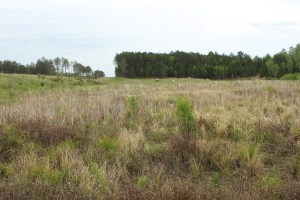
This photo from spring 2015 shows that wetlands have begun to take hold along Highway 53.
Road construction in northeast Minnesota often causes wetland impacts that require expensive mitigation. However, borrow areas excavated for road construction material can be developed into wetland mitigation sites if hydric vegetation, hydric soils and adequate hydrology are provided. Fourteen wetland mitigation sites were constructed north of Virginia, Minnesota along the U.S. Trunk Highway 53 reconstruction project corridor and evaluated for wetland. The sites were established with the goal of mitigating for project impacts to seasonally flooded basin, fresh meadow, shallow marsh, shrub swamp, wooded swamp, and bog wetlands. All but one of the sites consistently meet wetland hydrology criteria.
The sites contain a variety of plant communities dominated by wet meadow, sedge meadow, and shallow marsh. Floristic Quality Assessment (FQA) condition categories for the sites range from “Poor” to “Exceptional.”
According to the research report published in March 2016, these sites have shown the potential for creating mitigation wetlands in abandoned borrow pits in conjunction with highway construction. Adaptive management, particularly water level regulation, early invasive species control, tree planting, and continued long-term annual monitoring can make mitigation sites like these successful options for wetland mitigation credit.
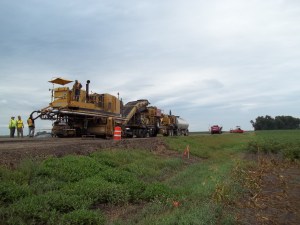
This photo shows a cold in-place recycling equipment train in action.
MnDOT already extends the lives of some old concrete highways by paving over them with asphalt instead of tearing them up. Now MnDOT hopes to add a third life for these old concrete roads by using a process called cold in-place recycling to re-use that existing asphalt pavement when it reaches the end of its life.
Cold in-place recycling (CIR) uses existing pavements, without heat, to create a new layer of pavement. It involves the same process of cold- central plant mix recycling (which is being employed by MnDOT for the first time on two shoulder repair projects this year), but it is done on the road itself by a train of equipment. It literally recycles an old road while making a new road.
CIR has been in use in Minnesota for 20 years, but only with hot-mix asphalt (HMA) over gravel roads. The purpose of a new study, which was approved for funding in April 2016, is to validate Iowa’s promising new practice using CIR on bituminous over concrete.
In this research project (see proposal), MnDOT will use cold-in-place recycling to replace the asphalt pavement on a concrete road and then evaluate it for several years, comparing it also with control sections.
Along with the potential of a better service life, the cost of CIR is much lower than new hot mix asphalt (HMA). Therefore, a 20-percent to 30-percent price reduction per project may be realized.
Roadways for humans can sometimes create roadblocks for fish, but researchers hope to establish a set of culvert design practices to help aquatic creatures get where they’re going.
Many fish depend on mobility along a river for feeding and spawning. Where roads meet rivers, however, culverts can block fish and other aquatic organisms that can’t navigate changes in current, lighting and other factors.
Waterway barriers threaten an already endangered species of minnow known as the Topeka shiner (pictured above). It can also be a big problem for economically important fish such as trout or northern pike. That’s why the Minnesota Department of Natural Resources prefers building bridges to culverts.
However, bridges are not always economically feasible, and so MnDOT is working closely with the DNR to develop culverts that protect both public safety and the environment.
Culverts allow water to pass under roads. Occasionally, they can harm a stream’s fish habitat by inadvertently acting as a barrier to fish passage or migration. There are nearly 11,000 culverts in Minnesota.
Sediment Content
Recent research suggests that installing boxed culverts differently could greatly improve fish passage.
Culverts are typically placed a little below the streambed with the expectation that the stream flow will naturally fill them with sediment. Researchers tested that assumption and found it to not always be accurate.
“We found that pre-filling the culvert with sediment that replicates the streambed as part of the installation process helped prevent upstream erosion and the development of vertical drops that can become barriers to aquatic movement,” said Jessica Kozarek, a University of Minnesota research associate. “In addition, pre-filling the culvert helped ensure the sediment remained inside the culvert flows were high and water moved quickly during rainstorms.”
MnDOT has been working with the DNR to identify the conditions that determine whether a newly installed culvert will naturally fill with sediment, replicating surrounding streambed conditions, or whether a stream’s water flow will transport sediment out of a culvert.
Using an experimental flume at the University of Minnesota’s St. Anthony Falls Laboratory, researchers tested MnDOT’s standard box culvert design under a variety of stream conditions.
Laboratory simulations suggest that filling a culvert with sediment at installation, rather than allowing it to fill over time is, with some exceptions, generally the best approach for low- and moderate-grade streams. Additionally, steep, fast-moving waters require a filled culvert with structures such as larger rocks to keep sediment in place. These structures also create steps, pools and riffles that enable fish to rest as they move upstream.
MnDOT will use this latest research, along with conclusions from other recent studies, to create a guide for fish-friendly culvert designs.
“Of all the things we’ve studied, there are maybe three or four research projects. This manual will pull it all together,” said Petra DeWall, state waterway engineer at the Minnesota Department of Transportation.
Further research is underway to determine whether aquatic organisms are deterred by low light conditions in long, dark culverts. Researchers are also looking into whether mussel spat rope could be used to create a rough bottom to reduce water speed in culverts with no sediment.
For Minnesota’s roadside grasses, life isn’t easy. To survive, grass must be able to withstand extreme stresses including drought, heat, disease, soil compaction, poor quality soils, and high levels of road salt. Ideally, it could survive all that while still looking lush and green.
“Many roadsides, especially in metropolitan areas, need to look good,” says Eric Watkins, associate professor in the Department of Horticultural Science. “In addition to aesthetics, quality roadside vegetation is needed to prevent erosion and maintain water quality from roadside runoff.”
In 2010, MnDOT noticed a number of its new sod and seed plantings were failing and asked U of M experts to take a look at its specification. “We saw the problem immediately,” Watkins says. “The specification was for a mix with a lot of Kentucky bluegrass, which needs a great deal of care and watering. There was clearly an opportunity for improvement.”
During the next several years, Watkins’ team, led by former graduate student Josh Friell, worked to identify the best seed and sod for use along Minnesota’s roadsides in research sponsored by the Minnesota Local Road Research Board and MnDOT. Findings are now available in a final report.
The study was completed in several stages. First, many different types of cool-season grasses were planted in the fall and assessed the following spring to determine their ability to establish and survive on roadsides in Minnesota. Next, researchers looked at the salt tolerance of those grasses.
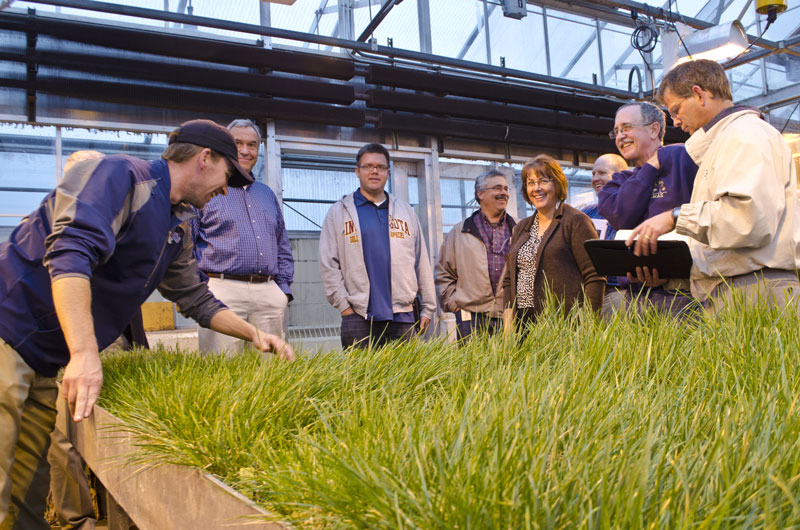
Eric Watkins (third from left) leads a greenhouse tour of grass mixtures.
“In cold-weather climates like Minnesota’s, salt tolerance is required because of the application of deicing salts in the winter,” Watkins explains. “To determine if a grass species could stand up to this stress, we applied different levels of salt solution to the different grass species in a greenhouse. We identified several types of fescue grass as the most salt tolerant.”
Based on the results of the first two stages, researchers developed and tested 50 different grass mixtures along Minnesota’s roadsides and evaluated the survival and performance of those plantings for two years. In addition, each mixture was planted under a movable rain-out shelter to determine drought tolerance. This phase of the study resulted in the identification of a mix of three types of fescue for planting on roadsides in Minnesota.
Finally, researchers needed to find out if the new grass mixture would work as sod (sod growers need to be able to harvest it properly from their sod fields). “Most sod currently grown in Minnesota is Kentucky bluegrass, which isn’t the best for winter survival when salt stress is a problem,” says Watkins. “We grew 51 different grass mixtures as sod for 22 months and found that contrary to popular belief, fine fescue mixtures produced sod of acceptable strength for harvest.”
MnDOT has applied the research to standard specifications for construction activities for salt-tolerant sod products, salt/shade/drought-tolerant turf seed mixtures, and a third-party certification program for ensuring performance standards are met based on past and current research results, says Dwayne Stenlund, MnDOT erosion control engineering specialist. Researchers are also working with the state’s sod growers to produce sod grown from the new seed blends.
Moving forward, the researchers plan to continue their work to improve Minnesota’s roadside grass plantings. “The reality is that the success of sod or seed plantings depends on a number of factors, including time of year, amount of water, soil preparation, temperature, and sod harvest depth,” Watkins says. “In our next project, beginning this spring, we will identify the most important factors for the success of roadside plantings and sod cultivation, and then help MnDOT update the specifications for managing new installations.”
Stormwater can pick up chemicals and sediments that pollute rivers and streams. Roadside drainage ditches, also known as swales, lessen this effect by absorbing water. But until recently, MnDOT didn’t know how to quantify this effect and incorporate it into pollution control mitigation measures.
In a recently completed study, researchers evaluated five Minnesota swales, measuring how well water flows through soil at up to 20 locations within each swale.
“There’s a big push in Minnesota, and probably everywhere, to do more infiltration,” Barbara Loida, MS4 Coordinator Engineer, MnDOT Metro District, said. “We know that our ditches are doing some of that, but we wanted to look at how much infiltration these ditches are providing.”
A key finding: grassed swales are significantly better at absorbing water than expected, which may reduce the need for other, more expensive stormwater management practices, such as ponds or infiltration basins.
This could save MnDOT and counties significant right-of-way and construction costs currently expended on more expensive stormwater management techniques. While swales were recognized in the Minnesota Pollution Control Agency’s new Minimal Impact Design Standards, there was a need to quantify the amount of water a swale can absorb so it could receive the appropriate MIDS credits.
Researchers also tested the ability of carbon, iron chips, steel wool and other materials to remove pollutants as ditch check filters—material put into swales to enhance removal of pollutants.
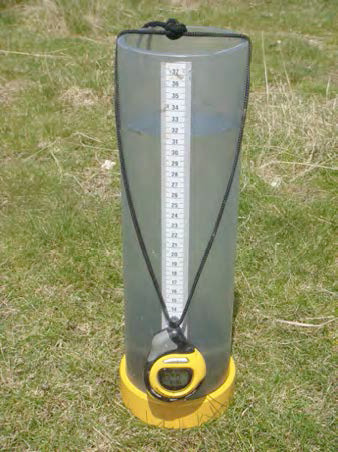
Gradations on a Modified Philip Dunne infiltrometer allow the measurement of stormwater infiltration.
What’s Next?
A follow-up project, which the MPCA is participating in, will seek to clarify the impact of swale roughness on infiltration rates. The goal is a calculator for real-world infiltration rates that MnDOT and local agencies would be able to implement.
MPCA, MnDOT and the city of Roseville are also partnering on a project to install and test the effectiveness of ditch check filters in real-world locations.
Maintenance recommendations should help MnDOT and local agencies ensure that swales operate at maximum efficiency. These recommendations should continue to be revised as knowledge evolves.
The same chemicals used to treat drinking water might now be able to treat stormwater runoff to reduce the amount of pollutants entering Minnesota lakes and rivers from road construction sites.
A research project headed by Mankato State University and funded by the Minnesota Department of Transportation has identified three chemical flocculants that are effective at removing a broad range of Minnesota soils from water.
“Water is leaving construction sites carrying too much sediment,” said Minnesota State University-Mankato Environmental Engineering Professor Steve Druschel. “Chemical treatment has been used to treat drinking water for 70 to 80 years, and our thought was to try it in construction as well.”
Adding flocculant to a sample of water from the Minnesota River causes sediment to clump and sink.
Recent MnDOT research has investigated monitoring the amount of sediment in stormwater runoff and using temporary ponds to let sediment settle out of stormwater before it runs off the construction site. MnDOT also wanted to examine the possibility of treating construction runoff with flocculants, which are chemicals that cause suspended sediment to form clumps that quickly settle out of the solution.
Researchers tested 21 chemicals to see how well they could remove 57 types of soil from water. While no chemical was effective for the entire range of Minnesota’s soils, three chemicals were broadly effective on a range of samples.
The research will contribute to improved treatment of stormwater runoff from construction sites and reduce the amount of sediment pollution entering the state’s rivers and lakes.
Although flocculants have been used to treat drinking water for seven decades, there has been only limited testing of their use in treating construction runoff. Research was needed to evaluate the effectiveness of this approach.
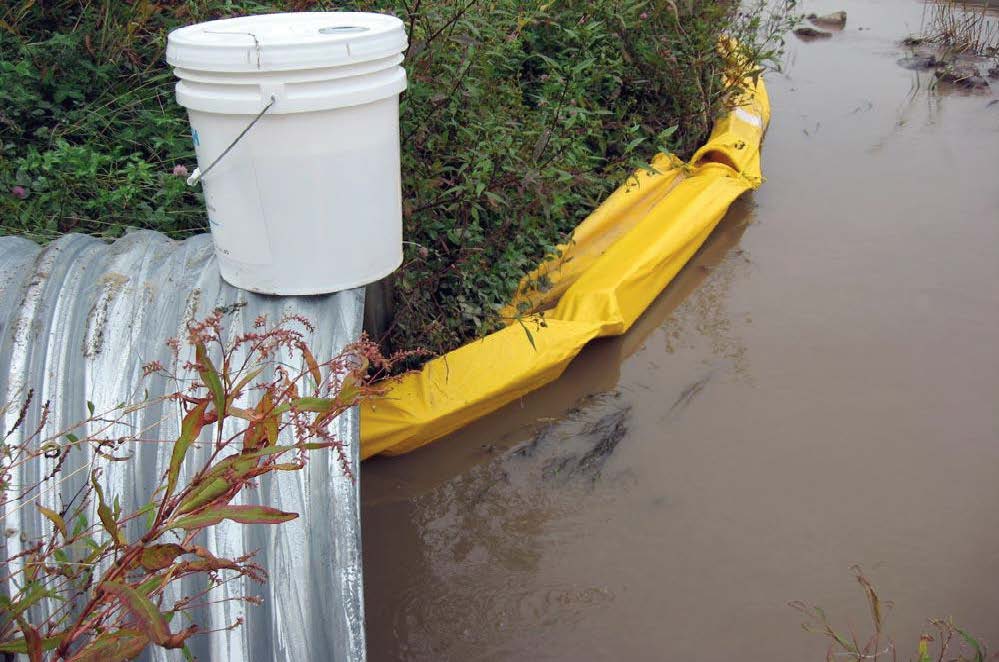
Adding flocculant to stormwater runoff can be as simple as drilling a hole in a bucket of the chemical and mounting it above the water (as shown here), although thorough mixing must be ensured. MnDOT hopes to develop a system that will automatically dispense a precise dose based on the amount of sediment in the water.
Since it is not feasible for workers to constantly monitor sediment concentration in stormwater runoff, MnDOT hopes to leverage the knowledge gained from this project to develop an automated system that measures the amount of sediment in runoff and automatically adds the appropriate dose of flocculant to treat the water.
“We’re trying to develop a portable water treatment plant that can be applied to construction projects to deliver clean runoff water after a storm,” said MnDOT Environmental Specialist Dwayne Stenlund.
Any chemicals recommended for field usage will need to be approved by the Minnesota Pollution Control Agency, and methods for disposing of used chemicals will need to be identified as the environmental impacts of residual chemicals are unknown.
*Editor’s note: This article was adapted from the September-October 2014 issue of our Accelerator newsletter. Read it online or sign up for your free subscription.
Related Resources
Flocculation Treatment BMPs for Construction Water Discharges – Technical Summary, 1 MB (PDF); Final Report, 29 MB (PDF)
Soil carried away in stormwater runoff from road construction sites can pollute lakes and rivers.
Stormwater settling ponds provide a place for this sediment to settle before the water is discharged into local bodies of water. However, since stormwater ponds have limited space, a mechanism is needed to remove clean water from the pond to prevent the overflow of sediment-laden water.
MnDOT-funded researchers have designed temporary stormwater ponds with floating head skimmers that can remove clean water from the surface of the settling pond, using gravity to discharge water into a ditch or receiving body.
The Marlee Float from the SW Fee Saver is one of five available floating-head skimmers that researchers identified.
This is a new approach for MnDOT and Minnesota cities and counties, so research was needed to provide practical guidance for how to use these devices on construction sites.
“This was a small-scope implementation project for professionals to use as they design temporary stormwater ponds that meet state parameters,” said Dwayne Stenlund, MnDOT Erosion Control Engineering Specialist.
A new MnDOT study identifies five methods for “skimming” stormwater ponds that can improve a pond’s effectiveness by 10 percent. MnDOT researchers also created designs for temporary stormwater ponds on construction sites with the capacity to remove approximately 80 percent of suspended solids.
These designs will help contractors meet federal requirements for stormwater pond dewatering. Researchers also determined how often a pond’s deadpool must be cleaned, based on watershed size and pool dimensions.
“When sediment settles, it’s hard to determine when to clean out a pond. Based on the density of the sediments in the Minnesota River and the loading rates we computed, we were able to calculate how often we need to clean out a pond so sediment doesn’t reach the height of the skimmer,” said Joel Toso, principal of Wenck Associates and a consultant for the project.
Resources
Reducing Construction Pollution by Skimming Stormwater Ponds – Technical Summary (PDF, 2 MB, 2 pages); Final Report (PDF, 3 MB, 43 pages)
Putting GPS units on MnDOT highway mowers is expected to speed mowing operations and cut herbicide usage by 50-percent in metro area ditches, reducing groundwater contamination.
MnDOT’s Metro District highway maintenance division will be one of the first — if not the first — state agencies in the country to equip the majority of its maintenance tractors with Automated Vehicle Location systems.
Not only will crews be able to effortlessly track their progress — reducing paperwork and freeing time for other maintenance activities — but the AVL’s live mapping software will help them avoid noxious weed patches, thereby reducing their spread.
Last year, MnDOT tested the GPS software on five mowers.
“AVL alone enables the tracking of vehicle positions, but when combined with equipment sensors and an on-board monitor with user interface, it becomes a very innovative way to reduce operation costs,” said MnDOT Project Engineer Trisha Stefanski, who applied for funding from MnDOT’s Transportation Research Innovation Group for the pilot project.
Vehicle tracking systems have been shown to reduce chemical usage by crop farmers, improve route efficiencies in truck driving and help cities and counties track snowplows.
The on-screen mapping shows the location of weed patches, so mowers can avoid them, reducing their spread.
MnDOT Metro, which tested five AVL units last year, hopes to equip as much of its remaining fleet as possible.
In the grant application, Stefanski estimated the technology will pay for itself in about a year’s time, largely due to herbicide savings.
Noxious weeds
MnDOT is required by law to manage certain noxious weeds along its highways. Each year, weed inspectors survey one-quarter of metro ditches for weeds, which enables them to concentrate eradication efforts on the worst areas.
Touch-screen maps will contain the noxious weed locations so operators can see weed patches and mow around them.
Herbicide usage is estimated to drop an estimated $100,000 to $150,000 per year. (This estimate was based on the original funding request. Final numbers haven’t been released.)
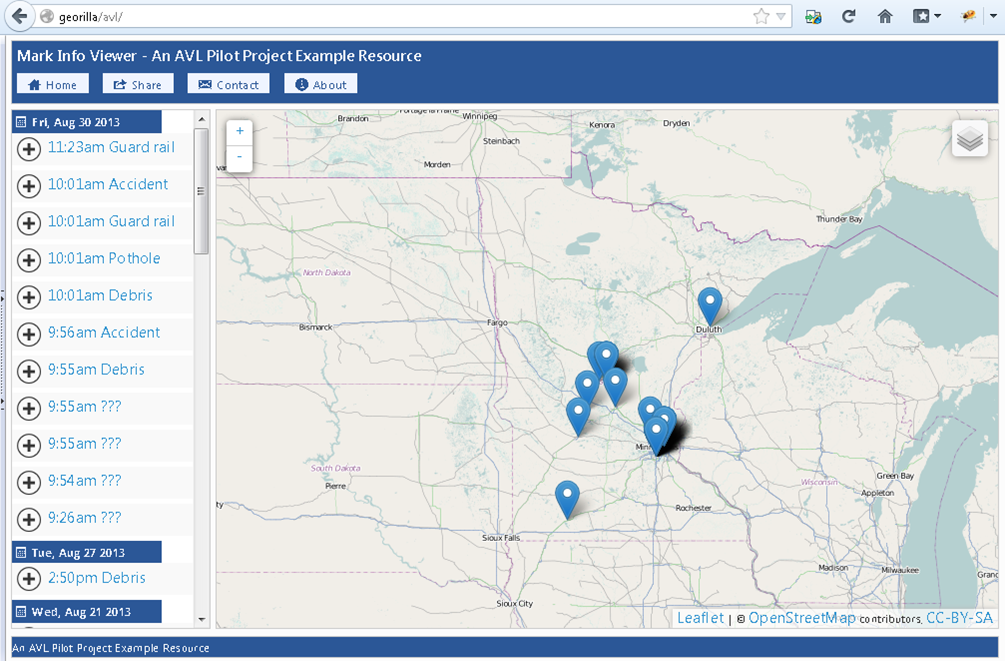
Operators can use the on-screen map to mark the location of new patches of noxious weeds.
Noxious weeds like Wild Parsnip — which can cause painful skin boils — might even be eradicated, reducing the risk for field crews, such as construction workers and Adopt a Highway volunteers.
Until now, maintenance crews have relied on paper maps to identify weed locations, which is less effective.
“What’s better, looking at a live screen when you’re going down the road and seeing where weeds are coming up, or trying to refer to a piece of paper?” Stefanski said.
Other advantages
The AVL equipment will also allow for automated reporting.
Mower operators can use the on-board AVL monitor to mark the location of guardrail hits, potholes, washed-out culverts, debris and unmarked noxious weeds.
Operators can electronically mark the location of guardrails, debris, potholes and more.
Currently, operators must track their activities using hand-written forms or spreadsheets in the office.
The AVL system will also automatically track their location history, allowing operators to optimize their routes based on how long it took to mow segments in the past.
It will also be easier to answer questions from the public, who want to know the last time a certain ditch was mowed.
“Making everything geographically located adds so much analysis opportunity,” Stefanski said.
MnDOT also has AVL technology on an herbicide applicator to better track where it’s sprayed. Other future potential applications including pothole patching and road sweeping operations, Stefanski said.
Excalibur and the High Roller may be closed for the season, but Valleyfair Amusement Park still has one attraction open for the season: a driving track for Minnesota snowplow drivers.
MnDOT-funded researchers are studying the effects of weather and vehicle traffic on different deicing treatments in the parking lots of Valleyfair and Canterbury Park in Shakopee, Minn.
It’s been a busy winter, but each week MnDOT Metro District snowplow drivers make one last stop before heading home, to apply different combinations of salt and anti-icing chemicals to nine 1,000-foot driving lanes. They also drive over each lane multiple times to test the effect of traffic.
“We’re running trucks up to 30 miles per hour with different speeds, wind conditions, traffic conditions and pre-wetting chemicals,” said Steve Druschel, a researcher with the Minnesota State University, Mankato. “Each lane is its own experimental unit.”
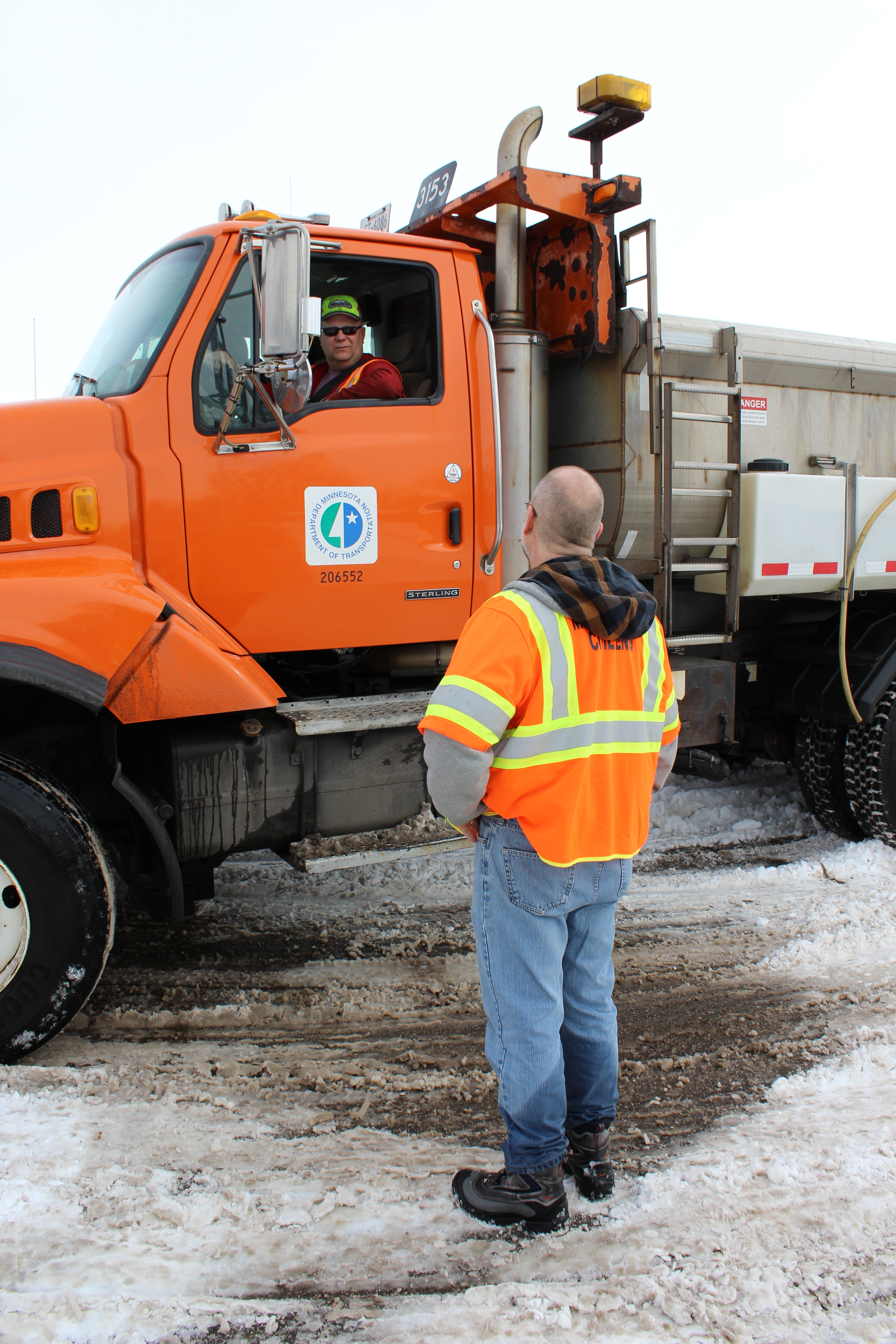
Professor Steve Druschel speaks with MnDOT snowplow driver John Hokkanen.
Professor Druschel’s students will review more than 17,000 photos from time-lapsed cameras to document how the snow melted in each experimental run.
“The influence of factors like pavement type and age, traffic volume, truck proportion, weather conditions and sun presence will be assessed to evaluate which techniques have special advantages for certain situations or roadways,” said Maintenance Research and Training Engineer Tom Peters.
In 2010, Druschel tested 25 anti-icing compounds in 1,500 different combinations in a laboratory to study the effectiveness of different deicers.
“Public work superintendents commented, ‘Great work. It looks good, except it’s all in the lab. Beakers aren’t what people drive on,’ ” Druschel said. “So we’re taking it from the two-inch ice cup to the real world in phase two of this study.”
With rock salt prices quadrupled, finding the most cost-effective methods of treatment is important.
This latest research will help determine the best times for applying anti-icing treatments and examine whether certain chemicals — such as a pre-storm liquid treatment that costs twice as much — melt enough snow to be worth the extra cost.
Test runs in Shakopee are strictly experimental, but in Mankato students are analyzing how real-world salting treatments are working on the North Star Bridge.
An article in the Mankato Free Press tells how Druschel’s team is collecting road melt runoff and documenting bridge traffic. (Big trucks, for instance, squeeze more water out of the snow.)
MnDOT snowplow driver John Hokkanen makes a test run at the research site at Canterbury Park. (Photo by Nick Busse)
Students plan to use time-lapsed photos, along with weather data and snowplow records, to determine what chemical treatments worked best – and when.
With the multi-pronged research project, Druschel hopes to put definitiveness to what some snowplow drivers have already tried in the field.
“The key to it is not so much that we’re so smart and we have a better idea or are inventing something new,” he said. “We’re just trying to enhance what they are already doing.”
Helpful resources
Salt Brine Blending to Optimize Deicing and Anti-Icing Performance –Technical Summary (PDF, 1 MB, 2 pages) and Final Report (PDF, 11 MB, 151 pages) (previous study)
















 Crossroads