If you’ve ever driven near a bike lane and not known what to do, you’re not alone.
A forthcoming video from the Local Road Research Board seeks to answer common questions about on-street bike lanes and help bicyclists and motorists better understand the rules. The video is due to be released this spring; in the meantime, we thought we’d give you a sneak preview by addressing three common misconceptions about bike lane rules and safety.
1) Are bicyclists required to use a bike lane, when present?
No. Although bike lanes usually provide the smoothest, safest and most efficient method of transportation — for everybody — they are not required to use them. They are allowed to ride outside bike lanes to make turns or avoid debris, and they still have the option of using an adjacent trail where available.
2) Are vehicles allowed to enter bike lanes?
Yes, but only to park or turn onto a driveway or street. Motorists should treat bike lanes like any other lane of traffic and yield to approaching bicyclists, but they do have the right to enter bike lanes when turning.
3) Do bicyclists have to follow the same rules as motorists?
Yes. Bicycles are considered vehicles under Minnesota state law and have the same rights and responsibilities. Cyclists are required to obey stop signs and signal their turns, just like motorists.
A recent federal project funded 75 miles of new bike lanes in four communities, including the city of Minneapolis. Biking in these areas increased 50 percent; 7,700 fewer tons of carbon dioxide were emitted and gas consumption was reduced by 1.2 million gallons. (Source)
Watch for the LRRB’s new bike safety video on Crossroads this spring. In the meantime, check out MnDOT’s tips on bicycle safety.
With freight traffic increasing on U.S. roadways, commercial truck drivers often struggle to find safe and legal places to park. If parking spaces are not available at a nearby rest area or truck stop, drivers may be forced to pull over in unsafe locations or continue driving and become dangerously fatigued. Drivers may also risk violating federal hours-of-service rules, which require them to rest after 11 hours of driving.
In response to this issue, a team from MnDOT, the University of Minnesota, and the American Transportation Research Institute is developing a system that can identify available truck parking spaces and communicate the information to drivers—helping them determine when and where to stop. System benefits include improved safety, reduced driver fatigue, and better trip management.
The system uses a network of digital cameras suspended above a parking area to monitor space availability. Image processing software developed by researchers at the U of M’s computer science and engineering department analyzes the video frames and determines the number of available spaces.
As part of a demonstration project funded by MnDOT and the Federal Highway Administration, the project team is installing the system at three MnDOT rest areas and one private truck stop on I-94 west and northwest of the Twin Cities.
The U of M research team first installed the system in late 2012 at the the Elm Creek Rest Area, two miles north of Interstate 494 on I-94. As of early 2014, the system has been installed at an additional rest area, and a third site is in progress.
Next steps for the project include implementing several mechanisms that will communicate parking information to truck drivers. First, the team plans to install variable message signs along I-94 this spring. Also in the works are an in-cab messaging system and a website.
Overall results of the demonstration project will help the team determine whether this technology holds promise for use in other corridors throughout the nation.
Read the full article in the February issue of Catalyst.
What if something as simple as changing the texture of the pavements we drive on could not only increase safety, but also reduce noise pollution and boost our vehicles’ fuel economy?
It’s possible, according to the latest research from MnROAD, the state’s one-of-a-kind pavement research facility. In a new report, investigators detail how quieter pavement textures, such as those applied by grinding grooves into pavements with diamond-coated saw blades (see the photo above), may also reduce rolling resistance — the force that resists a tire as it moves across the pavement’s surface.
The potential benefits to the public are significant. A 10-percent reduction in rolling resistance could reduce the U.S. public’s fuel consumption by 2–3 percent, eliminate up to $12.5 billion in fuel costs each year (as well as cutting carbon emissions). Add on the cost savings from reducing noise pollution (building noise barriers along highways can cost as much as $3 million per mile), and it’s clearly a win-win situation.
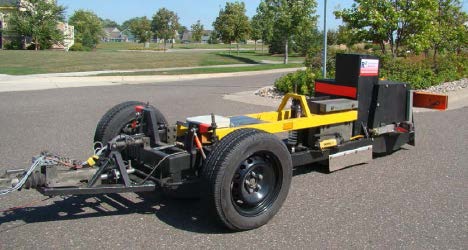
In the study, researchers used an innovative line-laser profiler to develop three-dimensional representations of test pavement surface textures. They then investigated the relationship between these surface characteristics and data on rolling resistance that was collected during a 2011 study using a special test trailer developed by researchers in Poland. This year, the same trailer will be used to conduct a second round of rolling resistance measurements at MnROAD.
The research is related to an ongoing pooled-fund study on concrete pavement surface characteristics. The goal is to produce data that will allow MnDOT to identify ideal ranges for surface characteristics that improve pavements’ quietness and ride quality while keeping them safe and durable.
Learn more
Pavement Texture Evaluation and Relationships to Rolling Resistance Final Report (PDF, 2.9 MB, 136 pages) and Technical Summary (PDF, 1 MB, 2 pages)
PCC Surface Characteristics – Rehabilitation Final Report (PDF, 2.8 MB, 104 pages) and Technical Summary (PDF, 1 MB, 2 pages)
Researchers relied on rolling resistance data from a study conducted in 2011 with a test trailer developed by the Technical University of Gdańsk, Poland. This was the first time such measurements were taken in the United States.
Staff from MnROAD, the Minnesota Department of Transportation’s cold weather road research facility in Albertville, Minn., were presented with the Marlin J. Knutson Award for Technical Achievement by the American Concrete Pavement Association in December.
The award cites the facility’s well-deserved reputation for being a place where both agency and industry ideas are put to the test. This award was presented as a tribute to the agency’s commitment to learning and putting ideas into practice.
The Marlin J. Knutson Award for Technical Achievement is presented to an individual or group who has made significant contributions to advance the development and implementation of technical innovations and best practices in the design and construction of concrete pavements.
(Far right) Gerald Voigt, ACPA president and CEO, presented MnDOT with the Marlin J. Knutson Award for Technical Achievement. Receiving the award are (from left) Luke Johanneck, Bernard Izevbekhai, Roger Olson, Tom Burnham, Glenn Engstrom, Maureen Jensen and Sue Mulvihill. (Photo courtesy of the ACPA)
“MnROAD is helping to make roads last longer, perform better, cost less, construct faster, and have minimal impact on the environment,” said Gerald Voigt, ACPA president and CEO. “It is a model for other agencies to follow.”
MnROAD is a pavement test track initially constructed between 1991-1993. It uses various research materials and pavements and finds ways to make roads last longer, perform better, cost less to build and maintain, be built faster and have minimal impact on the environment. MnROAD consists of two unique road segments located next to Interstate 94.
Staff from the MnROAD facility in Albertville were recognized during the ACPA’s Distinguished Service and Recognition Awards ceremony in December. (Photo by David Gonzalez)
This article, authored by Rich Kemp, originally appeared in Newsline, MnDOT’s employee newsletter.
New streetcar lines are in the planning stages in Minneapolis and St. Paul. Proponents cite not only the lines’ ability to strengthen the transit system, but also their potential as catalysts for development. Estimating the impacts of streetcars is challenging, however, as most U.S. lines operate in downtown areas with many interrelated factors at play. A recent U of M research project examined the issue through the prism of one city’s experience: post-Katrina New Orleans.
The team—research fellow Andrew Guthrie and Assistant Professor Yingling Fan of the Humphrey School of Public Affairs—analyzed building permits near streetcar stops in the downtown business district and in several urban neighborhoods.
“Hurricane Katrina allowed—or required—more redevelopment to occur at a faster pace than normal, potentially allowing existing streetcar lines’ latent development impacts to appear,” Guthrie says. “This created an unfortunate yet rare opportunity for study.”
The researchers estimated how the frequency of commercial and residential permits changed with distance from streetcar stops, controlling for hurricane damage, proximity to existing commercial areas, and pre-Katrina demographics.
They found that throughout the system, building permits strongly reflect the distance to stops—and that commercial and residential permits move in opposite directions within the first 750 feet.
Commercial permits declined the further away the location was from a stop. In residential areas, commercial permits show variation depending on neighborhood characteristics. The number of neighborhood residential permits rose about 24 percent with every 100 feet from a stop.
Based on their results, Guthrie and Fan conclude that traditional streetcar lines can help increase commercial development not just in downtown business districts, but in other urban areas as well. The findings also indicate that streetcars shape development in urban neighborhoods in a fundamentally different fashion than light rail.
Read the full article in the January issue of Catalyst.
Although bike share systems are becoming more popular across the United States, little is known about how people make decisions when integrating these systems into their daily travel.
In a study funded by CTS, researchers from the U of M’s civil engineering department investigated how people use the Nice Ride bike share system in Minneapolis and St. Paul. The researchers examined how Nice Ride affects accessibility to jobs and developed a model to predict station choice.
In the first part of the study, the researchers created maps showing accessibility to jobs by census block for both Nice Ride and walking—as well as the difference between the two—at time thresholds ranging from 5 to 55 minutes.
Overall, in blocks with both Nice Ride and walking job accessibility, Nice Ride provides access to 0.5 to 3.21 times as many jobs as walking.
By comparing Nice Ride to walking, the study demonstrated that walking can successfully be used as a baseline to show how a bike share system improves job accessibility. The results also pinpointed when and where Nice Ride had the strongest accessibility advantage over walking.
“This type of information can be used by bike share system planners to identify where new stations could be built to maximize their impact on job accessibility,” says grad student Jessica Schoner, a member of the research team.
In addition, the team developed a theoretical model for bike share station choice. The model considers users’ choice of a station based on their preference for the amount of time spent walking, deviation from the shortest path (the closest station may not be in the direct path of the person’s destination), and station amenities and neighborhood characteristics.
Findings show that people generally prefer to use stations that don’t require long detours to reach, but a station’s surroundings also play an important role. Results also indicate that commuters value shorter trips and tend to choose stations that minimize overall travel time.
According to Schoner, understanding people’s station preference can help provide guidance to planners that want to expand or optimize a bike share system.
Read the full article in the January issue of Catalyst.
The Topeka shiner, a small minnow that inhabits slow-moving prairie streams, was once widespread and abundant in portions of Iowa, Kansas, Minnesota, Missouri, Nebraska and South Dakota. It now inhabits less than 10 percent of its original geographic range. (Photo courtesy of the Minnesota Department of Natural Resources)
In a new study funded by the Minnesota Department of Transportation, engineers are trying to ensure that new culverts do not degrade the habitat of an endangered fish in southern Minnesota.
The state has already researched how to better accommodate fish passage at river and stream crossings. Now it is looking at design guidelines for culverts that specifically impact the Topeka shiner, a small endangered fish found in five Midwestern states.
In Minnesota, the Topeka shiner is known to live in at least 57 streams, totaling 605 miles, within the Big Sioux and Rock River watersheds.
“The Topeka shiner is reported to have been erased from about 50 percent of its historic range in Iowa and much of its range in Minnesota, which is why Minnesota is so intent on doing what it can to help this fish thrive here,” said Alan Rindels, MnDOT’s project coordinator for the research.
The Topeka shiner is endangered due to the degradation of stream habitat, stream channelization, non-native predatory fishes and construction within waterways.
Culverts might impede the passage of this small minnow for a number of reasons, including that they might be too long, lack sufficient depth or carry water too fast.
Culverts (also called small bridges) allow water to pass under roads. Occasionally, they can harm a stream’s fish habitat by inadvertently acting as a barrier to fish passage or migration. On the West Coast, large-scale efforts are under way to protect migratory salmon, and in Minnesota, culvert designers are concerned about fresh water species.
In addition, long culverts block sunlight, which possibly discourages fish from swimming through. Typically, older culverts are replaced with longer culverts to improve road safety and minimize maintenance costs. To eliminate or minimize impacts to the Topeka shiner, the state is trying to determine if light mitigation strategies are necessary.
Researchers from the University of Minnesota’s St. Anthony Falls Research Laboratory will monitor a newly installed culvert (110 feet in length) and a few other culverts in critical Topeka shiner habitat streams during spawning and fall movement.
Additionally, a laboratory-based light manipulation experiment will examine the behavior of the warm-water fish when presented with a dark culvert.
Guidelines for culvert design in Topeka shiner habitat will be developed based on these results, as well as examples from neighboring states. The state is also collaborating with the U.S. Fish and Wildlife Service and affected Minnesota counties.
Minnesotans have grown accustomed to roundabouts as they’ve proliferated throughout the state, but many motorists are still confused by the less common two-lane roundabout.
While roundabouts have been shown to reduce vehicle delay and severe crashes, the few Minnesota cities with this type of multi-lane roundabout have had a prevalence of driver mistakes.
In Woodbury, two such roundabouts were converted into smaller, one-circulating-lane designs due to driver confusion.
The City of Richfield had no such option at the high-volume Portland Avenue and 66th Street, a formerly signalized intersection that carries about 30,000 vehicles per day. (See video)
Crash-prone and congested prior to its reconstruction in 2008, a two-lane roundabout seemed to be the practical solution for this intersection. But although the roundabout reduced overall crashes, the intersection still had more fender benders than designers were comfortable with, according to City Engineer Kristin Asher.
“The crashes were primarily related to improper left-turns from the outside lane and failure to yield at the entry,” she said.
Not only were drivers unsure which lanes they should use to enter or exit the roundabout, they didn’t know how to respond to other cars inside the roundabout. (See news story)
“People don’t understand they have to yield to both lanes inside the roundabout,” explained University of Minnesota researcher John Hourdos.
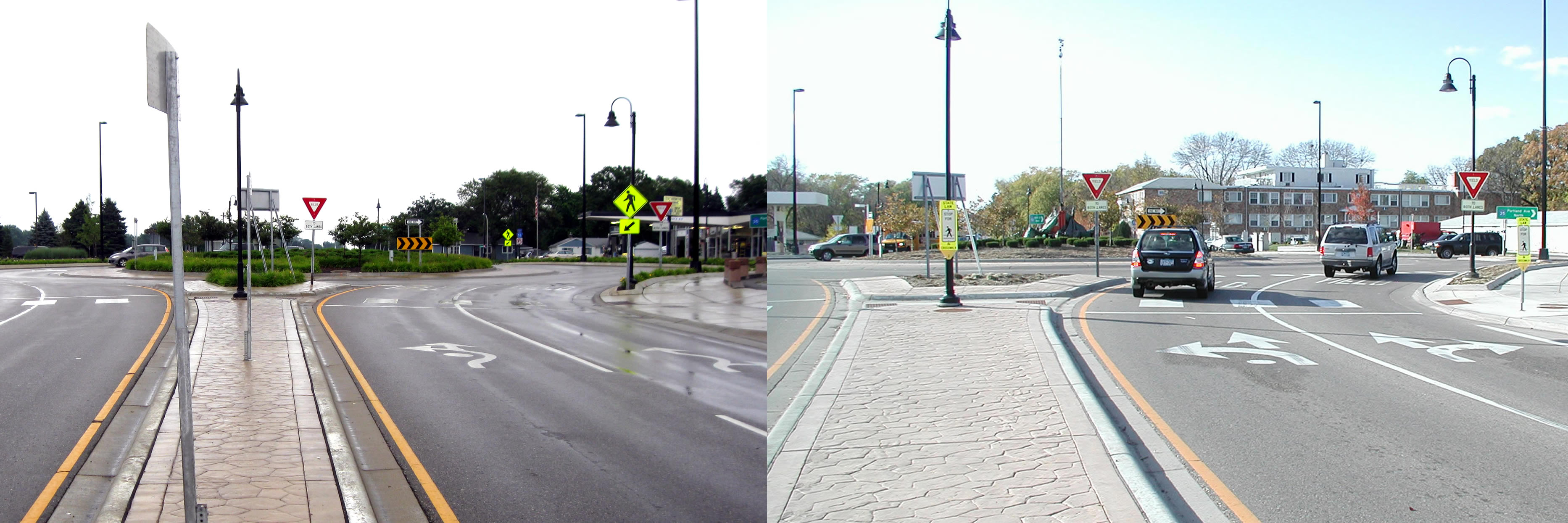
The city of Richfield extended the solid lines leading up to the intersection from 50 to 250 feet to encourage drivers to choose the correct lane before entering the roundabout. It also replaced fish-hook-style roundabout signs with traditional lane designation signs and did away with complex striping patterns.
Before and after photos show the original fish-hook style pavement markings, left, that were replaced with a more traditional design. (Courtesy City of Richfield)
Hourdos examined two years of traffic data to see how motorists responded to the improvements that were made in 2011.
He found 50 percent more drivers entered the correct lane from the get-go, which led to a reduction in improper turns within the roundabout. Lane violations were also reduced by 20 percent.
“One of the main problems was drivers didn’t know they have to choose one of the two lanes,” Hourdos explained. “Then once they were inside the roundabout, they were forced to either deviate from their course or commit a violation.”
The city also increased sign visibility to address yielding problems; however, these changes didn’t seem to make a difference.
With state and federal guidelines lacking much guidance for how to sign two-lane roundabouts, the LRRB is funding a new study for three other multi-lane roundabouts: in St. Cloud, at Highway 169/494 and one planned for the future realignment of County Roads 101 and 61 between Chanhassen and Shakopee.






 Crossroads