Tag Archives: university of minnesota

New crash report interface will improve usability and data quality

The data collected at the scene of a crash by law enforcement officers are important for more than just drivers and their insurance companies. The information is also used on a much larger scale by state agencies and researchers to analyze and evaluate crashes, trends, and potential countermeasures.

“Big decisions get made based on that data—million-dollar decisions,” says Nichole Morris, a research associate at the U of M’s HumanFIRST Laboratory. “So you have to be sure that what goes in to that report is high quality and reflects what actually happened at the scene of the crash.”

As part of an effort to improve this data quality in Minnesota, Morris is leading a team of HumanFIRST researchers in a project to redesign the electronic crash report interface used by law enforcement officers. The team’s goal is to create a new interface that improves the accuracy, speed, reliability, and meaningfulness of crash report data.police_guy

The project is occurring in conjunction with a redesign of Minnesota’s crash records database and is being sponsored by the Traffic Records Coordinating Committee (TRCC) at the Minnesota Department of Public Safety (DPS) and by MnDOT.

“In industry, they do this work all the time, looking at usability and design. But when you think about what a state does in terms of usability, nothing like this to our knowledge has ever been done. This makes it a very exciting and revolutionary project for Minnesota,” Morris says.

In the first phase of the project, the researchers completed a human factors analysis on the existing crash report interface to identify potential problem areas. This included a step-by-step task analysis and in-depth interviews with law enforcement officers.

During this process, the researchers identified several areas they hoped to improve. For instance, they wanted the new interface to be smarter, making better use of autofill features to reduce the amount of manual data entry.

Following the analysis, the team built two versions of a mock crash report interface for usability testing: a wizard and a form. In both versions, the researchers added decision aids to ease usability. They also significantly improved the system’s autofill capabilities, reducing the ratio of officer to system data entry from 6:1 to nearly 1:1.

The researchers then conducted four rounds of usability testing with law enforcement officers for both the wizard and the form. Results were split: half the officers preferred the wizard and half preferred the form. Because of these findings, the TRCC is planning to build full versions of both, Morris says, which will allow officers to use the version they prefer.

Going forward, the researchers plan to make a few more adjustments to the research prototype before handing it off to the state vendor, Appriss, which will build the new system. The team will then work collaboratively with Appriss to complete additional beta and usability testing before the new interface launches in January 2016.

“The results of the HumanFIRST prototypes are being combined with the vendor’s prior experience for a best-of-breed approach,” says Kathleen Haney, traffic records coordinator at DPS. “This is a fantastic project, and the results will be relevant for years to come.”

Read more about the project in the December 2014 CTS Catalyst.

Continuous Scour Monitoring Improves Bridge Safety

A leading cause of bridge failure is bridge scour, which occurs when rapidly moving water erodes riverbed soil around abutments or piers.

Monitoring bridge scour with traditional inspection methods can be dangerous and difficult, so MnDOT has been working with researchers from the University of Minnesota’s St. Anthony Falls Laboratory to develop a continuous monitoring system to test certain bridges more safely and efficiently.

MnDOT currently monitors 45 scour-critical bridges — and local Minnesota agencies monitor 360 more — using visual inspections or water data websites during flooding events. Once a predetermined threshold is exceeded, portable scour monitoring equipment is deployed to measure scour depth.  If scour has undermined the foundations of a bridge, inspectors close it for repair.

But portable scour monitoring systems can be difficult and dangerous to deploy from the bridge deck or boat in fast-moving water. It can also be difficult to get inspectors to sites quickly enough in areas subject to flash flooding.

A better alternative for such situations are fixed scour monitoring devices that continuously monitor scour and send data wirelessly to bridge personnel, alerting them when scour reaches a dangerous level.

The Highway 43 Bridge in Winona was affixed with continuous bridge scour monitoring equipment.
New technology

MnDOT has not historically made use of fixed scour monitoring equipment, but as advances in technology have made these devices more affordable and reliable, the agency  became interested in exploring the use of fixed monitoring equipment at locations where the use of portable equipment is problematic. ( A major concern for fixed scour monitoring is damage from debris and ice.)

Researchers have installed fixed remote monitoring stations on four such bridges.

Stations on the first two bridges (Highway 14 over the Minnesota River in Mankato and Highway 43 at the Mississippi River in Winona, pictured at top) ran successfully for three years, with outages due to primarily to power and communication issues.

Researchers learned valuable lessons from these bridges and have now installed monitoring equipment on two more: The Old Hastings Bridge (Highway 61 over the Mississippi River), on which float-outs were installed; and the Dresbach Bridge (Interstate-90 over the Mississippi River), which had a tilt meter and underwater sonar device installed.

“The less familiar personnel are with technical equipment, the less they tend to use it,” said Andrea Hendrickson, State Hydraulics Engineer, MnDOT Office of Bridges and Structures. “This research project gave us the familiarity and technical information we need to be comfortable using fixed scour monitoring equipment on bridges that warrant it.”

Related Resources

*Editor’s note: This article was adapted from an article in the latest issue of our newsletter, Accelerator. Read it online, or sign up to receive it by mail. 

Access Across America: University of Minnesota ranks accessibility to jobs by transit

New research from the Accessibility Observatory at the University of Minnesota ranks 46 of the 50 largest (by population) metropolitan areas in the United States for accessibility to jobs by transit.

The new rankings, part of the Access Across America study begun last year, focus on accessibility, a measure that examines both land use and transportation systems. Accessibility measures how many destinations, such as jobs, can be reached in a given time.

“This project provides the most detailed evaluation to date of access to jobs by transit,” says Andrew Owen, director of the Observatory. “We directly compare the transit accessibility performance of America’s largest metropolitan areas.”

The findings have a range of uses and implications. State departments of transportation, metropolitan planning organizations, and transit agencies can apply the evaluations to performance goals related to congestion, reliability, and sustainability. In addition, detailed accessibility evaluation can help in selecting between project alternatives and prioritizing investments.

“It can help reveal how the costs and benefits of transportation investments are distributed,” Owen says.

Top 10 metro areas: job accessibility by transit (January 2014)

  1. New York
  2. San Francisco
  3. Los Angeles
  4. Washington
  5. Chicago
  6. Boston
  7. Philadelphia
  8. Seattle
  9. Denver
  10. San Jose

The report—Access Across America: Transit 2014—presents detailed accessibility values for each of the 46 metropolitan areas, as well as detailed block-level color maps that illustrate the spatial patterns of accessibility within each area. In addition, time-lapse map videos for each area are forthcoming and new analysis of the data from the accessibility to jobs by transit rankings will be published periodically. Upcoming reports in the Access Across America series will explore more detailed aspects of transit accessibility to jobs, including accessibility to jobs of different wage levels and a comparison with accessibility by car.

In the study, rankings were determined by a weighted average of accessibility, giving a higher weight to closer jobs. Jobs reachable within 10 minutes were weighted most heavily; jobs were given decreasing weight as travel time increases up to 60 minutes. Travel times were calculated using full transit schedules for the 7:00 to 9:00 a.m. period. The calculations include all components of a transit journey, including “last mile” access and egress walking segments and transfers.

“Accessibility is the single most important measure in explaining the effectiveness of the urban transportation system,” says David Levinson, University of Minnesota civil engineering professor and principal investigator on the project.

According to Owen, accessibility can be measured for various transportation modes, to different types of destinations, and at different times of day. “There are a variety of ways to define accessibility,” Owen explains, “but the number of destinations reachable within a given travel time is the most directly comparable across cities.”

The research is sponsored by the Center for Transportation Studies at the University of Minnesota. Accessibility Observatory reports, including the analysis of job accessibility by auto published last year and interactive maps, are available on the Access Across America: Transit 2014 web page.

Parking availability system takes aim at truck driver fatigue

MnDOT, in partnership with the Federal Highway Administration, is test-deploying a high-tech system to help combat drowsy driving and keep truck drivers in compliance with federal hours-of-service regulations.

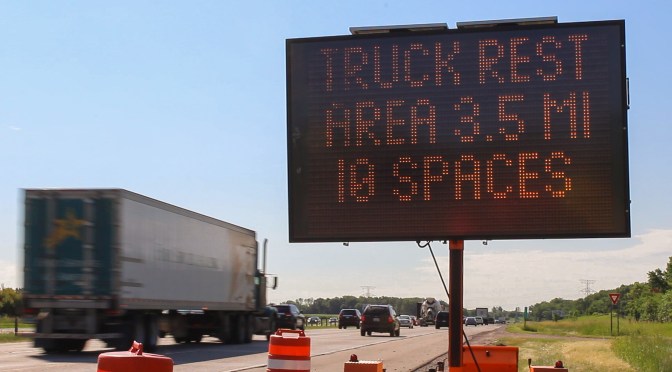
Developed by researchers at the University of Minnesota, the prototype system lets  drivers know when parking spaces are available at rest stops ahead. It has been deployed at several locations along the heavily traveled I-94 corridor between Minneapolis and St. Cloud.

From today’s MnDOT news release:

ST. PAUL, Minn. – New technology along the I-94 corridor west and northwest of the Twin Cities is helping truckers find safe places to park. Three Minnesota Department of Transportation rest areas are now equipped with automated truck stop management systems that tell truck drivers when parking spaces are available.

The technology will improve safety, lead to better trip and operations management by drivers and carriers and help MnDOT and private truck stop owners manage their facilities more effectively, according to John Tompkins, MnDOT project manager.

“So far, the results have been positive. We’ve had 95 percent accuracy in determining the availability of spaces,” he said.

Federal hours of service rules require truck drivers to stop and rest after 11 hours of driving. Tompkins said if drivers continue to drive beyond 11 hours, they could become fatigued and be forced to park in unsafe locations such as freeway ramps. They could also face legal penalties.

The problem of truck driver fatigue recently took the national spotlight when an allegedly drowsy driver slammed his semitrailer into a limousine carrying actor-comedian Tracy Morgan and six others. One passenger died in the crash.

The parking availability project is led by MnDOT Freight Project Manager John Tompkins and University of Minnesota professor Nikolaos Papanikolopoulos. MnDOT Research Services & Library produced the video above, which demonstrates the system in action. You can learn more about the project on the Center for Transportation Studies website.

MnPASS: Two systems, both work

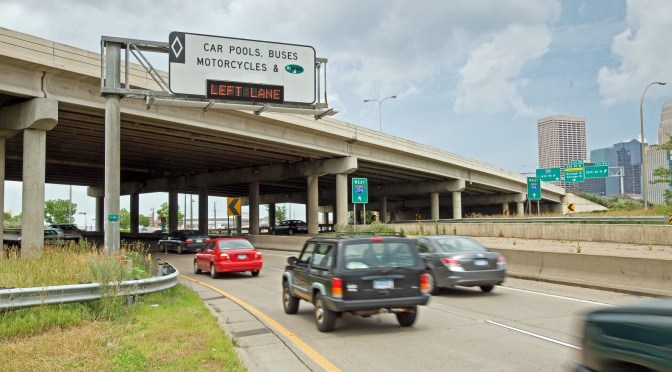
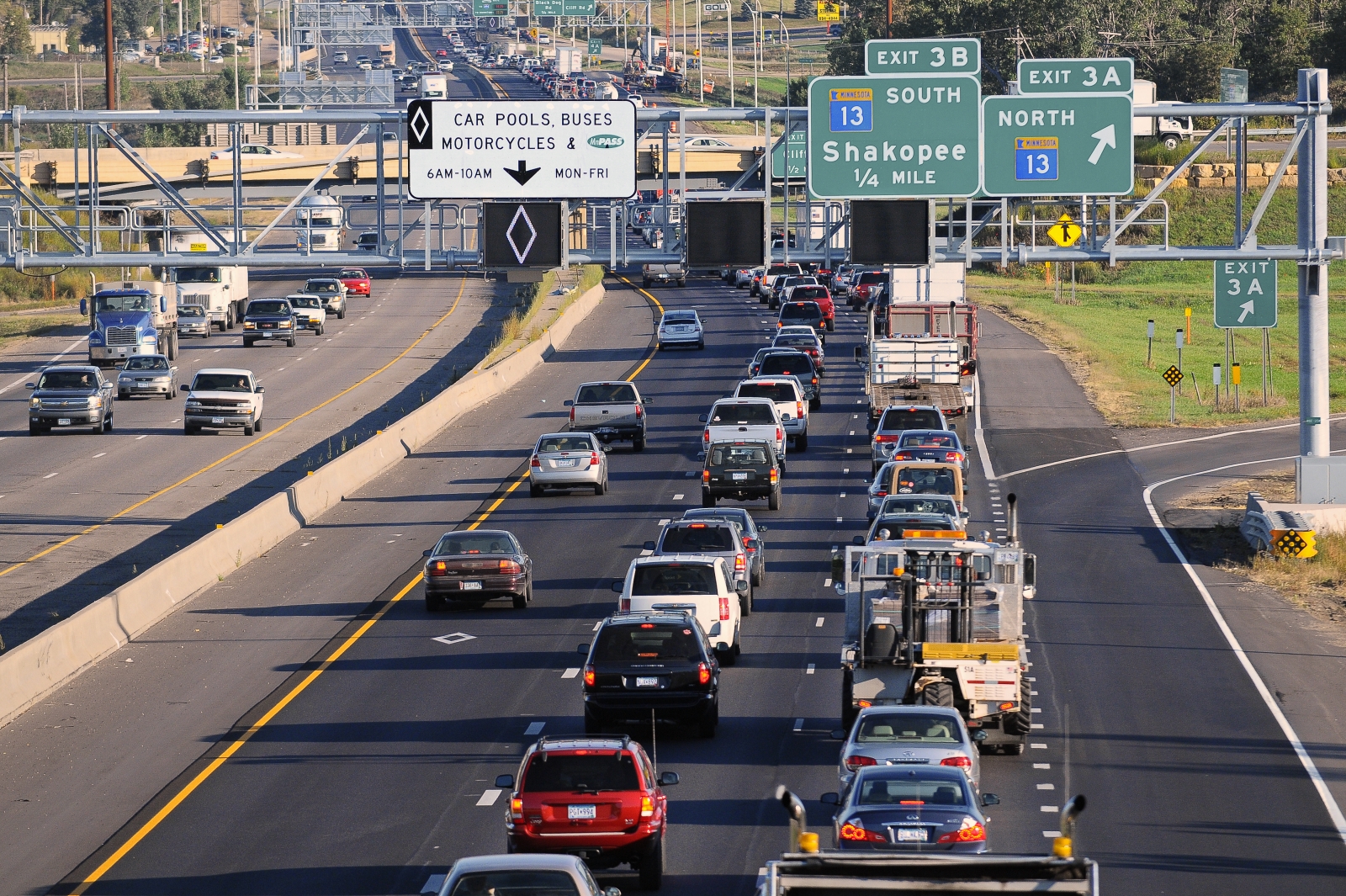
I-35W’s MnPASS lane, where vehicles can frequently enter and exit the high-occupancy toll lane, is just as safe as the MnPASS lane on I-394, where motorists only have a few shots to enter the system, a new study finds.

Researchers at the Minnesota Traffic Observatory undertook the MnDOT-funded study because of objections to open systems like the one on 35W.

“The federal government has very strong arguments against the open system. They’re saying it’s going to be dangerous – cause more disruption and more congestion,” said John Hourdos, director of the Minnesota Traffic Observatory. “We found that both roadways are working very well today because they were designed appropriately for their location.”

The definition of an open system is one that has more opportunity for access than restriction. On 35W, a dotted white lane means vehicles can enter the toll lane at will, and a solid line bars access.

Vehicles must have two occupants on-board or an electronic pay card to use the express lanes during rush hour.

MnPASS on Highway 35W.

The reason I-35W allows vehicles to enter MnPASS more frequently than I-394 is because there are more ramps where new vehicles are entering the freeway and might want to get on MnPASS.

Researchers studied whether accidents are more likely to occur by studying the number of accident-inducing vehicle movements along the 35W corridor. They found that areas where accidents are mostly likely to occur are also where the lane would have to allow access anyway under a closed system like 394.

The study also looked at mobility, determining that MnPASS users have just as good free-flowing traffic under the open system.

Helpful tools

Researchers also created design tools that engineers can use to determine where access points should be on MnPASS lanes.

Until now, engineers have relied on rule of thumb. For example, the general guidance for allowing access on a closed system was 500 feet for every lane between the entrance ramp and the HOT.

The tools can be used to automatically determine how fluctuations in the MnPASS fee will affect congestion within the lane.

The fee to use MnPASS depends on the time of day.

As the express lane become more congested, the fee to use it increases. This slows the number of cars entering the lane, increasing the speed of the vehicles already in the lane.

“We ran the tool on three locations on 35W and found that, for example, on Cliff Road, you can increase the traffic by 75 percent and still be okay,” Hourdos said. “You have more leeway there than north of the crossroads of Highway 62 and 35W, for instance.”

 Related Resources

Bicycle and pedestrian-counting project wins CTS partnership award

(Feature image courtesy Michael McCarthy, Center for Transportation Studies.)

Earlier this year, we wrote about the Minnesota Bicycle and Pedestrian Counting Initiative, a project that developed guidelines and protocols to help transportation planners accurately count non-motorized traffic. This groundbreaking research involved a diverse partnership of state and local officials, University of Minnesota faculty, and private and nonprofit organizations.

On Wednesday, April 23, the project team (photo above) was honored with an award from the Center for Transportation Studies. Team members accepted the CTS Research Partnership Award in a ceremony at the McNamara Alumni Center in Minneapolis. The award is given each year to projects that have resulted in “significant impacts on transportation” and that draw on “the strengths of their diverse partnerships” to achieve their results.

The video below, produced by CTS, explains the importance of the project. MnDOT is now in the process of implementing the research results by installing permanent counters and using portable counters in select locations around the state. MnDOT plans to use the information for a variety of purposes, including planning, safety analysis, investment planning and quality-of-life analysis.

Project team members will present their research findings at the North American Travel Monitoring Exposition and Conference in July. The conference’s focus is on “Improving Traffic Data Collection, Analysis, and Use.”

*Bonus: Read about last year’s Research Partnership Award-winner, a MnDOT-led, multi-state effort to reduce low-temperature cracking in asphalt pavements.

Learn more about the project:

Reducing confusion at two-lane roundabouts

Minnesotans have grown accustomed to roundabouts as they’ve proliferated throughout the state, but many motorists are still confused by the less common two-lane roundabout.

While roundabouts have been shown to reduce vehicle delay and severe crashes, the few Minnesota cities with this type of multi-lane roundabout have had a prevalence of driver mistakes.

In Woodbury, two such roundabouts were converted into smaller, one-circulating-lane designs due to driver confusion.

The City of Richfield had no such option at the high-volume Portland Avenue and 66th Street, a formerly signalized intersection that carries about 30,000 vehicles per day. (See video)

Crash-prone and congested prior to its reconstruction in 2008, a two-lane roundabout seemed to be the practical solution for this intersection. But although the roundabout reduced overall crashes, the intersection still had more fender benders than designers were comfortable with, according to City Engineer Kristin Asher.

“The crashes were primarily related to improper left-turns from the outside lane and failure to yield at the entry,” she said.

Not only were drivers unsure which lanes they should use to enter or exit the roundabout, they didn’t know how to respond to other cars inside the roundabout. (See news story)

“People don’t understand they have to yield to both lanes inside the roundabout,” explained University of Minnesota researcher John Hourdos.

In a recently completed study funded by the Minnesota Local Road Research Board, researchers from the Minnesota Traffic Observatory examined whether sign and pavement marking changes would improve performance.

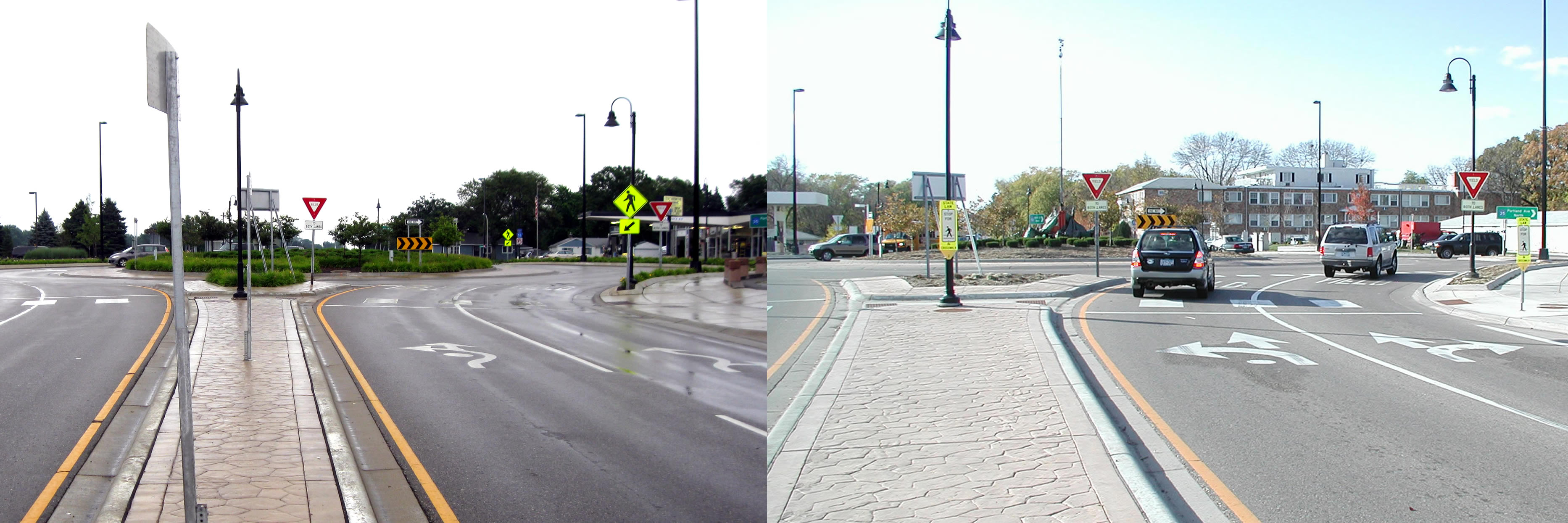
The city of Richfield extended the solid lines leading up to the intersection from 50 to 250 feet to encourage drivers to choose the correct lane before entering the roundabout. It also replaced fish-hook-style roundabout signs with traditional lane designation signs and did away with complex striping patterns.

These before and after photos show the original fish-hook style pavement markings, left, which were replaced with a more traditional design. (Photos courtesy of the city of Richfield)
Before and after photos show the original fish-hook style pavement markings, left, that were replaced with a more traditional design.
(Courtesy City of Richfield)

Hourdos examined two years of traffic data to see how motorists responded to the improvements that were made in 2011.

He found 50 percent more drivers entered the correct lane from the get-go, which led to a reduction in improper turns within the roundabout. Lane violations were also reduced by 20 percent.

“One of the main problems was drivers didn’t know they have to choose one of the two lanes,” Hourdos explained. “Then once they were inside the roundabout, they were forced to either deviate from their course or commit a violation.”

The city also increased sign visibility to address yielding problems; however, these changes didn’t seem to make a difference.

With state and federal guidelines lacking much guidance for how to sign two-lane roundabouts, the LRRB is funding a new study for three other multi-lane roundabouts: in St. Cloud, at Highway 169/494 and one planned for the future realignment of County Roads 101 and 61 between Chanhassen and Shakopee.

Report: Effect of Signing and Lane Markings on the Safety of a Two-Lane Roundabout (PDF, 4 MB, 72 pages)

Update (1/30/2014): Watch the LRRB’s new video on how to navigate a multi-lane roundabout.

Robotic message painter could help keep road crews safe

Using rollers and stencils to draw turn arrows and crosswalk stripes on roads seems a bit archaic to MnDOT District 3 Maintenance Superintendent Randy Reznicek, who asked researchers if they could develop an automated road message painter.

University of Minnesota-Duluth Associate Professor Ryan Rosandich has taken that vision and created an robotic arm that can spray-paint pavement signs, with the goal of saving crews time and keeping them safer.

Designed to be mounted to the front of a maintenance vehicle, the robot is operated remotely by a laptop, programmed with numerous types of messages.

In an earlier prototype, researchers developed a trailer painter that could be pulled behind a truck.

Crews currently use heavy, eight-foot by four-foot stencils and rollers to paint designs, with an estimated 75 percent of such work involving the repainting of existing markings.

“It takes two people to lift the stencils,” explained MnDOT maintenance worker Joe Gilk, whom Reznicek presented with the idea about five years ago. “This would eliminate one position. One person could just run the truck and you could use that other person in another area of our job.”

Rosandich, who heads the Mechanical and Industrial Engineering Department at the University of Minnesota-Duluth, led the initial development of a software system and trailer painter.

MnDOT has funded further research to develop the more technically difficult robotic arm, which it anticipates could be used in other aspects of maintenance work as well.

MnDOT District 3 maintenance worker Joe Gilk, left, and maintenance superintendent Randy Reznicek watch the demonstration of the robotic message painter, an idea that came from their office.
MnDOT District 3 maintenance worker Joe Gilk, left, and District 1 traffic engineer Rob Ege watch a demonstration of the robotic message painter, an idea that came from Gilk’s office.

Rosandich recently demonstrated the mechanical arm to a MnDOT road crew (no paint was used during the demonstration), but additional software and mechanical tweaks remain before researchers take the machine out for final testing on the pavement this spring.

A companion vision system is being developed to identify existing markings to guide the robot in the repainting of existing messages.

The robot’s three-segmented aluminum shell arm is capable of painting up to a 12-foot wide lane and has enough battery power for a whole day’s worth of work, Rosandich said.

Once the prototype is complete, researchers hope to find a manufacturer to develop and produce a machine that could be used by maintenance crews across the state. MnDOT has already had great success in deploying automated pavement patching systems in some districts.

Not only would a robotic message painter free up maintenance crews and speed up sign-painting, but Rosandich sees worker safety as its “biggest selling point.”

The start-up cost for manufacturing such a device is estimated to be $150,000.

Patching pavement with microwaves and magnetite

On Wednesday, I had a chance to watch a demonstration of a uniquely Minnesotan pavement patching technology that combines an industrial-strength microwave with a special asphalt mix. What makes it “uniquely Minnesotan?” In addition to having been developed by University of Minnesota researchers and a Monticello-based company (and with some funding from MnDOT), this innovative method involves a special asphalt mix using magnetite, a mineral that abounds on Minnesota’s Iron Range.

It also addresses a very Minnesotan transportation problem: winter pavement repair. In the video above, Kirk Kjellberg of Microwave Utilities, Inc., highlights some of the benefits of using the 50,000-watt microwave to heat the pavement during patching. In addition to creating a longer-lasting patch, the microwave is considerably faster than many alternative techniques. The technology is still relatively new, but its supporters claim it allows for pavement repairs in the middle of winter that are as strong and durable as the ones road crews do in the summer.

The demonstration, which was organized for members of the Local Road Research Board, took place at MnDOT’s District 3 training facility in St. Cloud.

See also:

‘Intelligent’ traffic drum could help prevent work-zone tragedies

2012-26 Image
A prototype of the Intelligent Drum Line system.

Work-zone safety is a serious, ongoing challenge for transportation agencies. According to MnDOT, the current three-year average for Minnesota work zones is 1,819 crashes and seven fatalities per year. And that’s not counting near-misses: just talk to anyone who has worked as a flagger, and they will likely have a story about diving into a ditch to avoid being hit by a distracted driver. Consequently, MnDOT is constantly exploring ways to make work zones safer — which brings me to the photo above.

What you’re looking at is no ordinary traffic cone. It’s a prototype of a new warning device called the Intelligent Drum Line system — basically a modified orange traffic drum packed with electronics that can detect speeding drivers and blast them with audiovisual cues to let them know they’re entering the work zone too fast.

Our new technical summary explains the details of the new system, which was developed at the University of Minnesota, with funding and in-kind assistance from MnDOT:

The prototype design uses two modified traffic drums placed 1 to 3 feet from the shoulder of the road and 300 to 400 feet apart. Sensors in the first drum detect vehicles, measure their speed and distance, and communicate this information to the second drum…

When the IDL system detects an oncoming vehicle traveling faster than a threshold speed, the system activates visual warning systems in both drums and initiates a countdown. When the speeding vehicle is approximately 1 second away from the first drum, the system activates an air horn to warn the driver.

As the vehicle passes the first drum, the audible alarm terminates and the system transmits a command to the second drum to start another countdown. When the vehicle is approximately 1 second away from the second drum, the system activates another audible alarm.

Testing of the IDL system at MnROAD has been successful; however, researchers still need to study how drivers react to the system in real-world conditions. Before they can do that, the design will have to be refined so that it can pass Federal Highway Administration crashworthiness tests. On a related note, MnDOT is currently funding a separate University of Minnesota study into which technologies are most effective at capturing drivers’ attention in work zones. The study will include visual and auditory cues similar to the ones used in the IDL prototype.

Learn more: