Tag Archives: research

MnDOT tests new technologies to monitor bridge scour

A research implementation project could provide MnDOT with a new set of tools to help combat a major source of bridge failure.

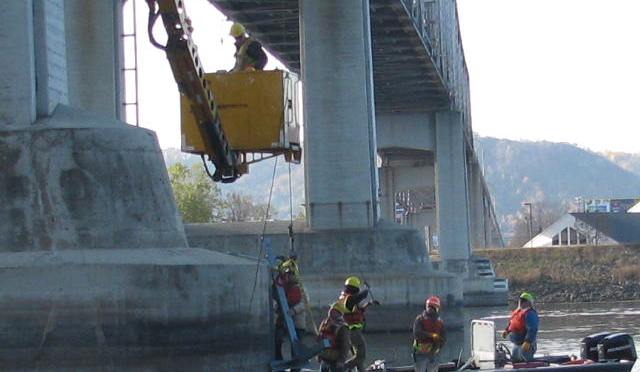
The MnDOT Bridge Office is testing several new methods of monitoring bridge scour — erosion that occurs around bridge piers and abutments during high water-flow events like floods. Acting Waterway Engineer Nicole Danielson-Bartelt said the project’s goal is to be able to monitor scour-critical bridges remotely rather than sending maintenance personnel out on the water during difficult or hazardous conditions.

“There are a number of bridges that are pretty difficult to monitor, especially during high water events,” she said. “Typically, you need to get out on a boat and do either sonar readings or drop weights. It’s dangerous work to be out on the water during those types of events unless you have the right training.”

The project will evaluate several different monitoring technologies, including continuous monitoring equipment like tilt meters and active sonar. The sonar systems, which allows continuous stream bed and water surface elevation data to be transmitted to a website for graphical display, could provide benefits that go beyond monitoring individual bridges.

“The ability to collect continuous, long-term data could help engineers understand short term scour-fill and long term aggradation-degradation cycles,” said Solomon Woldeamlak, a Bridge Office hydraulic engineer. He added that the data can be used to calibrate existing methods of estimating scour at bridges.

Other devices being tested include “float-out” devices, which are buried in the sand around the abutment and send out a signal only if washed to the surface by a scour. Danielson-Bartelt said these non-continuous monitoring devices might be appropriate for bridges where installing permanent sonar is not advisable due to the presence of debris that could damage the equipment.

Monitoring equipment has been installed at two locations: the Highway 43 Winona bridge over the Mississippi River and the Highway 14 Mankato bridge over the Minnesota River. A final report on the project is expected in late 2014/early 2015. You can learn more about some of the products that are being tested on the website of ETI Instrument Systems, Inc., which provided the equipment.

‘Intelligent’ traffic drum could help prevent work-zone tragedies

2012-26 Image
A prototype of the Intelligent Drum Line system.

Work-zone safety is a serious, ongoing challenge for transportation agencies. According to MnDOT, the current three-year average for Minnesota work zones is 1,819 crashes and seven fatalities per year. And that’s not counting near-misses: just talk to anyone who has worked as a flagger, and they will likely have a story about diving into a ditch to avoid being hit by a distracted driver. Consequently, MnDOT is constantly exploring ways to make work zones safer — which brings me to the photo above.

What you’re looking at is no ordinary traffic cone. It’s a prototype of a new warning device called the Intelligent Drum Line system — basically a modified orange traffic drum packed with electronics that can detect speeding drivers and blast them with audiovisual cues to let them know they’re entering the work zone too fast.

Our new technical summary explains the details of the new system, which was developed at the University of Minnesota, with funding and in-kind assistance from MnDOT:

The prototype design uses two modified traffic drums placed 1 to 3 feet from the shoulder of the road and 300 to 400 feet apart. Sensors in the first drum detect vehicles, measure their speed and distance, and communicate this information to the second drum…

When the IDL system detects an oncoming vehicle traveling faster than a threshold speed, the system activates visual warning systems in both drums and initiates a countdown. When the speeding vehicle is approximately 1 second away from the first drum, the system activates an air horn to warn the driver.

As the vehicle passes the first drum, the audible alarm terminates and the system transmits a command to the second drum to start another countdown. When the vehicle is approximately 1 second away from the second drum, the system activates another audible alarm.

Testing of the IDL system at MnROAD has been successful; however, researchers still need to study how drivers react to the system in real-world conditions. Before they can do that, the design will have to be refined so that it can pass Federal Highway Administration crashworthiness tests. On a related note, MnDOT is currently funding a separate University of Minnesota study into which technologies are most effective at capturing drivers’ attention in work zones. The study will include visual and auditory cues similar to the ones used in the IDL prototype.

Learn more:

Previewing MnDOT’s next round of research projects

MnDOT Research Services recently released its 2013 request for proposals. If you have any kind of direct interest in transportation research in Minnesota, chances are you might have known that already. But those with more of a general curiosity might be interested to see the list of research need statements from the RFP, as they provide a nice preview of the next round of potential MnDOT research projects.

As you can see, some are of a highly technical nature. (It’s safe to say that a study on “PCC Pavement Thickness Variation Versus Observed Pavement Distress” would be of interest mainly to engineers.) Others, however, like “The Economic Impact of Bicycling in Minnesota,” might have a broader appeal. In any case, it’s a fascinating glimpse at the myriad of issues that MnDOT is attempting to address through research and innovation.

Here’s the list of research need statements from the 2013 RFP, broken down by category:

Environment

Maintenance

Materials and Construction

Multimodal

Policy and Planning

Traffic and Safety

What happens when you incentivize transit use during construction projects

In 2010, MnDOT began a three-year long, $67 million repair and upgrade project on I-35 in Duluth. Dubbed the “Mega Project,” it created a serious disruption for Duluth-area commuters. To help mitigate the impact, the Duluth Transit Authority stepped up its bus services, offering free rides in newly established bus-only express lanes as well as access to new park-and-ride lots and various other enticements. Perhaps not surprisingly, many area residents took advantage of their new transit options to avoid construction-related travel delays. But what’s really interesting is what happened after the construction ended.

As described in a recently published MnDOT/University of Minnesota study, commuters who started taking the bus to avoid traffic caused by the construction ended up continuing to ride the bus even after the construction ended. Researchers surveyed riders during and after the 2010 and 2011 construction seasons and found that, even after bus fares went back to normal levels, only 15 percent of the new bus users switched back to driving. Researchers concluded that once riders developed a habit of using transit, the habit tended to stick.

The report author sums up the phenomenon quite nicely in her executive summary:

Human beings are creatures of habit. Most of us travel the same route every day to the same destination. Sometimes, however, something comes along to push us to examine our habits and possibly change them. A major highway construction project can be such an event. (…) This provides a very good opportunity to examine our travel patterns and possibly change our habitual modes.

Of course, this change didn’t just happen on its own. As the technical summary notes, the DTA marketed its services aggressively during this period. (The above photo is just one example.) The study also noted that the elimination of expanded bus services in the winter had a negative impact on ridership.

Read more:

Geotextile research at MnROAD

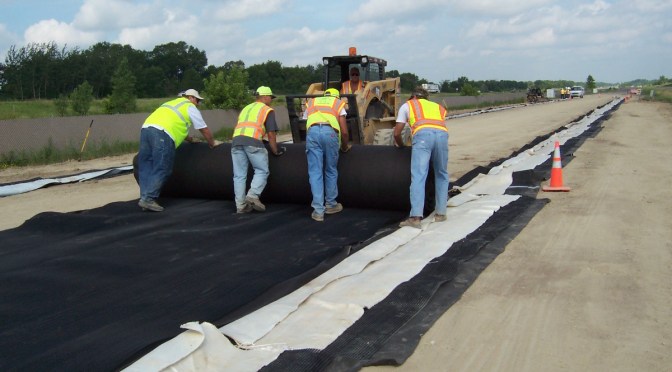
Geotextiles are synthetic polymer materials used to improve the performance of roadways. As discussed in this 2011 technical summary, geotextiles facilitate filtration and water drainage, improve the integrity and functioning of base materials, and provide a stable construction platform over soft or wet soils. These improvements can benefit both the cost-efficiency and longevity of pavements.

Geosynthetic materials have been used throughout Minnesota, and can be found in both reconstructed and new roadway projects. The use of geotextiles as a separator layer under concrete overlays, however, has had limited documentation in Minnesota and other cold weather climates. MnROAD‘s recent dedication of several test cells to this purpose will determine the performance of this application of geotextiles, with the goal of improving its applications on other Minnesota roadways.

The new test sections, designated as Cells 140 and 240, consist of a very thin, 3-inch concrete overlay over an existing 7-inch concrete pavement constructed 20 years ago. Some unique features of the design include the use of a fiber-reinforced concrete mix, two different thicknesses of the nonwoven geotextile, and the use of a special type of glue, rather than nails, to fasten it to the existing concrete before paving.

The fabric and fiber used in the concrete mix were supplied through a public-private partnership with Propex Geotextile Systems. The results of this study, along with other unbonded overlays constructed at MnROAD and around the country, will be incorporated into a new national pooled fund project — TPF 5-(269) — led by MnDOT. This project will develop an improved mechanistic design procedure for unbonded overlays.

A second application being demonstrated at MnROAD is the use of a geosynthetic drainage system under several dowel bar baskets in new concrete pavement test section. Minnesota has historically used a dense-graded base layer under concrete pavements to provide a stable foundation and construction platform. However, this material drains very slowly, and traps moisture within the joints, leading eventually to significant distress (See Effect of Drainage on the Performance of Concrete Pavement Joints in Minnesota.) This application will compare the use of the geotextile drainage material placed under both sealed and unsealed joints, as well as a control joint without the drainage material.

Best practices for trail crossings – webinar and draft report

Last week, MnDOT Research Services hosted a workshop on a forthcoming report, “Decision Tree for Identifying Alternative Trail Crossing Treatments.” It was broadcast as a webinar, the recording of which is now available online via Adobe Connect:

http://mndot.adobeconnect.com/p8hlfripuwe/

The final report is coming soon, but in the meantime you can see the draft version on our website (link), along with case studies and other related documents.

Bridging the gap between research and implementation

The end goal of transportation research, broadly speaking, is to see the results implemented — that is, to transfer the knowledge generated through research to those who can put it to good use. Research Services and the Center for Transportation Studies use a variety of tools to help disseminate research results: our respective websites, email lists, social media, newsletters and this blog, to name a few. But what do we know about how our audiences actually interact with these various channels of communication?

At the Transportation Research Board Annual Meeting earlier this year, researchers from Nebraska presented the findings of a very interesting survey on how engineers and other transportation practitioners prefer to learn about research results. Their presentation, entitled “What Engineers Want: Identifying Transportation Professionals as an Audience for Research,” is available via Slideshare. (Unfortunately, WordPress won’t let me embed it.)

Some key takeaways from the survey:

  • Practitioners overwhelmingly prefer one- or two-page technical briefs to other types of research communication products. (Other popular formats include presentations, video highlights and webinars.)
  • By a wide margin, practitioners use search engines like Google or Bing to seek research results (compared to other options like contacting a colleague or university faculty).
  • Practitioners are mostly interested in information on how to implement findings, as well as cost-benefit analyses of implementation.

The survey results present what I think is a fairly realistic and nuanced picture of the audience for transportation research; they’re also consistent with our (Research Services) own internal research on the issue. The bottom line is that research results need to be condensed into usable bits of information and made easily accessible in a variety of formats. People want information they can use, without having to dig for it. More importantly, they want it in whatever their preferred format is, whether it be print, email, Web, RSS, social media or in-person presentations.

Interestingly, Research Services already produces the kind of two-page technical briefs described in the survey. We call them “technical summaries,” and they are among our most popular products. We generally produce a technical summary for each research project we manage, and post them on our website alongside the full research report. Reading a two-page summary, written in layman’s terms, is certainly easier than poring over research reports that oftentimes number in the hundreds of pages, so it’s not surprising that even those with a strong engineering background prefer the format.

As a side note, last Friday we published a batch of 10 new technical summaries — along with two new transportation research syntheses, which are a type of literature review. Topics range from pedestrian and bicycle safety in roundabout crossings to the effect of intelligent lane control systems on driver behavior. You can check the full list on the Research Services main page.

Now it’s your turn: What forms of communication do you think are most effective at reaching transportation practitioners? Which ones do you prefer? Let us know in the comments.

Permeable pavements could protect the environment, save taxpayer dollars

KSTP has a nice story today on the Minnesota Department of Transportation’s ongoing research into permeable pavements at the MnROAD research facility. (The video isn’t embeddable on WordPress, but you can find a direct link here.)

Permeable pavements (also known as “porous” or “pervious” pavements) are designed to allow water to pass through roadways and infiltrate directly into the underlying aggregate and soil. Their primary effect is to reduce stormwater runoff, which carries harmful materials from the road’s surface out into waterways. Of course, reducing runoff also mitigates the need for the kinds of costly drainage structures that are normally required to manage stormwater. Permeable pavements also reduce noise and mitigate the potential for hydroplaning, among other documented benefits.

These types of pavements are already used in some areas in Minnesota — mainly in parking lots and city streets — and MnDOT has been studying their potential use for full-depth roadway pavements. As the video indicates, so far the results have been encouraging. (You can read more about MnDOT’s ongoing research on the MnROAD website.)

As a side note, the amount of water these pavements can absorb is quite impressive. Last month, we posted a new Local Road Research Board video on stormwater management. In one scene, a public works crew dumps what appears to be several hundred gallons of water onto a permeable pavement and watch as it disappears almost instantaneously. (Watch the clip here.)

Here are the results of some recent permeable pavement studies here in Minnesota:

About those roundabouts

One of my unofficial duties as a MnDOT employee is to respond to a near-constant barrage of opinions from my family and friends regarding the condition of our state’s roadways. (My wife, for example, half-jokingly tries to ascribe personal responsibility to me for the congestion she faces on her morning commute.) Interestingly, one of the issues that gets brought up to me most often in private conversations is roundabouts — the circular intersections that are widely praised by engineers but often vilified by a skeptical public.

From a public interest perspective, the verdict on roundabouts is overwhelmingly positive. With very few exceptions, roundabouts have been shown to dramatically reduce both the frequency and seriousness of traffic accidents when compared to other types of intersections. One oft-cited source, the National Insurance Institute for Highway Safety, reports that U.S. intersections converted to roundabouts have experienced a 35-47 percent decrease in crashes and an 72-80 percent decrease in injury crashes (source here). Moreover, because the don’t have stop signs or traffic lights, roundabouts have been found to reduce traffic delays and pollution.

Perhaps not surprisingly, research on these potential benefits has precipitated a rash of roundabout construction. In Minnesota alone, 115 have already been built, with another 39 either planned or under construction, according to the Pioneer Press. Love them or hate them, roundabouts are becoming a fact of life here.

Of course, not everyone loves them. In spite of their stellar  record, roundabouts remain something of a political lightning rod. This article in the Mankato Free Press and this news segment from KSTP provide typical examples of the kind of skepticism officials face when proposing to put in a roundabout. The problem is persistent enough that many officials see a need to develop a public relations game plan. On June 19, the Transportation Research Board is offering a free webinar entitled “Community Outreach: Successful Outcomes for Roundabout Implementation,” designed to help transportation professionals understand and respond to political opposition to roundabouts. It’s free for employees of TRB sponsor organizations (including MnDOT); a $99 registration fee is required for employees of non-sponsors.

For those who are unfamiliar with roundabouts, there are some good resources designed to help people understand their purpose and benefits. Several years ago, the Local Road Research Board produced the video above (along with an accompanying brochure). MnDOT also has a resource page devoted to explaining the use of roundabouts.

Those with more than a passing interest in the subject might also want to check out these recent MnDOT/LRRB-sponsored studies:

New video showcases Minnesota city and county stormwater management techniques

Earlier this week, the Minnesota Local Road Research Board released this new video showcasing best practices for local stormwater management. Although it’s primarily a training video for engineers and other public works professionals, non-transportation geeks might also enjoy learning about some of the interesting, innovative techniques being employed in cities and counties across the state.

Those who’d prefer not to watch the whole 14-minute video can skip ahead by clicking on these highlights:

  1. Woodbury’s stormwater ponds (1:52)
  2. Washington County’s bioretention gardens (2:56)
  3. “Green roof” bioretention method (4:02)
  4. Maplewood’s underground detention system (4:39)
  5. Greenway stormwater project in Minneapolis (6:03)
  6. Minnetonka’s hydrodynamic separator treatment system (7:47)
  7. Arden Hills’ infiltration (swales) system (8:26)
  8. Shoreview’s permeable pavements (9:52)
  9. Ramsey-Washington permeable pavement project (11:11)
  10. Tree boxes/trenches in Ramsey-Washington (12:06)

Overall, the video gives you an appreciation for the incredible amount of planning and work that goes into managing stormwater runoff — a task that’s critical to protecting the state’s waterways from pollution (but which many people no doubt take for granted). For those who want to learn more, the best management practices showcased here are examined in greater detail in a recent LRRB report, “Decision Tree for Stormwater BMPs,” which is available for free on the LRRB and MnDOT Research Sevices websites: