

Approximately 50% of roads in Minnesota are gravel. The performance and long-term sustainability of such roads depend on the quality of the surface layer. Unbound large particles can form an unstable road surface that becomes rough, developing potholes and corrugations as this material is scattered by vehicles or washed away by rain. As a result, more frequent maintenance and reconstruction is required, which becomes very expensive for Minnesota counties.
Continue reading New Project: Evaluation of Gravel Stabilizer Used on Gravel Roads and ShouldersTag Archives: MnDOT
New methods to determine safe bridge loading will help keep Minnesota’s truck freight moving
April 10, 2023
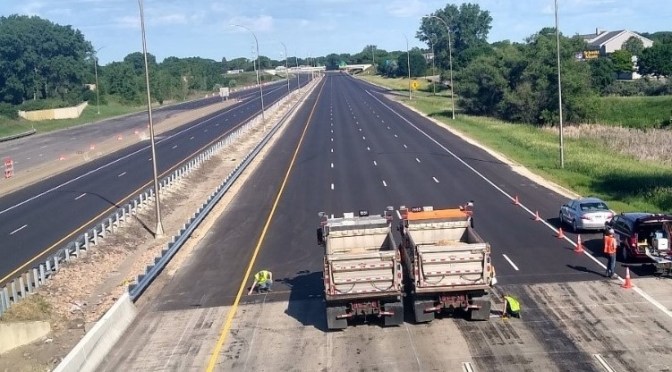
When transportation officials determine which route a heavy truck should take, their aim is maximizing efficiency while ensuring safety. Detours around bridges on critical freight routes increase fuel and labor costs for the trucking industry—and eventually hit consumer pocketbooks, too.
Continue reading New methods to determine safe bridge loading will help keep Minnesota’s truck freight moving
MnDOT Library is Among State Government Libraries Recognized by Gov. Walz
Gov. Tim Walz proclaimed April 23-29 Capitol Area Library Consortium Week to recognize CALCO libraries during National Library Week.
Continue reading MnDOT Library is Among State Government Libraries Recognized by Gov. Walz
MnDOT Library launches digital library
The MnDOT Library recently got a request for a copy of Minnesota Standard Specifications for Highway Construction from 1938. It might seem obscure, but the request was easy to fulfill because a digitized version of the manual was readily available in the newly launched MnDOT Digital Library.
Continue reading MnDOT Library launches digital library
Findings Lay Groundwork for Shared Mobility Transit in Rural Minnesota
Originally published in Catalyst, February 13, 2023.
Public transit services are vital for community health and connectivity, yet the transit solutions found in urban areas—such as frequent bus service and light rail—don’t exist in rural areas. As a result, mobility may be limited in rural communities because of the high costs and low availability of affordable, reliable transportation options.
Continue reading Findings Lay Groundwork for Shared Mobility Transit in Rural Minnesota
Managing Building Assets With Scanning and Reality Modeling
MnDOT owns and maintains approximately 900 buildings across Minnesota, and the Building Services Section is responsible for planning repairs, renovations or expansions. Architects, engineers and other specialists involved in these activities require data regarding building and site conditions. Collecting this data is often a multidisciplinary and laborious effort that can be time-consuming and expensive. Alternative technologies, however, can gather and process large amounts of accurate information more comprehensively, safely and cost-effectively.
Continue reading Managing Building Assets With Scanning and Reality Modeling
Evaluating Pavement Thickness With 3D Ground-Penetrating Radar
Building on previous MnDOT-sponsored work, researchers have developed a nondestructive method of assessing pavement thickness using 3D ground-penetrating radar (GPR). A vehicle equipped with an array of transmitting and receiving antenna pairs travels at traffic speed collecting full-width GPR data for analysis, minimizing the amount of pavement coring required.
Continue reading Evaluating Pavement Thickness With 3D Ground-Penetrating Radar
Managing Stormwater Runoff with Recycled Peat and Taconite Tailings
Researchers have found that peat has high potential to replace commercial compost in MnDOT’s standard bioslope and bioswale design for roadside ditches, and that taconite tailings performed comparably to the sand currently specified in MnDOT designs, with the additional benefit of removing phosphates.
Finding alternatives to commercial compost and sand for use in bioswales will help MnDOT meet regulatory requirements for stormwater runoff, while reducing the costs and environmental effects of transporting and storing these materials.
“The results of this project will very much facilitate the development of green infrastructure by reducing its cost to MnDOT and Minnesota local agencies, helping them to do more with less,” said Dwayne Stenlund, Erosion Control Specialist, MnDOT Erosion Control and Stormwater Management.
What Was Our Goal?
The objective of this project was to evaluate peat and muck excavated from construction activities, taconite tailings from area mining operations, and other stormwater quality filter media for use in bioswales and bioslopes along Minnesota highways. Laboratory and field tests of these products would examine their capacity to absorb water, retain pollutants and support plant growth to determine if they are beneficial and practicable in these designs.
What Did We Do?

Researchers began by conducting a comprehensive literature review on the use of bioslopes and bioswales as stormwater treatment best management practices. Then they collected peat and muck near a highway construction project, as well as locally sourced sand, compost, taconite tailings and commercial peat.
These materials, as well as various combinations of materials, were used in laboratory experiments to determine how well they:
- Absorbed water, using a falling head test to measure saturated hydraulic conductivity, which indicates the rate at which water infiltrates a material.
- Retained pollutants, using leaching experiments to quantify how well they removed copper, lead, zinc, nitrate and phosphate.
- Sustained plant growth, using bioassays and greenhouse studies.
Finally, researchers conducted pilot field tests on three plots containing a 50/50 percent peat and sand mixture, and another three plots with a 50/50 percent compost and sand mixture. Between April and August of 2017, they monitored water infiltration, discharge water quality and vegetation establishment for these sites.
What Did We Learn?
“Ultimately, a combination of peat and taconite tailings will compare favorably with current MnDOT specifications for bioslope and bioswale design,” said Kurt Johnson, Research Fellow, University of Minnesota Duluth Natural Resources Research Institute.
Researchers found that peat has a strong potential for replacing commercial compost in MnDOT’s standard bioslope and bioswale designs, and that taconite tailings also performed comparably to the sand currently specified in these designs. However, muck has little potential to replace commercial compost or peat due to its low permeability, poor infiltration and filtration properties, and lack of support for plant growth.
Results for the three properties of interest follow:
- Infiltration rate: While muck had an unacceptably low hydraulic conductivity, peat performed at least as well as compost, and taconite tailings as well as sand. Pilot tests showed that a 50/50 mix of peat and taconite tailings had a similar water storage capacity to a 50/50 mix of compost and sand.
- Pollution retention: Muck absorbed only 50 percent of metals; salvaged peat, commercial peat and compost performed well, absorbing more than 80 percent. However, only taconite tailings showed the potential to remove phosphate. None of the materials removed nitrate.
- Plant growth: Mixtures of compost or peat with sand or taconite tailings all performed well in providing a viable substrate for plant growth. Mixes containing compost performed the best in plant growth trials. Muck was difficult to mix with any other material, and its value for plant growth was minimal. Greenhouse study results showed no difference between sand and taconite tailings in their effect on plant growth response.
What’s Next?
In a second phase of this project, “Development and Regionalization of In Situ Bioslopes and Bioswales,” MnDOT will conduct further laboratory tests on alternative materials for bioslopes and bioswales, and expand field tests to several sites in Minnesota that have been constructed using these materials. Researchers also recommend the development of specifications and detail drawings for the use of these materials.
This blog pertains to Report 2017-46, “Comparing Properties of Water Absorbing/Filtering Media for Bioslope/Bioswale Design,” published November 2017.
Smartphone prototype app warns drivers of high-risk curves
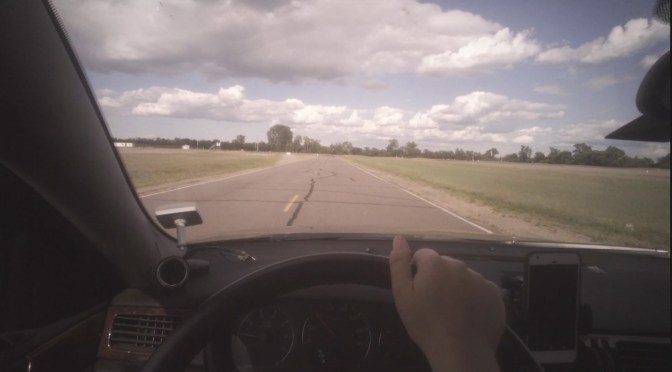
Lane-departure crashes on curves make up a significant portion of fatal crashes on rural Minnesota roads. To improve safety, solutions are needed to help drivers identify upcoming curves and inform them of a safe speed for navigating the curve.
“Traditionally there are two ways to do this: with either static signage or with dynamic warning signs,” says Brian Davis, a research fellow in the U of M’s Department of Mechanical Engineering. “However, while signing curves can help, static signage is often disregarded by drivers, and it is not required for roads with low average daily traffic. Dynamic speed signs are very costly, which can be difficult to justify, especially for rural roads with low traffic volumes.”
In a recent project led by Davis on behalf of MnDOT and the Minnesota Local Road Research Board, researchers developed a method of achieving dynamic curve warnings while avoiding costly infrastructure-based solutions. To do so, they used in-vehicle technology to display dynamic curve-speed warnings to the driver based on the driver’s real-time behavior and position relative to the curve. The system uses a smartphone app located in the vehicle to provide the driver with visual and auditory warnings when approaching a potentially hazardous curve at an unsafe speed.
“Highway curves [make up] 19 percent of the total mileage of the paved St. Louis County highway system, yet these curves account for 47 percent of all severe road departure crashes,” says Victor Lund, traffic engineer with St. Louis County. “In-vehicle warnings will be a critical strategy to reduce these crashes.”
To begin their study, researchers designed and tested prototype visual and auditory warning designs to ensure they were non-distracting and effective. This portion of the study included decisions about the best way to visually display the warnings and how and when audio messages should be used. “To create the optimal user experience, we looked at everything from how to order the audio information and when the message should play to the best length for the warning message,” says Nichole Morris, director of the U’s HumanFIRST Lab and co-investigator of the study.
Next, a controlled field test was conducted to determine whether the system helped reduce curve speeds, pinpoint the best timing for the warnings in relation to the curves, and gather user feedback about the system’s usefulness and trustworthiness. The study was conducted with 24 drivers using the test track at the Minnesota Highway Safety and Research Center in St. Cloud, Minnesota. The selected course allowed drivers to get up to highway speeds and then travel through curves of different radii, enabling researchers to learn how sensitive drivers are to the position of the warnings.
Based on the study results, the system shows both feasibility and promise. “Our in-vehicle dynamic curve warning system was well-liked and trusted by the participants,” Davis says. “We saw an 8 to 10 percent decrease in curve speed when participants were using the system.”
The project was funded by MnDOT and the Minnesota Local Road Research Board.

Seven Pilot Projects to Change Transportation Practice in Minnesota
Roadside fencing that protects endangered turtles, a toolkit for identifying potentially acid-producing rock and a device that could save MnDOT $200 million a year in pavement damage are just a few of the advancements that MnDOT hopes to make in the near future, thanks to seven recently funded research implementation projects.
Each spring, the governing board for MnDOT’s research program funds initiatives that help put new technology or research advances into practice. This year’s picks aim to improve the environment, reporting of traffic signal data, notification of lane closures and the design and quality of pavements.
Here’s a brief look at the projects (full proposals here):
Protecting the Environment and Wildlife
- To avoid the leaching of potentially acid-generating rock during excavation projects, MnDOT hopes to develop a GIS-based risk-screening tool that identifies areas where PAG rock might be encountered. Guidance will be developed for identifying and handling PAG rock.
Found in bedrock throughout the state – especially northern Minnesota, PAG minerals can release acid upon contact with air or water, a danger to aquatic and human life.
“Anytime we dig, there is the potential to expose this stuff,” said Jason Richter, chief geologist.
- Reducing roadway access for small animals, including endangered turtles, is a priority for MnDOT and the Minnesota Department of Resources. MnDOT will analyze the effectiveness of different types of small animal exclusion fences tried across the state and develop a standard set of designs for future projects.
Improved Reporting of Traffic Signal Data
- A centralized hub of traffic signal data could benefit future vehicle-to-infrastructure (V2I) applications and assist with the modeling of transportation project impacts. Methods and tools will be developed for a regional database of intersection control information that extracts data from MnDOT’s recently acquired Central Traffic Signal Control System and soon-to-be adopted Signal Performance Measure application.
Real-Time Notice of Lane Closures
- In this pilot project, 20 MnDOT arrow board messages will be equipped with technology that automatically reports lane closures on 511 and highway message boards, providing more timely motorist notification.
Longer-Lasting Roads and Improved Quality Control
- This summer, a new quality assurance device called the Rolling Density Meter will be deployed on several pavement projects, eliminating the need for destructive sample cores.
“This is the ultimate in compaction control,” said Glenn Engstrom, Office of Materials and Road Research director. If contractors obtain the right level of density when paving asphalt roads, MnDOT could eliminate $200 million per year in premature road failure. - In 2018, MnDOT plans to require Intelligent Compaction (a pavement roller technology that reduces workmanship issues) on all significant asphalt projects. A vehicle-mounted mobile imaging device will be piloted that collects necessary supportive roadway alignment data, without the need for survey crews.
- Upgrades to MnDOT’s pavement design software, MnPAVE, (incorporating recycled unbound and conventional base material properties) will help increase the service life of Minnesota roads.
 Crossroads