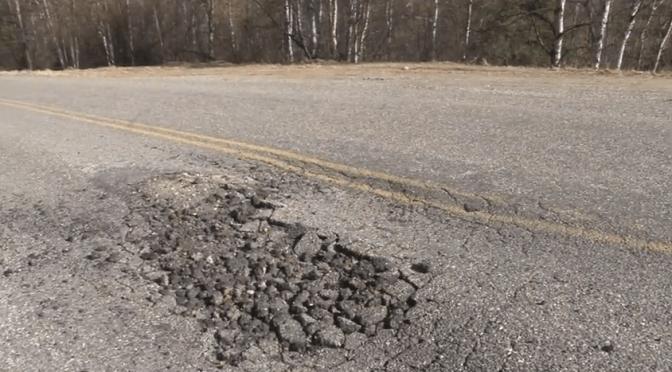
Regardless of whether you’re familiar with the term “frost heave,” if you live in Minnesota and drive on the roads, you’re already familiar with its destructive capacity. Many of the dips, bumps, potholes and cracks that appear on our roads every spring are a direct result of frost heave, which occurs when water accumulates in the soil beneath the pavement and begins freezing and then thawing along with the changing seasons. The resulting expansion and contraction weakens the road base and leaves it susceptible to damage from traffic loading.
These new videos produced by the Local Road Research Board explain how frost heave works, and describe some of the strategies public works departments use to combat it. The top video is is the shortened, executive-summary version, while the bottom video is the full, 13-minute version meant for transportation professionals.
The Minnesota Local Road Research Board is a major source of funding for transportation research in the state. Occasionally, it also produces educational videos designed to raise public awareness of important transportation topics.
Two new video offerings from the LRRB (embedded above and below) are focused on save driving in work zones. While not directly research-related, they might prove a useful resource to transportation professionals. More importantly, they serve to remind us all of the very real and dramatic consequences of work zone crashes, of which there are approximately 2,000 per year in Minnesota.
You might want to also check out some of their other recent YouTube offerings, including explanations of why we need stop signs and speed limits, as well as a fascinating look at how potholes are patched.
MnDOT Research Services recently released its 2013 request for proposals. If you have any kind of direct interest in transportation research in Minnesota, chances are you might have known that already. But those with more of a general curiosity might be interested to see the list of research need statements from the RFP, as they provide a nice preview of the next round of potential MnDOT research projects.
As you can see, some are of a highly technical nature. (It’s safe to say that a study on “PCC Pavement Thickness Variation Versus Observed Pavement Distress” would be of interest mainly to engineers.) Others, however, like “The Economic Impact of Bicycling in Minnesota,” might have a broader appeal. In any case, it’s a fascinating glimpse at the myriad of issues that MnDOT is attempting to address through research and innovation.
Here’s the list of research need statements from the 2013 RFP, broken down by category:
Last week, MnDOT Research Services hosted a workshop on a forthcoming report, “Decision Tree for Identifying Alternative Trail Crossing Treatments.” It was broadcast as a webinar, the recording of which is now available online via Adobe Connect:
The final report is coming soon, but in the meantime you can see the draft version on our website (link), along with case studies and other related documents.
Intersections between trails and roadways can be dangerous places for bicyclists and pedestrians. Next week, MnDOT Research Services is offering a free webinar on a forthcoming manual designed to help make trail crossings safer.
On Tuesday, July 9, from 1:00 p.m. to 2:30 p.m. (CDT), University of Wisconsin—Madison Professor David Noyce will be conducting a workshop on his forthcoming handbook, “Decision Tree for Identifying Alternative Trail Crossing Treatments.” The project, funded by MnDOT and the Local Road Research Board, aims to identify current engineering state-of-the-practice for trail crossings and provide guidance as to appropriate crossing designs and vehicular and bicycle right-of-way hierarchies.
You can click on the link below at the specified date and time to watch the webinar. No registration is required.
On Tuesday, June 4, the University of Minnesota is hosting a free Complete Streets seminar. The event will serve as a preview of a forthcoming guide, “Complete Streets Planning and Implementation at Multiple Scales Guidebook and Case Studies,” funded by MnDOT and the Minnesota Local Road Research Board.
Unfortunately, the event itself is sold out, but you can still watch it online for free via webcast. You can find all the relevant information on this web page, including direct links to the webcast sessions:
According to the announcement, the event will cover “examples of Complete Streets policies, design guidance, engagement strategies, and financing mechanisms that help communities move from policies and plans to on-the-ground projects.”
Earlier this week, the Minnesota Local Road Research Board released this new video showcasing best practices for local stormwater management. Although it’s primarily a training video for engineers and other public works professionals, non-transportation geeks might also enjoy learning about some of the interesting, innovative techniques being employed in cities and counties across the state.
Those who’d prefer not to watch the whole 14-minute video can skip ahead by clicking on these highlights:
Overall, the video gives you an appreciation for the incredible amount of planning and work that goes into managing stormwater runoff — a task that’s critical to protecting the state’s waterways from pollution (but which many people no doubt take for granted). For those who want to learn more, the best management practices showcased here are examined in greater detail in a recent LRRB report, “Decision Tree for Stormwater BMPs,” which is available for free on the LRRB and MnDOT Research Sevices websites:
In Minnesota, with our often wildly unpredictable weather and constant freeze-thaw cycles, potholes are a fact of life. Anyone who’s climbed into a motor vehicle in the last month or so has doubtlessly encountered countless reminders of this dismal reality. Fortunately, we have a small army of public works professionals devoted to eradicating this perennial nuisance. The Minnesota Local Road Research Board recently produced this video, which nicely explains the various methods used to combat potholes in Minnesota.
Potholes form when water invades cracks in the pavement and infiltrates the soil beneath it. When that water freezes, it stretches the road surface, causing the fractures to expand. After a few cycles of freezing and thawing, the pavement begins to buckle and eventually collapses under the weight of passing traffic, creating disruptions in the road’s surface.
Road crews use a variety of methods to fill potholes. The simplest method is the “throw-and-go” procedure, in which workers simply shovel an asphalt mixture into the pothole and pack it down until the road’s surface is smooth. A related method is “throw-and-roll,” where the patch is compacted using an asphalt roller.
Other methods include:
“semi-permanent” patching, in which workers clear the pothole of moisture and debris and then square the edges with a pavement saw before applying the patch;
“spray injection,” which involves using specialized equipment to blast water and debris out of the pothole before spray-filling it with asphalt mix and finally applying a dust coat of dry aggregate on top; and
“slurry” or “microsurfacing” crack filling, in which a slurry of aggregate, asphalt emulsion and mineral filler is placed over a crack in the pavement and leveled off using a squeegee.
This Asphalt Pavement Maintenance Field Guide (PDF), co-funded by MnDOT and produced by CTS, provides a handy how-to guide to pothole patching and other types of pavement repairs commonly applied by public works professionals in Minnesota.