This article was originally published in Catalyst, April 2020.
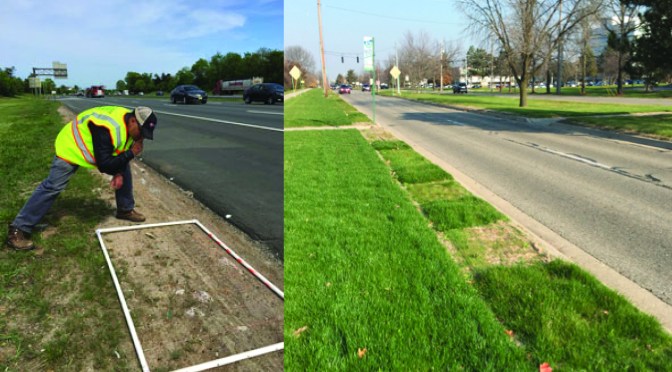
Vibrant green grass along roadways is a common sight across urban and rural landscapes in Minnesota and many other states, but its survival is a significant challenge—especially in cold climates. Roadway salt and other stressors can cause turfgrass installations to fail, requiring expensive reseeding or sodding efforts.
The Minnesota Local Road Research Board (LRRB) has added pavement condition forecasting technology to an existing, web-based roadway inventory tool that will enable counties to generate low-cost maps and reports that help them prioritize their work by showing how roadway conditions will look under different construction scenarios for decades to come.
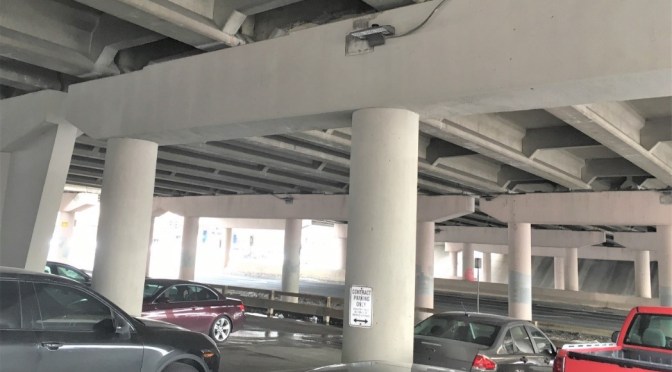
Well-documented efforts undertaken two decades ago to mitigate corrosion of a Highway 394 reinforced concrete bridge have given researchers the perfect scenario for evaluating the treatments’ long-term effectiveness. The test results are mixed: State-of-the-art methods for electrochemical chloride extraction and fiber-reinforced polymer wrapping of bridge elements performed well in combination, but poorly in isolation.
A new research study has shown that few landowners know about MnDOT’s snow fence program, its benefits to community safety and mobility, and incentives to install snow fences. Following community meetings and surveys in four regions of Minnesota, researchers identified promising promotional methods for the snow fence program, the constraints landowners face in adopting snow fences, and incentives and assistance to improve snow fence adoption. Project results will guide MnDOT’s efforts to expand the use of snow fences around the state
Working with an advisory panel of road managers from local agencies, researchers have developed a practitioner-ready guide for converting severely distressed low-volume paved roads to improved, easily maintained gravel roads. The guide includes decision-making tools and an online webinar for training.
A new resource is available to help agencies greatly reduce the risk of disturbing potentially acid-generating (PAG) rock in places like northern Minnesota when conducting road projects. When exposed to air and water, PAG minerals can generate drainage that is hazardous to the environment. A MnDOT-sponsored research team developed a best practices manual that provides comprehensive steps to identify, mitigate and monitor PAG material during highway construction.
Entomologists have developed an innovative method for surveying bumble bees alongside Minnesota roadways, the results of a new research study funded by the Minnesota Department of Transportation.
Research shows that MnDOT roadsides offer rich bumble bee habitats. The study offers information on surveying bee habitats and recommendations for improving habitats.
A new study sponsored by the Minnesota Local Road Research Board has identified 1,000 feet as an optimal sight distance for allowing drivers to make better crossing decisions at rural intersections. Researchers used a state-of the-art driving simulator to examine drivers’ ability to judge traffic speed and gaps between cars at unsignalized intersections with varying sight distances.
The Minnesota Local Road Research Board has developed a new gravel road management tool — a simple, customizable spreadsheet for inventorying a gravel road system, tracking maintenance activity and expenditures, and budgeting and planning future needs.
A related user guide provides details about required inputs, gravel road evaluation protocols, and customization based on needs and available data.






 Crossroads