

In a recent study of inspection reports, design documents and other data to evaluate the safety performance of bridge barriers, investigators found that the most commonly used barrier designs meet newer safety requirements and keep Minnesota drivers safe.
Continue reading Assessing Bridge Barriers for Today’s Vehicle Needs
Smartphone App Gives Crossing Guidance to the Visually Impaired
In a recent research project, MnDOT sought to validate a smartphone app designed to guide pedestrians who are blind or visually impaired through signalized and unsignalized intersections. The project succeeded in showing the app’s effectiveness in tests at six intersections in Stillwater, Minnesota.
Continue reading Smartphone App Gives Crossing Guidance to the Visually Impaired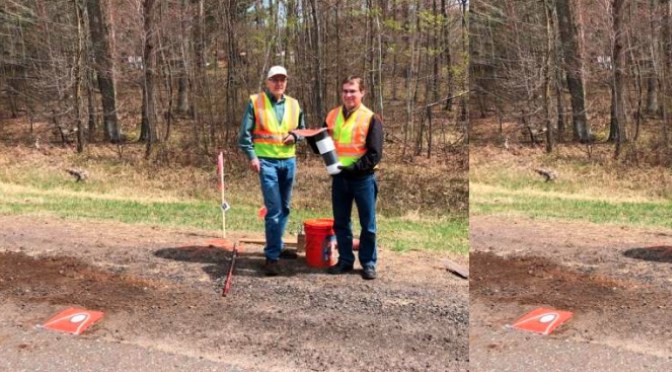
Low-Volume Road Runoff Analyses Suggest Optimal Treatments
Assisted by many county agency staff, researchers collected and analyzed runoff from low-volume rural roads over two years to determine how their contaminants compared to those of high-volume roadways. Results documented that runoff from low-volume roads has a lower contaminant concentration and that ditches and swales can be used to effectively treat rural road runoff.
Continue reading Low-Volume Road Runoff Analyses Suggest Optimal Treatments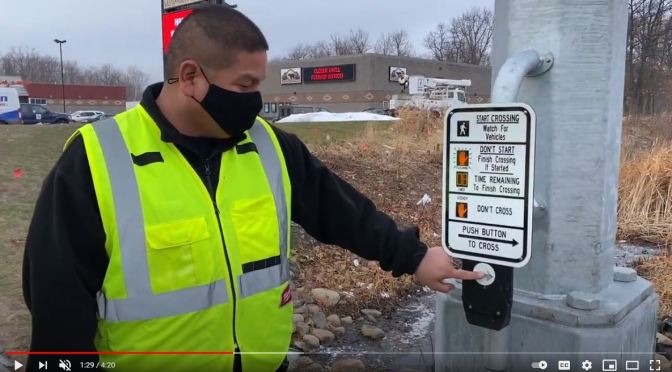
Understanding Rural Pedestrian Travel Behavior and Safety Issues
In collaboration with the Advocacy Council for Tribal Transportation and other tribal members, University of Minnesota researchers monitored 10 roadway sites specified as safety risks for pedestrians on four rural Minnesota reservations. Analysis of videos and group brainstorming produced a shortlist of potential countermeasures that could be incorporated into future highway projects.
Continue reading Understanding Rural Pedestrian Travel Behavior and Safety Issues
MnDOT & LRRB Award Funding to Innovative Research
MnDOT and the Minnesota Local Road Research Board have funded 26 new research projects and are seeking volunteers to serve as Technical Advisory Panel members and help guide the research.
Continue reading MnDOT & LRRB Award Funding to Innovative Research
Improving Winter Maintenance: Pilot Testing New Snowplow Technologies
![[Infographic] Testing Snowplow Technologies: Slurry Spreader (target direction of salt, reduce salt use, reduce corrosion on trucks), Two-Way Reversible Plow (located on side of plow, providing more mobility in plowing and directing snow), Underbody Scraper (located under plow, clears compacted snow and ice from roads), True-Float Wind (mounted on front or side of plow, providing more mobility in plowing and directing snow)](https://mntransportationresearch.org/wp-content/uploads/2020/12/snowplowinfographic.jpg)
Every winter, MnDOT ensures Minnesotans can travel safely by plowing more than 30,000 lane miles with approximately 800 snowplows.
In a new research implementation project jointly funded by the Office of Research & Innovation and Office of Maintenance, MnDOT is pilot testing five new pieces of snowplow equipment: two slurry spreaders (one from Henke, one from Swenson), a two-way reversible plow, an underbody scraper and a true-float wing (all from Henke).
Continue reading Improving Winter Maintenance: Pilot Testing New Snowplow Technologies
Connected and Automated Vehicles: Mobility and Equity for Disadvantaged Communities?
This article was originally published in Catalyst, November 2020.
As momentum for connected and automated vehicles (CAVs) continues to build in Minnesota, researchers in the U’s Transportation Policy and Economic Competitiveness (TPEC) program are working to understand how CAV technology could serve transportation-disadvantaged communities. CAVs offer the potential to provide greater mobility and equity for many people, but public engagement is essential to ensure all user needs are understood and addressed.
Continue reading Connected and Automated Vehicles: Mobility and Equity for Disadvantaged Communities?
Team Receives NSF Grant to Study ‘Smart e-Scooters’
This article was originally published in Catalyst, November 2020.
Electric scooters let riders move quickly between the roadway and the sidewalk, but these sometimes-unpredictable travel patterns can pose risk for riders and the people around them. Making scooters smarter is the goal of a new U of M research project funded by the National Science Foundation (NSF). Under the $1.2 million Cyber-Physical Systems grant, a cross-disciplinary team will study smart tracking systems on scooters for ensuring safe and smooth interaction with other vehicles and pedestrians.
Continue reading Team Receives NSF Grant to Study ‘Smart e-Scooters’
New Project: Cost/Benefit Analysis of Fuel Efficient Speed Control Using Signal Phasing and Timing Data
Due to rising fuel costs and environmental impact, consumers are increasingly aware of fuel efficiency (MPG) in the vehicles they purchase, which is reflected in increasing hybrid and electric vehicle sales. A major source of fuel consumption is acceleration and deceleration cycles caused by stopping at red lights—acceleration from a full stop requires significant power.
Continue reading New Project: Cost/Benefit Analysis of Fuel Efficient Speed Control Using Signal Phasing and Timing Data
Monitoring Performance of an Iron-Enhanced Stormwater Filtration System
A recent study determined the effectiveness of a two-cell iron-enhanced stormwater filtration basin to remove phosphorus from highway stormwater runoff collected from 2012 to 2018. Researchers recommended design changes that would allow for more accurate monitoring of these filter basins.
Continue reading Monitoring Performance of an Iron-Enhanced Stormwater Filtration System
