

From a competitive pool of over 75 proposals, MnDOT and the Minnesota Local Road Research Board have funded 25 new research projects and are seeking volunteers to serve as Technical Advisory Panel members and help guide the research.
Continue reading State Research Program Funds Projects to Address Transportation Challenges
Innovative Additions Could Help Asphalt Pavements Sense Damage—and Repair Themselves
This article was originally published in Catalyst, January 2022.
University researchers are investigating ways to extend the life of asphalt pavements and generate cost savings by adding innovative materials to asphalt mixes. In a recent study, they found that improving asphalt mixes with graphite nanoplatelets and taconite concentrates offers new possibilities for enhancing damage-detection techniques and restoring subsurface cracking using microwave energy.
Continue reading Innovative Additions Could Help Asphalt Pavements Sense Damage—and Repair Themselves
Model Helps Predict Likelihood of Farm Vehicle Crashes on Public Roads
This article was originally published in Catalyst, January 2022.
A U of M study of farm vehicle safety on rural roads identified factors—such as crop type and number of vehicles operated—that can help predict the likelihood of a farm’s vehicles being involved in a crash on a public road.
Continue reading Model Helps Predict Likelihood of Farm Vehicle Crashes on Public Roads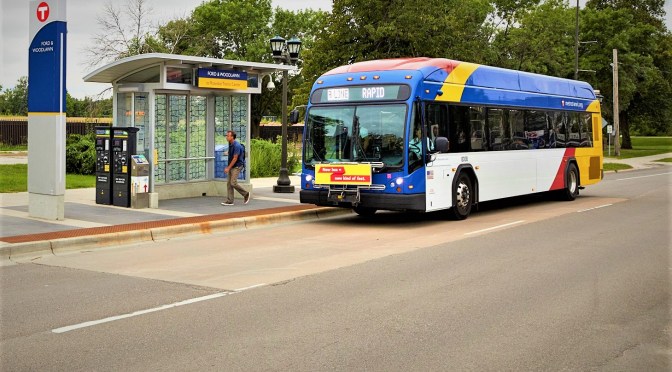
Property Values Remain Stable after Opening of Twin Cities Bus Rapid Transit Line
This article was originally published in Catalyst, January 2022.
Arterial bus rapid transit (BRT) has gained momentum in the Twin Cities as a less-expensive alternative to light-rail transit. However, this expansion of BRT has also raised concerns that the new lines will spur an increase in housing values and neighborhood gentrification, potentially displacing low-income residents. A new study eases these concerns: It found that the A Line BRT route encouraged ridership but had no effect on housing values.
Continue reading Property Values Remain Stable after Opening of Twin Cities Bus Rapid Transit Line
New Project: Identifying Deer-Vehicle Collision Concentrations in Minnesota
Deer-vehicle collisions are a significant risk to public safety on Minnesota roads—causing injuries and death for humans and animals, and property damage. Minnesota ranks among the top 10 riskiest states for deer-vehicle collisions in the nation.
Continue reading New Project: Identifying Deer-Vehicle Collision Concentrations in Minnesota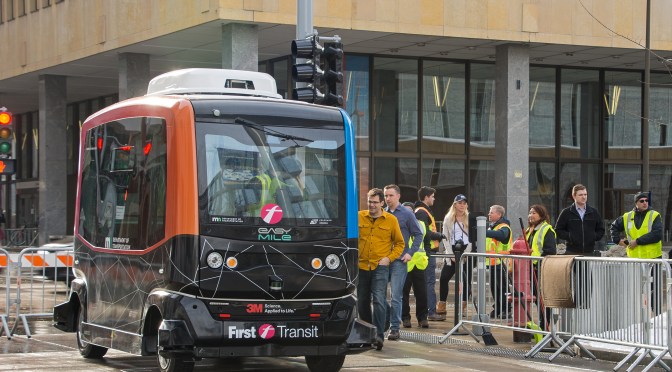
New Project: Designing An Autonomous Service to Cover Transit Last Mile in Low-Density Areas
Public transportation provides a safe, convenient, affordable, and eco‐friendly mobility service. However, due to its fixed routes and limited network coverage, it is sometimes difficult or impossible for passengers to walk from a transit stop to their destination. This inaccessibility problem is also known as the “transit last mile connectivity problem”.
Continue reading New Project: Designing An Autonomous Service to Cover Transit Last Mile in Low-Density Areas
New Project: Bridge Low Slump Concrete Overlay Mix Design for Mobile Mixers
In recent years, MnDOT has seen an increase in cracking of low slump overlays. Cracking of overlays allows chlorides to get into the bridge deck which leads to deterioration of the reinforcement and eventual delamination or spalling. This means that the bridge deck needs to be repaired or even replaced before the service life has been reached.
What is a low slump overlay? A low slump overlay is a technique used by DOTs to extend the life of bridge decks. They are typically 2″ thick and designed to provide low permeability.
Continue reading New Project: Bridge Low Slump Concrete Overlay Mix Design for Mobile Mixers
Quantifying the Effect of Geogrids in Asphalt Pavement Foundation Layers
Geogrid inserted between the layers of asphalt pavement during construction can increase the strength and durability of the finished road. To help engineers decide whether to use geogrids in road construction projects, researchers calculated just how much strength and durability geogrid material can add to an asphalt pavement and integrated the findings into MnDOT’s design software.
Continue reading Quantifying the Effect of Geogrids in Asphalt Pavement Foundation Layers
Innovative Materials and Technologies for Sustainable Pavement Infrastructure
In search of enhanced pavement damage detection practices, researchers investigated two innovative additives to asphalt binders: graphite nanoplatelets and taconite concentrates. They also examined the ability of microwave energy to restore subsurface cracking.
Continue reading Innovative Materials and Technologies for Sustainable Pavement Infrastructure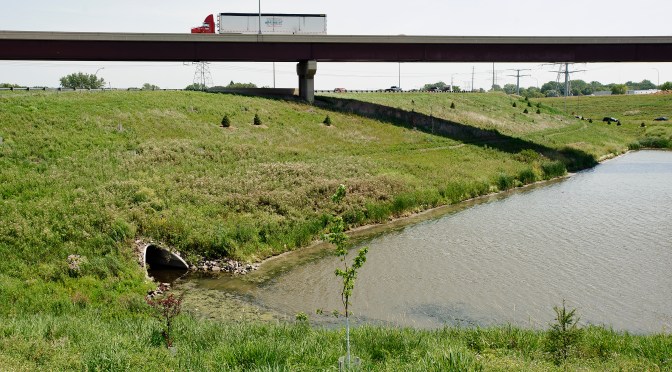
New Tools and Protocols for Successful Infiltration Facilities
Roadside infiltration facilities like wet ponds and swales have been used for more than 30 years to filter roadway contaminants from stormwater runoff, but they have a high rate of failure due to inaccurate determination of soil infiltration rates.
Continue reading New Tools and Protocols for Successful Infiltration Facilities
