Category Archives: Bicycling

Minnesotans geared up for e-bike rebates. Now data reveals more about them

Republished from CTS News (Catalyst) for October 14, 2025

More than 14,600 Minnesota residents applied for a rebate through the state’s e-bike rebate program when it launched in 2024. Established by the Minnesota Legislature to help reduce the cost of buying a new e-bike, the program was so popular that within minutes of opening in June 2024, the number of applicants overwhelmed the system and crashed the website. The state was forced to fix the technology challenges and reopen the application about a month later.

The scenario drove researchers at the University of Minnesota to dig deeper into the data about who applied for the rebate in the first year. Their project aims to shed light on who benefitted from the program, get feedback on the application process, and learn more about rebate use.

E-bikes, which operate like a bicycle but have an electric battery and motor for pedaling assistance, have increased in popularity in recent years, and supporters are promoting their potential as a sustainable transportation option. The state legislature allocated $2 million in both 2024 and 2025 for the rebate program.

“Minnesotans seem to have an appetite to get an e-bike, whether that’s because of the state’s incentive or for other reasons—including that Minnesota has some of the best bike infrastructure around,” says Kaitlyn Denten, a researcher with the Humphrey School’s Institute for Urban and Regional Infrastructure Finance (IURIF) and project co-lead.

For the first part of this project, researchers analyzed rebate applicant data, which included demographic information, income level, tax filing status, and ZIP code but no personal identifiers. Data also included a person’s rebate application status, the rebate amount, and whether the applicant used the rebate to purchase a new e-bike.

In the program’s first year, the maximum rebate was $1,500; individual amounts depended on an applicant’s income level and tax filing status. People who applied for and received a rebate certificate could purchase their e-bike and eligible bike accessories from a participating retailer. Of the total applicants, 1,519 people received a rebate and 1,327 used one to purchase an e-bike. According to the data, half of the rebates went to households earning less than $75,000 a year.

The Twin Cities seven-county metro area had strong representation, with 66 percent of applicants, 67 percent of recipients, and 66 percent of rebate users coming from the metro area. The average age of applicants was 49 years old.

For the project’s second part, researchers used an online survey to collect feedback on the application process and information about how people who received a rebate were using their e-bike, among other data. The survey, which was available between March 17, 2025, and April 5, 2025, received nearly 4,500 responses.  

Of the survey respondents, 3,920 individuals applied for a rebate, 496 received a rebate, and 455 used the rebate to purchase an e-bike. For those who received a rebate but didn’t use it, among the reasons cited were that the rebate didn’t cover enough of the e-bike’s cost and the rebate certificate expired before they were able to use it. 

One surprising finding: Some people bought an e-bike even if they didn’t receive a rebate, says CTS scholar Camila Fonseca-Sarmiento, IURIF director of fiscal research and project co-lead. “Or, if a couple received a rebate, they ended up buying two e-bikes. This could be spurring the use of e-bikes instead of personal vehicles.”

Many survey respondents expressed frustration with the initial application process, referring to the technical glitches, long wait times, and unclear instructions. Several respondents did note, however, that the second application round ran more smoothly.

Some respondents also raised concerns about the fairness of the program’s rollout, pointing to barriers faced by people with limited internet access and electronic devices, people with disabilities, and people with inflexible work schedules (the application period opened on a weekday).

Future research should focus on the effects of 2025 program changes, including income eligibility, application processes, and rebate amount, the researchers say. In addition, researchers noted that a statewide travel study could help assess how rebates might influence a shift from personal vehicle use to an e-bike, a question left unanswered because of limited e-bike use among current rebate recipients.

This research project was sponsored by the Applied Research in Transportation (ART) Program, which addresses time-sensitive research questions in a 6 to 12 month timeframe. CTS and the Minnesota Department of Transportation contributed initial funding to launch this pilot program in 2024, with the Metropolitan Council joining in 2025. To reinforce the applied nature of the program, ART projects must directly address a current process, document, or policy need with an initial focus on sustainability in transportation and climate change impacts.

—Peter Raeker, contributing writer  

Related Research from MnDOT

Operational Characteristics of Conventional and Electric-Assisted Bicycles and Their Riders (ongoing)

Assessing the Economic Impact and Health Benefits of Bicycling in Minnesota

Mobile lockers, equitable freight planning, and cargo e-bikes will play roles in urban freight

Reprinted from CTS News, January 14, 2025

Freight transportation is evolving rapidly, and its future success will require managing increased residential demand, planning for equity, and incorporating micro-delivery options such as cargo e-bikes. At the 2024 CTS Transportation Research Conference, three experts shared their knowledge of these trending topics in a session focused on the future of urban freight.

In response to the increasing demand for residential package delivery spurred by the shift towards online shopping, U of M Department of Industrial and Systems Engineering PhD student Can Yin shared her research on mobile parcel locker scheduling. Yin explained that in the growing ecommerce market, last-mile delivery is the most expensive and time consuming. While door delivery is commonly used, it can be unsecure and inconvenient for customers.

“Parcel lockers are an alternative, but they come with the disadvantages of limited locations, expensive fixed cost, and the inability to adapt to varying demand,” Yin said.

A newer, more flexible alternative is the use of mobile, vehicle-based parcel lockers, which offer greater flexibility, higher accessibility, and lower fixed costs—particularly if autonomous vehicles eliminate the need for driver salaries. However, mobile parcel lockers also create challenges for e-commerce businesses such as estimating demand and customer choices.

To address these challenges, Yin’s research team developed a mobile parcel locker demand-estimation model. Additionally, the researchers found that compared with stationary lockers, mobile lockers offer a better value and demand fulfillment.

Another challenge surrounding the rapid growth of e-commerce and urban freight is racial equity in urban freight planning. In his presentation, University of Washington Urban Freight Lab researcher Travis Fried explained how his research is seeking to better understand these inequities and create a framework for mitigating them.

The past and present systems that perpetuate the segregation of people and neighborhoods have been well documented. However, Fried said there is little research exploring how these patterns play out in freight planning and their impacts on air quality, health, and road safety for people of color. Fried’s research looked at high-volume traffic exposure and found that low-income populations of color were disproportionately exposed to e-commerce traffic.

“By our most conservative estimate, BIPOC [Black, Indigenous, and people of color] populations were exposed to 35 percent more traffic related to last-mile home delivery on average, despite ordering less than half as many packages as white populations,” Fried said. That’s because delivery facilities and highways are disproportionately located near historically marginalized neighborhoods, he explained.

In light of this finding, Fried emphasized the importance of including equity considerations when prioritizing urban freight strategies. “Solutions focused on the upper end of the distribution chain have outsized benefits for marginalized communities, so we need to consider that in our cost-benefit evaluations and engagement strategies,” he added.

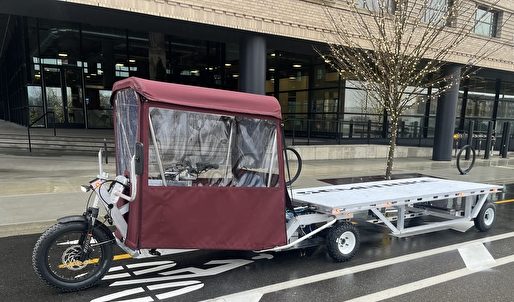
Using cargo e-bikes for last-mile freight delivery was the topic of the session’s final presentation from Marc Liu of Civilized Cycles. Liu explained how his company’s innovative semi-trike—which has as much cargo capacity as a small delivery van—can be used to move a significant amount of cargo over short distances, particularly within campus environments such as universities, hospitals, residential developments, and military bases.

cargo bike
Semi e-trike from Civilized Cycles

“Regardless of what these campuses are moving, they have the same core challenge of moving as much cargo as possible while keeping operating costs as low as possible,” Liu said. “On top of that, emissions and safety are key concerns because most of this happens in pedestrian-heavy areas.”

Liu explained that the first customers for the cargo e-bikes are micro-mobility fleet operators at the forefront of sustainable transportation including Lime, Net Zero Logistics, and Amazon. Moving forward, the company is targeting campus environments for expansion. Liu said that “economics drives adoption” and believes the key to adoption is offering an affordable, American-made product that reduces vehicle fleet costs, increases safety, improves efficiency, and reduces greenhouse gas emissions.

—Megan Tsai, contributing writer

Related Resources

Using Mobile Device Data to Estimate Bicyclist and Pedestrian Traffic

MnDOT relies on estimates of annual average daily traffic volumes to plan and maintain safe, effective transportation network infrastructure for all travelers. Estimating traffic volumes for nonmotorized road users such as bicyclists and pedestrians has been challenging because monitors are limited compared to vehicle traffic counters. Data from mobile devices, routinely collected through a variety of platforms, offers a potential source of traveler routes. Using monitored nonmotorized traveler data to validate mobile datasets, researchers produced a data visualization tool to estimate bicyclist and pedestrian counts within the Twin Cities area.

Continue reading Using Mobile Device Data to Estimate Bicyclist and Pedestrian Traffic

Short Films, Big Visions: Transportation-themed films spark conversation about community connections

April 4, 2023

Dozens of community members and transportation advocates tuned in to “Short Films, Big Visions: A Series on Transportation and Community” on February 23. Co-hosted by CTS and the Humphrey School of Public Affairs, the virtual event featured a screening of short films produced by the Redford Center for its “Community Power” series followed by an engaging panel discussion.

Continue reading Short Films, Big Visions: Transportation-themed films spark conversation about community connections

How Did COVID Impact Biking and Walking in Minnesota? Trail Data Holds Answers, Say U of M Researchers

This article was originally published in Catalyst, May 2022.

Photos and stories about people biking and walking on packed trails were common during the early stages of the COVID-19 pandemic. Transportation researchers also reported surges in bicycling and walking during this time of social restrictions and widespread closures, but little was known about how those surges related to longer-term trends.

Continue reading How Did COVID Impact Biking and Walking in Minnesota? Trail Data Holds Answers, Say U of M Researchers

New Approach Helps Estimate COVID Exposure Risk for Trail Users

This article was originally published in Catalyst, November 2021.

As gyms and indoor health facilities closed during the beginning of the pandemic, people flocked to trails and parks, creating both opportunities and concerns for public health and land managers. The US Centers for Disease Control and Prevention (CDC) recommended a six-foot distance between people (even outdoors), but little was known about compliance with these recommendations.

Continue reading New Approach Helps Estimate COVID Exposure Risk for Trail Users

New Project: Mobile-Device Data, Non-Motorized Traffic Monitoring, and Estimation of Annual Average Daily Bicyclist and Pedestrian Flows

Understanding pedestrian and bicyclist flows is vital to distributing a limited construction budget to new infrastructure for improved safety on specific roads. Unfortunately, statewide data collection for active transportation flows is challenging.

MnDOT and local agencies historically have lacked estimates of bicycle and pedestrian traffic on Trunk Highways and County State Aid Highways.

Since about 2016, MnDOT has begun monitoring bicycle and pedestrian flow at more than 25 locations across the state, but, given the small number of counters and the variability of flows in response to variations in weather across Minnesota, these monitoring data are insufficient for estimation of Annual Average Daily Bicyclists and Annual Average Daily Pedestrians.

One option for obtaining travel data without expensive infrastructure is relying on mobile data collection.

Continue reading New Project: Mobile-Device Data, Non-Motorized Traffic Monitoring, and Estimation of Annual Average Daily Bicyclist and Pedestrian Flows

New Project: Guidance for Separated/Buffered Bike Lanes With Delineators

New research has started that will provide needed guidance for the design of separated bike lanes, which are rapidly growing in popularity. The two-year Minnesota Local Research Board-funded study, which is being performed by the University of Minnesota, will identify the safety, cost and accessibility attributes of different lane designs and produce a technical memorandum with design guidance for transportation planners.

Background

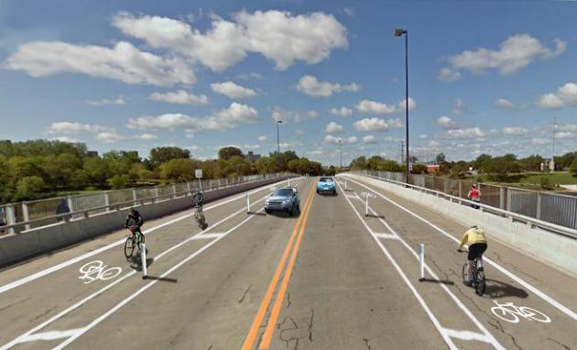
Separated bicycle lanes (SBLs) are a bicycle facility that employs both a paint and vertical element as a buffer between vehicle traffic and bicycle traffic.

In 2016, the City of Minneapolis increased the total mileage of separated bike lanes in the city from 5.4 to 9.4 miles with plans to increase that to 30 miles by 2020. While many other cities around the U.S. are in the process of installing separated bike lanes as part of their non-motorized transportation networks, research about them has not kept pace.

The Federal Highway Administration’s Separated Bike Lane Planning and Design Guide  identified several gaps in existing research, including the effects of SBLs on vehicle traffic, the preferred speed and volume thresholds to recommend SBLs, and the differences in safety between one- and two-way SBLs.

Despite safety being a major concern with SBLs, the guide states that “there are no existing studies that have satisfied best practices for analyzing the safety of SBLs.” The guide goes on to caution that even in cases where research on the safety or operational effects of SBLs does exist, “much of the highest quality research comes from outside the U.S.” The FHWA guide also lists cost as a gap in knowledge about SBLs, saying “few benchmarks exist for separated bike lane costs, which vary extensively due to the wide variety of treatments and materials used.”

This research project will provide a thorough synthesis of current research and guidelines and a comprehensive analysis of the impacts of different midblock bike lane designs to help Minnesota-based agencies make data-driven design and planning decisions. Design variables include delineator type and spacing, land and buffer widths, and one- vs two-way bike lanes. Impacts that would be evaluated include installation, maintenance, and user costs as well as safety and facility usage.

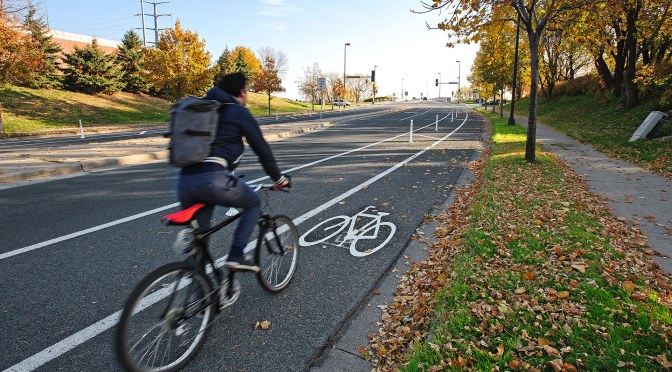
Two lane road with bicycle lanes on both sides of the road with cars on the road and cyclists in the bike lanes.

Objective

When considering installing SBLs, many aspects including impacts on both bicycle traffic and other types of traffic (pedestrians, passenger cars, delivery trucks, etc.) must all be considered. However, much of this information is unavailable. By providing a comprehensive repository for the relevant data on the numerous SBL design options, this project will allow engineers and policy-makers to make more informed decisions regarding bicycle infrastructure installations and improvements. Access to this sort of hard data will aid in the process of performing will aid in the prioritization of options for bike facilities thereby reducing the waste of funds on unneeded or unaffordable projects.

Scope

The tasks of the research project include:

  • Conduct a thorough literature review to identify any gaps in the current research.  Examples of this might include the effects of SBLs on all road users, frequency of bicycle and vehicle violations for various SBL designs, recommended speed and volume thresholds for installation, the costs associated with SBLs, or the differences in safety between one- and two-way SBLs.
  • Conduct research such as observational field studies, crash record analysis, synthesis of the results of other studies, road user surveys, review of previous project budgets, bicycle facility repair record analysis, municipal records of complaints and violations, or some combination thereof.
  • Develop a list of options for the design of multi-modal facilities and the respective impacts of those options based on findings from the field studies. This could include maintenance costs, user costs and safety impacts.

By providing transportation planners, engineers, and other practitioners new information on the impacts likely to be associated with different designs, the practitioners will be in a better position to both choose among designs and mitigate potential adverse effects of those designs. The list of design options and associated impacts will be summarized in a technical memorandum with a more thorough presentation in the project final report.

Watch for new developments on this project.  Other Minnesota transportation research can be found at MnDOT.gov/research.

Clearly Marked Bicycle Lanes Enhance Safety and Traffic Flow

Researchers evaluated bicycle and motor vehicle interactions at nine locations in Duluth, Mankato, Minneapolis and St. Paul,in a study sponsored by the Minnesota Local Road Research Board to better understand how bicycle facilities affect traffic. Results show that on shared roadways without clearly marked bicycle facilities, drivers are more inclined to pass bicyclists, encroach on other traffic lanes or line up behind bicyclists than on roadways with clearly striped or buffered facilities.

“This project gave us qualitative information and some quantitative information. The observations made provide something we can build on,” said James Rosenow, Design Flexibility Engineer, MnDOT Office of Project Management & Technical Support.

“The solid line makes the absolute difference in bicycle facilities— something that we haven’t seen in any other study. We found that the presence of a clearly marked or buffered bicycle lane makes a large difference in the way drivers behave around bicyclists,” said John Hourdos, Director, Minnesota Traffic Observatory, University of Minnesota.

What Was the Need?

The availability of multimodal traffic facilities encourages travelers to use a range of transportation methods, from driving to riding on public transit and bicycling. Although bicycle use is low compared to motor vehicle and public transit use, MnDOT’s Complete Streets program encourages cities and counties to dedicate roadway space to bicycle facilities to expand transportation options and “maximize the health of our people, economy and environment.”

Planners and engineers typically consider bicycle facilities from the bicyclist’s perspective. It is less common to design and plan for bicycle use from the driver’s perspective. However, effective multimodal planning requires an understanding of how bicycles affect traffic if congestion-causing interactions are to be avoided, particularly on high-volume roads. Bicycle facilities must invite use, ensure safety for all road users and at the same time not slow traffic.

What Was Our Goal?

This project aimed to investigate interactions between drivers and bicyclists on urban roadways that employ various bicycle facility designs, and to determine how different bicycle facilities affect traffic. Researchers sought to look at bicycle facilities from the driver’s point of view.

What Did We Do?

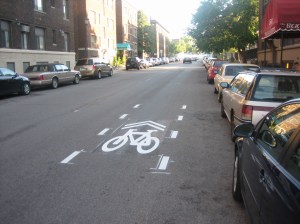
Pavement markings with directional arrows and a bicycle icon, called sharrows.
Sharrows can be marked with or without stripes. By themselves, sharrows seem to have no more impact on traffic than do no bicycle facilities at all.

The investigation team reviewed 44 bicycle facility design manuals and guidance documents, 31 research papers on implementation or assessment of facility designs, and design manuals used by seven other Complete Streets programs from around the United States to identify facility designs that warranted further study.

With help from the MnDOT Technical Advisory Panel and local planners, the team selected nine sites in Duluth, Mankato, Minneapolis and St. Paul that offered a range of facilities—buffered bicycle lanes, striped bicycle lanes, sharrows (shared-use arrows), signed shared lanes and shoulders of various widths.

At each site, they set up one to three cameras and videotaped during daylight hours for five to 51 days. Researchers then trimmed the video data into relevant car-and-bicycle-interaction time frames. This yielded from 16 to 307 hours of video from each site for detailed analysis.

The research team then reviewed the video and analyzed how drivers behaved when encountering bicyclists on roads with and without bicycling facilities. Researchers grouped driver behavior into five categories: no change in trajectory, deviation within lane, encroachment on adjacent lane, completion of full passing maneuver and queuing behind bicyclists. Researchers confirmed their observations with statistical modeling. After analyzing the results of behavior as it correlated with facility type, researchers presented the traffic flow implications of different bicycle facility designs.

What Did We Learn?

  • Literature Review. Almost all design guidance drew heavily on directives from the American Association of State Highway and Transportation Officials or the National Association of City Transportation Officials. Of the 62 bicycle facility design elements identified in bicycle guidance documents, fewer than half have been studied in any way for efficacy, safety or traffic impact.
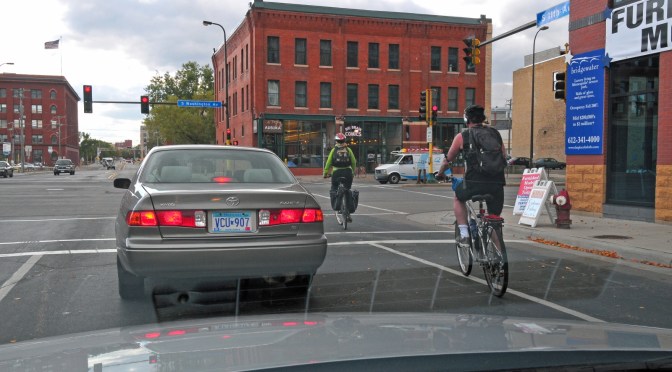
  • Video Analysis. On roadways with sharrows, signs for shared lanes or no bicycle facilities, drivers were more likely to encroach on adjacent lanes than were drivers on road-ways with buffered or striped bicycle lanes. Queuing, or lining up behind bicyclists, showed the greatest potential to impact traffic flows. The highest rates of lining up occurred on roads without bicycle facilities and roads with shared facilities but no marked lanes.
  • Implications. Sharrows may alert drivers to the presence of bicyclists, but in the impact they make on traffic, sharrows differ little from no bicycle facilities. Roadways with signs indicating shared lanes also show little difference in driver behavior from roadways with no facilities. Therefore, where space allows, buffered or striped bicycle lanes should be used instead of sharrows or signs to increase the predictability of driver behavior and reduce queuing impacts on traffic.

What’s Next?

This study provides enough data to support the recommendation of dedicated, striped or buffered bicycle facilities where demand or interest exists. However, the detailed video analysis conducted for this project provides only part of a three-dimensional study of the efficacy and value of various bicycle facility designs. Further study will be needed to quantify facility and vehicle-bicycle interaction in terms of other traffic impacts like speed and traffic flow coefficients, and to quantify crash rates and other safety impacts. Research is also needed to investigate bicycle facility demand and bicycle use on road-ways that do not currently have bicycle facilities.


This post pertains to the LRRB-produced Report 2017-23, “Traffic Impacts of Bicycle Facilities,” published June 2017.

New manual helps agencies count bike, pedestrian traffic

As part of an ongoing effort to institutionalize bicycle and pedestrian counting in Minnesota, MnDOT has published a new manual designed to help city, county, state, and other transportation practitioners in their counting efforts.

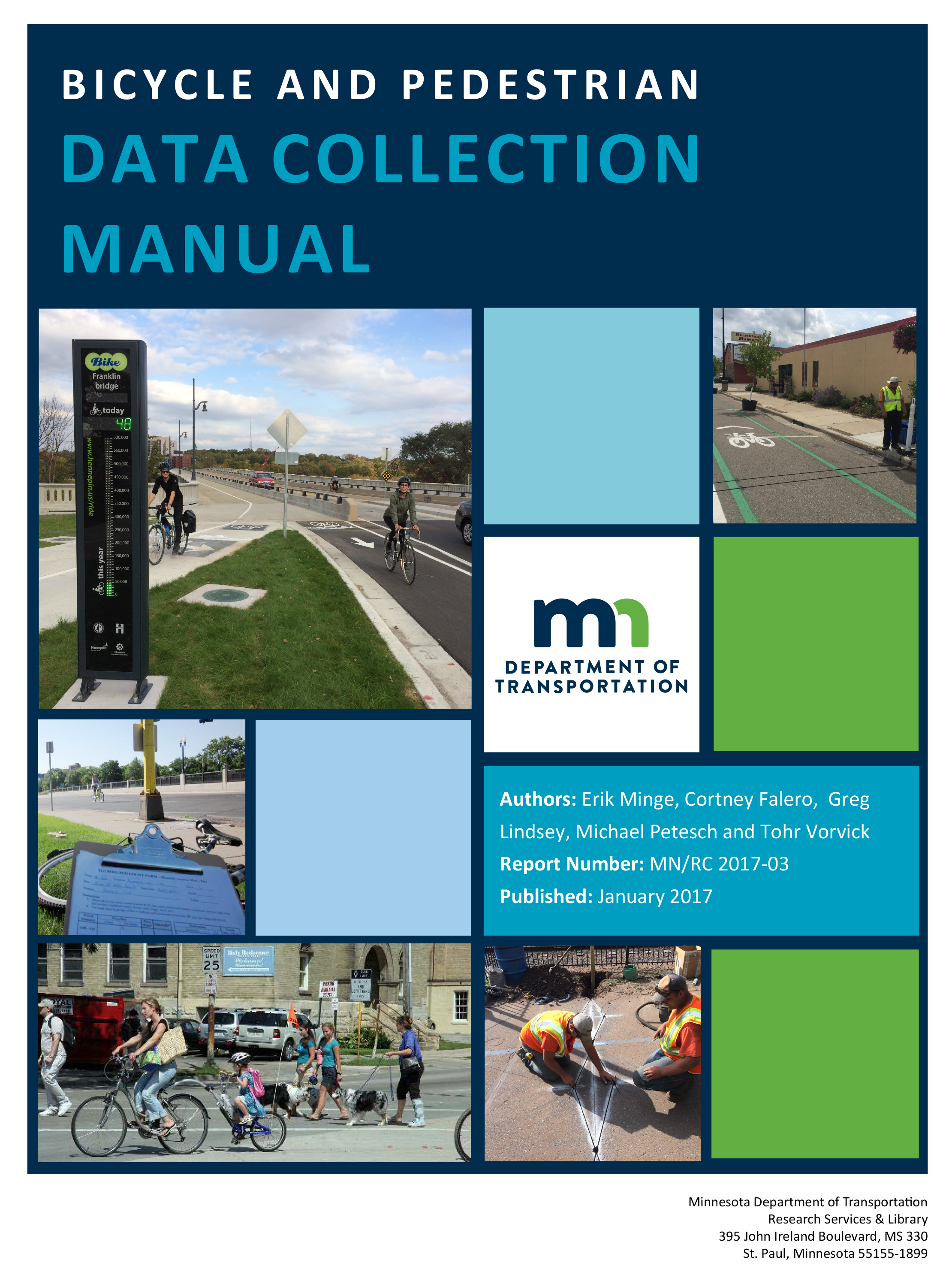
The Bicycle and Pedestrian Data Collection Manual, developed by University of Minnesota researchers and SRF Consulting Group, provides guidance and methods for collecting bicycle and pedestrian traffic data in Minnesota. The manual is an introductory guide to nonmotorized traffic monitoring designed to help local jurisdictions, nonprofit organizations, and consultants design their own programs.Bicycle and Pedestrian Data Collection Manual

Topics covered in the manual include general traffic-monitoring principles, bicycle and pedestrian data collection sensors, how to perform counts using several types of technologies, data management and analysis, and next steps for nonmotorized traffic monitoring in Minnesota. Several case studies illustrate how bicycle and pedestrian traffic data can be used to support transportation planning and engineering.

The manual was completed as part of the third in a series of MnDOT-funded projects related to the Minnesota Bicycle and Pedestrian Counting Initiative, a collaborative effort launched by MnDOT in 2011 to encourage nonmotorized traffic monitoring across the state. U of M researchers, led by professor Greg Lindsey at the Humphrey School of Public Affairs, have been key partners in the initiative since its inception.

In addition to the manual, U of M researchers have published a final report outlining their work with MnDOT on this project. Key accomplishments include:

  • A new statewide bicycle and pedestrian traffic-monitoring network with 25 permanent monitoring locations
  • A district-based portable counting equipment loan program to support MnDOT districts and local jurisdictions interested in nonmotorized traffic monitoring
  • Minnesota’s first Bicycle and Pedestrian Annual Traffic Monitoring Report
  • A MnDOT website for reporting annual and short-duration counts that allows local planners and engineers to download data for analysis
  • Provisions added to MnDOT equipment vendor agreements that enable local governments to purchase bicycle and monitoring equipment
  • Annual training programs for bicycle and pedestrian monitoring
  • Provisions in the Statewide Bicycle System Plan and Minnesota Walks that call for bicycle and pedestrian traffic monitoring and creation of performance measures based on counts

“This is an excellent resource that steps through all aspects of managing a count program, and I think it will be very helpful to other states and organizations that want to implement their own programs,” says Lisa Austin, MnDOT bicycle and pedestrian planning coordinator. “Since Minnesota is a leader in counting bicycle and pedestrian traffic, it also fulfills what I think is an obligation to share our story with others.”