Category Archives: Materials and Construction

MnROAD 2014 Peer Exchange (photo gallery)

MnROAD is hosting pavement researchers from around North America this week to discuss research conducted at its cold weather pavement testing facility in Albertville, Minnesota.

Participants at the three-day conference (June 10 to 12) are reviewing the findings of recent pooled fund studies, sharing their implementation experience and recommending what projects should be picked for the next round of research.

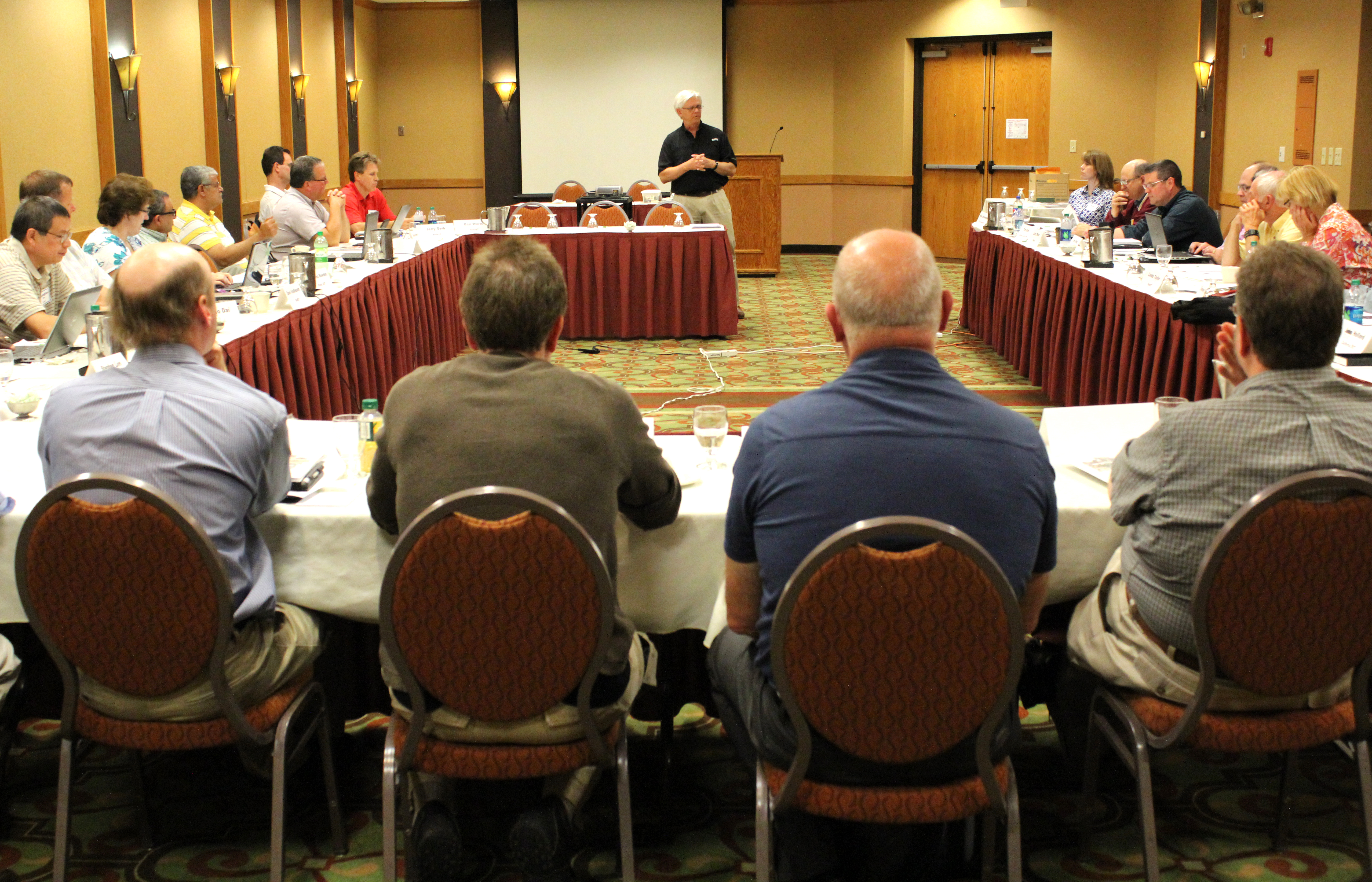
Bob Orthmeyer from the Federal Highway Administration, said MnROAD was the only facility in the country that could supply several test sections needed for a recent study.
Bob Orthmeyer from the Federal Highway Administration said MnROAD is the only facility in the country that could supply several test sections needed for a recent study.
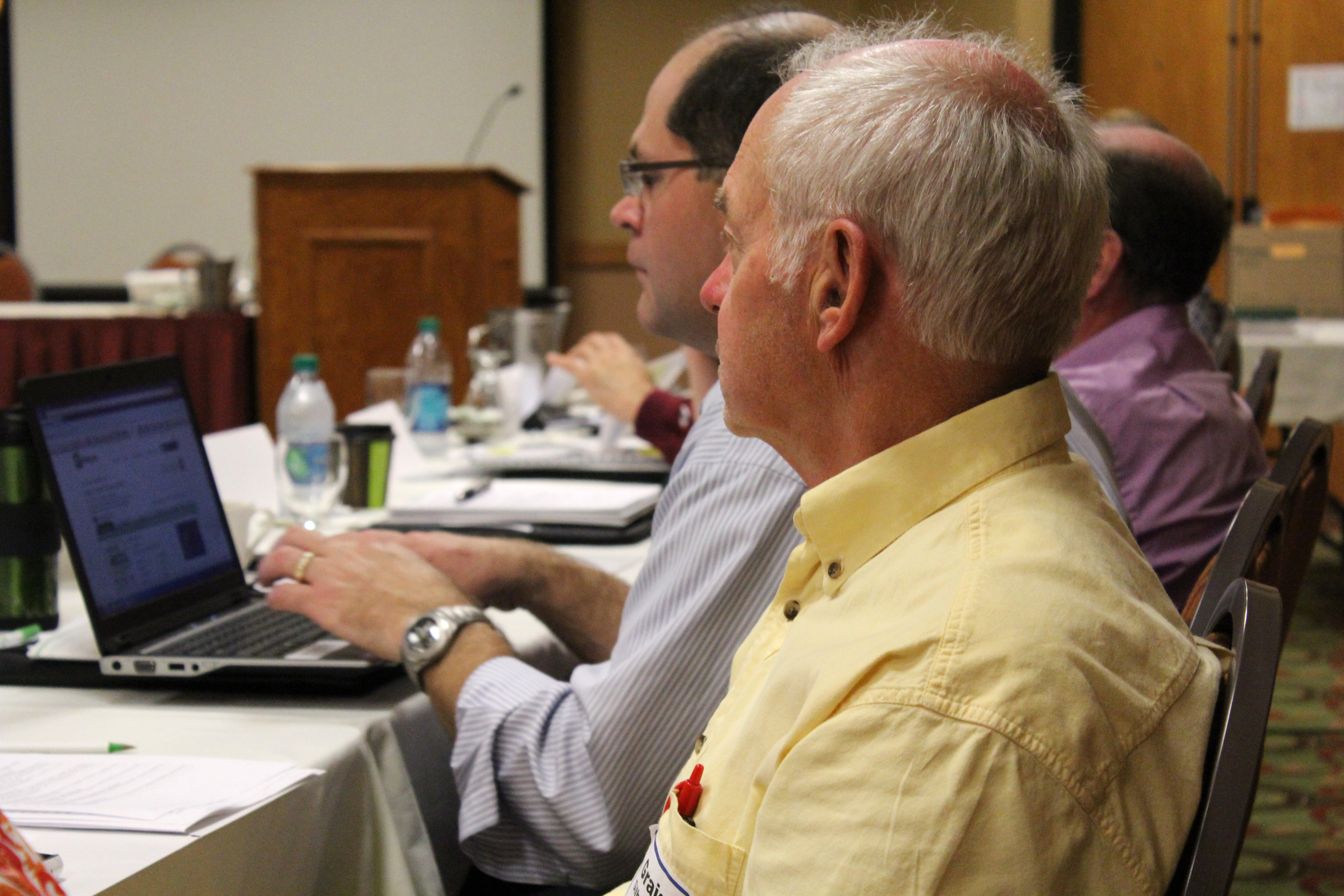
Graig Gilbertson from MnDOT District 8 listens to one of seven presentations Tuesday on the latest research.
Graig Gilbertson from MnDOT District 8 listens to one of seven presentations Tuesday on how agencies have implemented MnROAD’s second phase of research projects.
Stephen Lee shares the Ontario Ministry of Transportation's experiences during a discussion Tuesday on research implementation.
Stephen Lee shares the Ontario Ministry of Transportation’s experiences during a discussion Tuesday on research implementation.
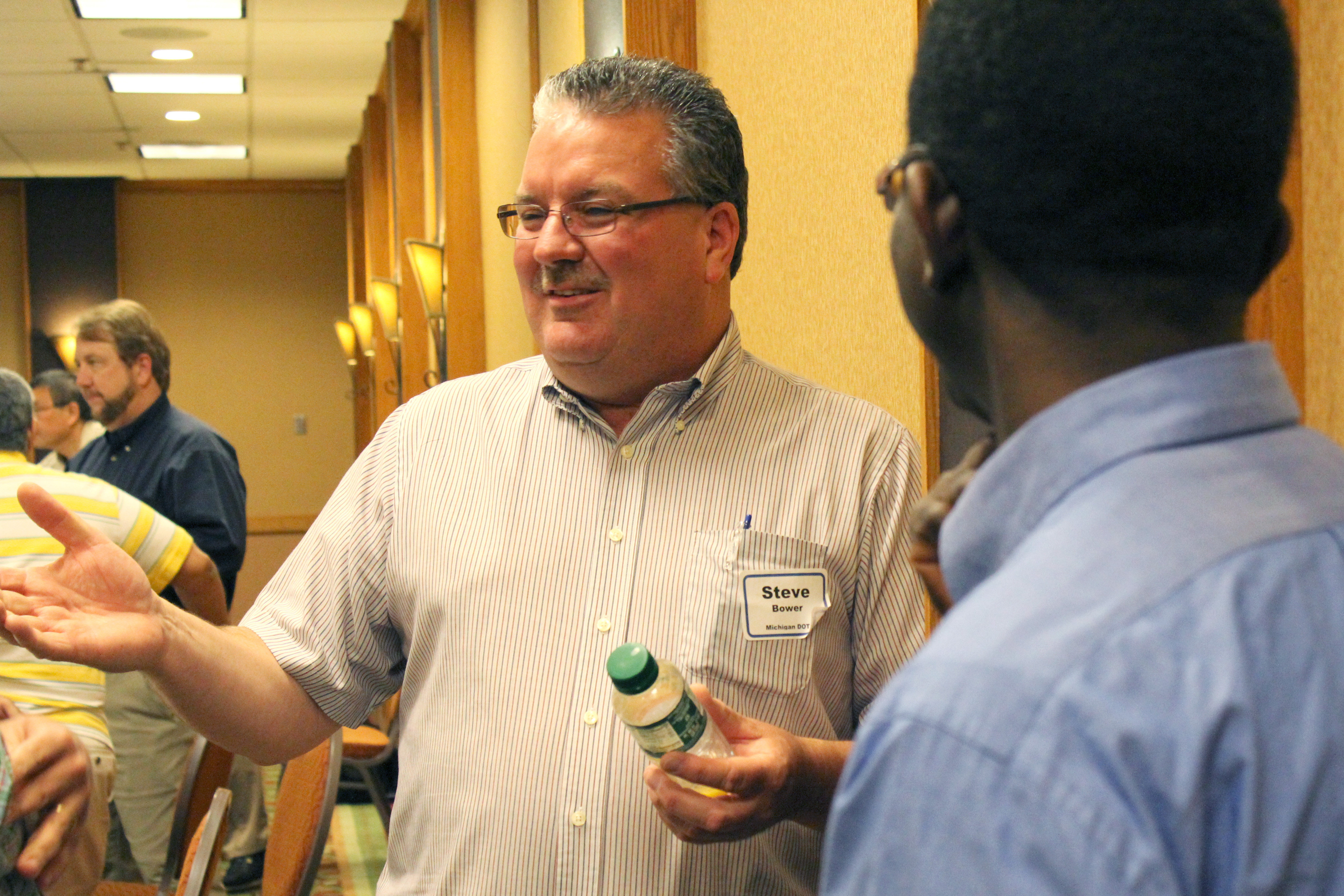
Steve Bower, a Michigan Department of Transportation Research Engineer, visits with MnROAD researcher Bernard Izevbakhai, right, and others during a break.
Steve Bower, a Michigan Department of Transportation Research Engineer, visits with MnROAD researcher Bernard Izevbakhai, right, and other peers.
Construction engineering professor Joe Mahoney, from the University of Washington, leads a group discussion on improving research efforts at the close of the session Tuesday.
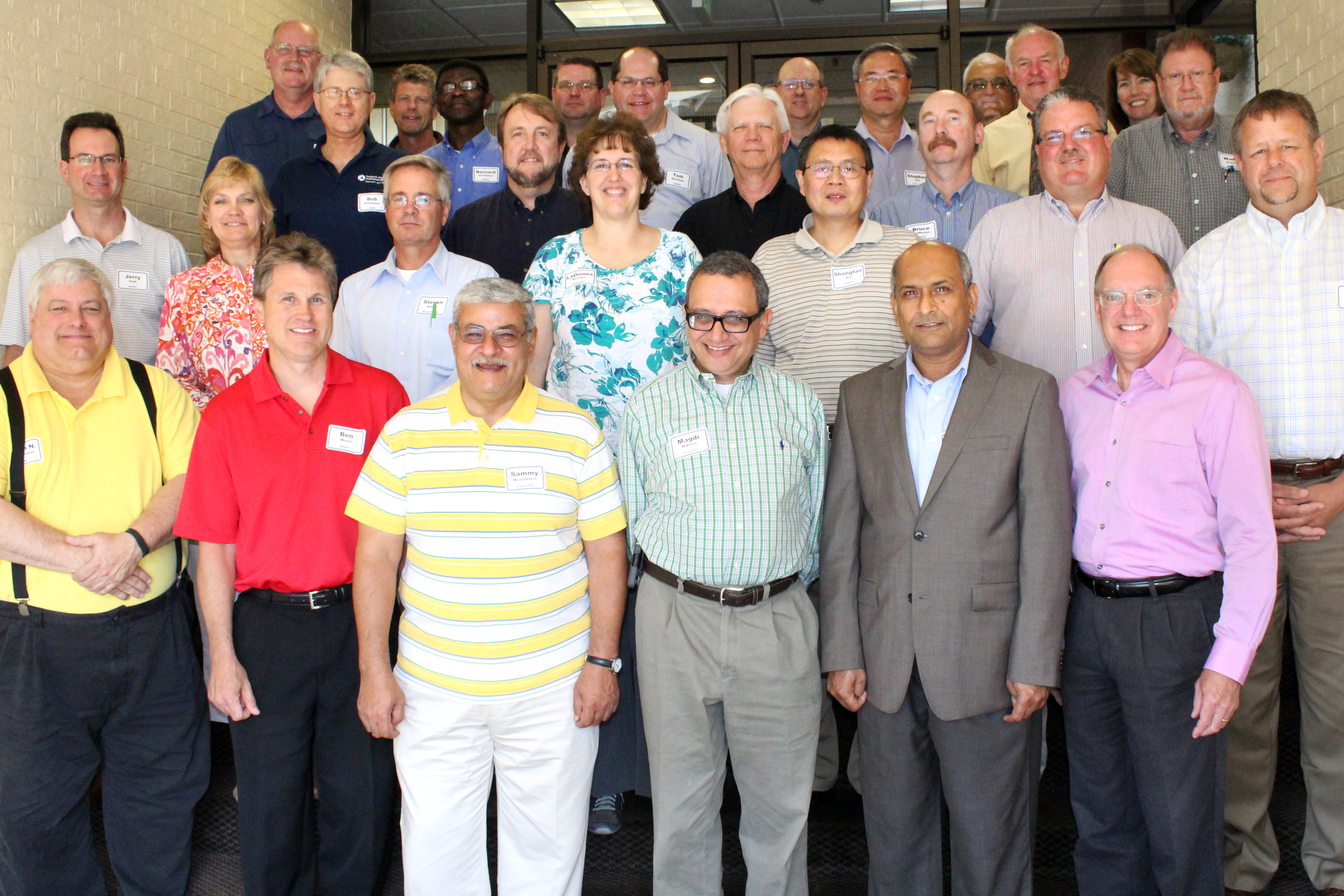
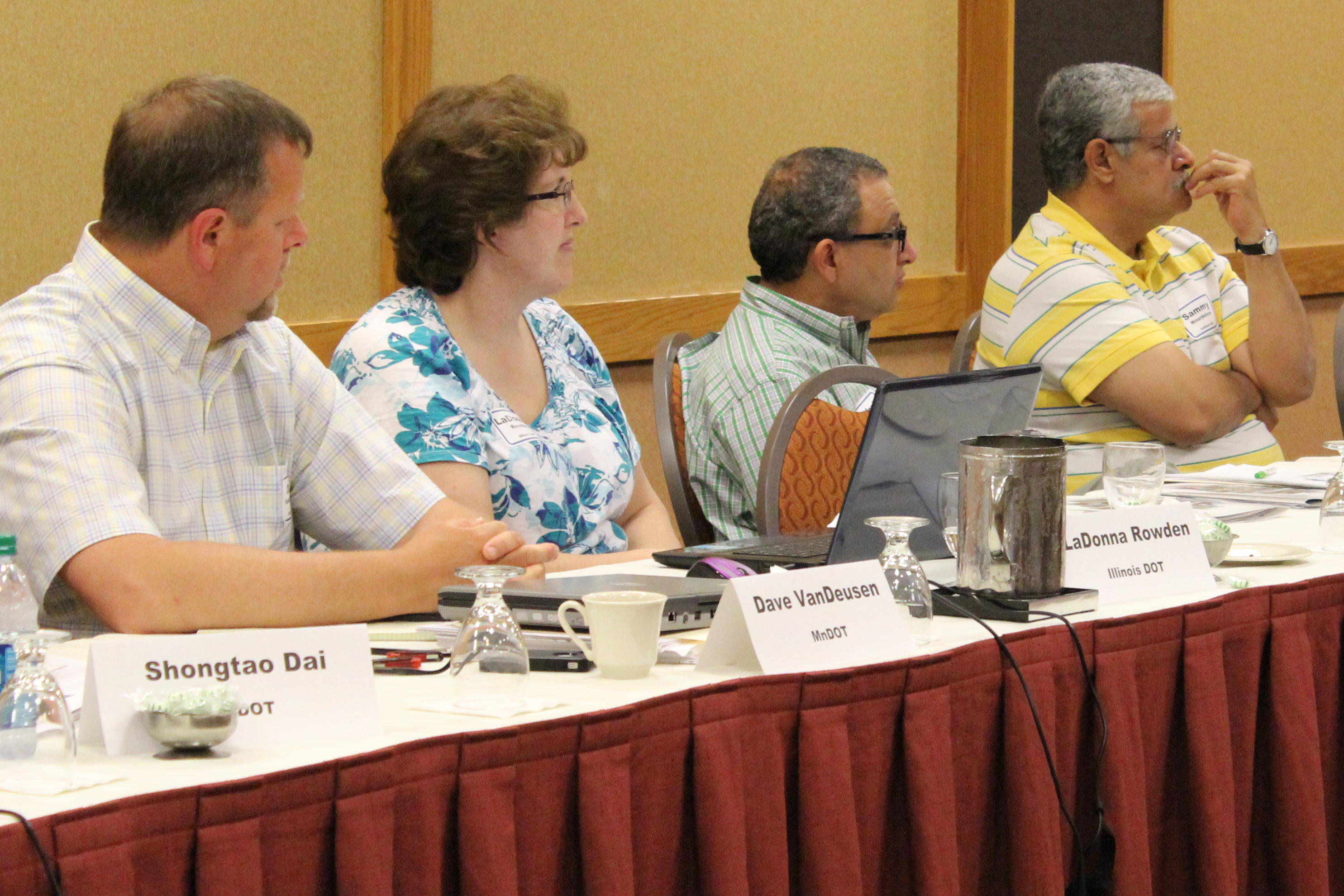
From left, Dave VanDeusen from MnDOT, LaDonna Rowden from the Illinois Department of Transportation, Magdi Mikhail from the Texas Department of Transportation and Samy Noureldin from the Indiana Department of Transportation. — at Holiday Inn Bloomington I-35W.
From left, Dave VanDeusen from MnDOT, LaDonna Rowden from the Illinois Department of Transportation, Magdi Mikhail from the Texas Department of Transportation and Samy Noureldin from the Indiana Department of Transportation.
Researchers came from Missouri, Maine, Texas, Illinois, Michigan, California, Ontario, Wisconsin, Indiana and Washington for the three-day workshop.


Back to gravel? As dollars shrink, counties look for solutions

A large percentage of Minnesota’s local highways were built in the 1950s, the same era that birthed the modern interstate system. But the golden age of highway construction has caught up to counties, who are struggling to maintain and rehabilitate aging road systems with fewer and fewer dollars.

“Our economic resources do not meet the financial investment needed as the bulk of our pavements surfaced in the 1950s reach the end of their useful life all about the same time,” said Freeborn County Engineer Susan Miller.

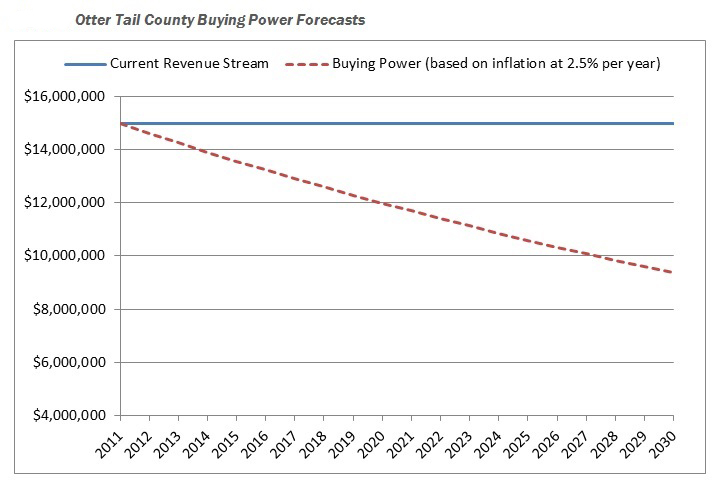
In rural Otter Tail County alone, the cost of road construction has climbed 10.5 percent per year for the past 10 years.

Meanwhile, there has been only one increase in funding — an 8.5-cent bump in the state gasoline tax “that was eaten up the moment it was enacted,” said County Engineer Rick West.

Otter Tail’s funding gap? An estimated $11 million in year 2011 alone.

With no change in sight, counties across the state are banding together in a research project through the Local Road Research Board to identify ways to reduce the size of their road systems and lower preservation costs.

Forced into a corner

The LRRB launched the study at the behest of counties who were considering turning some paved highways back to gravel just to get by — even though it would probably increase long-term maintenance costs.

In addition to providing expertise on that topic, consultants worked with a group of pilot counties to develop other strategies of stretching county road dollars further. These include: changing maintenance schedules; using different gravel road materials; transferring roads to city or township ownership; adopting different road performance measures; and raising local revenue.

“This project of how five different counties approach funding limitations and how to manage a system with constrained resources is one of the best that I have been a part of through the LRRB,” said Miller, who found the data critical to convincing her county board to pass a wheelage tax.

ottertail2

A new way of thinking

Although the ideas developed through the study aren’t entirely new, for a busy county engineer with few staff, the assistance to implement them has been very valuable.

“We’re practitioners — not researchers,” said Otter Tail’s Rick West. “It’s really forced us to look at our system in its entirety and from a long-range perspective. For us, that’s huge.”

The LRRB selected pilot counties (Dakota, Otter Tail, Freeborn, Stearns and Anoka) that reflect the diversity of the state. After researchers help them implement their chosen strategies, they will hold informational workshops for others throughout the state.

“Other counties with similar roadway preservation issues or management structures can follow these best practices,” said Michael Marti of SRF Consulting Group. “There are a lot of tools out there, there just needs to be more demonstration or training on each of these tools.”

Anoka County, for example, undertook a detailed analysis to determine which roads should become city-owned and which roads the county should assume.

The evaluation system used by Anoka, which examines travel data and other factors, could be adopted by other counties.

Public education

While some ways of changing the system of road maintenance may not be immediately popular, the community will get on board if they understand why, said Otter Tail County Board Chairman Wayne Johnson.

For instance, Otter Tail had to explain why it’s more cost-effective to sealcoat four-year-old roads than reconstruct beat-up, low-volume roads.

“That’s hard to get your arms around when it’s been the other way for 50 to 60 years,” Johnson said.

Community residents did, however, reject one possible strategy discussed at eight public outreach meetings: unpaving roads.

Otter Tail’s entire county road network is paved — a reflection of investments made back in the 1950s that have become somewhat of a community ethic for Ottertail’s 57,000 residents (a population that triples during the summer).

Tools used in the study enable counties to illustrate just how far behind they are in terms of maintenance and prioritize where to make improvements.

“Everyone wants roads to be maintained, but until the road system preservation study, nobody understood the magnitude of the funding gap between where we are and what we need to do to preserve the system,” said Johnson, who recently shared his county’s findings at the National Association of County Engineers conference.

The data is critical for the public to understand why a county might seek a local tax or different method of road maintenance.

“It’s far better to try to tell them what the problem is on the front end, rather than defend the decision on the back end,” Johnson said. “We’re after them to buy into something because it’s their roads and their money.”

Resources
  •  The project findings will be completed later this year and available on the LRRB’s website.

New test could help asphalt pavements survive winter intact

If there was ever a winter that demonstrated what cold weather can do to asphalt pavements, last one was it. But future winters may wreak less havoc on Minnesota roadways, thanks to a new asphalt mixture test in the final stages of evaluation by MnDOT’s Office of Materials and Road Research (OMRR).

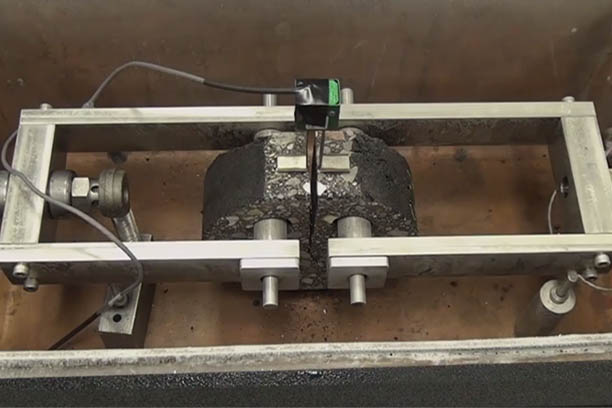
Developed through a decade-long multi-state research project, the Disc-shaped Compact Tension (DCT) test evaluates the low-temperature performance of asphalt mixes. (See a video about the project that helped develop the DCT test below.)

For the first time, engineers will be able to predict how well a contractor’s proposed asphalt mix will hold up under harsh Minnesota winters.

“Performance testing is assuring that we’re getting what we’re paying for,” explained MnDOT Research Project Engineer Luke Johanneck.

Low-temperature cracking is the most prevalent form of distress found in asphalt pavements in cold climates. As the temperature drops, the pavement tries to shrink, creating cracks that allow water to seep in and eventually lead to pavement deterioration.

Until now, engineers have typically evaluated the individual components (such as amount of crushed aggregate and asphalt binder grade) and volumetric properties (such as air voids and asphalt content) of an asphalt mix, not how the final product performs in low temperature.

“It’s like baking a cake,” explained MnDOT Bituminous Engineer John Garrity. “Our current system says put in a half-cup of oil, two eggs and cake mix. Rather than just looking just at those individual components, taste the cake to see how good it is.”

Created by researchers at the University of Illinois, the DCT test applies tension to an asphalt mixture sample to determine its thermal fracture resistance. The test was determined to be the best of several methods looked at in another research study, conducted by the University of Minnesota with assistance from neighboring state universities.

The Disc-Shaped Compact Tension Test measures the fracture energy of asphalt  mixture lab or field specimens, which can be used in performance‐type specifications to control various  forms of cracking.
The test measures the fracture energy of asphalt mixture lab or field specimens, which can be used in performance specifications to control various forms of cracking.

The Office of Materials and Road Research is conducting pilot tests to become more familiar with the DCT test and to educate road contractors, who may eventually be required to use the test in Minnesota.

“This is very new to a lot of people that have been in the business for a long time,” Johanneck said.

Last summer, OMRR asked five contractors to submit asphalt mixes for testing. If a mix didn’t pass, the contractor was given suggestions for how to modify their recipe to better resist thermal cracking. This summer, OMRR plans to collect asphalt mixes from around the state to see how they measure up against a set of performance targets that were developed in the pooled fund study.

“We envision this at some point being part of our standard bid specifications,” Garrity said.

Those with a professional interest in the subject might be interested in a new video from MnDOT Research Services & Library (below) that demonstrates how to do the sample preparation for the DCT test.

Research Studies

Current DCT Test Implementation Project (2014) Pooling Our Research: Designing Asphalt Pavements That Resist Cracking at Low Temperatures (March 2013 Technical Summary) Synthesis of Performance Testing of Asphalt Concrete (September 2011) Investigation of Low Temperature Cracking in Asphalt Pavements National Pooled Fund Study 776 (2007 report)

Related Videos

Frost Damage in Pavement: Causes and Cures (full-length) Frost Damage in Pavement: Causes and Cures (short version)

Flume research simulates Red River flooding to test road protections

Flooding in the Red River Valley is an almost annual occurrence, and the cost to roads, property and lives is huge.

Highway 1 gets torn up year after year, only to be rebuilt in time for next year’s flood, joke residents in the little town of Oslo, which becomes an island whenever the roads close.

While not much can be done to prevent swollen farm fields from overflowing, what if a road embankment itself could be bolstered to prevent physical damage to the underlying structure of the road?

“We can’t just raise the road because it would create backwater upstream,” explained JT Anderson, Assistant District 2 Engineer. “Our best bet is to let the water over-top the road and try to protect the road when it does.”

Researchers have built a flume inside the University of Minnesota’s St. Anthony Falls Laboratory to test six methods of embankment protection specific to the needs of towns like Oslo.

“It is not uncommon for one over-topping site to have a half-mile long stretch of road being damaged,” said university research engineer Craig Taylor. “One road being protected should cover the cost of the study and the cost of deploying the erosion control product for that road.”

Nationally, research of this kind has mostly been restricted to high-intensity flooding.

“Those really high-depth, short duration events, you can only protect an embankment with concrete and boulders,” Taylor said. “With longer duration, low-depth floods, we may be able to protect roads with soft armoring, like reinforced vegetation.”

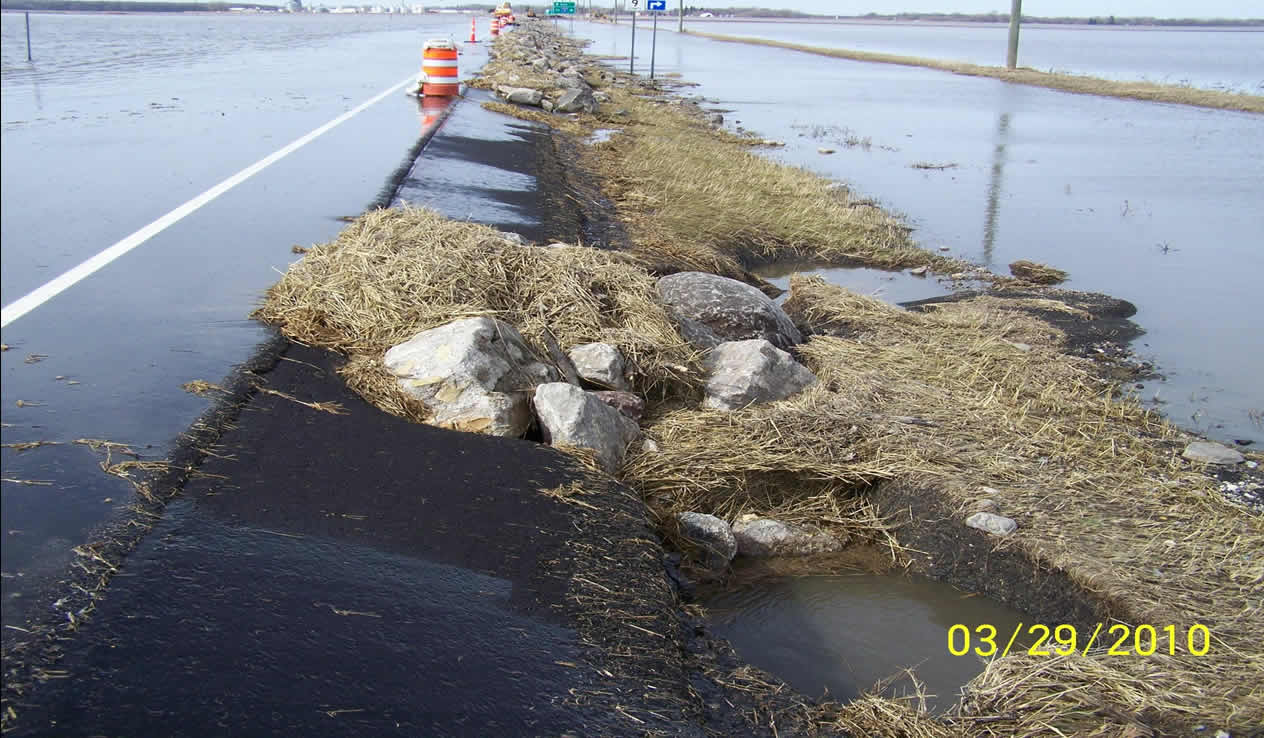
The damage in northern Minnesota has been the worst on east-west roads, where the river flow runs perpendicular to the center of the road, causing the road to act like a dam and the water to jump at the edges.

“It eventually eats through that road embankment and makes the road collapse,” Anderson explained.

Researchers will examine how a cross-section of a road holds up under various erosion control methods at different levels and speeds of water-flow.

The damage from flooding was less in 2010 after engineers added rocks and vegetation to the side of Highway 9, near Ada.
The damage from flooding was less in 2010 after engineers added rocks to the side of Highway 9, near Ada, Minn.

One test will be to slow the flow of water by covering the road shoulder with a rubberized membrane and temporary water-filled tubes.

Permanent schemes — such as turf reinforcement mats and rocks — will also be tested.

“These methods have been deployed in the field, but you never really know under which conditions they survived or failed,” Taylor said.

In the Red River Valley, MnDOT engineers have tried a combination of vegetation and boulders, as well as concrete blocks covered with topsoil, to protect highways. Flattening a slope is another option.

“I expect that a single erosion protection technique will not cover every situation our road embankments may be exposed to at any given location,” Anderson said.  “Rather, I expect we would look at using several different techniques in concert to develop an effective erosion protection system for the expected velocities.”

Innovative pavement textures reduce noise, improve fuel economy

What if something as simple as changing the texture of the pavements we drive on could not only increase safety, but also reduce noise pollution and boost our vehicles’ fuel economy?

It’s possible, according to the latest research from MnROAD, the state’s one-of-a-kind pavement research facility. In a new report, investigators detail how quieter pavement textures, such as those applied by grinding grooves into pavements with diamond-coated saw blades (see the photo above), may also reduce rolling resistance — the force that resists a tire as it moves across the pavement’s surface.

The potential benefits to the public are significant. A 10-percent reduction in rolling resistance could reduce the U.S. public’s fuel consumption by 2–3 percent, eliminate up to $12.5 billion in fuel costs each year (as well as cutting carbon emissions). Add on the cost savings from reducing noise pollution (building noise barriers along highways can cost as much as $3 million per mile), and it’s clearly a win-win situation.

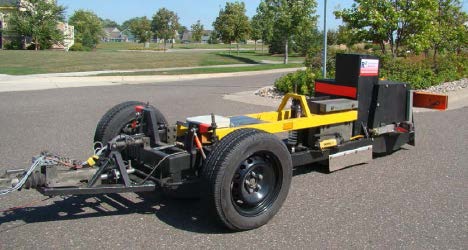
In the study, researchers used an innovative line-laser profiler to develop three-dimensional representations of test pavement surface textures. They then investigated the relationship between these surface characteristics and data on rolling resistance that was collected during a 2011 study using a special test trailer developed by researchers in Poland. This year, the same trailer will be used to conduct a second round of rolling resistance measurements at MnROAD.

The research is related to an ongoing pooled-fund study on concrete pavement surface characteristics. The goal is to produce data that will allow MnDOT to identify ideal ranges for surface characteristics that improve pavements’ quietness and ride quality while keeping them safe and durable.

Learn more
Researchers relied on rolling resistance data from a study conducted in 2011 with a test trailer developed by the Technical University of Gdańsk, Poland. This was the first time such measurements were taken in the United States.

MnROAD earns concrete pavement association award

Staff from MnROAD, the Minnesota Department of Transportation’s cold weather road research facility in Albertville, Minn., were presented with the Marlin J. Knutson Award for Technical Achievement by the American Concrete Pavement Association in December.

The award cites the facility’s well-deserved reputation for being a place where both agency and industry ideas are put to the test. This award was presented as a tribute to the agency’s commitment to learning and putting ideas into practice.

The Marlin J. Knutson Award for Technical Achievement is presented to an individual or group who has made significant contributions to advance the development and implementation of technical innovations and best practices in the design and construction of concrete pavements.

(far right) Gerald Voigt, ACPA president and CEO, presented MnDOT with the Marlin J. Knutson Award for Technical Achievement during a ceremony in December. Receiving the award are (from left) Luke Johanneck, Bernard Izevbekhai, Roger Olson, Tom Burnham, Glenn Engstrom, Maureen Jensen and Sue Mulvihill. (Photo courtesy of the ACPA)
(Far right) Gerald Voigt, ACPA president and CEO, presented MnDOT with the Marlin J. Knutson Award for Technical Achievement. Receiving the award are (from left) Luke Johanneck, Bernard Izevbekhai, Roger Olson, Tom Burnham, Glenn Engstrom, Maureen Jensen and Sue Mulvihill. (Photo courtesy of the ACPA)

“MnROAD is helping to make roads last longer, perform better, cost less, construct faster, and have minimal impact on the environment,” said Gerald Voigt, ACPA president and CEO. “It is a model for other agencies to follow.”

MnROAD is a pavement test track initially constructed between 1991-1993. It uses various research materials and pavements and finds ways to make roads last longer, perform better, cost less to build and maintain, be built faster and have minimal impact on the environment. MnROAD consists of two unique road segments located next to Interstate 94.

Staff from the MnROAD facility in Albertville were recognized during the ACPA’s Distinguished Service and Recognition Awards ceremony in December. (Photo by David Gonzalez)

This article, authored by Rich Kemp, originally appeared in Newsline, MnDOT’s employee newsletter. 

Geotextile research at MnROAD

Geotextiles are synthetic polymer materials used to improve the performance of roadways. As discussed in this 2011 technical summary, geotextiles facilitate filtration and water drainage, improve the integrity and functioning of base materials, and provide a stable construction platform over soft or wet soils. These improvements can benefit both the cost-efficiency and longevity of pavements.

Geosynthetic materials have been used throughout Minnesota, and can be found in both reconstructed and new roadway projects. The use of geotextiles as a separator layer under concrete overlays, however, has had limited documentation in Minnesota and other cold weather climates. MnROAD‘s recent dedication of several test cells to this purpose will determine the performance of this application of geotextiles, with the goal of improving its applications on other Minnesota roadways.

The new test sections, designated as Cells 140 and 240, consist of a very thin, 3-inch concrete overlay over an existing 7-inch concrete pavement constructed 20 years ago. Some unique features of the design include the use of a fiber-reinforced concrete mix, two different thicknesses of the nonwoven geotextile, and the use of a special type of glue, rather than nails, to fasten it to the existing concrete before paving.

The fabric and fiber used in the concrete mix were supplied through a public-private partnership with Propex Geotextile Systems. The results of this study, along with other unbonded overlays constructed at MnROAD and around the country, will be incorporated into a new national pooled fund project — TPF 5-(269) — led by MnDOT. This project will develop an improved mechanistic design procedure for unbonded overlays.

A second application being demonstrated at MnROAD is the use of a geosynthetic drainage system under several dowel bar baskets in new concrete pavement test section. Minnesota has historically used a dense-graded base layer under concrete pavements to provide a stable foundation and construction platform. However, this material drains very slowly, and traps moisture within the joints, leading eventually to significant distress (See Effect of Drainage on the Performance of Concrete Pavement Joints in Minnesota.) This application will compare the use of the geotextile drainage material placed under both sealed and unsealed joints, as well as a control joint without the drainage material.

Permeable pavements could protect the environment, save taxpayer dollars

KSTP has a nice story today on the Minnesota Department of Transportation’s ongoing research into permeable pavements at the MnROAD research facility. (The video isn’t embeddable on WordPress, but you can find a direct link here.)

Permeable pavements (also known as “porous” or “pervious” pavements) are designed to allow water to pass through roadways and infiltrate directly into the underlying aggregate and soil. Their primary effect is to reduce stormwater runoff, which carries harmful materials from the road’s surface out into waterways. Of course, reducing runoff also mitigates the need for the kinds of costly drainage structures that are normally required to manage stormwater. Permeable pavements also reduce noise and mitigate the potential for hydroplaning, among other documented benefits.

These types of pavements are already used in some areas in Minnesota — mainly in parking lots and city streets — and MnDOT has been studying their potential use for full-depth roadway pavements. As the video indicates, so far the results have been encouraging. (You can read more about MnDOT’s ongoing research on the MnROAD website.)

As a side note, the amount of water these pavements can absorb is quite impressive. Last month, we posted a new Local Road Research Board video on stormwater management. In one scene, a public works crew dumps what appears to be several hundred gallons of water onto a permeable pavement and watch as it disappears almost instantaneously. (Watch the clip here.)

Here are the results of some recent permeable pavement studies here in Minnesota:

Construction kickoff at MnROAD, the state’s high-tech road research facility (updated)

*Editor’s note: This article was updated 6/11/13 with additional information provided by MnROAD engineers.

You’re probably aware that MnDOT recently kicked off its 2013 construction season, comprising $1.1 billion in new transportation investments in more than 300 projects across Minnesota. What you might not know is that another MnDOT construction season has begun at MnROAD, the department’s unique, high-tech pavement test facility located near Albertville, Minn.

MnROAD serves as a proving ground for innovative pavement designs, equipment and construction techniques that help transportation professionals all over the world strengthen roads, cut costs, and reduce construction times. It has a two test tracks — a 3.5- mile mainline carrying “live” traffic and a 2.5-mile closed-loop, low-volume roadway — that are used for state, university and private industry pavement research. These tracks are made up of dozens of individual “cells,” which are unique stretches of pavement each representing several research projects.

This summer, several test cells are being torn up and repaved. Cell 40, a 20-year-old concrete pavement, will receive an innovative 3-inch thick unbonded concrete overlay.  To increase the capacity of such a thin overlay , a fiber-reinforced concrete mixture will be used.  To separate and cushion the thin overlay from the existing concrete, two different thicknesses of nonwoven geotextile fabric will be laid.  This will help MnROAD researchers to understand how much cushioning is needed, as well as the drainage capacity of each fabric.  Fabric interlayers are gaining popularity as an alternative to asphalt interlayers.

Thin concrete overlays of asphalt, commonly known as whitetoppings, will also be used to reconstruct Cells 60-63.  Similar to Cell 40, fiber reinforced concrete will be used to test its benefit in supplementing load transfer at joints and across cracks.  Pavement built with this material will be strengthened by the fiber, prolonging a road’s lifespan, and potentially allowing for thinner concrete pavements.  Findings from Cells 40 and 60-63 support the ongoing development of improved design procedures for concrete overlays.

Cell 13 reconstruction is using recycled concrete aggregate provided by the contractor’s stockpile from other pavement projects. The concrete from the stockpile will be included in the concrete mix — a new practice to understand how to better recycle paving materials and ascertain the cost and benefits of this practice. Cell 13 will also be testing two innovative types of preformed joint sealants, and several joints drained by geotextile drains.

Construction updates are available on the MnROAD website as well as information regarding current research projects.

Image from MnROAD's 2013 construction kickoff.
Removing concrete in MnROAD Cell 13.