
Transportation research comes in many different forms and methodologies…
Tag Archives: transportation
New LRRB videos focus on work zone safety
The Minnesota Local Road Research Board is a major source of funding for transportation research in the state. Occasionally, it also produces educational videos designed to raise public awareness of important transportation topics.
Two new video offerings from the LRRB (embedded above and below) are focused on save driving in work zones. While not directly research-related, they might prove a useful resource to transportation professionals. More importantly, they serve to remind us all of the very real and dramatic consequences of work zone crashes, of which there are approximately 2,000 per year in Minnesota.
You might want to also check out some of their other recent YouTube offerings, including explanations of why we need stop signs and speed limits, as well as a fascinating look at how potholes are patched.

Previewing MnDOT’s next round of research projects
MnDOT Research Services recently released its 2013 request for proposals. If you have any kind of direct interest in transportation research in Minnesota, chances are you might have known that already. But those with more of a general curiosity might be interested to see the list of research need statements from the RFP, as they provide a nice preview of the next round of potential MnDOT research projects.
As you can see, some are of a highly technical nature. (It’s safe to say that a study on “PCC Pavement Thickness Variation Versus Observed Pavement Distress” would be of interest mainly to engineers.) Others, however, like “The Economic Impact of Bicycling in Minnesota,” might have a broader appeal. In any case, it’s a fascinating glimpse at the myriad of issues that MnDOT is attempting to address through research and innovation.
Here’s the list of research need statements from the 2013 RFP, broken down by category:
Environment
- Weights and Measurements for Verification of High Organic Soils
- Automated flocculation dosing rates based on real-time turbidity and flow monitoring
Maintenance
Materials and Construction
- PCC Pavement Thickness Variation Versus Observed Pavement Distress
- Evaluation of Recycled Aggregates Test Section Performance
- Design Guideline for Stabilization of Unpaved Shoulder—Phase I (Synthesis study)
- Optimal RAP Content for Minnesota Gravel Roads
- Modernizing Road Construction Plans and Documentation
- Alternate Design Methods to Renew Lightly Traveled Paved Roads
- Full Depth Reclamation (FDR) for Urban and Suburban Street Application
- Prevention of Stripping Under Chip Seals
- Bio-Fog Seal Evaluation
Multimodal
- Understanding and Communicating the Tradeoffs Associated with Urban Roadway Design
- Traffic Impacts of Bike Lanes
- The Economic Impact of Bicycling in Minnesota
- Coordination of Inter-City Multimodal Investments
Policy and Planning
- Methods for Evaluating the Economic Development Potential of Transportation Projects
- Barriers to Right-of-Way Acquisition and Recommendations for Change
Traffic and Safety
- Evaluation of Intersection Conflict Warning Systems
- Dynamic Traffic Assignment (DTA) Mesoscopic Travel Model
- Driver Performance with Future Warning Sign Delivery
- Evaluation of Safety and Mobility of Two-Lane Roundabouts
- Safety study of 35W improvements done under UPA project
- Development of a Queue Warning System Utilizing ATM Infrastructure

What happens when you incentivize transit use during construction projects
In 2010, MnDOT began a three-year long, $67 million repair and upgrade project on I-35 in Duluth. Dubbed the “Mega Project,” it created a serious disruption for Duluth-area commuters. To help mitigate the impact, the Duluth Transit Authority stepped up its bus services, offering free rides in newly established bus-only express lanes as well as access to new park-and-ride lots and various other enticements. Perhaps not surprisingly, many area residents took advantage of their new transit options to avoid construction-related travel delays. But what’s really interesting is what happened after the construction ended.
As described in a recently published MnDOT/University of Minnesota study, commuters who started taking the bus to avoid traffic caused by the construction ended up continuing to ride the bus even after the construction ended. Researchers surveyed riders during and after the 2010 and 2011 construction seasons and found that, even after bus fares went back to normal levels, only 15 percent of the new bus users switched back to driving. Researchers concluded that once riders developed a habit of using transit, the habit tended to stick.
The report author sums up the phenomenon quite nicely in her executive summary:
Human beings are creatures of habit. Most of us travel the same route every day to the same destination. Sometimes, however, something comes along to push us to examine our habits and possibly change them. A major highway construction project can be such an event. (…) This provides a very good opportunity to examine our travel patterns and possibly change our habitual modes.
Of course, this change didn’t just happen on its own. As the technical summary notes, the DTA marketed its services aggressively during this period. (The above photo is just one example.) The study also noted that the elimination of expanded bus services in the winter had a negative impact on ridership.
Read more:

Best practices for trail crossings – webinar and draft report
Last week, MnDOT Research Services hosted a workshop on a forthcoming report, “Decision Tree for Identifying Alternative Trail Crossing Treatments.” It was broadcast as a webinar, the recording of which is now available online via Adobe Connect:
http://mndot.adobeconnect.com/p8hlfripuwe/
The final report is coming soon, but in the meantime you can see the draft version on our website (link), along with case studies and other related documents.
Portable weigh-in-motion system demonstration
Weigh-in-motion (WIM) systems consist of sensors placed in road pavements to measure the weight of vehicles passing over them, along with other data such as speed, axle load and spacing, and vehicle type. This data is used to enforce weight limits on trucks and is also useful in a wide range of other applications, such as pavement design and traffic analysis.
However, constructing and maintaining permanent roadside WIM stations is expensive, so these systems are installed primarily on roadways with heavy traffic, such as interstate and trunk highways, and rarely used for rural local roads. Meanwhile, heavy truck volumes on local roads are increasing, significantly shortening their lives. A less costly, portable WIM system is needed for such roads so that collected data can be used to better design these roads to accommodate heavy truck traffic.
One solution for bringing WIM technology to local roads is to implement a portable, reusable system similar to pneumatic tube counters used to conduct traffic counts. With funding and technical assistance from MnDOT and the Local Road Research Board, Professor Taek Kwon of the University of Minnesota—Duluth has developed a prototype system that has already proven to be nearly as accurate as the more expensive, permanent systems. MnDOT Research Services staff drove up to MnROAD this week to observe a live demonstration of the technology, and made this short video.
The research being conducted here is part of an implementation project based on Kwon’s original study, the results of which can be found in this research report and its accompanying two-page technical summary from MnDOT Research Services.
Research partnerships create better pavements
As is painfully evident this time of year, Minnesota’s weather is highly destructive to our asphalt roadways. One of the biggest challenges for transportation practitioners in cold-climate states like ours is low-temperature cracking in asphalt pavements. The distress caused by our extreme weather variations and constant freeze-thaw cycles wreaks havoc on our asphalt streets and highways, causing decreased ride quality, increased maintenance costs and shorter pavement lifespans.
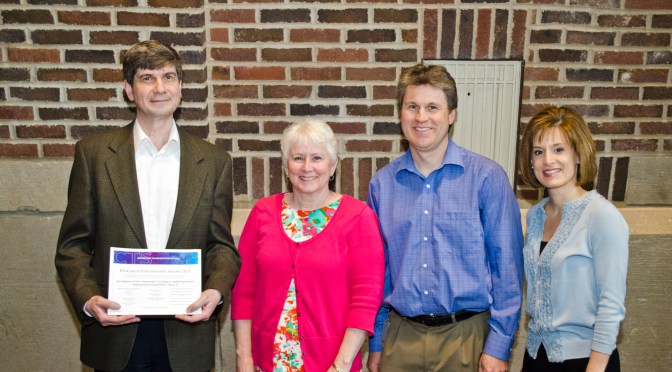
On April 17, the Center for Transportation Studies presented its 2013 Research Partnership Award to the team members of a multi-state, Minnesota-led study designed to combat the problem. The project, “Investigation of Low Temperature Cracking in Asphalt Pavements, Phase II,” was a national pooled-fund study involving six state DOTs, four universities, the Minnesota Local Road Research Board and the Federal Highway Administration. It resulted in a new set of tools — test methods, material specifications and predictive models — that will be used to build longer-lasting pavements.
The project is a prime example of the value and benefits of cooperative research. Each organization brought its own unique strengths and expertise to bear on the problem. The University of Minnesota, led by Professor Mihai Marasteanu, brought its strength in lab testing of binders and mixtures, for example; other universities leveraged their respective expertise in data analysis, statistics and modeling capabilities. MnDOT, as the lead state agency, controlled the finances and kept the research on track, guiding the process through technical advisory panels. MnDOT’s materials laboratory and its unique MnROAD pavement research facility also played a key role in the study.
The above video provides an excellent overview of the project and includes commentary from key MnDOT and University of Minnesota team members. MnDOT is already moving to implement the results. It plans to use the new test procedure on several road construction projects this year. Iowa and Connecticut are among the other states reportedly planning implementation projects.
See also:
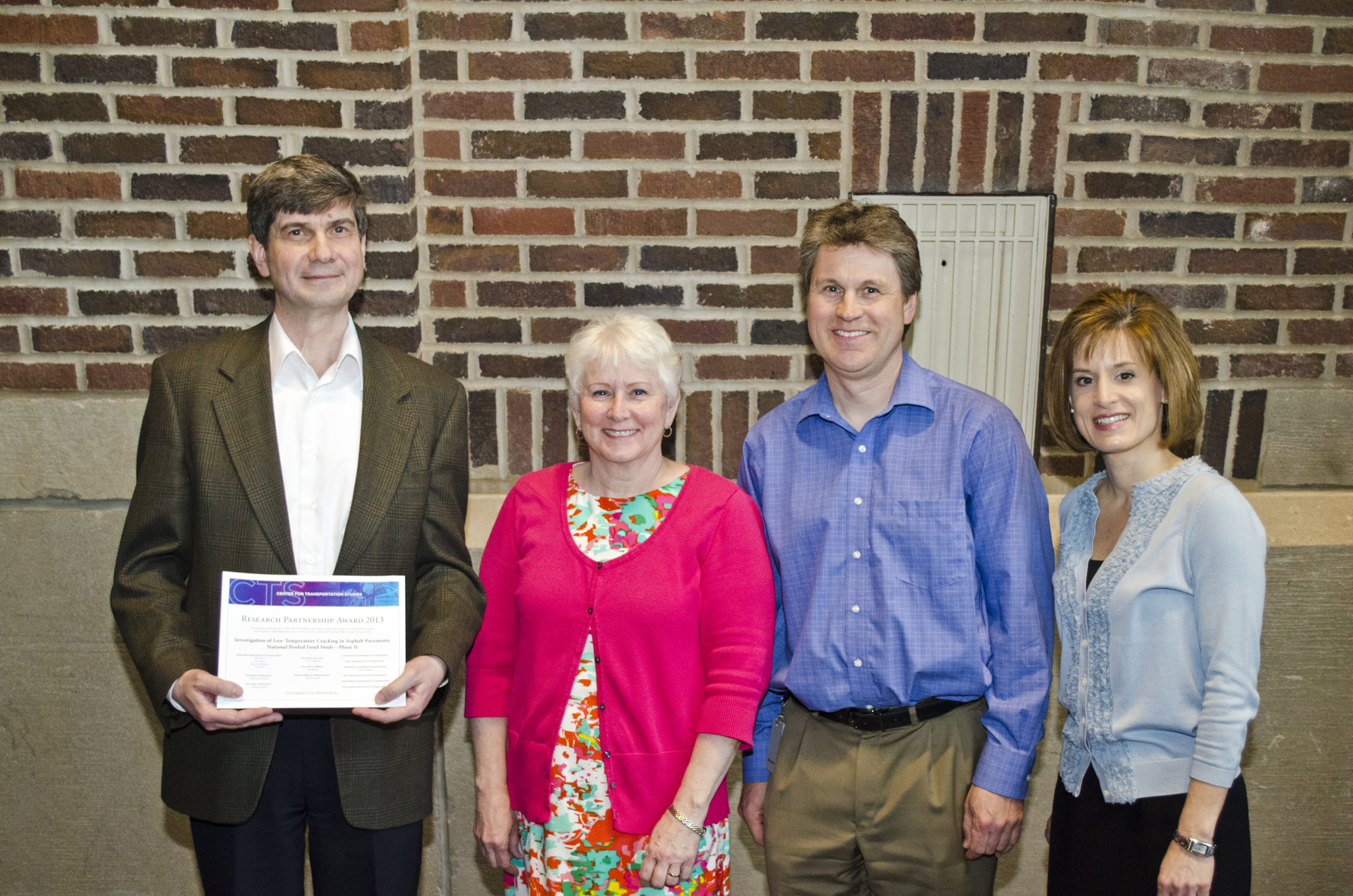
- From left: University of Minnesota Professor Mihai Marasteanu, the project’s principal investigator; MnDOT State Aid Director Julie Skallman; MnROAD Operations Engineer Ben Worel; and CTS Associate Director for Development and Finance Dawn Spanhake, who presented the award. (Photo by Cadie Adhikary, Center for Transportation Studies)

The people (and machines) who fix Minnesota’s potholes
In Minnesota, with our often wildly unpredictable weather and constant freeze-thaw cycles, potholes are a fact of life. Anyone who’s climbed into a motor vehicle in the last month or so has doubtlessly encountered countless reminders of this dismal reality. Fortunately, we have a small army of public works professionals devoted to eradicating this perennial nuisance. The Minnesota Local Road Research Board recently produced this video, which nicely explains the various methods used to combat potholes in Minnesota.
Potholes form when water invades cracks in the pavement and infiltrates the soil beneath it. When that water freezes, it stretches the road surface, causing the fractures to expand. After a few cycles of freezing and thawing, the pavement begins to buckle and eventually collapses under the weight of passing traffic, creating disruptions in the road’s surface.
Road crews use a variety of methods to fill potholes. The simplest method is the “throw-and-go” procedure, in which workers simply shovel an asphalt mixture into the pothole and pack it down until the road’s surface is smooth. A related method is “throw-and-roll,” where the patch is compacted using an asphalt roller.
Other methods include:
- “semi-permanent” patching, in which workers clear the pothole of moisture and debris and then square the edges with a pavement saw before applying the patch;
- “spray injection,” which involves using specialized equipment to blast water and debris out of the pothole before spray-filling it with asphalt mix and finally applying a dust coat of dry aggregate on top; and
- “slurry” or “microsurfacing” crack filling, in which a slurry of aggregate, asphalt emulsion and mineral filler is placed over a crack in the pavement and leveled off using a squeegee.
This Asphalt Pavement Maintenance Field Guide (PDF), co-funded by MnDOT and produced by CTS, provides a handy how-to guide to pothole patching and other types of pavement repairs commonly applied by public works professionals in Minnesota.
See also:
 Crossroads