

Two county roads provided a testing ground for three combinations of aggregate bases and asphalt binders. Results from more than two decades of research and monitoring of pavement test sections validated previous conclusions. A larger gradation aggregate base showed superior performance over the pavement life cycle when compared with the standard aggregate base. Additionally, sections constructed without transverse joints to allow natural thermal cracking outperformed sections with sawn and sealed joints.
Continue reading Finding High-Performing Aggregate Bases for Long-Lasting PavementTag Archives: research

Will Hydrogen Be a Carbon-Neutral Fuel Alternative for Freight?
Reprinted from CTS News, March 19, 2024
—Sophie Koch, contributing writer
Hydrogen is getting a lot of attention in recent years as a potential fuel source in the transportation sector. However, it is important to consider the pros, cons, and limitations of this molecule when deciding how to use it.
Continue reading Will Hydrogen Be a Carbon-Neutral Fuel Alternative for Freight?
Rural Needs, Statewide Answers: Demographics, Health Care Access, and Community Engagement
Monday, May 13, 2024, 9:00–11:30 am, In Person
Join CTS for their annual all councils meeting to explore topics related to CTS’s 2024 theme of Rural Needs, Statewide Answers: Improving Transportation for All Communities.
The event is free to attend, but registration is required. Please register by Friday, April 26.
Continue reading Rural Needs, Statewide Answers: Demographics, Health Care Access, and Community Engagement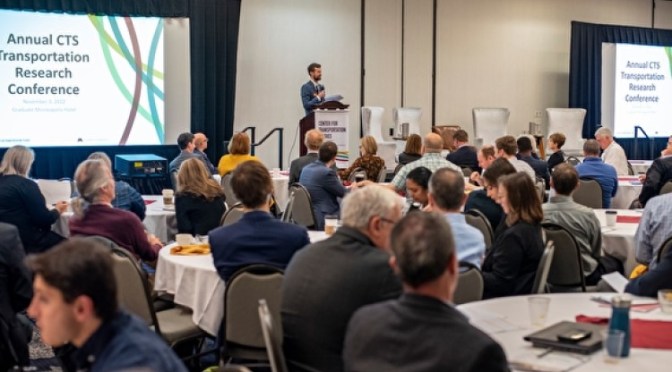
2024 CTS Transportation Research Conference
Mark your calendar for our annual conference! The event convenes researchers and practitioners from Minnesota and the Upper Midwest to highlight new learning, emerging ideas, and the latest innovations in transportation. Attendees learn about research findings, implementation efforts, and engagement activities related to a variety of transportation topics.
Continue reading 2024 CTS Transportation Research Conference
Clear Roads Annual Survey of State Winter Maintenance Data
Clear Roads has published the results of their ninth Annual Survey of State Winter Maintenance Data, which compiles winter resources, material and cost data from 41 states for the 2022-2023 winter season. The spreadsheet includes all submitted data, as well as calculated statistics, winter severity index data, and a United States map that displays many of these metrics. The spreadsheet also includes data from the previous seven surveys (winters 2014-2015 through 2021-2022) and displays averages and changes across winter periods.

MATI Program RFP Webinar Materials, FAQ Now Available
Webinar materials and a new FAQ about the Mobility, Access, and Transportation Insecurity (MATI) Program RFP process are now available on the MATI website.
Continue reading MATI Program RFP Webinar Materials, FAQ Now Available
New Project: Evaluation of Static and Dynamic No Right Turn on Red Signs at Traffic Signals
Making signalized intersections safer for pedestrians can be achieved by reducing points of conflict between pedestrians and vehicles. One source of conflict occurs when a vehicle makes a right turn on red (RTOR) onto a street in which pedestrians are crossing. During this turn, the driver must cross the path of pedestrians while at the same time searching for gaps in conflicting vehicle flow.
Continue reading New Project: Evaluation of Static and Dynamic No Right Turn on Red Signs at Traffic Signals
A Mobile App to Report Driver Intrusions Into Work Zones
Transportation workers face critical safety risks when drivers fail to comply with traffic control instructions in work zones. These intrusions threaten not only the flaggers who are directing traffic, but all workers on the job site and the drivers themselves. Knowing the nature and frequency of intrusions is necessary to develop effective prevention strategies. A new mobile phone app enables workers to quickly and easily report incidents, allowing MnDOT to analyze risks and improve worker safety.
Continue reading A Mobile App to Report Driver Intrusions Into Work Zones
New Project: Develop Element Level Bridge Performance Measures and Targets
Currently, federal bridge performance measures in the United States and measures most commonly used by state transportation agencies for bridge management are based on National Bridge Inventory (NBI) General Condition Ratings that reflect bridge component conditions (deck, superstructure and substructure).
MnDOT also collects bridge element data that provides a more granular, objective and quantitative assessment of condition, and would like to have performance measures and targets based on the bridge element data that guides a data-driven methodology to select cost-effective treatments.
Continue reading New Project: Develop Element Level Bridge Performance Measures and Targets
New Project: Development of Erosion Control Product Longevity Test Methodology
MnDOT has approved products for blanket and hydromulches. There are many versions of each type of temporary erosion prevention materials, that vary in thickness, composition, and cost.
The two most common stabilization methods to control erosion and establish vegetation used by MnDOT are Hydraulic Erosion Control Products (HECP) and Rolled Erosion Prevention Products (REPP). Specifying the best fitting product for the situation keeps MnDOT in compliance with stormwater permits and is more cost effective.
Continue reading New Project: Development of Erosion Control Product Longevity Test Methodology
