

When a transportation innovation shows potential for significantly increasing safety, implementation may seem like the obvious next step. But without public support, a project can be met with resistance that results in delays, additional costs and a lost opportunity to save lives.
Continue reading Increasing Support for Innovative Traffic SolutionsCategory Archives: Traffic and Safety

Developing Smart Signs for Traffic Control in Work Zones
Providing traffic control in work zones is one of the highest risk jobs in the country. Flaggers are often considered the first line of defense against distracted, inattentive or aggressive motorists who may intrude into these work areas. A new, cost-effective system that tracks an oncoming vehicle’s trajectory can warn workers of an unsafe intrusion into the work zone and alert drivers to slow or stop.
Continue reading Developing Smart Signs for Traffic Control in Work Zones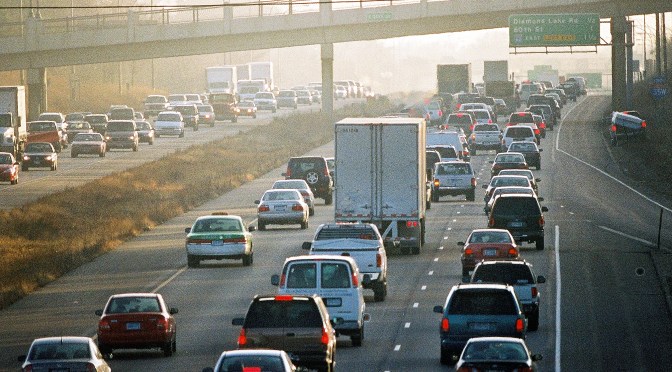
Improving and Expanding the Queue Warning System
Combining real-time traffic data, vehicle trajectories and computer algorithms allows queue warning systems to trigger traffic warnings on overhead message signs that alert drivers to congestion or crashes ahead. A recent study evaluated the warning system previously installed on a segment of Interstate 94 (I-94) and deployed the system in a second location, providing an improved understanding of its efficacy and considerations for expanding its use.
Continue reading Improving and Expanding the Queue Warning System
Guidance for Cities Considering Speed Limit Changes
The issue of reducing speed limits to increase public safety is an emotional, political, and controversial topic that has been debated by safety advocates, engineers, politicians, transportation officials, and the public for many years. A statutory change in 2019 put a spotlight on the topic, requiring a deeper look into how speed limits are established and the effectiveness that lowering speed limits has on reducing vehicle traveling speeds, as well as the impacts on pedestrian and bicycle traffic.
Continue reading Guidance for Cities Considering Speed Limit Changes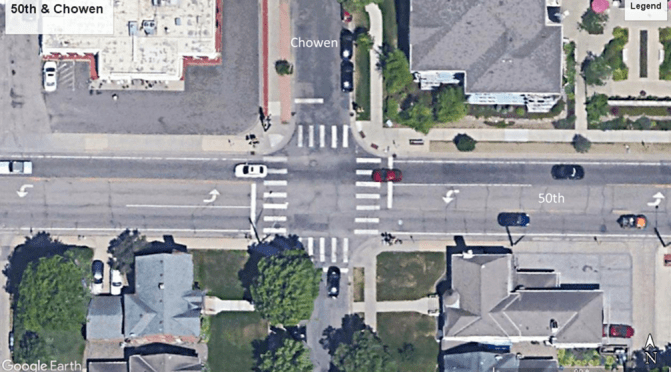
Impacts of Lane Conversions on Level of Service
Reconfiguring roadways, also referred to as a “road diet,ˮ can be a low-cost safety solution that makes space for different travel modes in addition to motor vehicle traffic. New guidance gives local engineers an initial indication of whether a road conversion would result in a loss of capacity given the roadway motor vehicle traffic demand.
Continue reading Impacts of Lane Conversions on Level of Service
Impacts of Autonomous Vehicles on Operation and Maintenance of Minnesota Roads
As autonomous vehicle technology evolves, transportation agencies want to understand how road maintenance and traffic operations may also need to evolve. New research begins to identify potential needs and further questions for winter road maintenance, work zones and traffic flow.
Continue reading Impacts of Autonomous Vehicles on Operation and Maintenance of Minnesota Roads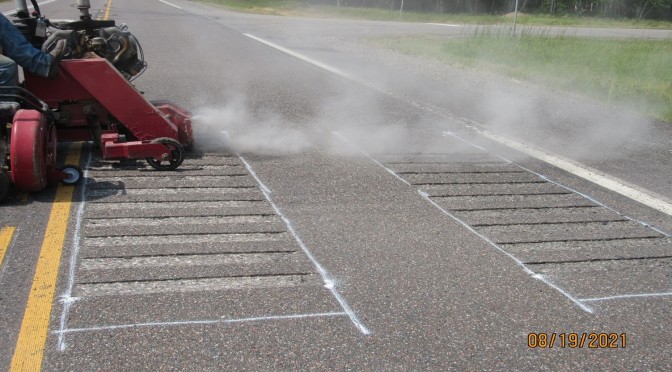
Using Rumble Strips to Encourage Stops at Rural Intersections
Vehicle crashes in rural areas often happen at intersections. Transverse rumble strips placed before a stop sign can be an effective safety measure that warns drivers approaching an intersection. Recent research has provided an increased understanding of the most effective rumble strip designs and noise characteristics to help county traffic engineers decide when and where to deploy the strips.
Continue reading Using Rumble Strips to Encourage Stops at Rural Intersections
New Project: Assessing Methods to Mitigate Cognitive and Physical Declines That Influence Driving Performance of Older Drivers
Supporting older drivers to safely age in place as they experience age-related declines is important as many Minnesota drivers are reaching retirement age. Minnesotans, 65 years and older, are expected to represent 20% of the state population by 2025, with an overall increase of 122% from 2010-2040. While older drivers are generally safe drivers, those aged 75-85 face the highest risks from injury.
Continue reading New Project: Assessing Methods to Mitigate Cognitive and Physical Declines That Influence Driving Performance of Older Drivers
With new signal timing method, Twin Cities traffic could flow more smoothly
Reprinted from Catalyst, May 12, 2023.
Eliminating intersection bottlenecks is one of the most persistent and difficult challenges for traffic engineers. A new mathematical theory called “max-pressure signal control” has been proven to achieve maximum throughput for entire city road networks, but it has not yet been used in practice. In a new study, U of M researchers brought the theory several steps closer to real-world use and found that it could offer many benefits to Minnesota road users.
“For most intersections and demand periods, we found that max-pressure control offered significant improvement over current signal timings,” says Michael Levin, an assistant professor with the Department of Civil, Environmental, and Geo- Engineering. “Large reductions in delay—sometimes over 50 percent—suggest that this new method of signal timing could achieve higher throughput during peak demand and be more responsive to queues.”
To achieve these findings, researchers began by addressing some aspects of max-pressure signal timing that would make it difficult to implement in a real-world setting. First, researchers addressed its assumption that all roadways had separate turning lanes by adapting the mathematical model to accommodate mixed travel lanes.
Another drawback of the original formula is that the signal control doesn’t operate on a cycle; this could cause long wait times when demand is uneven and make the signal cycle unpredictable for both drivers and pedestrians.
“To solve this issue, we modified the formula to include a maximum waiting time and require that the phase selection follows a cycle,” Levin says. “This allows traffic engineers to create an ordered set of phases for each intersection.”
Once the updated version of max-pressure control was developed, researchers tested it in simulations of two corridors in Hennepin County, Minnesota. The simulations revealed numerous potential benefits including reduced environmental impacts and reduced road user costs resulting from travel time savings and lower fuel costs.
“The findings show that our new max-pressure control formula will reduce the average queue length during peak hours and that vehicles will not wait as long at intersections,” Levin says. “We can also predict higher throughput and faster vehicle speeds, all of which will mitigate congestion and improve quality of life.”
In addition, a cost-benefit analysis shows that the total value of travel time savings is considerably larger than the cost to implement max-pressure control.
The project’s success led researchers to explore the possibility of a real-world pilot project with available traffic signal hardware. They found that the traffic signal technology currently used in Hennepin County could be upgraded to support a pilot study, laying the groundwork for a future real-world test of this promising new signal timing method.
The project was funded by the Minnesota Local Road Research Board (LRRB). Phase two of the work, also funded by the LRRB, is underway.
Writer: Megan Tsai
More Information
- MnDOT Phase I Project page
- Final report, Phase 1
- Phase 2 Project Page

New Project: Using Apps to Notify the Public of Local Road and Bridge Closures
The traveling public increasingly relies on navigation systems to get to their destinations. Currently, there is not a system, tool, or process being used by cities and counties in Minnesota to report road or bridge closures for use by transportation agencies to display to the traveling public or for use by third-party mapping/navigation companies (e.g., Waze, TomTom, HERE Technologies, Google Maps) to provide to the public.
This project will document up to three best practices for manual local road closure reporting, describe an approach that the Local Road Research Board could use to develop or implement an existing user-friendly road closure reporting system, and provide guidance on how to report closures to third-party mapping/navigation companies.
Objectives
MnDOT already operates and maintains a statewide traveler information reporting system known as CARS. This project will review and summarize the options and approach for adapting it for local road entry. As part of the study, researchers will:
- Develop best practices for reporting systems by documenting four examples used in other states for establishing and operating tools to report local road closures.
- Define three options for how to make a user-friendly system for local Minnesota agencies using the outcomes of the best practices summary.
- Prepare users guide for entering information into existing mapping tools that will assist in understanding the process to submit road closures and mapping updates to established mapping/navigation providers.
Project Details
- Estimated Start Date: 12/19/2022
- Estimated Completion Date: 03/31/2024
- Funding: Local Road Research Board
- Principal Investigator: Dean Deeter
- Technical Liaison: Perry Clark
Details of the research study work plan and timeline are subject to change.
To receive email updates about this project, visit the Local Road Research Board to subscribe.

