

Navigation apps can be valuable timesavers for drivers in Minnesota. To maximize their use, these apps need traffic information that is timely and accurate. While state highway closures are reported effectively, reporting road closures on local roads and highways is inconsistent. This project aimed to improve local road closure reporting by exploring the development of a streamlined reporting system and creating guidance for reporting local road closures to third-party navigation apps.
Continue reading Effectively Alerting the Public About Local Road ClosuresCategory Archives: Traffic and Safety

New Project: Development of a System to Report School Bus Stop Arm Violations
When a motorist ignores an extended school bus stop arm, it creates a direct and serious risk to children boarding and exiting a school bus. Capturing information about such incidents is a critical step in better understanding why they occur and how they can be prevented.
Continue reading New Project: Development of a System to Report School Bus Stop Arm Violations
New Project: Evaluation of Static and Dynamic No Right Turn on Red Signs at Traffic Signals
Making signalized intersections safer for pedestrians can be achieved by reducing points of conflict between pedestrians and vehicles. One source of conflict occurs when a vehicle makes a right turn on red (RTOR) onto a street in which pedestrians are crossing. During this turn, the driver must cross the path of pedestrians while at the same time searching for gaps in conflicting vehicle flow.
Continue reading New Project: Evaluation of Static and Dynamic No Right Turn on Red Signs at Traffic Signals
A Mobile App to Report Driver Intrusions Into Work Zones
Transportation workers face critical safety risks when drivers fail to comply with traffic control instructions in work zones. These intrusions threaten not only the flaggers who are directing traffic, but all workers on the job site and the drivers themselves. Knowing the nature and frequency of intrusions is necessary to develop effective prevention strategies. A new mobile phone app enables workers to quickly and easily report incidents, allowing MnDOT to analyze risks and improve worker safety.
Continue reading A Mobile App to Report Driver Intrusions Into Work Zones
Skid-resistant pavement markings could help stop slips
Reprinted from Catalyst, January 23, 2024
Retroreflective pavement markings such as bike lane indicators, crosswalks, and lane lines are designed to increase safety. However, the same retroreflective properties that add nighttime visibility can also make them slippery for vulnerable road users such as pedestrians, bicyclists, and motorcyclists—especially in wet or icy conditions.
Continue reading Skid-resistant pavement markings could help stop slips
Drivers Correctly Interpret Flashing Yellow Arrows for Left Turns
Permissive left turns, where a driver does not have a green arrow and must wait for a gap in oncoming traffic before turning, can be indicated by different traffic signal configurations. Flashing yellow arrows are becoming a preferred signal type in Minnesota and across the nation. New research provides traffic engineers with confidence that drivers understand the meaning of the signal, even without an accompanying Left Turn Yield sign.
Continue reading Drivers Correctly Interpret Flashing Yellow Arrows for Left Turns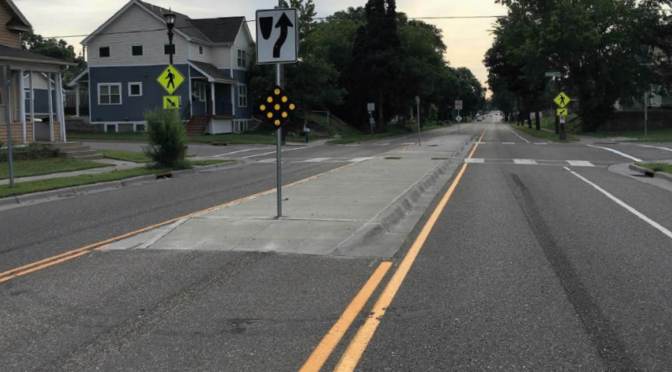
Reevaluating City Speed Limits with Public Safety in Mind
A recent legislative change has given Minnesota cities greater authority to set lower speed limits on streets in their jurisdiction—a decision that could potentially have positive impacts on public safety, especially pedestrian and bicycle traffic. A recent analysis of speed-setting practices and the effectiveness of speed limit changes resulted in a decision-making process for changing speed limits and alternative strategies to improve pedestrian and bicycle safety.
Continue reading Reevaluating City Speed Limits with Public Safety in Mind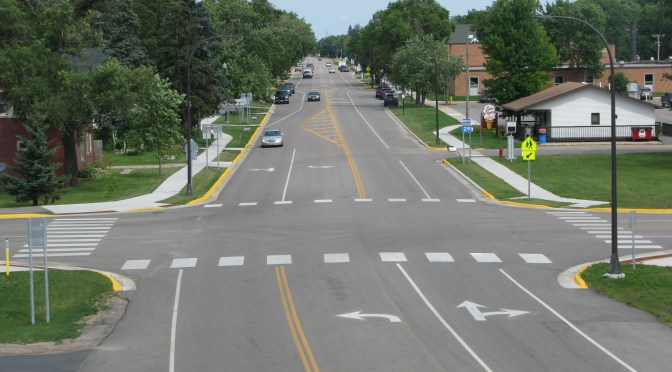
New Project: Complete Streets Speed Impacts
Minnesota Statutes §174.75 requires the MnDOT to follow a complete streets approach in all phases of planning, project development, operation, and maintenance activities. The purpose of the MnDOT complete streets policy “is to address the safety and accessibility needs of users of all ages and abilities. MnDOT assesses user needs at several stages of planning, project scoping and designing, construction, operation, and maintenance.”
Continue reading New Project: Complete Streets Speed Impacts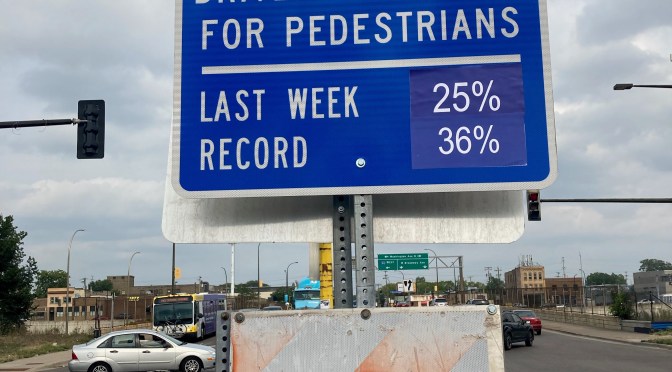
Improving Driver Yielding to Pedestrians at Intersections
Improving the rates of drivers yielding to pedestrians has been challenging despite crosswalk laws. Expanding on an earlier study, researchers further explored the effectiveness of engineering treatments at road crossings, giving agencies a deeper understanding of how to maximize pedestrian safety.
Continue reading Improving Driver Yielding to Pedestrians at Intersections
Impact of Urban Speed Limit Changes on Driving Speeds
Speed limits are a popular safety measure used in urban areas. A new analysis that monitored driving speeds before and after posted changes to speed limits reveals lower speed limits may not, at least initially, cause drivers to slow down.
Continue reading Impact of Urban Speed Limit Changes on Driving Speeds
