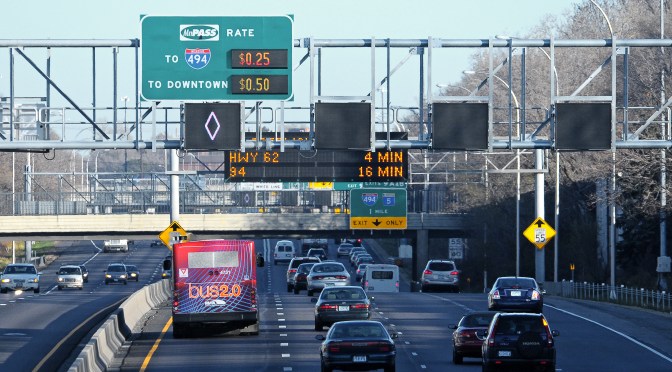
The majority of MnDOT’s dynamic message signs (DMS) are equipped to produce full color/full matrix messaging. Current signage regulations refer to retroreflective colors for static signs, but MnDOT aims to extend and modify existing standards and guidelines by exploring differences between static signs and DMS.
This research will systematically explore and optimize the use of different colors and color-coding schemes in DMSs to resemble the retro-reflectivity of static signs and examine how legibility, visibility, and effectiveness can be improved. Optimizing DMS colors to mimic retroreflective static sign colors and adapting them to myriad environmental conditions, MnDOT can realize reduced driver distractions, improved information comprehension, and increased safety. The project will also support improved decision-making processes by providing evidence-based guidance for future standards and practices for MnDOT beyond.
A pilot study will be conducted to assess the recommended color settings against benchmark real-world conditions. Empirical data on the new configurations will measure their performance, confirm their effectiveness and identify any adjustments required prior to broader implementation.
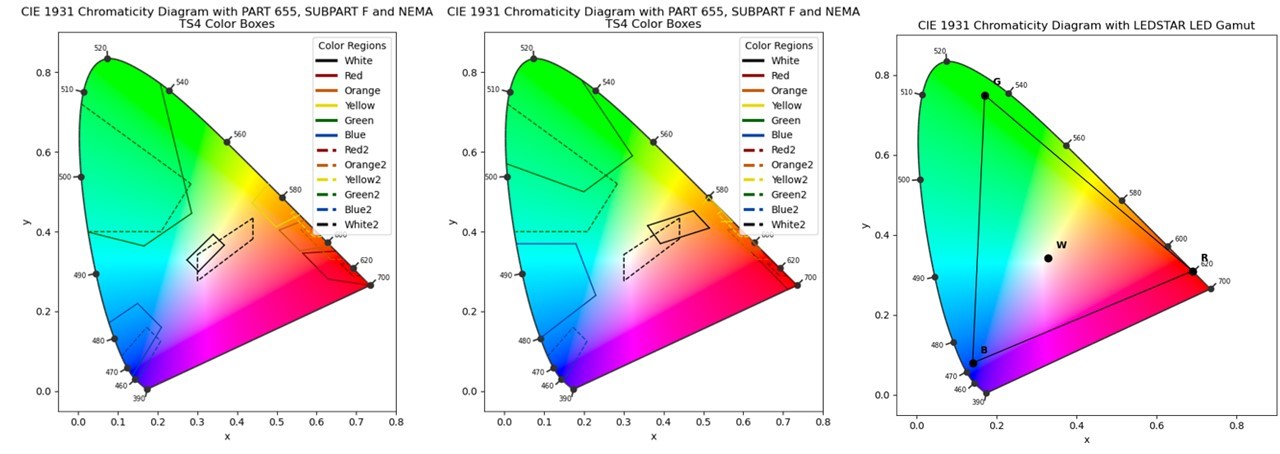
“Not all color is created equal! As illustrated in the three graphics below, federal standards for reflective sheeting and striping, NEMA standards for colors, and the triangle of visible light LED lights can produce do not correspond,” said Terry Haukom, senior engineer with MnDOT’s Regional Transportation Management Center. “This variance has caused the signage industry to display colors that meet federal standards but do not look correct to the human eye. In addition to exploring this incongruity, our research is focused on understanding and comparing what typical travelers understand and expect when viewing traffic information on the web, and whether the travel time numbers displayed on our signs can give drivers a better understanding of the travel time to the listed destination if it was displayed with a color scheme that leveraged web-based maps.”
The Objectives:
- Standardize the emitted colors from MnDOT’s DMS according to NEMA TS4 and MUTCD specifications, ensuring they match the retroreflected colors of static signs and align with current LED capabilities
- Document the public’s perception of optimum color if different from standards based on human factors feedback
- Document the public’s perception of dark pixel around graphics on emitted colors on DMS
- Research and document the public’s perception of emitted colors on DMS compared to static sign messages, and explore the incorporation of web-based travel time map colors to enhance visibility and clarity, especially with colors like amber
Project Details:
- Start Date: 06/2/2025
- Estimated Completion Date: 04/30/2027
- Funding: MnDOT
- Principal Investigator: Ali Zockaie
- Co-Principal Investigators: Mehrnaz Ghamami, Peter Savolainen, Kakan Dey
- Technical Liaison: Terry Haukom
Details of the research study work plan and timeline are subject to change.
To receive email updates about this project, visit MnDOT’s Office of Research & Innovation to subscribe.