

Local agencies in Minnesota use cold recycling technologies for flexible pavement rehabilitation because of their economic and environmental benefits. The three main methods are cold in-place recycling (CIR), cold central plant recycling (CCPR), and stabilized full-depth reclamation (SFDR).
Continue reading New Project: Improving and Developing Pavement Design Inputs and Performance Functions for Cold Recycled Pavement LayersCategory Archives: Materials and Construction
Adapting Asphalt Mixtures for Tougher Rural Roads
Seasonal and daily temperature variations, freeze-thaw cycles and other environmental factors lead to pavement distress on low-volume rural roads. Modifying asphalt mixtures could improve pavement resistance to these environmentally driven distresses. A comparison of the mechanical properties and performances of selected asphalt mixtures identified a mixture and method that hold considerable promise for improving performance and longevity on low-volume roads.
Continue reading Adapting Asphalt Mixtures for Tougher Rural Roads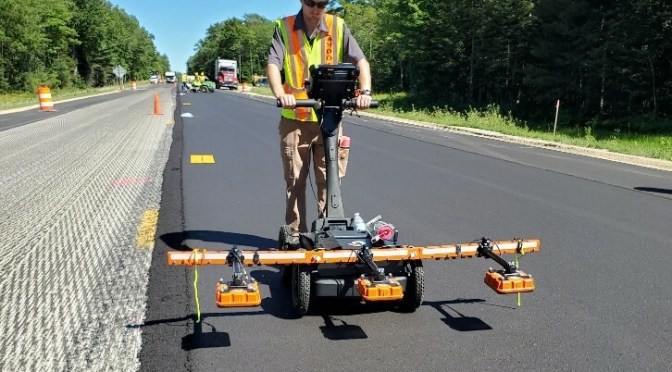
Measuring Pavement Density for Sustainable Centerline Joints
Longitudinal joints, created when lanes are paved sequentially, often need significant maintenance as the joints crack or deteriorate. While materials, construction methods and other factors may cause joint deterioration, insufficient pavement density is primarily responsible for weak joints, and measuring density has not traditionally been a widespread practice. New recommendations for joint construction and quick, nondestructive methods of measuring density during construction will support local agencies in laying longer-lasting pavement.
Continue reading Measuring Pavement Density for Sustainable Centerline Joints
Continuous Moisture Measurement During Pavement Foundation Construction
Accurate and timely moisture measurement of earthwork during compaction of foundation layers is crucial to proper construction and long-term durability of the pavement structures. Since the traditional methods for measuring moisture are point specific, expensive and/or time consuming. None of the existing methods have been able to deliver real-time, continuous moisture measurements that would aid engineers in delivering more durable pavement structures.
Continue reading Continuous Moisture Measurement During Pavement Foundation Construction
Effect of Low and Moderate Recycled Concrete Aggregate Replacement Levels on Concrete Properties
As the demand for aggregate in construction increases, recycling concrete waste as aggregate has been recognized as an environmentally sustainable solution with potential cost savings. It would allow recycling of construction and demolition waste and reduce some of the need to quarry and haul virgin aggregate. However, the use of recycled concrete aggregate (RCA) has been limited by concerns over its quality and performance, and by lack of uniform specifications as to what kind and how much of the aggregate to use in pavement construction. Studies and on-the-ground experience have shown that high levels of RCA reduce the durability of pavements. The effects of lower replacement levels have not been well documented, however.
Continue reading Effect of Low and Moderate Recycled Concrete Aggregate Replacement Levels on Concrete Properties
New Project: Development of Process to Lower Global Warming Potential of Construction Materials
Advances in science of life cycle assessment (LCA) have set the stage to develop methods that meet global warming potential (GWP) reduction targets for construction materials, specifically, using instruments such as Environmental Product Declarations (EPD).
Continue reading New Project: Development of Process to Lower Global Warming Potential of Construction Materials
Comparing the Cost-Effectiveness of Asphalt Binders for Local Roads
Asphalt pavements with polymer-modified binders (PMBs) perform better than pavements with unmodified asphalt binders. While pavements with PMBs may cost more initially, performance is improved in the long run. In a recent study, researchers compared the performance and life cycle costs of modified and unmodified binders and found that modified binders are more cost-effective, even for local low-volume roads.
Continue reading Comparing the Cost-Effectiveness of Asphalt Binders for Local Roads
New Project: Mitigating Tenting of Transverse Cracks and Joints in Asphalt Pavement
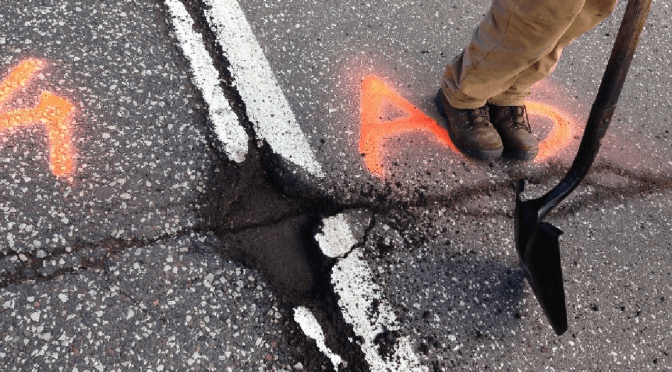
More than 60% of Minnesota’s roadways consists of asphalt pavement. When transverse cracks occur in asphalt, our frigid winters can cause a secondary distress known as pavement tenting, crack heaving, or lipping. As ice accumulates in the base materials underneath, it causes pavement on both sides of the transverse cracks and joints to heave.
Continue reading New Project: Mitigating Tenting of Transverse Cracks and Joints in Asphalt Pavement
Comparing Additives Used in Stabilized Full-Depth Reclamation
Beltrami and Hubbard counties planned pavement rehabilitation on a shared road, presenting a unique opportunity to directly compare two stabilizers: engineered emulsion and Base One, a proprietary mix. While there were some variations in performance and cost, both met design values for pavement strength.
Continue reading Comparing Additives Used in Stabilized Full-Depth Reclamation
Putting Research Into Practice: Fog Sealing Chip Sealed Roads Can Improve Performance
Applying a protective surface—or chip seal—to existing asphalt on relatively low-traffic roads is a pavement preservation method used by many transportation agencies. Yet despite its popularity, chip seals can cause various issues. Some agencies have found that applying a fog seal following a chip seal is a cost-effective strategy for improving asphalt performance and public satisfaction.
Continue reading Putting Research Into Practice: Fog Sealing Chip Sealed Roads Can Improve Performance Crossroads