
Longitudinal joints, created when lanes are paved sequentially, often need significant maintenance as the joints crack or deteriorate. While materials, construction methods and other factors may cause joint deterioration, insufficient pavement density is primarily responsible for weak joints, and measuring density has not traditionally been a widespread practice. New recommendations for joint construction and quick, nondestructive methods of measuring density during construction will support local agencies in laying longer-lasting pavement.
To minimize disruptions in traffic flow, road lanes are usually constructed in one lane while traffic continues uninterrupted in the adjacent lane. A centerline longitudinal joint is then created between the lanes. Damage to these joints is a primary cause of asphalt pavement failure. The pavement along the centerline joint often deteriorates, or ravels, weakening the surface and allowing moisture to infiltrate and cause further damage.
Possible causes of joint weakness and raveling include the materials used or specifications followed, construction quality or methods such as joint type or geometry and rolling patterns, or a combination of factors. Hot asphalt applied to cold—or cured—asphalt may also result in a weaker joint if not constructed properly.
Many studies have found that insufficiently dense asphalt is often the problem, and decreasing air void content or improving compaction can be beneficial. But ensuring that density is appropriate along a stretch of pavement can be resource-intensive.
To construct sustainable roads and decrease the drain on road maintenance resources, the Local Road Research Board wanted to leverage past research to identify best practices for long-lasting centerline longitudinal joint construction in asphalt paving. Additionally, local agencies wanted a better understanding of new technologies to measure and evaluate pavement density.
What Did We Do?
A comprehensive review of the literature explored types and geometries of longitudinal joints; construction practices, including rolling techniques; and methods to evaluate longitudinal joint quality and density. Researchers collected information about methods for constructing joints, measuring pavement density, relevant specifications and repair techniques from 25 states, Michigan DOT and Minnesota transportation agencies.
“This project was helpful in proposing a nondestructive method of testing pavement density during construction,” said Naomi Eckerd, county and municipal needs specialist, MnDOT State Aid.
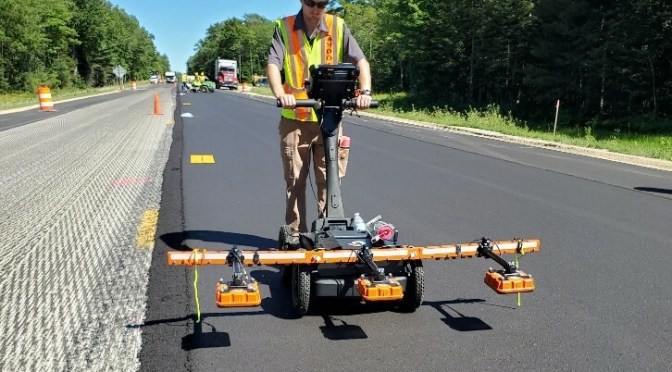
To determine pavement density, investigators focused on the density profiling system (DPS), which uses ground penetrating radar to measure a pavement’s dielectric properties, or how freely electrons move within the material. An analysis of DPS data and material samples from eight asphalt paving projects in Michigan and Minnesota illustrated how well the measurement technique performed. Laboratory tests on samples, including pavement cores and loose asphalt material, identified air void content and its relationship to dielectric properties.
What Did We Learn?
The literature review confirmed that pavement density, as determined by a low air void content, is one of the most important factors in longitudinal joint strength. The review of state practices revealed most agencies don’t specify the type of longitudinal joint to be constructed. Less than one-quarter specified techniques aimed at constructing a stronger joint. Several construction practices, however, appeared to be more successful in producing longer-lasting longitudinal joints.
Unconfined joints—where an asphalt layer’s edge does not abut another edge—can be problematic unless an edge restraint or a minimum cutback is used when laying the adjacent lane. Unconfined joints can be avoided by using various construction techniques, including sequential mill and fill and echelon paving.
Monitoring joint density, though helpful to ensure sufficient pavement strength, is not a common practice due to the resources and time involved and the destructive nature of the traditional coring method, according to surveyed agencies. The research demonstrated, however, that DPS is a nondestructive method that provides broad coverage and can give real-time feedback during construction.
From the statistical analyses comparing DPS data to air void measurements of asphalt materials, researchers proposed a longitudinal joint quality index to support monitoring pavement density. Finally, recommendations for using DPS in joint evaluation included construction specifications.
What’s Next?
MnDOT will consider the research recommendations and whether new specifications for measuring density and constructing longitudinal joints would support local engineers in facilitating the construction of long-lasting pavements.
More Information

