
For over 30 years, MnDOT has used the same low slump concrete overlay mixture to extend the service life of bridge decks. However, MnDOT suspected that changes in the materials used in the mixture over time may have contributed to increased cracking. This project evaluated a new mixture design, with and without glass fibers, to reduce cracking, improve sustainability and lower costs.
What Was the Need?
While low slump overlays are a valuable strategy to extend the life of bridge decks, they have begun exhibiting extensive cracking after installation. To mitigate this issue, MnDOT sought a new concrete mixture that could provide the same benefits while reducing cracking and maintenance needs.
This project evaluated promising concrete mixtures, assessed the ability of glass fibers to reduce cracking and documented the construction and performance of a new concrete mixture with and without glass fibers on a MnDOT project.
More specifically, this project aimed to identify an effective mixture design that minimizes cracking in low slump concrete overlays while maintaining low permeability and a compressive strength of at least 4,000 psi.
What Did We Do?
A new mixture for low slump overlays, with and without glass fibers, was assessed and compared with the existing MnDOT mixture. Investigators evaluated mixture performance using slump, float, box and bucket tests; water-to-cement ratio measurements; Super Air Meter testing; hardened air-void analysis; rapid freeze-thaw testing; shrinkage testing; chloride ponding and resistance testing; and compressive strength testing. To examine the impact of tining on the new mixture, investigators added grooves, or tines, to the surface of test sections containing one and two pounds of glass fiber per cubic yard.
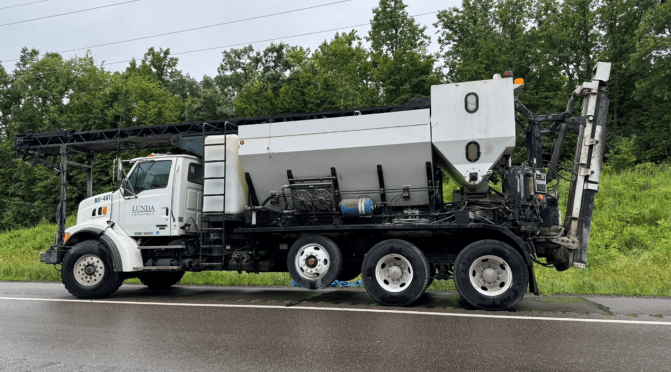
Field trials also provided feedback on the new mixture with and without glass fibers. The low slump concrete was prepared using a volumetric mixer truck, and a fiber chopper was used when fibers were included in the mixture.
“The field trial results show exciting promise for using the new concrete mixture, which experiences less cracking and has fewer maintenance needs,” said Kyle Fritz, Construction Engineer at MnDOT’s Bridge Office.
The new mixture uses 33% less cement, reducing paste volume, improving concrete properties and decreasing the carbon footprint by approximately 40%. The concrete property improvements include a 20% reduction in drying shrinkage while maintaining similar permeability and freeze-thaw durability. Although the new mixture has a 29% lower compressive strength, improvements in these other properties are expected to offset the decrease in strength. In addition, compressive strengths above 4,000 psi provide minimal benefit, and higher-strength concrete tends to become more brittle.
What Did We Learn?
Results demonstrated that the new concrete mixture, with and without glass fibers, exhibited adequate strength and resistance to outside chemicals infiltrating and weakening the concrete. One field trial section without fibers, inspected approximately three years after paving, remained in good condition and exhibited only small cracks. Another trial section containing glass fibers showed sufficient compressive strength 28 days after installation.
While the mixture with glass fibers required slightly more labor to finish, it reduced crack sizes by approximately 50%, which can extend service lives and increase concrete toughness.
Tining assessments found that mixtures containing one pound of fiber per cubic yard performed better than mixtures containing two pounds per cubic yard. Based on this finding and other test results, investigators recommend using an alkali-resistant glass fiber that meets industry-standard specifications at a dosage of one pound per cubic yard. The 1-inch fibers should be cut from a spool and added using a fiber chopper.
Field trial results demonstrated that a volumetric mixer could produce a high-quality, consistent concrete mixture when water ratios are properly adjusted throughout the mixing process.
What’s Next?
MnDOT has implemented the new low slump concrete mixture on six field projects in Minnesota. Feedback from MnDOT engineers indicates low levels of cracking while still meeting performance specifications. However, additional field tests are needed to compare the performance of the new mixture with and without glass fibers and determine the most cost-effective option, as fibers reduce crack size but increase cost.

