
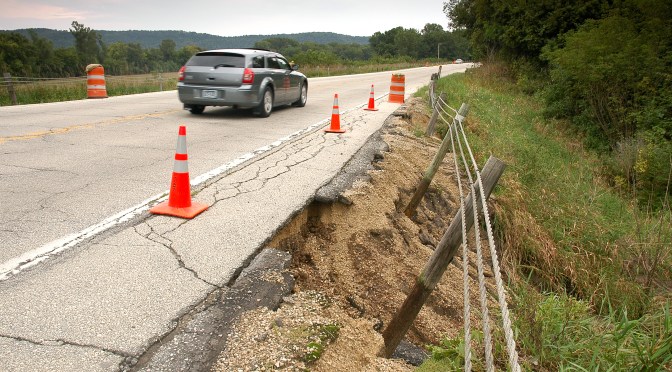
MnDOT continues working on systematically and proactively assessing stability of slopes along its highway system. Efforts are aimed at minimizing the potential for slope failures that could result in threats to public safety and costly repairs.
Continue reading New Project: Vulnerability Assessments of Critical Slope Areas Using Advanced Monitoring TechniquesTag Archives: MnDOT
Social Outcomes Improve by Incorporating Arts and Culture into Transportation Planning
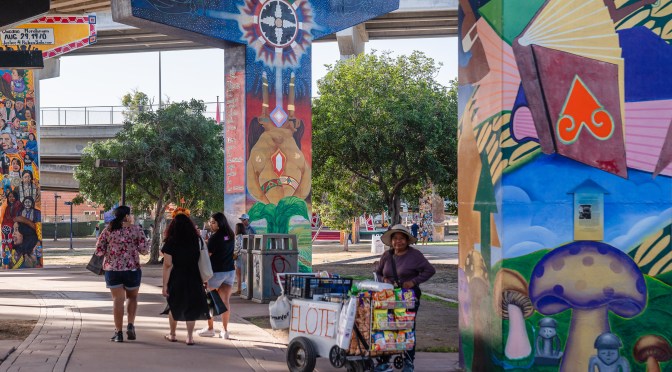
Historically, transportation projects have had a disproportionately negative effect on BIPOC (Black, Indigenous and people of color) and low-income communities. Today, state departments of transportation (DOTs) may be able to mitigate these negative effects by reaching out to these communities and incorporating their ideas and feedback into transportation planning. Local artists and culture bearers could serve as ambassadors for these communities by participating in the transportation planning process based on their creative placemaking ideas and connection to the community.
Continue reading Social Outcomes Improve by Incorporating Arts and Culture into Transportation Planning
Using Alternative Technologies to Detect Vehicles at Signalized Intersections
In Minnesota and across the country, the most common traffic signals are those that are actuated by a device embedded in the road that detects the presence of a vehicle at the intersection. While these embedded devices can last for decades, they don’t always detect modern vehicles, such as electric cars, or vulnerable road users, such as bicycles or motorcycles. New research evaluated the performance of video- and radar-based detection systems, which are becoming more readily available, under a variety of Minnesota weather conditions.
Continue reading Using Alternative Technologies to Detect Vehicles at Signalized Intersections
Crowdsourcing meets transportation planning with bike and pedestrian data counts
Increasing active transportation is an ongoing effort for transportation planners. Biking and walking can help decrease auto dependence, air pollution, and climate change and improve public health. Plus, it can help transportation agencies meet their strategic goals. The challenge? Making good decisions requires good data, and data for walking and biking trips can be hard to find.
Continue reading Crowdsourcing meets transportation planning with bike and pedestrian data counts
Augmented reality could make work zones safer—if the tech works for the workers
From catching Pokémon in the park to viewing a new IKEA chair in your living room, augmented reality (AR) often seems fun and low stakes. But what if wearable AR technology—such as safety glasses—could deliver warnings to roadway workers when they’re in danger? It’s an exciting possibility that hinges on one key question: Would this type of system meet the needs of workers?
Continue reading Augmented reality could make work zones safer—if the tech works for the workers
New Project: Species from Feces: A New Tool to Identify Bats in Culverts and on Bridges
Three bat species in Minnesota have been decimated due to white-nose syndrome. The northern long-eared bat is listed as endangered by the U.S. Fish and Wildlife Service, the tricolored bat listing is imminent, and the little brown bat listing is under consideration.
Continue reading New Project: Species from Feces: A New Tool to Identify Bats in Culverts and on Bridges
TZD Traffic Safety Hotdish: A Roadmap for Traffic Safety Culture Research and the Road Ahead
Wednesday, July 17, 2024
10:00 – 11:15 a.m. CDT
About the Event
This free virtual event will highlight the Traffic Safety Culture Research Roadmap, recently released by the National Academies of Sciences, Engineering, and Medicine.
Wes Kumfer, who led the creation of the roadmap, will review its development and contents. Jay Otto will share example projects and show how they fit into research on traffic safety culture. Join us to learn how you can identify traffic safety culture research needs and get insights to take back to your own organizational cultures!
Speakers
Dr. Wes Kumfer is an engineering research associate at the UNC Highway Safety Research Center (HSRC) with a focus on crash analysis and workforce development. His primary research interest is traffic safety management through a systems-oriented approach. While at HSRC, Kumfer has worked on pedestrian crash modeling, Safe System implementation, and engineering evaluation. He uses this experience as a member of the Road to Zero Coalition steering group and as an instructor for HSRC’s Road Safety Academy.
Jay Otto is a researcher and co-director for the Center for Health and Safety Culture at Montana State University. He received a bachelor’s and master’s degree in engineering and is fascinated by human behavior, how mindsets and systems influence behavior, and ways of growing cultures within communities and organizations that foster improved health and safety.
Registration
The webinar is free to attend, but registration is required. Once you have registered, you will receive an email confirmation with a Zoom link. The link should not be shared with others; it is unique to you.
Credit
Attendees are eligible for 1.25 Professional Development Hours (PDHs). Download the PDH credit form (PDF) for your records.
More Information
Contact Linda Dolan at ldolan@umn.edu.
Sponsors
This event is offered by the Minnesota Toward Zero Deaths Program and the Minnesota Departments of Health, Public Safety, and Transportation, with funding from the National Highway Traffic Safety Administration. It is hosted by the University of Minnesota’s Center for Transportation Studies.
Evaluating the Traffic Safety Benefits of J-Turns in Minnesota
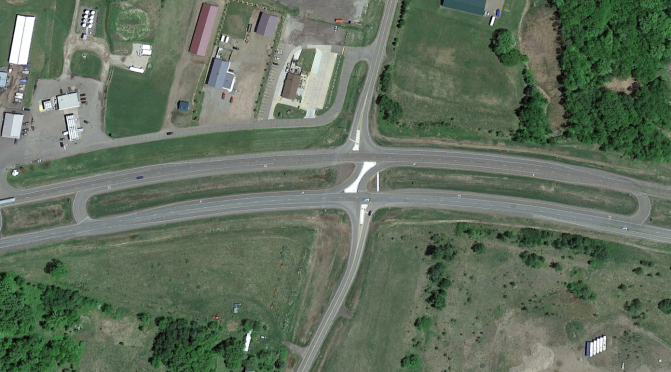
MnDOT traffic engineers are increasingly installing J-turn intersections on high-speed, multilane expressways to limit potential crash points. An analysis of crash data from intersections before and after the installation of J-turns demonstrated significant safety benefits from this alternative design. MnDOT researchers also explored crash history differences among J-turn intersections with varying characteristics. Consistent with the results from a previous study, this analysis found a clear decrease in fatal and other serious crashes after a J-turn was installed.
Continue reading Evaluating the Traffic Safety Benefits of J-Turns in Minnesota
Solutions to Mitigate Dowel/Tie-Bar Propagated Cracking – Phase 1
Cracking and spalling of concrete pavements reduce the service life of the roadway and result in added costs to an agency and disruptions to the traveling public when the damage is repaired.
Continue reading Solutions to Mitigate Dowel/Tie-Bar Propagated Cracking – Phase 1
Development of Mix Designs and Matrix of Materials for MnROAD Low Carbon Concrete Test Site
To address climate change mitigation goals, highway agencies are seeking alternative concrete paving mixtures that have a reduced embodied carbon content (ECC).
The research team first focused on developing a matrix of reduced ECC concrete mixtures to be tested at MnROAD. The 16 concrete mixtures selected for inclusion in the test matrix met minimum engineering requirements to ensure constructability and performance and were approved by MnDOT.
Between July 27 and August 9, 2023, 16 test cells were constructed at the MnROAD I-94 facility to evaluate reduced ECC concrete paving mixtures. The purpose of constructing these cells was to assess the in-service performance, environmental impact, and constructability of various alternative supplementary cementitious materials (ASCMs) that may reduce the embodied carbon content of concrete, while providing an opportunity to assess test results and in-service performance in coming years.
A preliminary environmental assessment showed that most mixtures were expected to have either a similar or lower ECC compared to the control mixture representative of typical MnDOT paving-grade concrete. Quality assurance testing conducted on field-cast specimens revealed generally acceptable results; most of the materials had similar performance compared to the control mixture, but the cells will continue to be monitored.
 Crossroads