
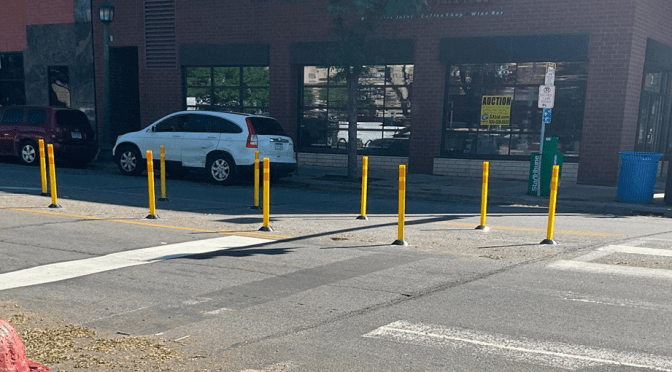
To enhance pedestrian safety at intersections, transportation agencies may install temporary or permanent infrastructure such as curb extensions or pedestrian refuge islands. While more permanent infrastructure with concrete is generally considered effective, specific details about temporary infrastructure with flexible delineators (or bollards), such as installation, use and safety impact, would be valuable to optimize cost-effectiveness. This project evaluated both temporary and permanent pedestrian infrastructure at crossing sites to measure the effects on pedestrian safety and driver behavior.
Continue reading Evaluating the Safety Impacts of Select Pedestrian InfrastructureTag Archives: featured

CTS Webinar: Industry and International Perspectives on AI Integration
Wednesday, April 1, 2026, 9:00–10:30 am CST, Virtual
Artificial intelligence (AI) is increasingly influencing how transportation and infrastructure projects are planned, delivered, and communicated. This Education and Engagement Council webinar builds on CTS’s earlier AI discussion by highlighting how AI is being used in practice, both nationally and internationally.
Speakers from outside Minnesota will share real-world examples of AI integration in infrastructure and construction contexts. Nicole Moon, Strategic Communications Highways and Roads Market Sector Lead at HDR, will discuss how AI is supporting transportation agencies and project teams through applied industry use.
Mr. Tomi Kotala, Project Director, City of Helsinki Public Works Department, and Mr. Pieti Marjavaara, Chief Innovation Officer, Construction Management, AINS Group, will discuss the Infrastructure Programme Helsinki, Finland. This strategic urban development initiative focused on designing and constructing a sustainable future for the city, including a massive expansion of the Light Rail Transit (LRT) network. They will demonstrate how their approach to Integrated Project Delivery (IPD) and alliance models optimizes infrastructure lifecycles through fair partnership. Efficiency is driven by Knowledge Management and industrial construction via data-driven, repeatable processes. The Project-AI concept evolves situational awareness into active AI-driven support for all project members, ensuring smarter, more predictable, and value-driven outcomes.
This webinar is designed to foster shared learning and discussion around how AI is being adopted today, why organizations are investing in these tools, and what lessons transportation professionals can take from industry and international experience. It is intended for practitioners, researchers, students, and others interested in the evolving role of AI in transportation and infrastructure.
Continue reading CTS Webinar: Industry and International Perspectives on AI Integration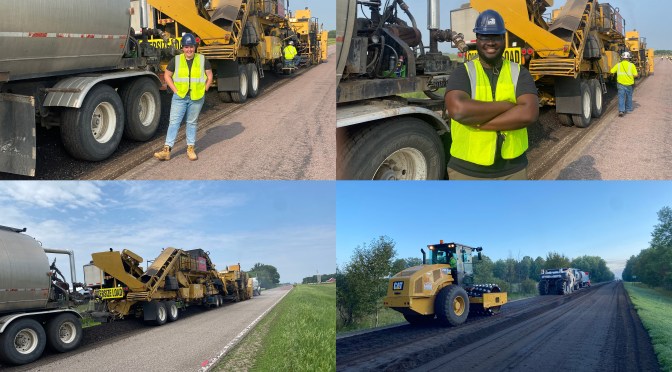
Assessing Recycled Pavement for Use in Road Design
Cold recycling road pavement materials into new road construction is a cost-effective and sustainable practice. However, the properties of these materials must be characterized to adequately design pavement structures. This project developed a framework and tool for transportation agencies to estimate the key material properties of cold recycled materials incorporated into road designs.
Continue reading Assessing Recycled Pavement for Use in Road Design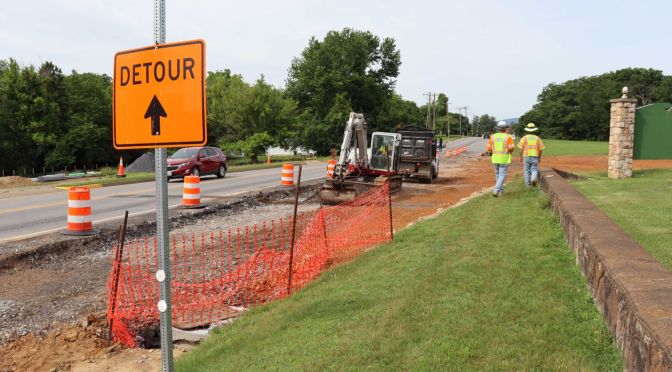
Limiting Pavement Damage from Detours
Detours for highway construction projects direct heavy freight vehicles onto local roads that were not designed to accommodate the frequency of heavy loads. Detours to these local roads often accelerate pavement deterioration that shortens their service life and requires additional repair. This project examined the structural and economic impacts of detours on local roads to develop a framework for optimizing detour routes that limit pavement damage while maintaining traffic mobility.
Continue reading Limiting Pavement Damage from Detours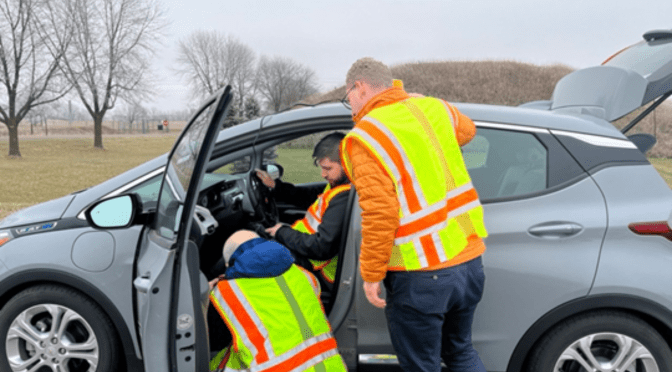
Using Onboard Vehicle Data to Assess Pavement Quality
Many modern vehicles continuously track location and performance data such as speed and acceleration. Collecting large amounts of this data to use in machine learning models has many potential applications, including aggregating and evaluating road pavement conditions. This project investigated the feasibility of using large amounts of onboard data from electric vehicles to monitor and assess pavement conditions comprehensively and cost-effectively across a large network.
Continue reading Using Onboard Vehicle Data to Assess Pavement Quality
New Project: Engineering Post-Construction Soil Composition to Support Resilient Stormwater Management
Post-construction soils can produce much higher stormwater runoff rates than pre-construction or typical vegetated soils. Poor soil conditions can hinder the establishment of vegetation and carry large volumes of runoff, sediment, and nutrient loads to local waters. Organic soil amendments (composts) may support post-construction vegetative growth by boosting soil structure, nutrient availability, and water holding capacity.
This research aims to define targeted pre-construction soil health baselines, determine optimized design and field implementation inputs that return soils to baseline health indices using organic amendments, and identify how these inputs can benefit transportation requirements and resilient stormwater treatment.
The results may facilitate the quantification of benefits provided through soil health restoration and the development of implementable guidance for roadside soil health restoration techniques.
“This research project will help us understand how implementing soil health practices can improve the performance of roadside vegetation establishment resulting in MnDOT being able to close out construction contracts and stormwater permits sooner,” said Warren Tuel, Natural Resources Program Coordinator with MnDOT’s Office of Environmental Stewardship. “There are also significant potential stormwater benefits of soil health practices including increased infiltration, improved treatment of pollutants present in highway stormwater runoff. The improved management of stormwater will result in improved water quality of runoff from MnDOT highway systems resulting in greater protection of the many water resources here in Minnesota.”
The objectives are:
- Evaluate resilience to water availability through organic amendment (e.g., compost) addition through greenhouse stormwater experiments
- Optimize amendment loadings based on resilience
- Develop a “recipe” for improving the health of poor soils based on soil health measurements, by amending the soil with compost or other organics
Project Details
- Start Date: 05/16/2025
- Estimated Completion Date: 06/30/2027
- Funding: MnDOT
- Principal Investigator: Bora Cetin
- Co-Principal Investigators: Angela Farina
- Technical Liaison: Warren Tuel
Details of the research study work plan and timeline are subject to change.
To receive email updates about this project, visit MnDOT’s Office of Research & Innovation to subscribe.

Comparing Salt Brine and Granular Salt for Safety and Performance
While studies have shown that salt brine can be less expensive and better for the environment than granular salt, public perception maintains that salt brine is less efficient and less safe for travelers.
In this Clear Roads project, researchers developed metrics for comparing the two different forms of salt and conducted a variety of tests to measure their performance in the field.
Now, agencies have data and infographics they can use to support their decision to use salt brine in place of granular salt.
Download the final report and two-page brief: CR 22-04 – Evaluation of Direct Liquid Application of Salt Brine vs Granular Salt as Measured through Various Performance and Safety Metrics, December 2025.
Reprinted from Clear Roads news, January 21, 2026.

Pedestrian Safety Impacts of Dedicated Right-Turn Lanes
While research has found that right-turn-only, or dedicated right-turn lanes, at intersections reduce traffic delays and vehicle crashes, their impact on pedestrian safety has been unclear. To better understand these impacts for future intersection design and countermeasure considerations, this project investigated driver response to pedestrians in or near crosswalks at dedicated right-turn lanes.
Continue reading Pedestrian Safety Impacts of Dedicated Right-Turn Lanes
CTS Webinar: Reaching Opportunities Through Transportation—New Results from the National Accessibility Evaluation
Wednesday, January 7, 2026
noon–1:00 p.m. CST, VIRTUAL
About the Event
Accessibility is the ease of reaching valued destinations. It can be measured for various transportation modes (auto, transit, bicycling, walking), to different types of destinations (home, work, school, shopping), at different times of day. Accessibility measures can be used to answer questions such as: How many jobs can I reach within a 30-minute transit trip from my home in Evanston, Illinois?
Continue reading CTS Webinar: Reaching Opportunities Through Transportation—New Results from the National Accessibility Evaluation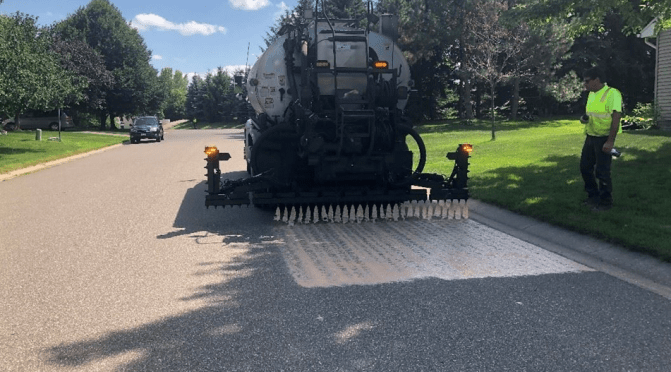
Assessing Rejuvenators That Extend Pavement Service Life
Over time, asphalt pavement becomes stiff and brittle due to oxidation, often leading to surface cracking and distress. To mitigate these damages and extend the service lives of roads, transportation agencies may apply a spray-on rejuvenator (SOR) to restore essential components of the asphalt. This project investigated the short- and long-term effectiveness of 12 SORs that state and local transportation agencies may consider for future use.
Continue reading Assessing Rejuvenators That Extend Pavement Service Life Crossroads