
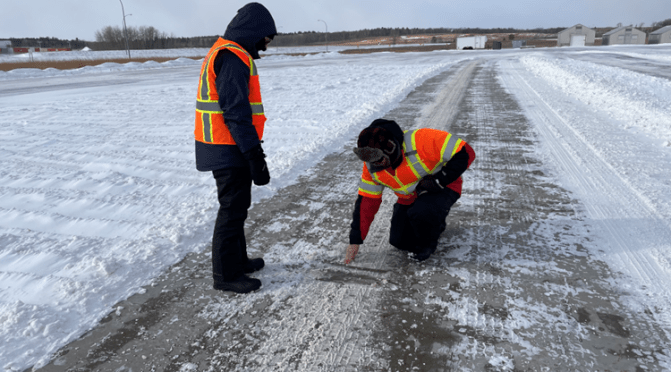
When temperatures fall below 15 degrees Fahrenheit (F), salt loses its effectiveness at melting snow on roads. To accommodate lower temperatures, transportation agencies often combine an alternative deicer with salt brine to treat roads and return them to an appropriate level of service. This project investigated the most common alternative deicer used in Minnesota to provide guidance to state and county winter maintenance managers about its application at different concentrations and temperatures.
Continue reading Evaluating the Use of a Common Alternative DeicerTag Archives: road salt
Permeable Barriers for Absorbing Road Salt Runoff
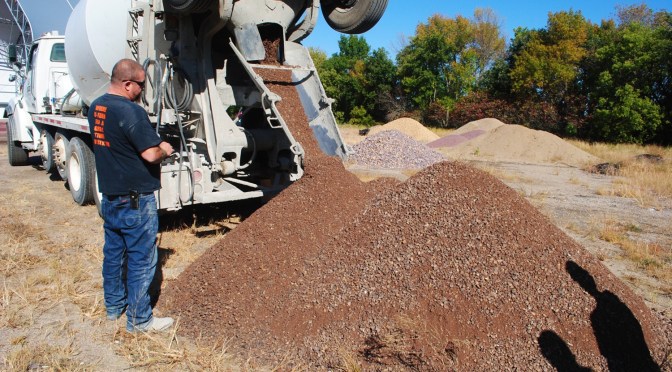
Treating roads with deicers during winter storms is essential for ensuring the safety of the traveling public. However, salt runoff can negatively impact the environment. In-ditch salt capture techniques may limit the migration of salt from roads into watersheds.
Continue reading Permeable Barriers for Absorbing Road Salt Runoff
Comparing Salt Brine and Granular Salt for Safety and Performance
While studies have shown that salt brine can be less expensive and better for the environment than granular salt, public perception maintains that salt brine is less efficient and less safe for travelers.
In this Clear Roads project, researchers developed metrics for comparing the two different forms of salt and conducted a variety of tests to measure their performance in the field.
Now, agencies have data and infographics they can use to support their decision to use salt brine in place of granular salt.
Download the final report and two-page brief: CR 22-04 – Evaluation of Direct Liquid Application of Salt Brine vs Granular Salt as Measured through Various Performance and Safety Metrics, December 2025.
Reprinted from Clear Roads news, January 21, 2026.

Beyond the border: Canadian studies consider permeable pavement, climate change impacts on deicing operations
Reprinted from MnLTAP News, November 17, 2025
The 2025 Salt Symposium highlighted two studies from Canada, one comparing salt applications on permeable and asphalt surfaces and another considering the impact of climate change on municipal operations. Hosted by Bolton & Menk, the August 5 Salt Symposium brought together professionals from throughout the world to share research, projects, and approaches for chloride management.
Continue reading Beyond the border: Canadian studies consider permeable pavement, climate change impacts on deicing operations
Environmental Evaluations of Potassium Acetate Used as a Road Salt Alternative
New research explored the environmental impacts of an alternative to road salt—potassium acetate, which is effective on ice at lower temperatures. Minnesota’s winter roads have been effectively treated for decades with chloride-based mixtures for anti-icing and deicing. Salt, however, corrodes steel in vehicles and infrastructure. Additionally, chloride runoff harms the aquatic environment. For example, up to 70% of road salt applied on Minneapolis-St. Paul metropolitan area roads ends up in groundwater aquifers and nearby lakes, many of which exceed regulatory limits for chloride concentrations.
Continue reading Environmental Evaluations of Potassium Acetate Used as a Road Salt Alternative
