
Treating roads with deicers during winter storms is essential for ensuring the safety of the traveling public. However, salt runoff can negatively impact the environment. In-ditch salt capture techniques may limit the migration of salt from roads into watersheds.
Over the course of a winter season, road maintenance agencies commonly apply more than 3 pounds of salt per foot of roadway as part of their winter weather management strategies. While the chloride in salt can have severe negative effects on surrounding watersheds, there are no current practices available to capture the harmful chloride.
Chloride contamination is especially harmful where highways cross small receiving streams that are home to endangered and threatened species as undiluted chloride is toxic to aquatic organisms. This project developed and evaluated roadside in-ditch salt capture techniques that absorb chloride in a manufactured treatment bag before it can reach streams and other water sources.
What Did We Do?
Laboratory testing evaluated the permeability and chloride capture effectiveness of different filter aggregate blends. Salt brine samples flowed through manufactured treatment media composed of different combinations of material, including calcium bentonite, sugar sand, beach sand, fine filter sand, pea stone gravel and sunrise granite crushed stone.
To assess hydraulic flow and its impact on salt capture for field placement considerations, investigators evaluated bags of treatment media in a 1/8th scale waterway model. The model replicated a roadside ditch and was subjected to realistic winter conditions such as a deep frost with frozen media. Investigators applied salt brine to better understand how it would interact with the treatment media and the impacts of melting frost.
In field studies, geotextile bags were installed in roadside ditches of four low-volume roads to evaluate the capture of applied deicer materials. The bags, which were 25 to 30 feet long and 2 to 4 feet wide, contained treatment media composed of 4% calcium bentonite, 25% fine aggregate and 71% coarse aggregate.
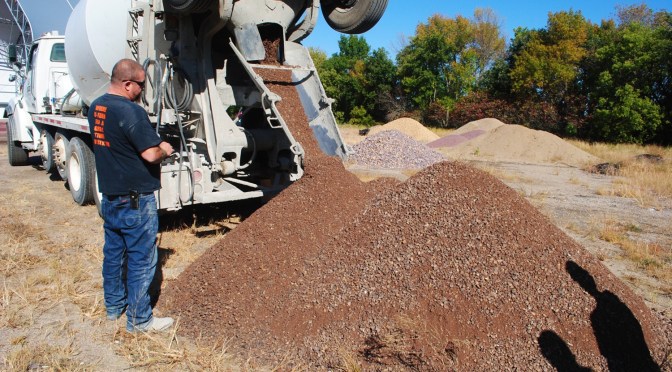
A comprehensive list of operational details, including mix design, mixing, flow-through bag filling, hauling and placement, monitoring, treatment and chloride removal, was evaluated as part of the field study.
What Did We Learn?
To attract and treat runoff for chloride capture, the treatment media must be more permeable than all other flow paths and slow enough to support sufficient treatment. Scale model findings demonstrated that permeabilities of greater than 0.10 cm/s are sufficient to attract winter melts for treatment, assuming no alternative path of greater permeability is in the vicinity.
“These findings offer valuable insights for continued work on the challenging topic of lowering the road salt contamination of watersheds,” said Jed Falgren, State Maintenance Engineer, MnDOT Operations.
Testing results found insufficient chloride capture by the treatment media in this project. Laboratory results found low rates of chloride capture, and scale model results found no observed chloride capture by treatment media.
Further, repeated flow through the treatment media and extended contact time with calcium bentonite did not lead to observable chloride capture. Field testing results were limited due to a winter season with little snowfall, but no consistent changes or trends in chloride presence were found when comparing untreated and treated ditchwater.
While the chemistry of the media must be altered to better absorb chloride, investigators overcame many logistical challenges that will be invaluable to similar future efforts.
Purchasing calcium bentonite clay from mining companies, working with construction companies to mix the media, designing and sewing the treatment bags, and transporting and removing the treatment bags offered lessons learned and provided insight to best practices for each mix and other aspects of the research. For example, since steeper ditch slopes increase the flow through the treatment media, placement of the treatment media in these ditches will need to be broader rather than deeper.
What’s Next?
This project made numerous strides in the effort to mitigate the negative impacts of salt use on roads. These include permeability findings, logistical solutions for obtaining treatment materials and mixing the media, designing and constructing bags to hold the treatment media, and lessons learned related to treatment bag placement in the field. Future work and evaluations will be able to leverage these operational details to further work in this area.

